




In This Article
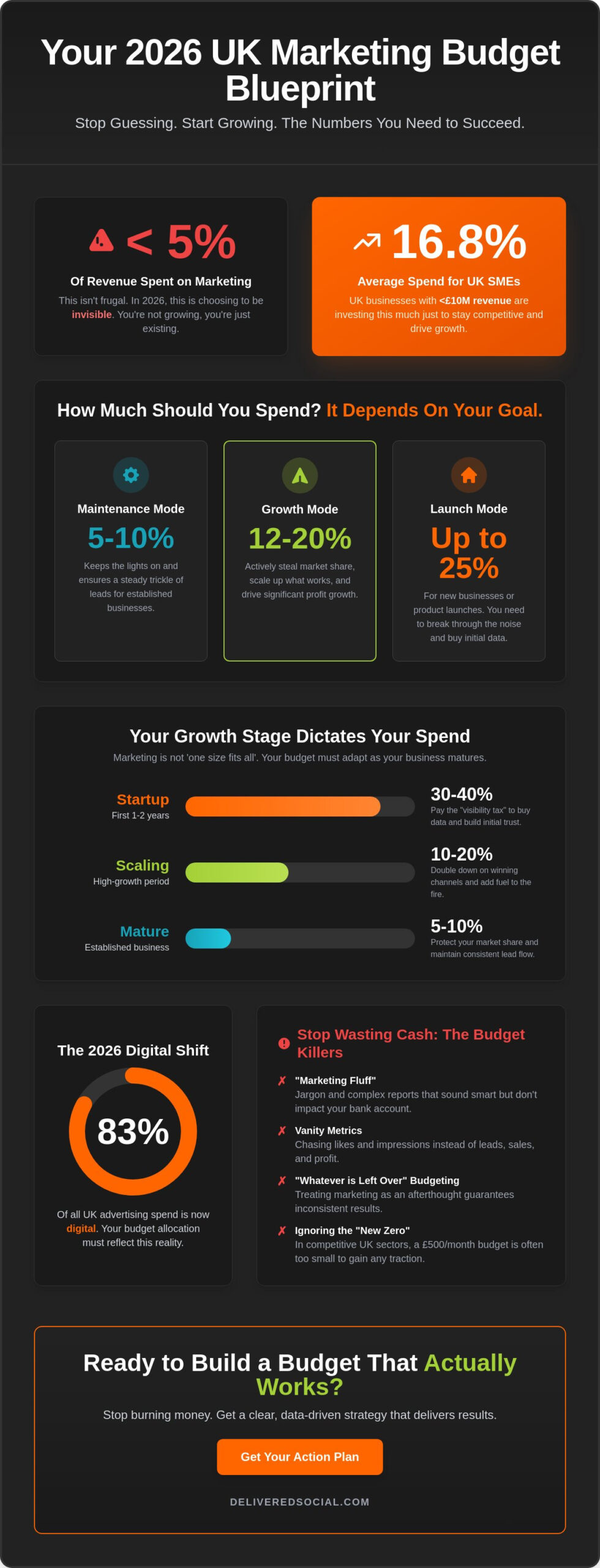
If you’re spending less than 5% of your revenue on marketing, you aren’t being frugal. You’re choosing to stay invisible. It’s the big question every founder asks: how much should a small business spend on marketing uk in 2026? Most people expect a vague answer about “it depends,” but that’s just agency fluff. The reality is that UK SMEs with under £10 million in revenue are currently investing 16.8% of their turnover just to stay competitive. If you’re still guessing your way through a spreadsheet, you’re likely wasting cash on ads that don’t convert or falling for jargon that sounds smart but does nothing for your bank account.
We get it. It’s frustrating to see your budget disappear while your lead flow feels like a leaky tap. You want a marketing plan that doesn’t suck. This guide delivers the straight-talking breakdown you need. You’ll get the 2026 benchmarks, from the 7% to 15% sweet spot for established firms to the 30% growth push for new startups. We’ll show you how to allocate that 83% digital spend across channels that actually drive profit. By the end of this chat, you’ll have a clear number for your spreadsheet and the confidence to stop burning money on nonsense.
Key Takeaways
- Stop guessing and learn the 2026 benchmarks that suggest a 7% to 15% revenue split for UK firms to actually see results.
- Identify the exact figures for how much should a small business spend on marketing uk depending on whether you are in maintenance mode or aggressive growth.
- Discover how to balance the “instant tap” of paid ads with long-term assets like SEO so you aren’t always paying for every single lead.
- Learn to spot the marketing fluff and vanity metrics that suck your budget dry without ever hitting your bottom line.
- Get a simple two-step action plan to audit your current mess and build a 2026 marketing strategy that actually works.
The Short Answer: UK Marketing Budget Benchmarks for 2026
Let’s skip the fluff. If you are spending less than 5% of your turnover on marketing, you aren’t growing. You’re just existing. In the hyper-competitive 2026 UK market, being invisible is a choice, and it’s a choice that leads to a slow death. Most UK SMEs with revenue under £10 million are now investing an average of 16.8% of their turnover into marketing just to stay ahead of the pack. That isn’t a random guess; it’s the cost of doing business when 83% of all UK advertising spend is now digital.
Your budget depends on your goals. If you’re in maintenance mode, 5-10% of gross revenue keeps the lights on and ensures a steady trickle of leads. Want to actually steal market share? You need to be in growth mode, which requires 12-20% of your revenue. If you’re launching a new business or a fresh product in 2026, expect to go as high as 25%. You have to break through more digital noise than ever before. If you’re wondering how much should a small business spend on marketing uk to see real magic, these are the cold, hard numbers for your spreadsheet.
Why the ‘Percentage of Revenue’ Model Still Wins
This model is simple. It scales as you do. When you have a bumper month, your marketing pot grows. When things are lean, it adjusts. You don’t need a degree in accounting to figure this out. Just take your total gross revenue and multiply it by your chosen percentage. It keeps you honest about your business health. The biggest mistake we see is owners spending “whatever is left over” at the end of the month. Spoilers: there is never anything left over. By treating marketing as a fixed percentage, you ensure your growth is fueled by a consistent strategy based on foundational Marketing principles rather than desperate, last-minute gambles.
UK Specifics: VAT, Inflation, and the 2026 Pound
The cost of digital “rent” on platforms like Meta and Google has climbed significantly. Inflation hasn’t just hit your energy bills; it’s hit your ad auctions too. In competitive UK sectors, a £500 monthly budget is effectively the new zero. It barely gets you through the door. You also need to account for VAT on your agency fees or tool subscriptions, which can eat into your net spend if you aren’t careful. A healthy UK marketing budget is one that covers both aggressive customer acquisition and long-term brand building to ensure you aren’t constantly starting from scratch every Monday morning.
Stage of Growth: Why Your Budget Changes as You Scale
Marketing isn’t a “set and forget” bill. The amount you pump into your growth engine depends entirely on where you are in your journey. If you’re a fresh startup in 2026, you’re effectively paying a “visibility tax” to break through the noise. Research shows that startups in their first year often need to spend 30% to 40% of their revenue on marketing. It sounds steep, but you aren’t just buying sales; you’re buying data. You’re learning who your customers are and which channels don’t suck before you commit the big bucks.
Once you hit the scaling phase, the strategy shifts. For UK businesses in a high-growth period, the recommended spend sits between 10% and 20% of annual revenue. This is where you stop throwing spaghetti at the wall and start doubling down on the winners. You’ve likely found your “magic” channel, and now you’re just adding fuel. This transition is a key part of any Ultimate guide to small business marketing because it prevents you from wasting cash on fluff that doesn’t scale. If you’re still wondering how much should a small business spend on marketing uk at this stage, the answer is usually “as much as you can profitably handle.”
Mature businesses have a different job: protecting their patch. If you’re established, a budget of 5% to 10% is usually enough to keep the leads ticking over and maintain your brand. However, you still need a “war chest” for market pivots. We saw this in 2024 and 2025 when budget contractions forced many to rethink their entire approach. Having a little extra tucked away allows you to experiment with new channels without risking the core of your business.
The ‘New Kid on the Block’ Tax
Established brands get cheaper leads because people already trust them. You don’t have that luxury yet. Building trust from scratch is expensive. The old “Rule of 7” is dead in 2026. Because of the sheer volume of digital content, most UK customers now need to see your brand 10 or more times before they even consider clicking. You have to pay for those extra impressions until your organic presence catches up.
Scaling Without the Headache
When you find something that works, don’t just double the budget overnight. We suggest the “10% rule” for scaling ad accounts. Increase your spend by 10% every few days to keep the algorithms happy and avoid the “Growth Trap” where your marketing outpaces your ability to actually deliver the work. Aim for a blended Return on Ad Spend (ROAS) of at least 2.5x to 3x to keep things sustainable. If your current setup feels like a mess, it might be time for a quick chat about your strategy to see where the leaks are.
The Great Split: Where Should Your Pounds Actually Go?
Knowing the total percentage is only half the battle. You also need to know where to drop the cash so it doesn’t just vanish into the digital void. In 2026, digital marketing accounts for over 83% of all UK advertising spend. That is a lot of noise to cut through. You can’t just throw a few hundred quid at Facebook and hope for magic. You need a split that balances the “right now” leads with long-term growth. If you are still trying to figure out how much should a small business spend on marketing uk, you have to look at the specific channels that actually move the needle.
Think of Content and SEO as buying a house. It takes time. It is a bit of a slog. But eventually, you own an asset that brings in leads without a daily bill. Paid Ads (PPC) are like staying in a hotel. It is instant. It is fancy. But the second you stop paying, you are out on the street. A balanced budget handles both. Social media isn’t just about “posting pictures” anymore; it is your 2026 storefront. If it looks like a mess, people won’t buy. Then there is the tools and tech. You need a CRM and email automation to stop leads from falling through the cracks. This software “alphabet soup” can get expensive, so only pay for what you actually use and ignore the rest of the fluff.
The 60/30/10 Rule for 2026
To keep things simple, we recommend a specific split for your 2026 budget. Put 60% of your cash into proven lead generation. This includes Google Ads and SEO. These are the channels that pay your bills today. Next, put 30% into brand awareness. Use this for social media and video content. It feeds your funnel for tomorrow so you aren’t always chasing the next click. Finally, keep 10% for “Wildcard” experiments. Try the stuff your competitors are too scared to touch. Maybe it is a weird new platform or a bold video series. If it fails, you only lost 10%. If it works, you have found your next growth engine. Following these Marketing budget benchmarks ensures your strategy stays grounded in reality.
The DIY vs. Agency Cost Reality Check
Many owners try the DIY route to save money. Here is the blunt truth: “Free” marketing actually costs you thousands in lost time and missed opportunities. While you are faffing with Canva or trying to learn TikTok, you aren’t running your business. That is a massive waste of your talent. A freelancer can help, but they are often a single point of failure. Hiring a digital marketing agency in the UK gives you a whole team of experts for roughly the cost of one mid-level employee. An agency isn’t just an annoying expense; it is an outsourced growth department designed to cut through the nonsense and get you results. Stop trying to do it all yourself. It is exhausting and it usually sucks.
Stop Wasting Cash: The Marketing Fluff That Sucks Your Budget Dry
Let’s talk about the money pit. You’ve worked out how much should a small business spend on marketing uk, but if you spend it on fluff, you might as well set fire to your notes. Vanity metrics are the biggest budget killers in 2026. Getting 10,000 likes on a post feels great for the ego, but likes won’t pay your UK corporation tax. Impressions don’t buy coffee. If your data doesn’t lead directly to a sale or a solid lead, it is just expensive noise. Every pound you spend needs to have a job to do.
Another classic mistake is the ‘Everything Everywhere’ trap. We see it all the time. A business has a £1,000 monthly budget and tries to spread it across 10 different channels. They do a bit of TikTok, a bit of Google, and a tiny bit of LinkedIn. The result? You are spread so thin that you don’t make an impact anywhere. It is better to dominate one channel than to be a ghost on five. Don’t let Shiny Object Syndrome distract you either. It is tempting to dump your proven SEO services because a new “magic” AI app launched this morning. Stick to what builds equity and ownership.
Finally, bad data is just gambling in a suit. If you aren’t tracking exactly where your leads come from, you’re just guessing. In 2026, with ad costs rising and platform competition at an all-time high, you cannot afford to guess. You need to know which pound brought in which customer. If you can’t see the path from click to cash, your marketing plan sucks. You need to be fiercely protective of your resources to ensure your 2026 spreadsheet actually balances at the end of the quarter.
How to Spot a ‘Fluff’ Agency
The industry is full of jargon-heavy nonsense. If an agency promises “guaranteed #1 rankings” or sends reports that look like a NASA spreadsheet but never mention profit, run. A good agency explains things in plain English. They should focus on your growth, not their “proprietary algorithms.” Most importantly, you must own your own accounts. If an agency locks you out of your own Google Ads or Meta data, they are holding your business hostage. That is a massive red flag. We prefer a transparent chat about your goals over a pitch full of corporate buzzwords.
The ROI Equation: Is It Actually Working?
Stop overcomplicating the math. The ROI equation is simple: (Revenue from Marketing – Marketing Cost) / Marketing Cost. If you spend £1,000 and make £3,000, your ROI is 200%. In the first three months of a new campaign, breaking even is actually a win. You are buying data and finding out what works. However, you must set “Kill Criteria.” If a campaign hasn’t delivered a single lead after 90 days, cut it. Don’t get emotionally attached to a failing ad. Kill the suck and move the budget to a winner.
Building a Budget That Doesn’t Suck: Your Action Plan
Enough with the theory. It is time to get your 2026 spreadsheet in order. You know the numbers. You know the benchmarks. Now you need a plan that actually works without making your head explode. Building a budget is not about finding the cheapest option; it is about finding the most effective way to buy your future growth. If you are still staring at a blank page wondering how much should a small business spend on marketing uk, follow these four steps to stop the bleeding and start the magic.
Step one is brutal honesty. Look at your 2025 revenue and your 2026 goals. If you want to grow by 30%, you cannot do it on a 2% marketing budget. It is mathematically impossible. Step two is auditing your current mess. Open your bank statements. Look at every tool, every “boosted” post, and every agency fee. If you cannot prove it brought in a lead, it is fluff. Kill it. This clears the deck for step three: picking your “Hero” channel. Whether it is SEO or paid search, fund it properly. Do not starve your winners to pay for your losers. Finally, step four is simple. Book a chat with someone who actually cares about your bottom line.
The ‘Social Clinic’ Approach
We do things differently here. We don’t believe in 50-page “strategy” documents that nobody ever reads. They are boring and they usually suck. Instead, we offer Social Clinics. It is a free, no-nonsense chat where we look at your business over a coffee. We can give you a straight-talking second opinion on your current PPC services spend or tell you if your social media is just shouting into a void. It is about getting a human-first perspective on how much should a small business spend on marketing uk in your specific niche. No jargon. No ego. Just growth.
Final Thoughts: Marketing is an Investment, Not a Bill
Stop looking at marketing as a cost to be minimised. It is the fuel for your business engine. If you spend 5-10% of your revenue, you are just keeping the lights on. If you want to fly, you need to hit that 12% plus mark. The cost of doing nothing is always higher than the cost of a well-run campaign. While you wait for the “perfect time,” your competitors are already stealing your market share. Ready for digital marketing that doesn’t suck? Let’s have a coffee and a chat.
Stop Guessing and Start Growing Your UK Business
You have the numbers. You have the 2026 benchmarks. Now it is time to stop faffing with spreadsheets and start making your budget work. Remember that 16.8% revenue benchmark for SMEs? It is a high bar, but you don’t have to hit it alone. The secret isn’t just knowing how much should a small business spend on marketing uk; it is knowing how to spend it without the fluff. Focus on your hero channels. Kill the vanity metrics that won’t pay the bills. Build an asset you actually own.
We’ve been providing digital marketing that doesn’t suck since 2016. Our team has helped over 500+ businesses find their magic and cut through the industry nonsense. No jargon. No ego. Just results that show up in your bank account. You deserve a marketing plan that actually delivers without the headache. It is time to treat your marketing like the investment it is.
Book a No-BS Social Clinic to fix your budget. Let’s have a coffee and get your 2026 growth on track. You’ve got this.
Frequently Asked Questions
Is 5% of revenue really enough for a UK small business?
No, not if you want to grow. Spending 5% of your turnover is strictly for maintenance mode. It is just enough to keep the lights on and replace the customers you lose through natural churn. If you want to actually scale in 2026, you need to be looking at 12% to 15%. Anything less means you’re just existing, not competing.
What is the average marketing spend for a UK SME in 2026?
UK SMEs with revenue under £10 million currently invest an average of 16.8% of their turnover into marketing. This is significantly higher than the 7.7% average seen across larger corporations. When figuring out how much should a small business spend on marketing uk, remember that smaller brands must spend more to break through the digital noise and build trust from scratch.
Can I do my own marketing for free?
You can try, but it is never actually free. You are paying with your time, which is your most expensive asset as a founder. While organic posting doesn’t have an ad bill, it requires hours of work that could be spent closing deals. Most “free” marketing strategies result in inconsistent lead flow and thousands of pounds in missed opportunities. It is a false economy.
How much should I spend on Google Ads vs. Social Media?
Start with a 60/40 split favoring Google Ads if you need leads today. Google captures people who are actively searching for your service right now. Social media is your 2026 storefront used for building trust and staying top-of-mind. If your lead flow is dry, put 70% into search ads until the till starts ringing. Then, you can shift more towards brand-building on social.
What are the most common marketing budget mistakes?
The biggest blunder is spending “whatever is left over” at the end of the month. Spoilers: there is never anything left. Other traps include chasing vanity metrics like “likes” and trying to be on every platform at once. Spreading a small budget across ten channels ensures you fail at all of them. Pick one “Hero” channel, fund it properly, and ignore the fluff.
How long does it take to see an ROI from a new marketing budget?
Give it 90 days. Paid ads can show life in a few weeks, but you need a three-month “learning phase” to optimize the data and stop wasting cash. SEO and content are even slower, often taking 6 to 12 months to really kick in. If you kill a campaign after 30 days because you aren’t a millionaire yet, you’ve just wasted your initial investment.
Should I hire a marketing employee or an agency?
Hire an agency if you want a full team of experts for the price of one junior employee. A single staff member cannot be a master of SEO, PPC, and creative design all at once. Agencies provide the tools and high-level strategy without the headache of UK National Insurance or pension contributions. It is the most cost-effective way for an SME to access “magic” results.
What should I do if my marketing budget isn’t getting results?
Audit your data and find the leak. If you are getting plenty of clicks but no sales, your website probably sucks. If nobody is clicking at all, your ads are the problem. Stop throwing good money after bad. Cut the failing campaigns immediately and move that budget to a winner. If you’re still stuck, it’s time for a straight-talking chat to find the nonsense.
Share This Article
About the Author: Jonathan Bird






























