



In This Article
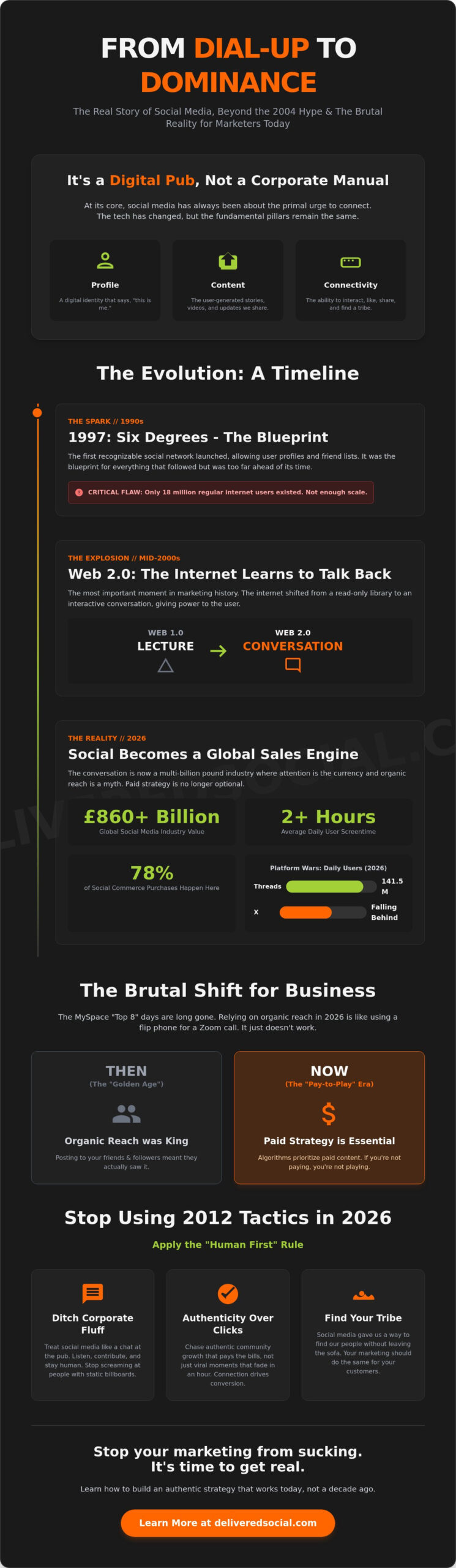
Social media isn’t just a collection of apps on your phone; it’s a digital campfire built on the primal urge to belong. If you are wondering social media when did it start, the answer doesn’t involve a Harvard dorm room in 2004. It actually goes back to the clunky, dial-up experiments of the 1990s where people first realised they could shout into the void and get a reply. Most history lessons on this topic are painfully dry and read like a corporate manual, leaving you feeling like you missed the boat or got lost in the noise.
We get it. You’re tired of the academic fluff and want to know how we shifted from personal updates to a global industry worth over £860 billion. We promise to give you the real story without the nonsense, from those first 90s chat rooms to the 2026 reality where Threads has 141.5 million daily users and X is falling behind. We are going to break down the entire timeline and show you how to use this context to stop your marketing from sucking in a world of 20-minute Reels and AI-driven feeds.
Key Takeaways
- Get the real facts on social media when did it start by looking past the 2004 hype to the 1997 launch of Six Degrees and the early chat room era.
- Ditch the corporate fluff and treat social media like a digital pub where human connection matters more than sounding “professional.”
- Understand the brutal shift from the MySpace “Top 8” days to the modern reality where organic reach is a myth and paid strategy is essential.
- Stop using 2012 marketing tactics in 2026 by applying the “Human First” rule to every post you share on LinkedIn or Instagram.
- Learn how to build an authentic community that actually drives growth instead of just chasing viral moments that don’t pay the bills.
Defining the Beast: What is Social Media, Really?
Forget the dry dictionary definitions you find in academic journals. They are full of fluff. In reality, social media is just a massive digital pub where everyone is talking at once. Some people are there to tell stories, others are there to argue with strangers, and a few are just lurking in the corner watching the chaos unfold. To truly grasp social media when did it start, you have to realise it wasn’t just a tech breakthrough. It was a social one. It gave us a stage, a microphone, and a way to find our “tribe” without leaving the sofa.
At its core, the beast relies on three simple pillars. First, you need a profile that says “this is me.” Second, you need user-generated content, which is just a fancy way of saying “the stuff we post.” Third, you need connectivity. This is the ability to interact, like, share, and occasionally get into a heated debate about whether pineapple belongs on pizza. In a comprehensive history of social media, you’ll see these pillars haven’t changed, even if the tech has become slicker. By 2026, social media has evolved into the internet’s nervous system. It’s no longer just a platform; it’s where 78% of social commerce purchases happen and where users spend over two hours every single day.
We also need to stop the nonsense of confusing social media with messaging apps. WhatsApp is a digital phone call. It’s private and direct. Social media is a performance. It’s public, searchable, and designed for an audience. If you’re a business owner, mixing these up is a fast track to making your marketing suck. You don’t treat a broadcast the same way you treat a private chat.
The Difference Between Networking and Media
Social networking is about who you know. It’s the digital version of your old school yearbook or your professional rolodex. Social media is about what you show. It’s the content, the videos, and the 20-minute Reels that keep people scrolling. Over time, these two ideas merged into what we now call the “attention economy.” Your time is the currency. Businesses that treat social media like a static billboard always fail. They scream at people instead of talking to them. The magic happens when you treat it like a chat at the pub. You listen, you contribute, and you stay human.
Web 2.0: The Moment Everything Changed
Before the mid-2000s, the internet was basically a giant, read-only library. You went online, read a page, and left. It was boring. Then came Web 2.0. Web 2.0 is the birth of the interactive user. Suddenly, the “write” button was just as important as the “read” button. This shift was the most important moment in marketing history because it stripped power away from big corporations and gave it to anyone with a keyboard. If you want to know social media when did it start, the answer is right here. It started when the internet stopped being a lecture and started being a conversation. That conversation is now worth £276 billion in global ad spend, and you can’t afford to ignore it.
The 90s Throwback: Where the Digital Spark Ignited
Long before we were doom-scrolling on the bus, social media was a cacophony of dial-up tones and pixelated avatars. If you are trying to pinpoint social media when did it start, you have to travel back to 1997. This was the year the digital spark actually ignited. It wasn’t about algorithms or monetisation back then. It was about the pure, raw thrill of talking to someone in a completely different time zone without paying for a long-distance phone call. The 90s gave us the first taste of a world where physical distance didn’t matter, and we were all hooked instantly.
Before the giants like Facebook were even a thought, we had the era of chat rooms and AOL Instant Messenger (AIM). These were the true proto-social platforms. They taught us how to communicate using only text and basic emojis. They also introduced the world to the “Away Message,” the first real ancestor of the modern status update. While many of these early experiments ended up as digital ghost towns, their failures were necessary. They proved that the human urge to connect was stronger than the clunky technology of the time.
Six Degrees: The Pioneer That Didn’t Make It
In 1997, Andrew Weinreich launched Six Degrees. It was a revolution. For the first time, users could create a profile, upload a list of friends, and surf through other people’s connections. It was the blueprint for everything that followed. However, Six Degrees was a victim of being too early for its own good. In the late 90s, only about 18 million people were regularly using the internet. The infrastructure simply couldn’t support a massive social network. Modern social media management teaches us that even the best ideas fail if the timing is wrong. You need an audience that is actually ready to engage.
Blogs and Bulletins: The Unsung Heroes
While Six Degrees was trying to map the world, other platforms were teaching us how to overshare. LiveJournal arrived in 1999, turning the private diary into a public performance. This was the moment we realised that people love to talk about themselves more than anything else. Around the same time, Bulletin Board Systems (BBS) were thriving in niche corners of the web. These systems paved the way for modern giants like Reddit and Discord. According to The Evolution of Social Media, these early communities were the first to prove that niche interests could build massive, loyal followings. They showed us that social media when did it start wasn’t just about the tech; it was about finding your people.
If your current strategy feels like it’s stuck in the dark ages, don’t panic. We can help you find your voice. Why not book a quick chat with us to see how we can make your brand’s story actually worth sharing?
The 2004 Explosion: When Social Media Went Nuclear
If 1997 was the spark, the early 2000s were the wildfire. This was the era when the internet stopped being a hobby and started being an obsession. When you ask social media when did it start to actually impact the way we live and breathe, the answer lies in this five year gold rush. It was a time of rapid growth, massive egos, and platforms that promised to change the world. Some did. Others crashed and burned so hard they became cautionary tales.
The timeline of this explosion is a masterclass in digital evolution:
- 2002: Friendster arrives. It made social networking “cool” for the first time, but it couldn’t handle its own fame. The servers were so slow they basically stopped working.
- 2003: MySpace fills the void. It was the wild west of the internet, full of glittery backgrounds and auto-playing indie music.
- 2004: The Facebook launches in a Harvard dorm room. It was clean, exclusive, and it changed the rules of engagement forever.
- 2005: YouTube goes live. Suddenly, we weren’t just reading text; we were watching cats, tutorials, and early “vlogs.”
- 2006: Twitter launches. It forced us to stop rambling and get to the point in 140 characters or less.
The MySpace Era: Customisation Overload
MySpace was the peak of unfiltered social media. It was messy. It was loud. It was glorious. You could pick your “Top 8” friends and start a social civil war by moving someone down the list. Everyone had a friend named Tom, the site’s co-founder who sold the platform for £311 million in 2005. The big lesson for 2026 is that people still crave that level of personality. MySpace worked because it let you show off who you were. If your current business profile feels like a boring corporate brochure, you are missing the magic that made MySpace a household name.
The Rise of Facebook: From College to Global Dominance
Facebook took the MySpace chaos and added order. By starting as an exclusive club for Harvard students, Zuckerberg created a “must-have” status that people were desperate to join. This was the moment social media became a digital marketing agency playground. We moved away from the guessing game of traditional ads. We had real names, real birthdays, and real interests. It turned social media into a precision tool for growth. By the time it opened to the public in 2006, the blueprint for the modern attention economy was already written in code. It wasn’t just a site anymore. It was a database of human behaviour.
The Evolution of ‘Social’ to ‘Sales’: A Business Reality Check
The 2010s were the decade that killed the “social” in social media and replaced it with a price tag. When we look back at social media when did it start to become a pure sales machine, the October 2010 launch of Instagram is the smoking gun. It triggered a visual revolution. Suddenly, if your life or your product wasn’t pretty, it didn’t exist. This shift turned every user into a brand and every brand into a content creator. It was no longer about what you were doing; it was about how good you looked doing it.
By 2026, the game has changed again. The myth of “free” social media is officially dead. Organic reach has been throttled to the point of extinction. If you want to be seen, you have to pay. This isn’t just a hunch; social media ad spend is projected to reach £217 billion globally this year. Social media has also become the world’s primary customer service desk. People don’t want to wait 48 hours for an email reply. They want a DM response in five minutes. If you aren’t there to answer, they’ll find a competitor who is.
We’ve also seen the rise of the influencer as a legitimate power broker. These individuals often command more trust and attention than billion-pound corporations. In the 2026 landscape, 78% of purchases happen directly within social platforms, making the social commerce market worth a staggering £858 billion. The line between “browsing” and “buying” has completely vanished.
The ‘Pay to Play’ Era
You can’t just post a grainy photo and hope for the best anymore. That’s a waste of your time. To get results, you need a strategy that integrates ppc services to cut through the noise. You need to target your audience with surgical precision. Data is the new oil in social media marketing, fueling every targeted ad that hits your feed. If you aren’t using that data to fuel your growth, you are just shouting into a void that isn’t listening.
TikTok and the Return to Raw Content
TikTok arrived and smashed the polished “Instagram aesthetic” to pieces. It brought back authenticity. We moved from the “Social Graph,” which showed you what your friends liked, to the “Interest Graph,” which shows you what you actually care about. The 2026 algorithm doesn’t care if you have ten followers or ten million. It only cares if your content is engaging. With Instagram Reels now allowing videos up to 20 minutes long, the focus has shifted back to storytelling. It’s about being human, being raw, and being interesting.
Ready to stop guessing and start growing? Let’s have a chat about your social strategy and make sure your brand doesn’t get left in the history books.
Making History Work for You: Social Media That Doesn’t Suck
Knowing social media when did it start is great for a pub quiz, but it’s useless if you’re still marketing like it’s 2012. Many businesses are stuck in a digital time warp. They post dry, corporate updates and wonder why their engagement is in the toilet. The history of this industry proves that people don’t want to be sold to; they want to be spoken with. If you wouldn’t say it to a mate at the local pub, don’t post it on LinkedIn. It’s that simple. We call this the ‘Human First’ rule. It’s about building a community that actually gives a toss about your brand.
At Delivered Social, we ignore the fluff that other agencies sell you. We don’t care about “magic” follower counts or vanity metrics that don’t help you grow. We focus on actual business outcomes. The evolution from 1990s experiments to the 2026 landscape shows us that the platforms change, but the psychology doesn’t. People still want to belong. If your strategy doesn’t reflect that, you’re just adding to the digital noise. With global social media penetration now sitting between 64.8% and 69.9%, you can’t afford to be just another boring profile.
Our No-BS Approach to Social Media
We don’t do fluff. We do real conversations that turn into actual leads. Our Social Clinics are the best way to get a straight answer about your digital presence without the jargon. We sit down, look at what you’re doing, and tell you exactly how to fix it. No ego. No nonsense. Just growth. It’s all part of our promise: digital marketing that doesn’t suck. We help you navigate the mess of 20-minute Reels and AI-driven feeds so you can focus on running your business.
Next Steps for Your Business
It’s time to audit your current platforms. Ask yourself: are you being social or just noisy? With approximately 5.79 billion social media users globally in 2026, the competition for attention is brutal. You need a strategy that understands where social media has been to predict where it’s going. Don’t let your business become a digital fossil. A strategy based on 2026 reality is the only way to stay relevant.
Stop guessing and start winning. We invite you to come over for a chat and some free fruit. We’ll talk about your goals, look at your data, and help you build a presence that actually works. Let’s make your social media awesome together.
Stop Living in the Past and Own Your Digital Future
Social media has moved at breakneck speed since those first 1997 experiments. We’ve gone from the “Top 8” drama of MySpace to a 2026 landscape where 78% of people buy products without ever leaving an app. Understanding social media when did it start is a reminder that while platforms die, the human need for connection never does. If you want to grow today, you have to ditch the corporate fluff and start acting like a real person again. It’s about being social, not just digital.
Since 2016, we’ve been delivering no-nonsense results for businesses that are tired of the usual agency rubbish. We don’t do jargon; we do growth. Whether you need a total strategy overhaul or just some honest advice at one of our Social Clinics, we’re here to help. It’s time for digital marketing that doesn’t suck. We take the stress out of your online presence so you can focus on what you do best.
Ready to turn your social presence from a ghost town into a thriving community? Book a chat with us and let’s make your social media awesome. Let’s grab a coffee and get your brand moving in the right direction.
Frequently Asked Questions
When was the first social media site created?
Six Degrees was the first recognisable social media site, launched in 1997 by Andrew Weinreich. It allowed users to create profiles and list friends, which was a revolutionary concept at the time. While the site shut down in 2001, it provided the blueprint for every platform that followed. It’s the definitive answer to social media when did it start, proving the industry is nearly three decades old.
Who is considered the ‘father’ of social media?
Andrew Weinreich is widely considered the father of social media because he launched Six Degrees and patented the “networking” framework. While names like Zuckerberg dominate the headlines today, Weinreich was the first to realise that digital profiles could map real-world relationships. He saw the potential of the internet as a social tool long before high-speed broadband was even a standard in UK homes.
How has social media changed since the early 2000s?
Social media has shifted from a simple digital yearbook to a complex, AI-driven sales machine. In 2004, it was about “poking” friends; in 2026, it’s about 20-minute Reels and seamless in-app shopping. The biggest change is the algorithm. We no longer see posts in chronological order. Instead, we see what a computer thinks will keep us scrolling for over two hours every day.
Why did MySpace fail while Facebook succeeded?
MySpace failed because it became a buggy, cluttered mess that couldn’t handle its own technical growth. Facebook succeeded by staying clean, exclusive, and incredibly stable during its early years. Zuckerberg’s team focused on building robust data tools for businesses. By the time MySpace sold for £311 million in 2005, Facebook was already building a database that made traditional marketing look like a total guessing game.
Is social media still free for businesses in 2026?
Social media is technically free to join, but organic reach is virtually dead for businesses in 2026. If you want your content to be seen by anyone other than your mum, you have to pay. With global ad spend hitting £217 billion this year, “free” is a myth. You need a proper strategy and a budget to cut through the noise and actually get results that don’t suck.
What was the first social media app on a smartphone?
Facebook was the first major social media app to hit the Apple App Store when it launched in July 2008. Before that, we had to use clunky mobile websites that were a nightmare to navigate. This move changed everything. It turned social media from something you did at a desk into something that lives in your pocket 24/7, leading to the massive engagement levels we see today.
How many people use social media worldwide today?
As of April 2026, between 5.24 billion and 5.79 billion people use social media worldwide. That is a global penetration rate of nearly 70%. In the UK, these numbers are even higher, meaning your customers are definitely online. If your business isn’t active on these platforms, you are essentially invisible to a huge portion of the market. It’s where your audience lives and shops.
What is the future of social media for small businesses?
The future for small businesses is about building authentic communities rather than chasing viral moments. AI will handle the boring bits like scheduling, but the human element is what will actually drive sales. Focus on raw, unpolished content that shows the face behind the brand. In 2026, people trust creators and local mentors more than faceless corporations. Keep it real and you will win.
Share This Article
About the Author: Jonathan Bird






























