




In This Article
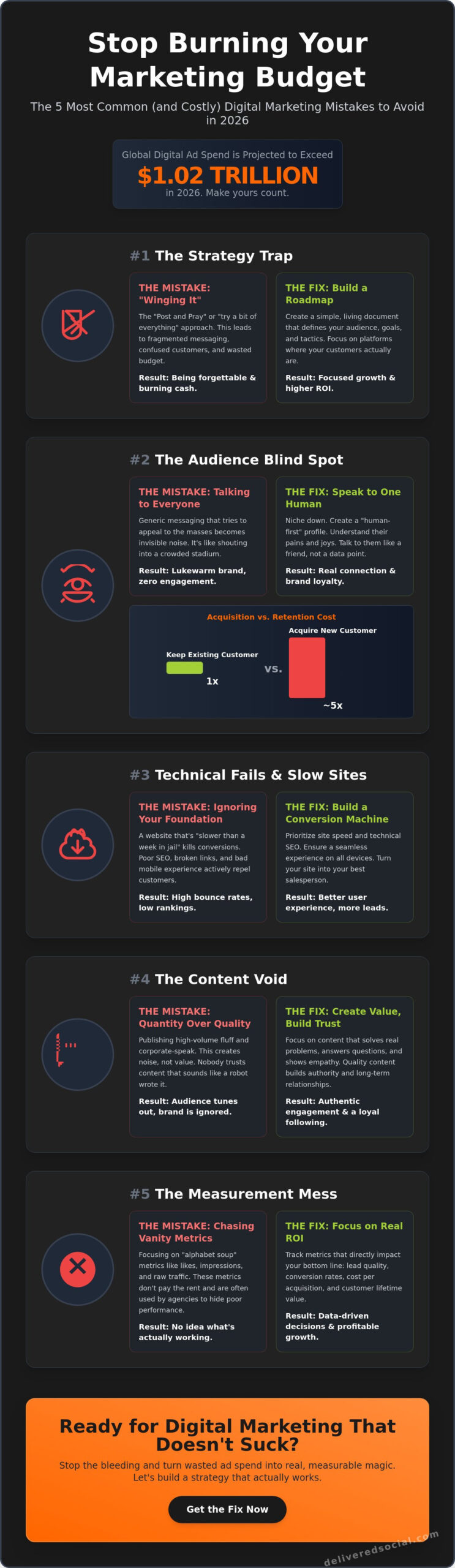
Did you know that global digital ad spend is projected to blast past $1.02 trillion in 2026? That is a staggering amount of money, yet a massive chunk of it is currently being set on fire by businesses making common digital marketing mistakes to avoid. You are likely exhausted from watching your hard-earned budget vanish while agencies hide behind jargon and “alphabet soup” metrics. It is frustrating. It is expensive. And frankly, it sucks. We believe in digital marketing that doesn’t suck.
We get it. You want results without the corporate nonsense. If you are ready to stop the bleeding, we have the fix. Whether it is ignoring the Oregon Consumer Privacy Act amendments that hit on January 1, 2026, or failing to adapt to Meta’s new attribution models from March 3, these errors are costing you cold, hard cash. This guide promises a clear roadmap to higher ROI and a strategy that actually works. We are diving into the specific traps draining your bank account and showing you how to turn that wasted spend into real, measurable magic.
Key Takeaways
- Stop “winging it” with a scattered strategy and learn how to build a simple roadmap that targets the right humans.
- Discover why technical fails and slow websites are killing your growth and how to turn your site into a high-speed conversion machine.
- Ditch the high-volume fluff and corporate-speak for quality content that builds real trust and engagement.
- Identify the common digital marketing mistakes to avoid when reading data reports so you can focus on ROI instead of vanity likes.
- Learn how to spot when an agency is feeding you nonsense and get the confidence to demand results that actually pay the rent.
The Strategy Trap: Why “Winging It” Is Killing Your Growth
Winging it isn’t a plan. It’s a disaster. Most businesses treat their marketing like a game of darts in a dark room. They throw money at every platform and hope something sticks. This “trying a bit of everything” approach is the fastest way to go broke in 2026. With global digital ad spend projected to blast past $1.02 trillion this year, you cannot afford to be aimless. If you don’t have a plan, you’re just donating your budget to big tech billionaires. A real strategy is a simple roadmap, not a 50-page snooze-fest that gathers dust in a drawer. It’s about knowing who you are, who you’re talking to, and exactly how you’re going to win.
Stop the “Post and Pray” nonsense on social media. Posting a random photo of your office lunch twice a week isn’t a strategy. It’s noise. When you lack focus, your messaging gets fragmented. Your customers end up confused. Confused customers don’t buy; they leave. Understanding basic digital marketing principles helps you see that every post needs a purpose. Without it, you’re making one of the most common digital marketing mistakes to avoid: being forgettable. In a world where the average cost per click has hit $2.85 across all industries, being forgettable is a luxury you can’t afford.
The Difference Between a Goal and a Wish
Saying “I want more sales” is a dream, not a strategy. It’s like saying “I want to be fit” while eating a donut on the sofa. You need milestones that actually mean something for your bottom line. Think about lead quality or conversion rates, not just raw traffic. A marketing strategy is a living document of intent that dictates how your brand interacts with the world to achieve specific business growth. It keeps you honest. It keeps you focused on growth, not just activity. It’s the difference between magic and fluff.
The “Shiny Object” Syndrome
You don’t need to be on every new platform that launches. If a new app drops tomorrow, you don’t have to be there unless your actual customers are already hanging out there. Prioritize the platforms where your audience spends their time. Say no to marketing fluff that doesn’t drive results. We’ve seen businesses waste thousands on “the next big thing” while their core website is slower than a week in jail. Focus on what works. Ignore the rest. That is how you build common digital marketing mistakes to avoid into a roadmap for success.
The Audience Blind Spot: Stop Talking to Everyone
If you think everyone is your customer, you are already losing. Shouting into a megaphone at a crowded stadium isn’t marketing. It’s a nuisance. In 2026, social media ad spend is expected to hit $219 billion. That is a lot of noise to cut through. If your message is generic, it becomes invisible. One of the biggest common digital marketing mistakes to avoid is the refusal to niche down. You are terrified of missing out on a sale, so you water down your brand until it tastes like lukewarm tap water. Nobody gets excited about tap water. You need to be the double-shot espresso for the right person.
Shouting at a crowd is exhausting. Having a chat with a friend is easy. Successful marketing in 2026 feels like the latter. Forbes recently highlighted several common marketing mistakes, and failing to understand the target audience sits right at the top. You have to use basic empathy. What keeps your customers awake at 2:00 AM? What makes them punch the air with joy? If you don’t know the answers, your ads will continue to suck. Stop treating your audience like a collection of data points and start treating them like humans with actual problems that you can solve.
Acquisition vs. Retention: The Great Imbalance
Creating a “Human-First” Buyer Profile
Stop using demographics like “Age 25-45.” It’s lazy and it tells us nothing. A 30-year-old in London has a completely different life than a 30-year-old in rural Wales. You need to understand the emotional “why” behind a purchase. Are they buying your services to find growth, or are they just trying to avoid the “measurement mess” we’ll talk about later? Speak their language. Ditch the corporate-robot talk. If you want to see how we build profiles that actually convert, come have a chat with our team. We promise it’ll be more useful than another “everyone is my customer” brainstorming session.
Technical Fails: SEO and Web Design Mistakes That Suck
A pretty website is useless if it’s slower than a week in jail. It might look stunning on your designer’s high-end Mac, but if it takes five seconds to load on a customer’s phone, they are gone. In 2026, 93% of all online experiences begin with a search engine. If your technical foundation is crumbling, you won’t even show up for the party. This is one of the most common digital marketing mistakes to avoid because it’s often hidden behind a wall of “Alphabet Soup.” Agencies love to throw technical jargon at you to hide the fact that your site isn’t actually working. If they can’t explain why your site is slow in plain English, they’re probably part of the problem.
Technical fails lead to what we call the measurement mess later on. You can’t track success if your site is a graveyard of broken links and 404 errors. According to reports on costly digital marketing mistakes, failing to maintain technical health is a primary driver of wasted ad spend. You are paying $2.85 per click just to send people to a page that doesn’t work. It’s nonsense. It’s frustrating. And it is completely avoidable with a bit of common sense and a lot of elbow grease.
The “Leaky Bucket” Website
Your website should be a conversion engine, not a leaky bucket. Friction points are the tiny annoyances that make users give up and leave. Maybe your “Buy Now” button is hard to find. Perhaps your contact form has 12 mandatory fields. Nobody wants to give their life story just to ask for a quote. People want a chat, not an interrogation. If you are tired of watching potential leads slip through the cracks, you need a web design agency surrey that builds for real humans. We strip away the fluff and focus on a clear, painless user journey.
SEO: It’s Not Magic, It’s Just Work
SEO is not a “one-and-done” task. It is a long-term commitment to being the best answer on the internet. Another of the common digital marketing mistakes to avoid is looking for “Black Hat” shortcuts. These are the dodgy tactics that promise page one rankings overnight. They don’t work. They get you banned by Google. Keyword stuffing is another relic that needs to die. It makes your brand look desperate and your content unreadable. For real, sustainable growth, you need seo services surrey that focus on technical excellence and genuine value. It’s not magic; it’s just hard work that pays off.
The Content Void: Quantity Over Quality is Nonsense
Posting five times a day is a waste of time if your content sucks. Seriously. It is a massive drain on your energy and your budget. Churning out low-grade posts just to tick a box is one of the most common digital marketing mistakes to avoid if you actually want to grow. In 2026, mobile advertising spend is hitting $495 billion. The digital world is louder than ever. If you are just adding to the noise with boring corporate-speak, you are invisible. People don’t want to be sold to by a robot. They want to talk to a human who actually gives a damn about their problems.
Video production is no longer an optional “nice-to-have” in 2026. It is the primary driver of consumer discovery. Short-form video is how people find brands and decide who to trust. If you are still relying solely on static images and dry text, you are essentially using a typewriter in a space race. Influencer marketing spend is also expected to reach $25 billion this year. This proves that people crave authenticity and real human connection. Stop hiding behind a logo and start showing the people who make the magic happen. Authenticity beats high-production fluff every single time.
Stop Selling, Start Helping
Give more than you take. Use the 80/20 rule: 80% of your content should provide pure value, and only 20% should be a direct sales pitch. Solve problems for free. Share your expertise without asking for a credit card number immediately. This builds a foundation of trust that makes the eventual sale feel like a natural next step. If you are struggling to find a story that doesn’t feel like a brochure, a creative agency surrey can help you cut through the nonsense and find your real voice.
Social Media Is a Conversation, Not a Megaphone
Social media is supposed to be social. It sounds obvious, but many businesses treat it like a one-way broadcast. Ignoring comments and direct messages is like walking away from a customer mid-conversation in a physical shop. It’s rude and it kills your engagement. Over-relying on automation can make your brand feel cold and robotic. People can smell a canned response from a mile away. Show the magic behind the scenes. Let your audience see the messy, wonderful reality of your business. That is how you turn followers into fans.
Ready to stop shouting into the void and start building real connections? Let’s have a chat about your social media management and get your content working for you.
The Measurement Mess: Why Your Data is Lying to You
Data is only useful if it is honest. Most businesses are drowning in numbers that don’t mean a thing. High engagement is great for the ego, but likes don’t pay the rent. If your agency is sending you 20-page PDFs full of graphs but your phone isn’t ringing, you have fallen into a measurement trap. This is a classic example of the common digital marketing mistakes to avoid: prioritizing vanity over value. You need to know if your marketing is actually putting money in the bank or just making your social media look busy.
You must track exactly where your leads are coming from. As of March 3, 2026, Meta changed its attribution model to only count link clicks for website conversions. Interactions like likes and shares are now tracked separately. If you are still looking at “engagement” as a sign of ad success, you are looking at the wrong map. Without proper tracking, you are just guessing where to spend your next pound. It is expensive guesswork that leads to a drained budget and zero growth. Stop obsessing over every penny and start looking at the big picture of your actual business expansion.
Real ROI vs. Agency Fluff
Agencies love “alphabet soup” reports. They use jargon to distract you from the fact that they aren’t delivering magic. You need to focus on metrics that impact your bank balance. If you are using ppc services, you must have clear conversion tracking in place. Ask your agency for a “BS-free” report that shows leads, sales, and actual revenue. If they won’t give you a straight answer, they are probably hiding a lack of results behind a wall of fluff.
The “Set It and Forget It” Ad Mistake
PPC is not a slow cooker. You cannot just set it and forget it. Campaigns need constant massaging and tweaking to stay effective as platform rules shift. For instance, Google Ads is transitioning to a 37-month data retention policy on June 1, 2026. If you aren’t adapting to these shifts, you are losing money to competitors who are more agile. ROI is the only metric that truly justifies your marketing spend. It is the difference between a growing business and a expensive hobby. Don’t let your data lie to you; make it work for your growth.
Time to Ditch the Fluff and Get Real Results
Marketing shouldn’t be a headache. You’ve seen how “winging it” and hiding behind “alphabet soup” metrics can drain your budget faster than a leaky bucket. In 2026, with global digital ad spend hitting $1.02 trillion, you can’t afford to stay invisible. Stop the “Post and Pray” nonsense and fix those technical fails. These common digital marketing mistakes to avoid are the only things standing between your business and real, measurable growth. Focus on human connection. Prioritize quality over quantity. Demand reports that show profit, not just vanity likes.
We believe in digital marketing that doesn’t suck. We don’t do long-term contracts because we prefer to let our results do the talking. If you are tired of the corporate nonsense, come see us at one of our Free Social Clinics for some honest advice. We will help you find the magic in your strategy without the ego. Want digital marketing that doesn’t suck? Let’s have a chat over coffee. It is your business. You have worked hard for it. Let’s make it awesome together.
Frequently Asked Questions
What is the biggest digital marketing mistake most businesses make?
The biggest error is launching campaigns without a written, defined strategy. Many businesses treat their budget like a game of darts, throwing cash at platforms and hoping for magic. Without a roadmap, you are just making one of the most common digital marketing mistakes to avoid. A documented plan makes you 397% more likely to succeed than those who just wing it.
How do I know if my current marketing agency is giving me fluff?
If your agency reports on “impressions” and “reach” but can’t show you a single lead, they are feeding you fluff. A transparent agency focuses on conversion rates and your bank balance. Ask for a BS-free report that shows exactly how many link clicks turned into revenue. If they hide behind jargon or “alphabet soup” acronyms, they are likely hiding a lack of results.
Is social media a waste of time for small businesses in 2026?
Social media is only a waste of time if you use it as a megaphone instead of a conversation. With social ad spend projected to hit $219 billion in 2026, the noise is louder than ever. You don’t need to post five times a day. Focus on quality over quantity and show the “magic” behind your business to build real trust with humans.
Why am I getting traffic to my website but no leads?
You likely have a “leaky bucket” website where friction points are killing your conversions. Your site might be slower than a week in jail, or your contact form might be too long and annoying. In 2026, 93% of online experiences start with a search, but they end instantly if your user journey is broken. Fix your technical fails to stop the bleeding.
How much should I realistically spend on digital marketing?
Realistic spending depends on your goals, but industry data from May 2026 shows small businesses typically spend between $500 and $5,000 per month on SEO. For PPC, keep in mind the average cost per click is now $2.85 across all industries. You need a budget that allows for constant “massaging” of your ads rather than a “set it and forget it” approach.
Should I focus on SEO or PPC first?
Focus on PPC for immediate leads and SEO for long-term organic growth. PPC gets you in front of customers today, but since 93% of online journeys begin with a search engine, technical SEO is a non-negotiable pillar for your future. The best strategy is using them together. Use PPC to test which keywords actually pay the rent, then dominate those terms with SEO.
Can I handle my own digital marketing or do I need an agency?
You can handle it yourself, but you will likely spend more time fighting platforms than growing your business. The landscape changes fast. Between new privacy laws in Kentucky and Rhode Island on January 1, 2026, and Google’s new data retention policies on June 1, it is a full-time job. An agency handles the technical nonsense so you can focus on your own magic.
What are vanity metrics and why should I ignore them?
Vanity metrics are numbers like “likes” and “followers” that look awesome but don’t pay the rent. They are the ultimate distraction. Obsessing over these empty stats is one of the common digital marketing mistakes to avoid in 2026. Focus instead on first-party data and actual conversion events. If a metric doesn’t lead to a chat or a sale, it is probably just fluff.
Share This Article
About the Author: Jonathan Bird































