




In This Article
Most web design agencies treat their pricing like a state secret. They bury the truth under layers of corporate fluff and “let’s hop on a call” nonsense. It’s exhausting. You’re likely here because you’re tired of the vague “it depends” answer. You’re worried about being overcharged for simple features or getting stuck with a DIY platform that looks like it was built in 1998. The question of how much does a website cost uk shouldn’t require a private investigator to solve.
We’re stripping away the intimidation factor. You deserve a straight-talking breakdown of UK web design costs in 2026. No jargon. No ego. Just the facts. Whether you’re looking at a £9 a month DIY builder or a £30,000 bespoke agency masterpiece, we’ve got the data. This guide covers the real price brackets for freelancers and agencies, separates essential features from luxury extras, and ensures you choose a partner that actually delivers a return on your investment. Let’s get into the numbers without the corporate filler.
Key Takeaways
- Get the blunt truth on how much does a website cost uk in 2026, covering everything from £0 DIY projects to £50,000+ enterprise engines.
- Understand the “freelancer gamble” and why paying for a dedicated SEO and UX team is the difference between a digital brochure and a lead-gen machine.
- Learn the difference between a recycled theme and a bespoke build so you never get overcharged for “standard” features again.
- Identify the “invisible” costs of hosting and maintenance that keep your site secure, fast, and actually visible on Google.
- Shift your focus from “initial price” to ROI, ensuring your new site is a revenue engine rather than just a digital paperweight.
The Reality of UK Website Costs: How Long is a Piece of String?
“How long is a piece of string?” is a rubbish answer. It’s the standard line people use to dodge a straight question. But when you ask how much does a website cost uk, it is unfortunately the most accurate starting point. In 2026, the price spectrum is wider than ever. You can technically build a site for £0 using a basic DIY builder, or you can drop £50,000+ on an enterprise level revenue engine. The gap between those two points isn’t just about “more pages.” It is about performance, strategy, and security.
Don’t fall into the trap of looking for an “average” price. Average is a dangerous word in web design. It’s like asking for the average price of a vehicle. Are we talking about a second hand bicycle or a custom fleet of delivery lorries? A site for a local dog walker has completely different requirements than a high performance e-commerce platform. The blunt truth is that you can easily find a “designer” to build a site for £500. You probably shouldn’t. A £500 site is usually just a generic template with your logo slapped on the top. It won’t rank on Google, it won’t convert visitors, and it will eventually cost you more in lost business than you “saved” on the build.
The Three Tiers of Web Investment
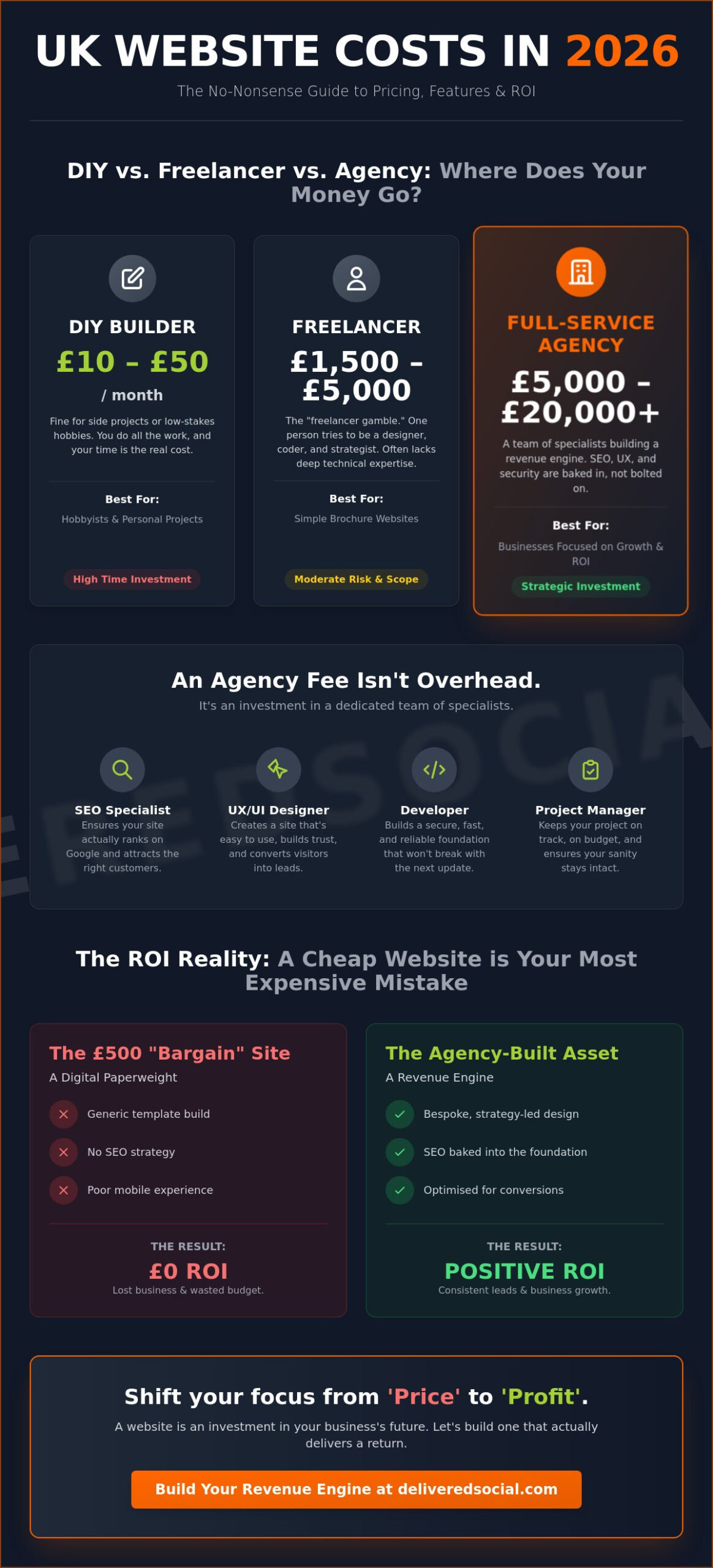
- Tier 1: DIY Builders (£10–£50/month). These are fine for side projects or low stakes hobbies. If you’re trying to scale a serious business, you’ll hit a technical ceiling almost immediately. You’re the one doing the work, which means your time is the real cost.
- Tier 2: The Freelancer (£1,500–£5,000). This is usually one person trying to be a designer, a coder, and a copywriter all at once. They might make a site look pretty, but they often lack the deep technical strategy needed for long term growth.
- Tier 3: The Full-Service Agency (£5,000–£20,000+). This is where brands are built. You’re paying for a team of specialists who understand what web design entails from both a psychological and technical perspective. SEO is baked into the foundation, not bolted on as an afterthought.
Why 2026 is Different for Web Pricing
The game has changed significantly this year. AI integration has arrived, which speeds up some of the boring coding bits, but it hasn’t made professional design “free.” In fact, standards are higher than ever. Basic “static” sites that just sit there like digital business cards are dead. Users now expect interactivity, instant load speeds, and a mobile experience that feels like a native app. When you look at how much does a website cost uk, you also have to factor in the rising cost of digital security. With UK data compliance getting stricter, a site that isn’t properly locked down is a massive legal liability. You aren’t just paying for pixels; you’re paying for a secure, high performance asset that actually does its job.
DIY vs. Freelancer vs. Agency: Where Does Your Money Go?
Let’s talk about the freelancer gamble. You find someone on a job board who promises a custom build for a grand. It’s tempting. But you’re betting your entire business on one person’s ability to be a master of everything. Most people aren’t. They might be a brilliant coder but have the artistic eye of a potato. Or they write great copy but the site breaks every time you update a plugin. You aren’t just paying for code. You’re paying for someone’s time. If that person gets a better offer or falls ill, your project dies with them.
Agencies are different. When you look at average website costs, agencies always sit at the top of the pile. Competitors will tell you it’s because of “high overheads” like fancy offices and beanbags. That’s a lazy excuse. The real reason is the team. You aren’t hiring a “web guy.” You’re hiring a dedicated SEO specialist, a UX designer, and a developer who actually knows how to secure a server. It’s a business strategy, not just a digital drawing. This is why some agencies charge £20,000 for a 5-page site. They aren’t selling pages. They are selling a revenue engine that converts visitors into cash. If you pay £500 for a site that gets zero leads, you’ve just thrown £500 in the bin.
The Hidden Value of a Professional Team
A “pretty” site that doesn’t work is a waste of space. A functional site that looks hideous is a brand killer. You need both. Designers focus on how it feels; developers focus on how it works. Then you have a Project Manager. Their job is to keep your sanity intact while the magic happens. Our web design agency surrey team focuses on results over just “looking nice.” We prioritize performance because a fast site is a profitable site.
Comparing the “True” Cost Over 3 Years
People often ask how much does a website cost uk in the short term, but the three-year view is what matters. DIY seems cheap until you factor in your own hourly rate. If you spend 100 hours building a site instead of running your business, that’s thousands in lost revenue. Plus, you’ll likely pay an agency to fix it 12 months later when it fails to rank. A professional build is an investment that usually pays for itself through better conversion rates and zero technical headaches. If you want to see how we can help you grow, let’s have a quick chat about your goals.
| Factor | DIY Builder | Professional Agency |
|---|---|---|
| Upfront Cost | £0 – £500 | £5,000 – £20,000+ |
| Your Time Investment | Very High | Very Low |
| SEO & Strategy | Non-existent | Fully Integrated |
| 3-Year ROI | Usually Negative | High Growth Potential |
Bespoke vs. Templates: Breaking Down the Technical Bill
Picking between a template and a bespoke build is the difference between buying a suit off the rack at a supermarket or getting one tailored on Savile Row. One sort of fits. The other makes you look like a legend. When people research how much does a website cost uk, they often see the low price of “premium” themes and think they’ve found a loophole. They haven’t. A theme is a pre-made skin. It is built to appeal to everyone, which means it is perfect for no one. It is packed with features you will never use, which slows your site down and kills your conversion rate.
Bespoke builds are different. They are tailored tools designed specifically for your sales funnel. In 2026, WordPress is the engine behind many of these high-performance machines. It isn’t just for blogs anymore. We use it to build complex, scalable platforms that can handle whatever your business throws at them. You aren’t just paying for the look; you’re paying for the architecture underneath. Off-the-shelf solutions are usually off-the-pace. If you want to outrun your competitors, you can’t be using the same generic template they bought for fifty quid.
The Template Trap
Cheap templates come with a hidden “template tax.” This is the bloated code that drags your load speeds into the gutter and ruins your mobile UX. Google hates slow sites. If your site takes more than three seconds to load, half your audience is gone. Scaling these themes is a nightmare too. When your business grows and you need new features, you’ll find that templates are rigid. You can’t just bolt on complex functions without the whole thing falling apart. A bespoke site is a tailored tool for your specific sales funnel.
E-commerce and Complex Features
Complexity scales the bill. Adding a shop isn’t just about adding a “buy” button. You’re dealing with secure payments, inventory management, and tax calculations. This is why e-commerce often adds £3,000 to £10,000 to a project instantly. Then there is the cost of integrating your site with CRMs or accounting software. This stuff takes time to get right. You can find a basic website cost breakdown that covers the basics, but performance is a feature in itself. Speed costs money because it requires expert optimization, but it makes money because it keeps users on the page. In the end, a fast site is a profitable site.
The “Invisible” Costs: Hosting, Maintenance, and the SEO Tax
You’ve paid the final invoice. The site is live. You’re done, right? Not even close. When calculating how much does a website cost uk, most people only look at the “build” price. They completely ignore the invisible costs that keep the lights on. It is like buying a car and forgetting you need insurance, fuel, and the occasional service to stop the engine from exploding. If you don’t budget for the aftermath, your shiny new site will be a broken, invisible ghost town within six months.
Hosting is the first trap. You can get “shared” hosting for £5 a month. It sounds like a bargain until your site takes ten seconds to load because you’re sharing a server with three thousand other dodgy websites. Pro managed hosting costs more, but it is the difference between a reliable storefront and a cardboard box in a windstorm. Then there is maintenance. WordPress, themes, and plugins need constant updates. If you skip these, you’re inviting hackers to have a party with your data. Maintenance isn’t optional; it is your insurance against the “white screen of death.”
Then we have the “SEO Tax.” Some competitors treat search optimization as an optional extra you can bolt on later. That is rubbish. Building a site without SEO services surrey from day one means you’ll eventually pay twice. You’ll pay once for the “pretty” site, and then you’ll pay again to have an expert rip out the bad foundations and fix the structure so Google can actually find you. Don’t pay the tax. Build it right the first time.
Ongoing Costs You Can’t Ignore
- Domain names and SSL certificates. These are your bare minimums. Without an SSL, your site will be flagged as “Not Secure,” which is a great way to scare off every single customer.
- Security monitoring. You need someone watching the gates. Proactive monitoring catches vulnerabilities before they become expensive disasters.
- Content updates. A site that hasn’t been updated since 2024 looks abandoned. You need fresh words, but don’t write them yourself. Professional copy converts; DIY rambling doesn’t.
Why Launch is Only 50% of the Journey
Launch day is just the beginning of the race. To get immediate traction, you should look at ppc services to drive targeted traffic while your organic rankings grow. A proper digital marketing agency surrey focuses on the long-term roadmap, not just the “Go Live” date. You also need to budget for professional photography and video production. Stock photos are boring. Real, high-quality media proves you’re a legitimate business and builds instant trust. Ready to stop guessing and start growing? Let’s talk about a website that actually delivers results.
The ROI Reality: Why a “Cheap” Website is Your Most Expensive Mistake
A cheap website is like a budget parachute. It looks fine while you are still on the ground, but you will deeply regret the saving once you are in mid-air. When business owners ask how much does a website cost uk, they often focus on the upfront bill rather than the opportunity cost. If you pay £2,000 for a site that generates zero leads, you haven’t saved money. You’ve just bought an expensive digital paperweight. Contrast that with a £10,000 site that brings in ten high-quality leads every week. That second site isn’t a cost; it is a revenue engine that pays for itself in months.
The “cowboy” designers on freelance boards won’t tell you this. They want to ship a pretty shell and disappear. We build sites to actually do something. At Delivered Social, we focus on the mechanics of growth. A site needs to be fast, secure, and psychologically mapped to make people click your “buy” or “contact” buttons. If your web design quote looks suspiciously low, it is usually because the “strategy” part has been completely binned. Spotting red flags early saves you from paying twice. If a quote doesn’t mention mobile optimization, site speed, or a long-term maintenance plan, you are being sold a lemon.
How to Measure Website Success
Vanity metrics are for egos. Real business owners care about conversion rates. Traffic is useless if it doesn’t buy anything. We prioritize User Experience (UX) to make it painfully easy for people to give you money. Our approach is simple. We don’t do fluff. We don’t use jargon to sound clever. We do growth. If your current site is just a digital business card that nobody visits, it is failing you. Success is measured in leads, sales, and a return on investment that makes the initial build cost look like pocket change.
Ready to Stop Guessing?
You can keep scrolling through vague price lists, or you can talk to a creative agency surrey that talks straight. We aren’t here for high-pressure sales or corporate nonsense. We want to take a blunt look at your business and tell you exactly what you need to win online. No fluff. No ego. Just results. When you are ready to stop gambling with your digital presence, we are here to help. Get a website quote that actually makes sense.
The No-BS Agency Checklist:
- Do they show you real-world results or just “pretty” screenshots?
- Is SEO part of the build or a “hidden” extra?
- Do they own their own servers or use £5/month shared hosting?
- Is there a clear plan for security and updates after the site goes live?
- Do they talk about your business goals or just their “creative vision”?
Build a Revenue Engine, Not a Digital Paperweight
Don’t let the mystery of how much does a website cost uk hold your business back any longer. You now have the full picture. A website isn’t just a bill to be paid; it’s an asset to be optimized for growth. We’ve stripped away the fluff. You now know why cheap templates fail and why “invisible” costs like managed hosting are essential. You understand why a dedicated team beats a freelancer gamble every single time. Stop settling for a digital business card that just sits there gathering dust. It’s time for a site that actually works for you.
Delivered Social has been helping UK businesses dominate their markets since 2016. We are a full-service digital agency that prioritizes 100% results over corporate nonsense. We talk straight. We cut out the jargon. We protect your resources like they’re our own. If you’re ready to invest in a high-performance platform that turns visitors into loyal customers, we’re ready to build it with you. Stop Wasting Money and Get a Website That Works. Your business deserves better than a “good enough” build. Let’s get to work and make your 2026 goals a reality.
Frequently Asked Questions
How much should a basic 5-page website cost in the UK in 2026?
Professional builds typically start between £2,500 and £5,000 for a standard 5-page business site. This price covers more than just the visual design; it includes the strategy, technical foundation, and basic search optimization. If you find a quote for £500, you’re likely getting a recycled template that won’t rank. Investing properly from the start ensures your site actually works as a lead generation tool rather than just a digital ornament.
Why are agency prices so much higher than freelancers?
You’re paying for a coordinated team of specialists rather than a single generalist. An agency gives you access to dedicated designers, developers, and SEO experts who all work together on your project. A freelancer is a one-person show. If they get sick or overwhelmed, your project stops. Agencies provide a layer of security, accountability, and a broader range of skills that one person simply can’t match.
Do I really need to pay for monthly website maintenance?
Maintenance is essential if you want your site to stay secure and functional. Think of it like a digital MOT. Plugins, themes, and security patches need constant updates to prevent hackers from trashing your data. Skipping maintenance might save a few quid now, but it leads to the “white screen of death” or a total site rebuild later. It’s a non-negotiable for any serious business.
How much does an e-commerce website cost to set up?
A professional e-commerce setup usually starts around £5,000 and can reach £40,000 for enterprise-level stores. Selling online is technically demanding. You need secure payment gateways, inventory tracking, and complex shipping rules. The price scales with the number of products and the level of automation you need. It’s a significant investment, but it’s the foundation of your entire digital storefront and revenue engine.
Can I just use a free website builder for my business?
You can use one, but it’s usually a bad move for a professional brand. Free builders often lock you into their ecosystem, force their branding on your URL, and offer zero help with SEO. They are great for personal blogs or bake sale flyers. For a real business, they look cheap and tell customers you aren’t willing to invest in your own success or professional image.
How long does it typically take to build a professional website?
A professional build typically takes between 4 and 12 weeks depending on the complexity of the project. A simple brochure site might be ready in a month, while a custom e-commerce platform can take up to six months. This timeline includes planning, design, development, and rigorous testing. Rushing the process usually leads to bugs and a poor user experience that costs you customers in the long run.
Are there hidden costs I should look out for in a web design quote?
The biggest “hidden” cost is usually VAT, which adds 20% to most UK agency quotes. You should also check for ongoing hosting fees, domain renewals, and the cost of professional copywriting or photography. Some agencies charge extra for training or post-launch support. Always ask for a total cost of ownership breakdown so you aren’t hit with unexpected bills three months after going live.
Is SEO included in the cost of a new website?
Technical SEO should be baked into the build, but ongoing ranking strategy is usually an extra service. A good agency ensures your site is fast and readable by Google from day one. However, getting to page one takes consistent effort. When researching how much does a website cost uk, remember that a site is just the vehicle. You still need to pay for the fuel to make it move.
Share This Article
About the Author: Jonathan Bird






























