


In This Article
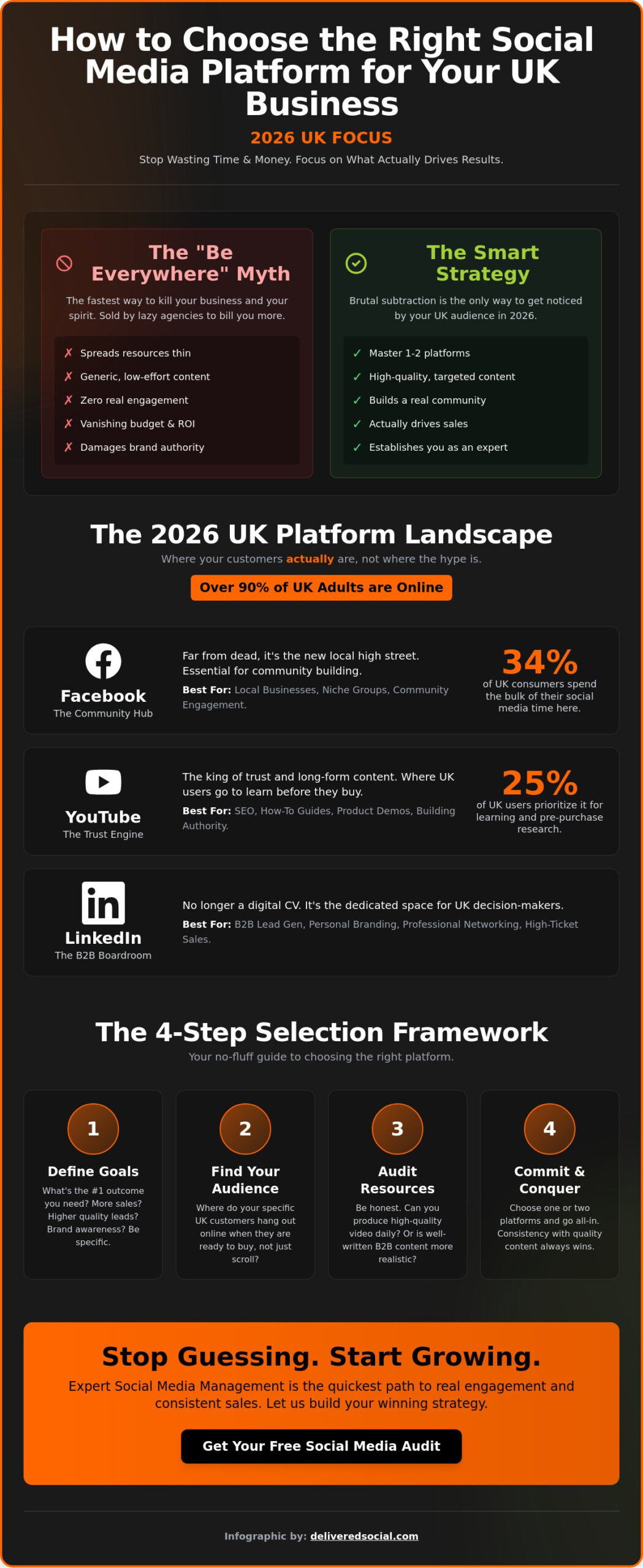
Trying to be on every social media platform is the fastest way to kill your business and your spirit. It is a total lie sold by lazy agencies who want to bill you for an omnichannel presence while your engagement stays at zero. You are likely exhausted from managing five different accounts, chasing algorithm shifts, and watching your budget vanish. We get it. It is painful to see Meta slap a 2% location fee on UK ads while your organic reach continues to tank. You deserve to know how to choose the right social media platform for your business uk without the corporate fluff.
Over 90% of UK adults are online, but they are not everywhere at once. This guide cuts the nonsense and helps you find exactly where your customers are hiding in 2026. We are going to strip away the platforms that suck the life out of your week and give you a clear, prioritized strategy. You will walk away with a plan to master just one or two platforms that actually drive results. We will cover the latest UK regulations and audience shifts so you can stop guessing and start growing.
Key Takeaways
- Stop trying to be everywhere. Learn why brutal subtraction is the only way to actually get noticed by your UK audience in 2026.
- Discover exactly how to choose the right social media platform for your business uk by matching your specific goals to current British user habits.
- Use our no-fluff 4-step framework to audit your internal resources and stop promising content you can’t realistically produce.
- Get the latest stats on UK age demographics so you can stop burning your budget on platforms your target market isn’t using.
- Learn why ditching the DIY approach for expert Social Media Management is the quickest path to real engagement and consistent sales.
The ‘Be Everywhere’ Myth: Why Your Social Strategy is Probably Failing
Most marketing gurus will tell you to grab every handle, join every new app, and post three times a day. They are lying to you. Spreading yourself thin across five different platforms is the fastest way to become invisible online. When you try to speak to everyone, everywhere, you end up speaking to no one. In 2026, the digital landscape is too crowded for “good enough” content. If you aren’t all-in on a platform, the algorithm will bury you. It is that simple. Knowing how to choose the right social media platform for your business uk starts with a massive reality check: you don’t need to be everywhere. You just need to be where the money is.
Platform Fatigue is the number one killer of SME marketing, occurring when a business spreads itself so thin across multiple apps that its content becomes generic, late, and completely ignored. You end up with a graveyard of half-finished profiles that actually hurt your reputation. A potential customer sees a Twitter account that hasn’t been updated since 2024 and they assume you’ve gone out of business. The “Right Platform” isn’t the one with the most users; it is the one where your specific UK customers are ready to buy, not just mindlessly browse.
Quality Over Quantity: The No-BS Reality
One active, high-engagement profile beats five ghost towns every time. In 2026, UK consumers are cynical. They can smell a low-effort post from a mile away. If you are just “posting for the sake of it” to tick a box, you are wasting your time and your budget. Shouting into the void with mediocre content damages your brand’s authority. People want to see that you understand what social media marketing is in a modern context. It is about building a community, not just broadcasting sales messages. With Meta pushing AI-driven Advantage+ tools and TikTok requiring mandatory commercial disclosures, the bar for “quality” has never been higher. If you can’t commit to high-quality video or daily interaction on a specific channel, get off it.
Identifying ‘Dead’ Channels for Your Specific Industry
Stop chasing the “Shiny Object Syndrome.” Just because a new app is trending in the news doesn’t mean your business belongs there. If you are a B2B consultancy in Leeds, you probably don’t need to be dancing on TikTok. Likewise, if you are a highly visual brand like an interior designer, you are wasting your breath on text-heavy platforms where your portfolio can’t shine. How to choose the right social media platform for your business uk requires looking at the data, not the hype. In 2026, UK marketers are piling into TikTok, but 34% of consumers still spend the bulk of their time on Facebook. Don’t let an agency talk you into a “trendy” platform if your customers aren’t actually there with their wallets open.
The 2026 UK Platform Landscape: Where the People Actually Are
The UK social map isn’t what it was two years ago. If you are still following 2023 advice, you are shouting at a brick wall. The Digital 2026 Global Overview Report shows that while marketers are obsessed with the next big thing, British consumers are actually quite loyal to their favorites. Over 90% of UK adults use at least one platform regularly. But they aren’t just scrolling. They are joining groups, watching long-form guides, and buying directly through apps. Figuring out how to choose the right social media platform for your business uk means looking at where the actual conversations are happening, not just where the hype is.
Facebook is the perfect example of this shift. People claim it’s dead, yet 34% of UK consumers plan to spend more time there this year than on any other app. It has moved away from a public feed and into a hub for local UK communities and niche groups. If you are a local business, ignore Facebook Groups at your peril. Meanwhile, YouTube remains the king of trust. With 25% of UK users prioritizing it, it’s where they go to learn before they buy. It is also a massive win for your Search Engine Optimisation (SEO) because Google loves video content that solves problems.
B2B Leaders: LinkedIn is Your Office
LinkedIn is no longer just a digital CV. It’s where UK decision-makers hang out to escape the noise of other platforms. Since April 2026, stricter disclosure rules mean sponsored content is more transparent, but organic reach still thrives for those with a personal brand. Don’t just post corporate updates. People buy from people. Direct outreach works, but only if you’ve built authority first. It is the undisputed heavyweight for professional networking in Britain. If your target is a CEO in London or a site manager in Manchester, you start here.
B2C & Retail: The Visual Powerhouses
If you sell a physical product or a lifestyle service, you need eyes on your brand. Instagram and TikTok are in a total dogfight for UK attention. Marketers are piling into TikTok, with 73% planning to increase spend there, but don’t sleep on Instagram’s 69% marketer share. TikTok is the home of the “viral” moment and short-form video. Instagram remains the king of the discovery phase. And for home and garden brands? Pinterest is the dark horse. It’s where the planning happens. If you want to master these visual spaces, high-quality Video Production is now a basic requirement for survival. How to choose the right social media platform for your business uk often comes down to whether you can produce the visuals these audiences demand.
The UK Reality Check: Matching Platforms to British Demographics
British audiences are a tough crowd. They have a built-in “nonsense detector” that triggers the second a brand sounds too American or overly corporate. If your content feels like a loud, high-pressure sales pitch from a generic script, you have already lost. Understanding how to choose the right social media platform for your business uk requires a deep dive into the specific habits of people from Portsmouth to Perth. It isn’t just about where they are. It is about why they are there and how much they are willing to spend when they arrive.
The 2026 landscape is heavily influenced by new regulations like the Online Safety Act and the Crime and Welfare Safety Act. These changes mean platforms are under more pressure to moderate content and verify ages, which shifts how different groups interact. Plus, with Meta’s 2% location fee for UK ad delivery implemented in April 2026, picking the wrong demographic isn’t just a waste of time. It is a direct hit to your bottom line. You need a solid framework for choosing social media platforms that accounts for these UK-specific costs and cultural nuances.
Age and Income Splits in the UK
The 45+ demographic in the UK is where the high disposable income usually sits. These users aren’t just on Facebook to see photos of their grandkids. They are active in local community groups and are increasingly using WhatsApp for business interactions. If you are targeting “middle-England” professionals, this is your heartland. Conversely, the 18 to 30 market has almost entirely abandoned traditional search engines. They use social discovery on TikTok and Instagram to find everything from lunch spots to accountants. If you aren’t visible there, you don’t exist to them. But remember, the UK digital age of consent is a moving target in 2026. Stay compliant or get banned.
Intent Mapping: Browsers vs. Buyers
Not all scrolls are created equal. Some platforms are for “lean-back” entertainment, while others are for “lean-forward” solutions. UK users on YouTube are often in a high-intent learning phase. They want to know how something works before they buy it. TikTok users are usually there to laugh, which makes it a low-intent environment where you have to work harder to convert a view into a sale. You must align your platform choice with your broader goals. Working with a dedicated social media management company can help you map these intent signals correctly. Don’t blow your budget on a platform where people are only looking for a distraction. Go where they have their credit cards ready.
The 4-Step Selection Framework: Cutting the Fluff
Stop overcomplicating things. You don’t need a 50-page strategy document to figure out how to choose the right social media platform for your business uk. You just need a brutal filter. Most businesses fail because they pick platforms based on what is trendy rather than what they can actually sustain. This framework is designed to strip away the ego and focus on the cold, hard reality of your daily operations. If a platform doesn’t pass these four steps, bin it. Your time is too valuable to waste on a channel that will never pay the bills.
The Resource Audit: The Truth Hurts
Be honest with yourself. If your team is camera-shy and you don’t have the budget for professional Video Production, stay off TikTok and Reels. Video now accounts for 59% of social media advertising investment in the UK. If you can’t compete at that level, you are just background noise. Likewise, if you can’t sit down and write 500 words of genuine, high-level insight, stay off LinkedIn. You need to match your internal talent to the platform requirements. Do you have a “talker,” a “writer,” or a “maker”? Pick the platform that plays to your existing strengths so you don’t burn out by week three.
Competitor Sabotage: Learning from Their Mistakes
Don’t just copy your competitors. Spy on them to see where they are failing. Look at their Instagram or Facebook pages. Are they getting hundreds of likes but zero comments? They are likely buying fake engagement or talking to a dead audience. Look for the “content gaps” they are ignoring. Maybe they are posting generic product shots but never answering the actual questions UK customers are asking in the comments. That is your opening. Use their laziness to choose your primary channel and dominate the space they are neglecting.
Once you’ve identified the gap, move to Step 3: Map the journey. Does your customer need to see a demo, read a review, or join a community? Match that need to the platform’s primary function. Finally, commit to a 3-Month Trial. Don’t look at the data every day. Give the algorithm time to learn who you are. If you find the process too draining or the results aren’t landing, it might be time to hand the reigns to a pro. Our Social Media Management team can take this entire framework off your plate and execute it with precision.
Stop Guessing and Start Growing: Why Pro Management Wins
You started this guide to find out how to choose the right social media platform for your business uk, but the most important choice you will make is who actually hits the publish button. Most business owners fall headfirst into the DIY trap. You think you are saving money by spending four hours on a Tuesday afternoon fiddling with a Reel that gets twelve views. You aren’t. You are just neglecting the parts of your business that actually make money. Real growth doesn’t come from random acts of content. It comes from a strategy that doesn’t suck.
Consistency is the only secret sauce left in 2026. The algorithms are brutal. They punish accounts that post once a month and then vanish when things get busy. A digital marketing agency Surrey doesn’t just post for the sake of it. They spot the trends before they peak and pivot your content before the algorithm kills your reach. They know the difference between a viral dance and a lead-generating video. It is about being intentional, not just active.
The ROI of Getting Your Time Back
Calculate the true cost of your time. If you spend 10 hours a week shouting at Canva, that is 40 hours a month taken away from sales, operations, or actually seeing your family. Professional social media management pays for itself by focusing on lead quality rather than vanity metrics. We don’t care about a thousand likes from bots in another country. We care about high-intent UK customers who actually want to buy what you are selling. Getting your time back is a massive business win. Use it to grow your company while the experts handle the scroll.
Integrated Strategy: More Than Just Social
Your social media should not live on a lonely island. In 2026, your profiles must feed directly into your SEO services Surrey and overall web traffic. A smart strategy connects your organic presence with your paid ads and search rankings. When someone finds you on LinkedIn, your website should be ready to convert them. When they search for you on Google, your social proof should be there to close the deal. It is a full-circle approach that builds deep trust. How to choose the right social media platform for your business uk is just the first step. The next is making sure that platform works in harmony with your entire digital footprint. If you are ready to stop guessing, let’s have a casual chat about your 2026 goals. No jargon. No ego. Just results.
Time to Stop Scrolling and Start Scaling
You have the map. Now you just need to walk the path. We have spent this guide tearing down the “be everywhere” lie and showing you how to match your business to the actual habits of UK buyers. Whether you are leaning into LinkedIn for professional networking or mastering the high-energy world of TikTok, the goal is simple. Focus on what works and bin the rest. Understanding how to choose the right social media platform for your business uk is the difference between a thriving community and a digital graveyard of half-finished profiles.
Since 2016, we have been helping businesses ditch the fluff with a refreshingly blunt approach to digital marketing. We are a full-service squad, handling everything from high-end Video Production to technical SEO and Web Design. You don’t have to navigate the 2026 algorithm shifts or new UK regulations alone. We take the guesswork out of your strategy so you can get back to running your company. Ready for social media that doesn’t suck? Let’s chat.
Success on social media isn’t about luck. It is about commitment and clarity. Pick your platforms, stay consistent, and get ready to grow.
Frequently Asked Questions
Which social media is best for small business UK 2026?
Facebook and WhatsApp are the current heavyweights for general reach, but TikTok is the undisputed king for brand discovery. Statistics show 34% of UK consumers plan to spend more of their time on Facebook in 2026, making it a safe bet for local firms. However, if you want to reach a younger demographic, TikTok’s discovery engine is unmatched for finding new eyes without a massive ad spend.
How many social media platforms should a UK business have?
Stick to one or two platforms and master them before even thinking about a third. Spreading yourself thin across five accounts is the fastest way to look invisible on all of them. Quality beats quantity every time. If you can’t post high-quality content consistently on three platforms, don’t try. Master one, get the leads flowing, and then consider expanding only if you have the resources.
Is Facebook still relevant for UK businesses in 2026?
Absolutely. Facebook is far from dead; it has just shifted into a hub for local UK communities and niche groups. It remains the platform where the largest chunk of UK adults spend their time daily. If you are a local service provider or a community-focused brand, ignoring Facebook Groups in 2026 is essentially leaving money on the table. It is where the “middle-England” audience still lives.
How do I know if my UK customers are on LinkedIn or TikTok?
Check their age and their current buying state. If you are targeting the 18 to 30 UK market, they are likely using TikTok as a search engine for social discovery. If you are looking for professional decision-makers and C-suite executives, they are active on LinkedIn. how to choose the right social media platform for your business uk requires knowing if your audience wants to be entertained or educated at that moment.
Can I manage my own business social media or should I hire an agency?
You should hire an agency the moment the opportunity cost of your time outweighs the fee. Many business owners waste ten hours a week on Canva when they should be closing sales or improving operations. Professional Social Media Management pays for itself by delivering high-quality leads and consistent branding while you focus on the work only you can do. DIY is often a slow road to burnout.
What is the most used social media platform in the UK for B2B?
LinkedIn is the undisputed champion for UK B2B networking and lead generation. It is where the professional audience hangs out to find industry insights and build genuine authority. While other platforms are pivoting toward mindless entertainment, LinkedIn has doubled down on professional networking. If your goal is to reach other business owners or corporate decision-makers, this is your primary digital office.
How much time should I spend on social media marketing each week?
Budget for at least ten hours a week if you are handling everything yourself. That time includes content creation, replying to comments, and staying on top of 2026 regulations like the Online Safety Act. how to choose the right social media platform for your business uk often comes down to how much time you can realistically steal from your day job. If you can’t commit the hours, the results will be non-existent.
What are the common mistakes when choosing a social media platform?
Chasing the “shiny object” is the most expensive mistake you can make. Just because a new app is trending in the news doesn’t mean your customers are there with their wallets open. Other blunders include ignoring UK-specific costs like Meta’s 2% location fee or failing to disclose commercial content on TikTok. Don’t pick a platform just because your competitor is there; they might be failing too.
Share This Article
About the Author: Jonathan Bird































