


In This Article
Most business owners treat their social media like a last-minute grocery shop. It’s panicked, disorganized, and full of stuff nobody actually wants. With over 5.2 billion people scrolling through feeds in 2026, just winging it is a guaranteed way to get ignored. You’re likely tired of the constant content fatigue and the sinking feeling of wasting hours on posts that flop. It’s a massive drain on your energy and your bottom line.
We agree that creating a social media content calendar shouldn’t feel like a corporate prison sentence. It’s actually your safety net. This guide is here to help you ditch the fluff and build a repeatable system that drives real results. You’ll gain a consistent brand presence and, more importantly, the time to actually run your business instead of being a slave to an algorithm. We’re going to walk through the essential tools, the shift toward authentic video, and how to stay relevant without losing your mind. Let’s get to work.
Key Takeaways
- Ditch the “Panic Posting” cycle by treating your schedule as your brand’s operational heartbeat, not a chore.
- Master the art of creating a social media content calendar using the batching method to reclaim over 10 hours of your work week.
- Identify the five non-negotiable elements every plan needs to ensure your posts actually drive results instead of just taking up space.
- Get a blunt comparison of DIY spreadsheets versus professional software to find a system that works for your specific business size.
- Learn how to recognize the exact moment to stop doing it all yourself and scale your brand with expert social media management.
Why Winging Your Social Media is a One-Way Trip to Burnout
Stop pretending that “winging it” is a personality trait. It’s a business failure. If you don’t have a plan, you don’t have a presence. You’re just shouting into a digital void and hoping someone accidentally hears you. Creating a social media content calendar is the operational heartbeat of your brand. It’s the difference between a business that grows and one that just exists. It keeps things moving when you’re too busy to breathe.
The “Panic Posting” cycle is where creativity goes to die. You know the routine. It’s 4:30 PM on a Tuesday. You suddenly realize you haven’t posted in four days. You scramble to find a blurry photo, write a caption that says absolutely nothing, and hit share. It’s stressful. It’s exhausting. And most importantly, it’s completely ineffective. This cycle kills your ability to think strategically because you’re always playing catch-up instead of leading the conversation.
Inconsistency has a massive hidden cost that most people ignore. In 2026, platform algorithms are smarter and more ruthless than ever. They prioritize accounts that show up reliably and provide value over time. When you ghost your audience for a week, you aren’t just missing out on views. You’re actively hurting your future reach. The platform stops trusting you as a reliable source of content, and your engagement numbers will reflect that lack of commitment.
Planning 30 days ahead might sound daunting, but it’s actually a massive relief. Deciding what to post once a month is infinitely easier than making that decision 30 separate times. When you commit to creating a social media content calendar, you’re giving yourself permission to focus on running your business instead of chasing likes. You move from being reactive to being proactive, which is where the real growth happens.
The Myth of Spontaneity vs. The Reality of Results
A lot of people think social media has to be 100% live to be “authentic.” That’s total nonsense. Most of the brands you love are using a highly structured approach. They aren’t just lucky; they’re prepared. When you have a solid plan in place, you actually create more room for real spontaneity. Because the basics are covered, you have the mental bandwidth to jump on a breaking trend or share a behind-the-scenes moment without the pressure of “needing” to post. You stop shouting into the void and start building a narrative that people actually want to follow.
What a Calendar Actually Is (The Non-Boring Version)
Forget the dry, dusty spreadsheets of the past. Your content calendar is a visual map of your brand’s digital story. It isn’t just a list of dates. It’s a command center for your links, video assets, and specific goals. Think of it as a modern editorial calendar. Simply put, a content calendar is the bridge between your business goals and your customer’s feed. It ensures that every post serves a purpose, whether that’s driving sales or building community. It’s how you stay in control of your time and your brand.
The Anatomy of a Social Media Calendar That Doesn’t Suck
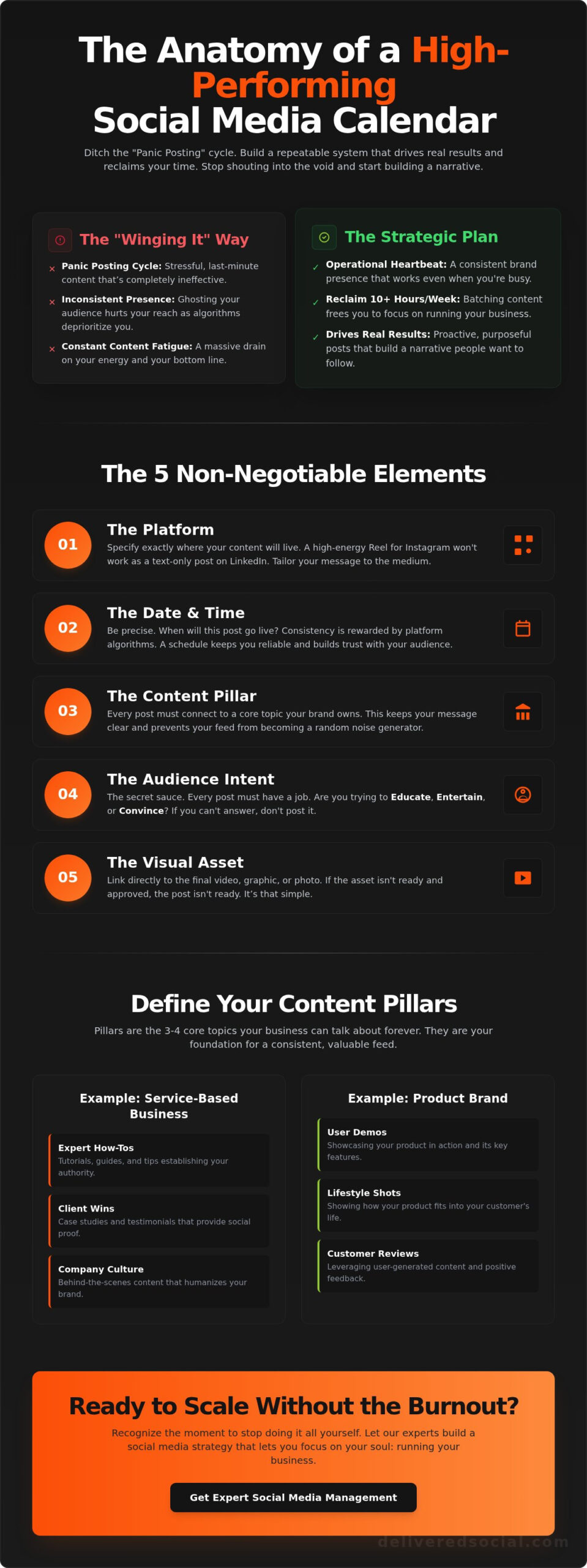
Most social media calendars are just glorified to-do lists. They’re boring, cluttered, and ultimately useless. If you’re serious about creating a social media content calendar that actually works, you need to strip away the fluff. A high-performing calendar needs five non-negotiable elements: the platform, the specific date and time, the content pillar, the audience intent, and the visual asset. Without these, you’re just throwing spaghetti at the wall. It’s about precision, not just participation.
Tracking “Intent” is the secret sauce. Every single post must have a job. Are you trying to educate your audience? Entertain them? Or convince them to buy? If you can’t answer that, don’t post it. You also need a dedicated column for visual assets. Whether it’s a high-energy video or a clean graphic, if the asset isn’t ready, the post isn’t ready. It’s that simple. If you find yourself stuck on the creative side, our team can help with Social Media Management so you can focus on the big picture.
Defining Your Content Pillars
Content pillars are the three or four core topics your business can talk about forever. They are your foundation. Without them, you’ll sound like a broken record or, worse, a random noise generator. For a service-based business, your pillars might be “Expert How-Tos,” “Client Wins,” and “Company Culture.” For a product brand, you might lean into “User Demos,” “Lifestyle Shots,” and “Customer Reviews.” By creating a social media content calendar around these pillars, you keep your feed fresh and your message clear. You can even find a solid social media content calendar template to help visualize how these pillars fit into your weekly rhythm.
Dates, Times, and Platform Specifics
Don’t be lazy. Posting the exact same caption and image on every platform at the same time is a rookie mistake. Every platform has a different “vibe.” LinkedIn is your professional networking event. Instagram is your aesthetic storefront. TikTok is the high-energy party. Your calendar should reflect these differences. Tailor your tone and format to fit the room. It shows you actually care about the community you’re building.
Also, watch out for “Key Dates.” While it’s tempting to post for every “National Day of Something,” don’t become a “Happy Monday” bot. Only jump on dates that actually matter to your brand and your audience. If it doesn’t add value, skip it. Consistency is about quality, not just filling space on a grid. Your calendar is a strategy, not a scrap book.
Tools of the Trade: Spreadsheets, Apps, or Handing it Over?
You don’t need a $500-a-month software suite to start. Most people overcomplicate this. They spend weeks researching tools and zero hours actually posting. Stop that. The best tool for creating a social media content calendar is the one you will actually open and update every day. If you love a physical planner, use it. If you live in your inbox, find a way to make that work. But for most of us, the choice comes down to the flexibility of a spreadsheet or the automation of a dedicated app.
The “Free vs. Paid” debate usually solves itself. If you have more time than money, go free. If your time is worth more than the monthly subscription fee, pay for the tool. It is a simple calculation. Don’t get sucked into paying for features you won’t use. Many small business owners buy enterprise-level tools and only use 5% of the functionality. That is just burning cash.
The Humble Spreadsheet: Pros and Cons
Google Sheets is still the king of collaboration for a reason. It’s free. It’s familiar. Everyone on your team already knows how to use it. When you are just starting out with creating a social media content calendar, a spreadsheet gives you total control over your layout. You can color-code your content pillars and track your intent without fighting a rigid interface. Even a professional social media management company starts with a solid, structured plan before moving into high-tech execution.
However, spreadsheets have a “clunky” factor. As you scale, they become a nightmare. You can’t preview how a post will actually look. You can’t schedule directly from the cell. Eventually, you’ll find yourself drowning in tabs and broken formulas. That’s the signal it’s time to move on to something built for the job.
Dedicated Scheduling Platforms
This is where the magic happens. Tools like Buffer or HeyOrca allow for that beautiful “set it and forget it” lifestyle. You can batch your entire month’s worth of content in one afternoon and let the software handle the heavy lifting. If you want a deep dive into the technical side, check out this guide on how to build a social media calendar. These platforms are brilliant for seeing a visual grid of your feed before you hit publish.
Be careful, though. Automation is a tool, not a replacement for a brain. Setting your brand on “autopilot” is dangerous. If a major news event happens or your industry shifts, those pre-scheduled posts can make you look tone-deaf. Use these tools to handle the repetitive tasks, but keep your hands on the wheel. They are fantastic for the approval process if you have a team, but they require a human touch to stay authentic.
Don’t ignore the learning curve. Some project management tools are built for massive corporations with 50-person marketing departments. If you’re a small business owner, you don’t have time to watch twenty hours of tutorials just to schedule a post. If the tool feels like a second job, fire it. Your goal is more time to actually run your business, not more time spent managing software.
How to Build Your First Month of Content in One Sitting
Batching isn’t just a productivity hack. It’s how you get your life back. By creating a social media content calendar in one focused session, you can save 10 or more hours every single week. No more daily panic. No more staring at a blinking cursor while your coffee gets cold. Before you type a single word, run a quick audit. Look at last month’s stats. If your educational videos crushed it but your “Happy Monday” posts got zero traction, stop doing the latter. Data beats intuition every time.
Use the 80/20 rule to stay sane. Plan 80% of your content to deliver consistent value. Leave the remaining 20% for reactive personality. This allows you to jump on trends or share a win without breaking your system. If you hit a wall, look at your pillars. Gaps usually appear when you’ve drifted away from your core topics. Revisit your “Client Wins” or “Expert Tips” to find fresh angles. It’s about being strategic, not just busy.
Step 1: The Brain Dump and Pillar Mapping
Start with the big rocks. Mark down launches, community events, or holidays that actually matter to your brand. Don’t worry about the perfect copy yet. Just get the concepts down. Assign a pillar to every day of the week. This ensures you aren’t just talking about yourself for five days straight. It builds a rhythm your audience can rely on. Variety is what keeps people from hitting the unfollow button.
Step 2: Drafting, Designing, and Scheduling
Now, get to work. Write all your captions in one sitting. This keeps your brand voice consistent and punchy. Next, batch your visual assets. Use templates for your graphics and edit your videos all at once. Finally, upload everything to your chosen platform. Scheduling it all at once is the ultimate way to reclaim your sanity. If this sounds like too much heavy lifting, our team provides expert Social Media Management to handle the grind for you.
Step 3: The ‘Check-In’ and Engagement Plan
A calendar isn’t finished just because it’s scheduled. Social media is a two-way street. Plan for 15 minutes a day to actually talk to the people commenting on your posts. Answer questions. Crack jokes. Be a human. A professional digital marketing agency manages this “human” element for you, ensuring your brand stays active even when you’re busy running the show. Don’t just post and ghost; it kills your reach.
Scaling Your Strategy Without Losing Your Soul
You can only batch so much before your brain turns to mush. At some point, the DIY approach stops being a cost-saver and starts being a growth-killer. If you’re spending more time fighting an algorithm than talking to your customers, you’ve reached the limit. There is a massive difference between just “posting” and actually “managing” a community. Posting is hitting a button. Managing is reading the room, adjusting the strategy, and turning followers into fans. It’s about being present, not just being loud.
A professional approach to creating a social media content calendar also ensures your social efforts aren’t living in a vacuum. Your social presence should feed your wider digital goals, specifically your SEO services. When people see you consistently on their feeds, they start searching for your brand name. Those search signals tell Google that you’re a trusted authority in your space. It’s a holistic cycle that starts with a plan and ends with a much healthier bottom line.
Consistency beats intensity every single time. A single viral post is great for the ego, but a steady stream of helpful, human content is what builds a business. You don’t need to be a one-person media empire overnight. Just show up. Stay reliable. Be the brand that people can count on to be there next Tuesday. That is how you win in 2026.
The ROI of a Managed Social Strategy
Likes are a vanity metric. They don’t pay the mortgage. Professional management is about turning those double-taps into actual leads. It’s about having a creative agency handle the heavy lifting so you can focus on the high-level work you actually enjoy. Your time is your most valuable resource. Don’t waste it on technical marketing chores that someone else can do better and faster. Let the experts handle the grid while you handle the growth.
Getting Started Today
The biggest mistake is waiting for the perfect moment. It doesn’t exist. Don’t wait for a fancy template or a high-end software trial to start creating a social media content calendar. Grab a piece of paper. Map out your first three pillars. Set a date for your first batching session and treat it like a non-negotiable meeting with your biggest client. Because, in a way, it is. It’s a commitment to your brand’s future.
If you’re still feeling stuck or overwhelmed, don’t just sit there. We’re here to help. Let’s have a no-BS chat about where you are and where you want to go. No jargon. No pressure. Just a straight conversation about getting you results without the corporate headache. Reach out when you’re ready to stop winging it and start winning.
Take Control of Your Digital Story
The era of “winging it” is officially over. You have the blueprint. You have the pillars. Now you just need to execute. Remember that creating a social media content calendar isn’t about adding more work to your plate; it’s about reclaiming your time. By batching your posts and sticking to a strategy, you move from being a reactive poster to a proactive business leader. Consistency will always beat random bursts of intensity. It’s the only way to grow in 2026 without losing your mind.
If you’re tired of the grind and want a results-driven strategy without the corporate jargon, we’re ready to step in. We offer full-service social media management designed for real growth. Ready to stop winging it? Let’s talk about managing your social media properly. Our no-BS approach means you get the results you need while you focus on what you actually do best. You’ve got this.
Common Questions About Social Media Planning
How far in advance should I plan my social media content?
Plan your content exactly 30 days in advance. It is the sweet spot for staying organized without losing touch with reality. Planning an entire year is a waste of time because trends move too fast. A monthly rhythm gives you enough breathing room to focus on your business while keeping your strategy agile. It is long enough to be strategic but short enough to stay relevant.
What is the best free tool for creating a social media calendar?
Google Sheets is the undisputed king of free tools. It is simple, collaborative, and doesn’t require a 40-page manual to understand. While you are creating a social media content calendar, a spreadsheet lets you map out your pillars and intent without the clutter of expensive software. It is the best way to build a solid foundation before you start spending money on fancy automation.
How many times a week should a small business post on social media?
Aim for three to five high-quality posts per week. Consistency is much more important than volume. Don’t feel pressured to post every single day if you are just sharing filler content that nobody wants to read. Focus on being reliable and providing real value. Your audience should know when to expect you. Quality will always win over spamming the feed with noise.
Should I use the same content calendar for all social platforms?
Use one master calendar to track everything, but customize the actual posts for each platform. You shouldn’t post a stiff LinkedIn update on a high-energy platform like TikTok. One central calendar keeps your brand story aligned across all channels. It ensures you aren’t repeating the same jokes or missing key dates on specific platforms. It is about one strategy with many different voices.
What should I do if I have a content calendar but no one is engaging?
Stop talking at people and start talking with them. Audit your intent immediately. If you are only posting “buy now” links, your audience will tune out. Mix in more educational and entertaining content that solves their problems. Check your past data to see what actually worked and do more of that. Engagement is a two-way street. You have to give value to get it back.
How do I balance promotional posts with educational content?
Stick to the 80/20 rule. 80% of your posts should provide value through education, entertainment, or community building. The remaining 20% is for direct promotion. This balance keeps your audience engaged without making them feel like they are being constantly sold to. It builds the trust you need so that when you finally do ask for the sale, your followers are actually ready to listen.
Is it okay to change my content calendar once it’s already scheduled?
Yes, your calendar is a safety net, not a prison. If a major trend breaks or your business needs change, pivot immediately. Creating a social media content calendar gives you the structure you need to be flexible when it matters. Don’t be afraid to pull a scheduled post if it no longer feels right for the room. Authenticity will always beat a rigid schedule.
Share This Article
About the Author: Jonathan Bird































