



In This Article
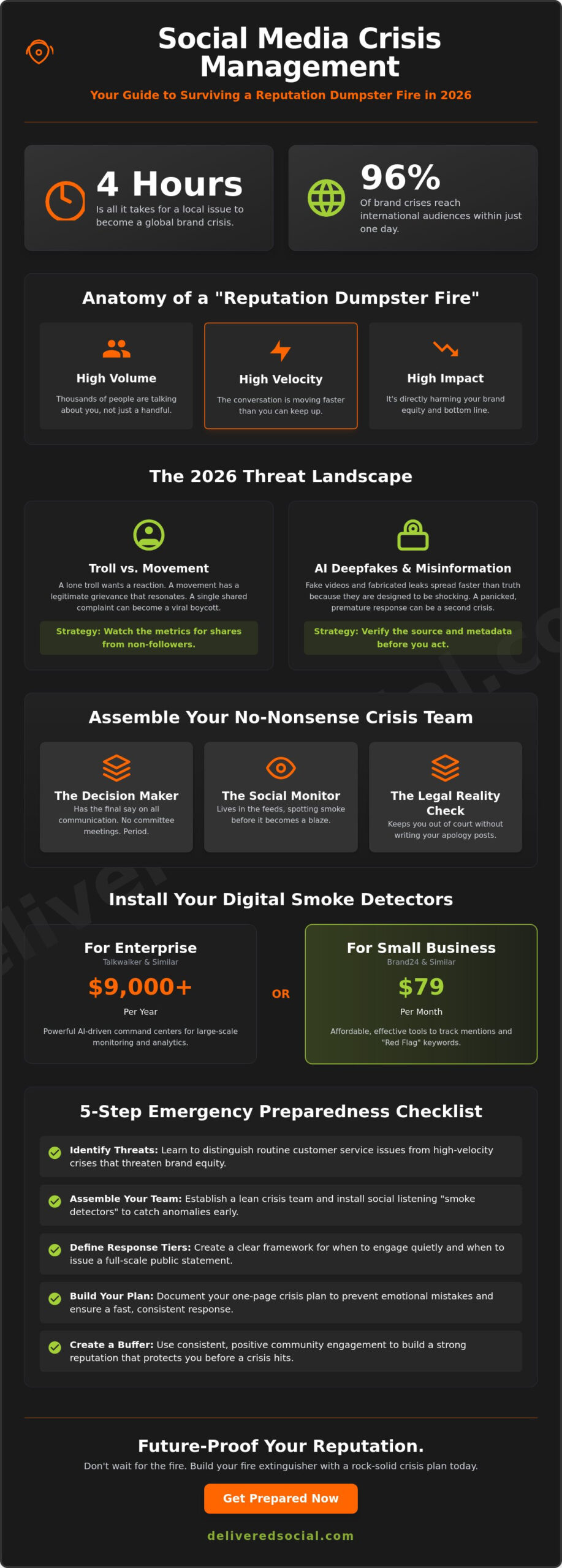
Your brand’s reputation isn’t built in the boardroom. It’s held hostage by anyone with a smartphone and a grudge. In 2026, it takes exactly four hours for a localized mess to become a global catastrophe. If you don’t have a rock-solid social media crisis management plan, you’re basically standing in a field of dry grass during a lightning storm with a kick me sign on your back. It’s a high-stakes environment where 96 percent of brand crises reach international audiences within a single day.
We get it. The fear of viral cancel culture is enough to keep any marketing manager up at night. You’re likely drowning in confusion over what needs a response versus what’s just a lonely troll. Throw in the new threat of AI deepfakes and a slow internal approval process, and it’s easy to feel paralyzed. It’s time to stop flinching and start preparing.
This guide is your fire extinguisher. You’ll learn how to build a response framework that actually works when the internet decides to set your brand on fire. We’re cutting through the corporate fluff to give you a ready-to-use system for handling trolls, spotting AI misinformation, and staying compliant with new 2026 data privacy laws. Let’s get to work.
Key Takeaways
- Learn to spot a real “Reputation Dumpster Fire” by separating routine customer gripes from the high-velocity threats that actually kill brand equity.
- Assemble a no-nonsense crisis dream team and install digital smoke detectors to catch anomalies before they spiral out of control.
- Master a tiered response framework so you know exactly when to provide a quiet “cool down” and when to trigger a full-scale public statement.
- Follow our five-step emergency checklist to build a social media crisis management plan that prevents emotional mistakes when the pressure is on.
- Discover how consistent, positive community engagement creates a reputation buffer that protects your brand long before the next crisis hits.
What Actually Counts as a Social Media Crisis in 2026?
One person complaining that their package arrived late isn’t a crisis. It’s just Tuesday. A real social media crisis is what we call a “Reputation Dumpster Fire.” This happens when negative sentiment hits three specific markers at once: high volume, high velocity, and high impact. If thousands of people are talking about you, the conversation is moving faster than you can read, and it’s actually hurting your bottom line, you’re in trouble. It isn’t just a bad day. It’s a threat to your brand’s future.
The old strategy of “ignore it and it goes away” died a messy death years ago. In 2026, silence is seen as guilt or indifference. Algorithms are built to reward engagement, and nothing drives engagement like outrage. Research shows it takes approximately four hours for a brand crisis to spread globally. If you stay silent, the algorithm fills the void with more anger. A tiny spark becomes a global blaze before you’ve even finished your morning coffee. This is why a proactive crisis management strategy is non-negotiable. If you wait for a committee to meet, you’ve already lost the war.
The Grumpy Customer vs. The Brand Crisis
You must learn to distinguish between a “lone wolf” troll and a genuine movement. Trolls want a reaction. They want to see you squirm. A movement is different. It’s fueled by a legitimate grievance that resonates with your broader audience. Watch the metrics. If a single bad review starts getting hundreds of shares from people who don’t even follow you, the thread is shifting. Your social media crisis management plan needs to help you spot these shifts early. How you handle one grumpy customer often determines if they become the face of a viral boycott.
The 2026 Threat: Deepfakes and AI Misinformation
The game changed with AI. Now, anyone can create a fake video of your CEO saying something offensive or a fabricated “leak” showing a product failing. Misinformation moves faster than the truth because it’s designed to be shocking. In fact, 96 percent of brand crises reach international audiences within 24 hours. Your social media crisis management plan must include a mandatory verification step. Do not issue a panicked apology for something that might not have actually happened. Verify the source. Check the metadata. Then, and only then, you act. Speed is vital, but being fast and wrong is a second crisis you don’t need.
Building Your Social Media Crisis Management Plan (Without the Jargon)
Forget the 50-page corporate manuals. You need a document that people actually read when their heart rate is 120 bpm. A real social media crisis management plan fits on one page. It’s about who does what, which tools are watching the door, and how you talk without sounding like a soulless bot. If your plan requires six committee meetings to approve a single post, you’ve already lost. Speed is the only currency that matters when the internet is trying to cancel you. You need to be fast, but you also need to be human.
Internal communication is where most brands fail. Your staff are your biggest asset, but they’re also your biggest liability during a fire. One well-meaning employee defending you on their personal account can turn a PR hiccup into a legal nightmare. Give them a clear rule: stay silent until the official word is out. This keeps the message consistent and prevents accidental fuel from being tossed on the flames.
Identifying Your Crisis Response Team
You need a tiny room, not a stadium. The “Decision Maker” must have the final say on everything. Period. There’s no time to call the CEO’s vacation home. Next, you need a “Social Monitor” who lives in the feeds and spots the smoke before it’s a blaze. Finally, bring in a “Legal Reality Check.” Their job is to keep you out of court, not to write your captions. If your lawyer writes your apology, it will sound like a terms of service update. Nobody likes those. Keep the team lean and the ego at the door.
Social Listening: Your Digital Smoke Detector
You don’t need a $9,000 “command center” to stay safe. While Talkwalker starts at over $9,000 a year, smaller businesses can use tools like Brand24 for $79 per month. These tools alert you when your brand name or “Red Flag” keywords start trending. In 2026, these tools use AI to summarize mentions so you don’t have to read 5,000 angry comments yourself. Set up alerts for your competitors too. Watching their dumpster fires is the best way to avoid your own. If you’re feeling overwhelmed, a bit of professional social media management can act as your early warning system.
Don’t ignore the AI threat in your social media crisis management plan. Deepfakes are cheap and easy to make now. If a video surfaces of your leadership saying something insane, don’t just react. Use your verification step to check if it’s real before your “Decision Maker” pulls the trigger. Being the first to respond is good, but being the first to respond to a fake video with a real apology is a disaster you can’t undo.
Response Tiers: Knowing When to Shut Up and When to Speak Out
Not every spark needs a fire brigade. If you treat every negative comment like a national emergency, you’ll burn out your team before lunch. Your social media crisis management plan must have clear tiers. It’s about matching the response to the heat. If you overreact, you look desperate. If you underreact, you look guilty. Finding the balance is what keeps your reputation intact when the internet starts getting loud.
The golden rule for every tier is simple: never argue with a screen-shotted receipt. If someone has proof you messed up, own it immediately. Trying to “clarify” your way out of a documented mistake makes you look like a liar. A sincere apology and a clear plan to fix it will always do more for your brand than a clever comeback. People can forgive a mistake, but they rarely forgive a cover-up.
Tier 1: Handling the Daily Grumble
Tier 1 is the “Cool Down” phase. This is for the daily grumbles. Maybe a customer is annoyed about a shipping delay or a minor website glitch. Your goal here is containment. Take the conversation to the DMs as fast as possible. Public arguments are spectator sports, and you don’t want to be the main attraction. Use “human” templates. These are pre-written starting points that allow your team to sound like people, not soulless corporate scripts. A little humor can defuse a minor gripe, but use it with extreme caution. If someone is genuinely losing money or time because of you, a joke is just gasoline.
Tier 3: Managing a Full Reputation Crisis
Tier 3 is the “Total Meltdown.” This is the high-velocity, high-impact disaster we defined earlier. We’re talking data breaches, legal action, or major ethical failures. At this stage, your CEO needs to be visible. You need 24/7 monitoring and a “One Source of Truth” landing page. Direct everyone there for updates so you don’t have to manage fifty different threads at once. Most importantly, pause all scheduled posts immediately. There is nothing more tone-deaf than a “Happy Monday” tweet appearing while your brand is being dragged through the mud. If you find yourself in a Tier 3 situation, getting help from a professional social media management company can be the difference between a recovery and a permanent exit.
Between these extremes sits Tier 2, the “Active Fire.” This is when the volume picks up and you see multiple people sharing the same complaint. You need a public statement now. A dedicated thread on the platform where the fire started is usually the best move. It shows you’re present, you’re listening, and you aren’t hiding in a boardroom. Your social media crisis management plan should empower your team to move from Tier 1 to Tier 2 without waiting for a three-day approval cycle.
The Emergency Response Checklist: 5 Steps to Take Right Now
When your notifications start exploding with hate, your brain enters fight-or-flight mode. That’s the worst possible time to make a decision. You need an emergency checklist in your social media crisis management plan that overrides your panic. It’s about taking control of the narrative before the narrative takes control of you. Follow these five steps to stop the bleeding and start the recovery.
- Step 1: Stop and Breathe. Never reply in anger. A single defensive tweet is like throwing a match into a gas tank. Walk away from the keyboard for five minutes.
- Step 2: Screenshot everything. If things get legal or if people start deleting their own baiting comments, you need the receipts. Evidence is your best friend when the facts start getting blurry.
- Step 3: Internal Lockdown. Tell the whole team to stay off social media. One rogue employee “defending the brand” on their personal account can double the damage in seconds.
- Step 4: The “Acknowledge and Move” post. You don’t need the full solution yet. You just need to show the world you’re awake and listening.
- Step 5: Fix it in public. Don’t just talk about the solution. Show the work. Transparency is the only way to rebuild the trust you just lost.
The First 60 Minutes: Your Critical Window
The Golden Hour is the critical sixty-minute window where your response determines if the fire stays in the bin or spreads to the curtains. Silence for an hour feels like a century to an angry mob. In fact, research shows that 96 percent of brand crises reach international audiences within 24 hours. A simple “We are aware of the issue and are looking into it” stops the “Are they even there?” comments. Gather your facts by talking directly to the people involved. Don’t get bogged down in internal meetings with people who don’t understand how fast the internet moves.
Drafting the Perfect Apology (That Doesn’t Suck)
A real apology has three parts: Remorse, Responsibility, and Remedy. Most brands fail because they use “weasel words” that shift the blame. Ban words like “Actually,” “Mistakes were made,” or “We’re sorry if you felt.” Those are non-apologies that only make people angrier. A video apology from a real person often beats a corporate text graphic. It’s much harder for a crowd to stay angry at a human being who looks genuinely gutted and is taking full ownership of the mess. If you’re currently staring at a screen of angry mentions, we can help you build a social media management strategy that keeps your brand’s cool under pressure.
Future-Proofing Your Reputation with Delivered Social
Building a social media crisis management plan is only half the battle. The other half is making sure you never actually have to use it. Think of outsourcing your social media management as a giant insurance policy for your reputation. We don’t just sit around waiting for things to break. We build “Reputation Buffers.” This is the bank of goodwill you earn from your followers by being consistently helpful, present, and human. When you have a buffer, your community actually defends you. They become your front-line advocates, which is often the difference between a brand that survives a scandal and one that disappears.
At Delivered Social, we do things differently. We hate the corporate ego that makes most agencies impossible to talk to. We prioritize results over fancy titles and jargon. Our proactive audit process identifies the cracks in your digital presence before a troll finds them. We look at everything from your response times to your security settings. It’s about being ready for the 2026 landscape where a single AI deepfake can travel the world in four hours. We provide the expertise without the unnecessary complexity.
Proactive Management vs. Reactive Panic
Panic is expensive. Proactive management is an investment. Our SEO services don’t just help you get found; they help you control what people see when they search for your name. If an old, unfair news story is lingering on page one, we work to bury it under a mountain of fresh, positive content. As a creative agency, we help you find a brand voice that resonates. When people feel like they know the humans behind the logo, they’re far less likely to join a digital mob. We focus on building a community that trusts you long before a crisis hits.
Let’s Chat (Before You Need To)
You shouldn’t wait until your brand is on fire to find a fire extinguisher. We offer low-pressure, no-BS consultations to look at your current social setup. We’ll tell you honestly where you’re vulnerable and where you’re winning. We handle the “boring” stuff like 24/7 monitoring and keyword alerts so you can actually run your business. We believe in being helpful mentors, not gatekeeping experts. Don’t leave your reputation to chance. Your social media crisis management plan is only as strong as the people executing it. Get a social media strategy that doesn’t suck today.
Stop Waiting for the Fire to Start
You now have the tools to tell a grumpy customer from a genuine reputation dumpster fire. You’ve got a tiered response system and a five-step checklist for those critical first sixty minutes. A solid social media crisis management plan isn’t about being perfect. It’s about being prepared enough to stay human when everyone else is losing their cool. Don’t let your brand’s future depend on luck or a slow internal committee. The internet moves too fast for hesitation.
Delivered Social has been cutting through the noise as an independent digital agency since 2016. We provide full-service support, from SEO to Video Production, all delivered with our signature jargon-free approach. We handle the monitoring and the heavy lifting so you can get back to running your business without looking over your shoulder. If you’re ready to move from reactive panic to proactive growth, let’s have a chat. Get a Social Media Strategy That Doesn’t Suck and start building your reputation buffer today. You’ve got this.
Frequently Asked Questions
What is the first thing I should do in a social media crisis?
Stop and breathe before you touch the keyboard. Your first move is to pause all scheduled posts so you don’t look tone-deaf while the world is shouting at you. Once the feed is quiet, screenshot the evidence and notify your designated decision-maker to trigger your response framework. Don’t reply in a state of panic.
Should I delete negative comments during a brand crisis?
Never delete comments unless they are clearly spam, hate speech, or contain illegal threats. Scrubbing your feed looks like a guilty cover-up and usually triggers a second wave of outrage from people who have already taken screenshots. Leave the criticism visible, acknowledge the issue publicly, and then try to move specific grievances into private messages.
How long does it take to recover from a social media reputation hit?
The initial fire usually burns out within a week, but rebuilding real trust can take months of consistent, positive action. You have to prove that you’ve actually fixed the problem rather than just apologizing for the bad optics. Recovery is a marathon of being helpful and transparent until your reputation buffer is restored.
Can AI help manage a social media crisis in 2026?
AI is a brilliant smoke detector for spotting sentiment shifts before they become full-blown disasters. Modern tools use AI to summarize thousands of mentions into clear, actionable themes so you aren’t stuck reading every single angry tweet. It helps you find the signal in the noise, but you should never let a bot write your actual apology.
How often should we update our social media crisis management plan?
Review your social media crisis management plan every six months at a minimum. The digital landscape moves too fast for an annual check-up. New threats like sophisticated deepfakes or changes in platform algorithms mean your 2024 strategy is likely obsolete in 2026. Keep your contact lists fresh and your tools updated to stay ahead of the curve.
What is the difference between a PR crisis and a social media crisis?
A PR crisis is a slow-burn event involving traditional media, while a social media crisis is a high-velocity explosion that happens in real-time. Social crises are spectator sports where anyone with a phone can join the conversation. If you don’t contain a social media mess within the first few hours, it almost always evolves into a traditional PR disaster.
Do small businesses really need a formal crisis plan?
Yes, because the internet doesn’t care about your company size. A single viral video from an unhappy customer can ruin a local reputation just as fast as a global one. You don’t need a fifty-page manual, but you do need a social media crisis management plan that defines who has the final say and what your first public post will look like.
How do I tell my employees not to post about an ongoing company issue?
Be blunt and tell them exactly why their silence matters. Explain that rogue posts, even well-meaning ones, can cause legal headaches and give the mob more fuel to work with. Give them a clear script or a single link to your official statement so they know how to handle questions from friends without making the situation worse.
Share This Article
About the Author: Jonathan Bird































