




In This Article
How many “likes” does it take to pay your office rent? If you can’t answer that, you aren’t alone. Most business owners feel like they’re throwing money into a digital black hole. Management thinks you’re just playing on Facebook all day. If all you’re showing them is a rising follower count while the bank account stays flat, they have every right to be skeptical.
We get it. Tracking a customer from a single post to a final sale feels nearly impossible, especially with the 2026 privacy laws in states like Kentucky and Rhode Island making data sharing more restricted. You’re tired of wasting budget on content that gets plenty of hearts but zero leads. Our promise is simple: we’ll show you how to stop chasing vanity metrics and start measuring real financial impact. This guide to proving social media marketing roi provides a no-nonsense framework for the modern landscape. We’ll dive into the essential shift toward server-side tracking and show you how to build a narrative that connects social activity directly to business growth.
Key Takeaways
- Stop obsessing over follower counts that don’t pay the bills. Prioritize the metrics that actually drive revenue.
- Use our straight-talking formula for proving social media marketing roi. No more guessing about your budget.
- Decode the attribution nightmare. Find out where your invisible leads are hiding in the world of Dark Social.
- Simplify your reporting. Ditch the 50-page slide decks for three high-impact numbers your boss actually wants to see.
- Understand why software alone can’t save your strategy. See how a human perspective turns content into a growth engine.
Why ‘Vanity Metrics’ Are Killing Your Social Media Strategy
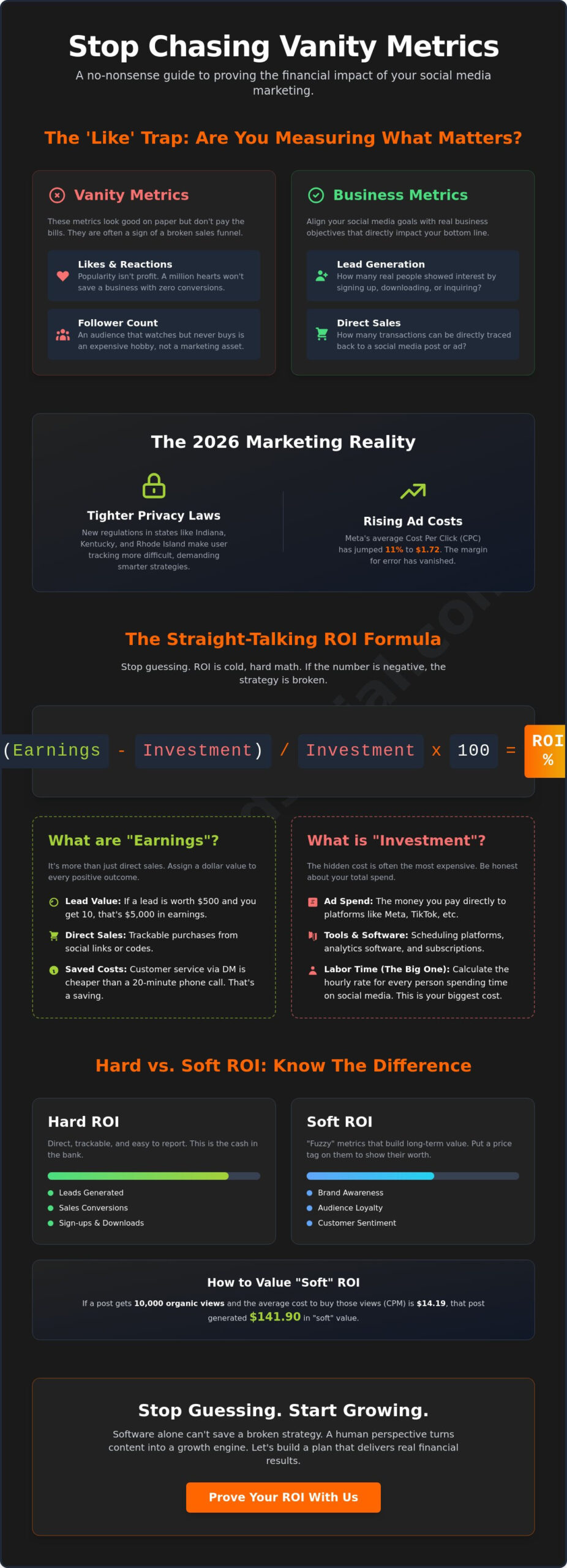
Stop patting yourself on the back for a post that got 500 likes but zero clicks. Popularity is great for high school, but it’s a total disaster for your profit and loss statement. If your strategy is built on “feeling popular,” you’re essentially gambling with your marketing budget. A million followers won’t save a business that has zero conversions. It’s just expensive noise. You’re paying for an audience that watches you perform but never pulls out a credit card. That isn’t marketing. It’s just a very expensive hobby.
Let’s talk about the 2026 reality. Proving social media marketing roi is getting harder by the day. As of January 2026, new privacy laws in states like Indiana, Kentucky, and Rhode Island have tightened the screws on how we track users. Combine that with the fact that the average cost per click on Meta has jumped 11% this year to $1.72, and the margin for error has vanished. You can’t afford to be sloppy anymore. Platforms are making it harder to rely on surface-level data, which means you have to look deeper to see if your investment is actually working.
Social media ROI isn’t a mystery. It’s the net profit generated from your social efforts divided by the total cost of those efforts. It’s cold, hard math that ignores how many people “loved” your latest Reel. If the math doesn’t check out, the strategy is broken. Period.
The ‘Like’ Trap: Why Engagement Isn’t ROI
High engagement is often a mask. It looks healthy, but it frequently hides a completely broken sales funnel. You’re chasing the dopamine hit of a viral video while your lead forms gather dust. This creates a psychological toll where you feel busy but your bank account stays flat. Chasing viral content over valuable content is a recipe for burnout. Social media ROI is a business-first metric that measures money in versus money out, not hearts on a screen.
Setting Goals That Actually Move the Needle
It’s time to move from “we want to be seen” to “we want to be bought.” You need to align your social targets with your actual business objectives. This starts with understanding how businesses use social media to move beyond just posting and start monitoring what actually converts. Use SMART goals to keep yourself honest. If a goal isn’t specific and measurable, it’s just a wish. To succeed in 2026, your plan should focus on:
- Lead Generation: How many real people signed up for your offer?
- Direct Sales: How many transactions happened because of a post?
- Customer Retention: Did social media help you keep the clients you already have?
Stop guessing. If you can’t tie a social action to a dollar value, you aren’t proving social media marketing roi. You’re just making noise in a very crowded room.
The Straight-Talking Guide to Calculating Social Media ROI
Let’s stop the hand-waving and get into the math. Proving social media marketing roi isn’t a dark art. It’s a calculation. The basic formula is simple: (Earnings from Social – Total Investment) / Total Investment x 100. If that number is positive, you’re winning. If it’s negative, we need to talk. Most people fail here because they don’t know what to count as “earnings” or “investment.”
Your earnings aren’t just direct sales from a “Buy Now” button. You have to look at lead value. If one lead is worth $500 to your business and social media generated ten of them, that’s $5,000 in the “Earnings” column. Don’t forget saved customer service costs either. If a customer gets their answer via a quick DM instead of a 20-minute phone call, you just saved money on payroll. That counts. Using a solid framework for measuring ROI helps you capture these hidden wins.
Now, the “Investment” side. This is where it gets uncomfortable. Most business owners count their ad spend and their tool subscriptions. They completely ignore labor time. Your time is the most expensive part of your social media budget. If you or an employee spends five hours a week making Reels, you have to calculate that hourly rate. If the math makes your head spin, our team at Delivered Social can help you streamline the whole process.
Hard ROI vs. Soft ROI: Knowing the Difference
Hard ROI is easy. It’s the trackable lead or the direct sale. Soft ROI is the “fuzzy” stuff like brand sentiment, loyalty, and share of voice. To report this to a boss, you have to put a price tag on it. How? Look at what you’d pay for that same reach through paid ads. If a post gets 10,000 organic views, and the average CPM is $14.19, that post just gave you $141.90 in “soft” value. It’s not cash in the bank, but it’s value created.
Tracking the Right KPIs for Your Funnel
Different stages of the funnel need different yardsticks. You can’t measure a brand awareness post by how many people bought a product ten seconds later. It doesn’t work like that. Follow this breakdown:
- Top of Funnel: Reach and Brand Awareness. This is the discovery phase where people find out you exist.
- Middle of Funnel: Traffic and Lead Magnets. This is the consideration phase where they start to trust you.
- Bottom of Funnel: Conversions and Sales. This is the decision phase where the money happens.
If you’re only measuring the bottom, you’ll miss the brand building happening at the top. If you’re only measuring the top, you’ll go broke. Balance is everything.
The Attribution Nightmare: Why You Can’t Track Every Penny
If you think you can track every single penny back to a specific post, you’re dreaming. It’s impossible. Welcome to the era of Dark Social. This is where your best leads actually live. They’re sharing your links in WhatsApp groups, Slack channels, and private DMs. Your analytics software can’t see inside those rooms. To your dashboard, those high-value leads just look like “Direct” traffic. It’s a total ghost in the machine that makes proving social media marketing roi a massive headache.
The 2026 privacy landscape has only made this harder. With the new state laws we mentioned earlier and mandatory universal opt-out signals like Global Privacy Control, your tracking pixels are basically working with one eye closed. You can’t just rely on a piece of code to tell you the whole story anymore. The “messy middle” of the customer journey is real. A customer might see your Reel on their phone during lunch, forget about it, see a retargeting ad on their laptop two days later, and then finally search your brand on Google to buy. Who gets the credit? In most systems, Google steals the trophy, even though social media did the heavy lifting.
The Problem with Last-Click Attribution
Last-click attribution is a lie. It’s like giving the trophy to the person who crossed the finish line while ignoring the teammates who ran the first 20 miles. If you cut your social budget because Google is showing more “last clicks,” your sales will eventually crater. You’re starving the top of your funnel. You have to understand that attribution is a map to guide your decisions, not a mirror that reflects the absolute truth. It shows you the general direction, not every single pebble on the path.
Better Ways to Track the Untrackable
You have to get creative and stop relying 100% on a single dashboard. Start using “How did you hear about us?” surveys at checkout. It’s low-tech, but it works. People will tell you “I saw you on Instagram” even when your pixel missed it entirely. Use unique promo codes for specific campaigns. If a code like “REEL20” gets used, you know exactly where that money came from without needing a single tracking cookie.
For those who want to get serious about their measurement framework, the American Marketing Association course on social media strategy is an excellent resource for building a tracking plan that doesn’t rely on luck. Proving social media marketing roi requires a mix of hard data and common sense. Use UTM parameters to keep your links organized, but don’t lose your mind when the numbers don’t perfectly align. Trust the process and the profit will follow.
Turning Data into Decisions: How to Report Results That Matter
Stop sending those 50-page PDF reports. Seriously. Nobody reads them. They end up in the digital equivalent of a dusty basement. Your boss or your client doesn’t care about your “reach” or how many people liked a picture of your office dog. They care about three things: How much did we spend? How much did we make? And what are we doing next? If you can’t answer those on one page, you’re failing at proving social media marketing roi. You need to strip away the fluff and focus on the numbers that actually keep the lights on.
Connecting social activity to business growth requires a mindset shift. You aren’t a content creator. You’re a growth driver. When you report a “bad” month, don’t hide. Be blunt. If a campaign flopped, explain why. Maybe the cost per click on Meta hit that $1.72 average and killed your margins. Maybe your creative didn’t land. Transparency builds trust. A pivot is always better than a cover-up. Use the data to decide where the money goes next, rather than just justifying where it already went.
The Boss-Proof Report Template
Keep it simple. Your report should follow a logical, three-step flow that respects your audience’s time. Start with the money and work backward. If you need help building this out, a solid social media management strategy can do the heavy lifting for you.
- Step 1: Highlight the Wins. Lead with revenue and leads. If you hit that strong 5:1 return on investment benchmark, scream it from the rooftops.
- Step 2: Explain the Work. What did you test? For example, in 2026, we know AI-generated creative is outperforming human-designed ads by 18% on click-through rates. If you tested this, show the result.
- Step 3: Define the Next Steps. How will you improve ROI next month? Don’t just say “post more.” Say “we are shifting 20% of the budget to Reels because the CPC is $0.44 lower than the feed.”
Speaking the Language of Business, Not Marketing
If you want to be taken seriously, stop using marketing jargon. It sounds like you’re trying to hide something. You need to translate your metrics into terms a CEO understands. Instead of talking about “impressions,” talk about “brand reach and market share.” Instead of “engagement,” talk about “customer sentiment and retention.” This shows you understand the big picture. As a modern Social media management company, we’ve seen that this shift in language is the fastest way to get your budget approved every single time. Speak their language, and they’ll give you the resources to grow.
Stop Guessing and Start Growing: Why a Partner Beats a Platform
Dashboards are tools. They aren’t solutions. You can spend thousands on a shiny tracking platform, but it still won’t tell you why your customers are bouncing at the checkout. Software gives you data. A partner gives you a plan. In 2026, global social ad spending is projected to hit $317.33 billion. That is a lot of money to set on fire if you’re just guessing. Proving social media marketing roi takes more than a login; it takes a human who understands the “why” behind the “what.”
An outside perspective is often the only way to see the leaks in your bucket. When you’re buried in the day-to-day of your business, you get attached to content that doesn’t work. You might love that weekly “Behind the Scenes” vlog, but if the data shows it has a 0% conversion rate, it needs to go. We don’t have that emotional attachment. We look at your spend with cold, hard logic. We’re here to make sure every pound you spend is working toward that 5:1 return on investment benchmark for paid campaigns. If it isn’t, we pivot. Fast.
Moving from “doing social” to “driving growth” requires a complete shift in how you view your budget. It’s not a cost to be managed. It’s an engine to be tuned. We strip away the corporate ego and the fancy terminology to focus on what actually moves the needle for your specific audience. No fluff. No excuses. Just growth.
The Delivered Social Approach to ROI
We don’t do 50-page slide decks. We do results. Our strategy sessions are blunt because your time is valuable. We focus on your profit, not our ego. If we think a platform is a waste of your money, we’ll tell you. If we see a gap in your funnel, we’ll fix it. As a Digital marketing agency surrey businesses rely on, we pride ourselves on transparent reporting. You’ll always know exactly where your money is going and, more importantly, what it’s bringing back. We handle the technical mess of server-side tracking and attribution so you can focus on running your business.
Ready to See Real Results?
Now is the time to audit your social media spend. Don’t wait until the end of the year to realize you’ve been wasting budget on “likes” that never turned into leads. The first step to a data-driven strategy is admitting that your current tracking might be lying to you. Let’s look at the numbers together and build a framework that actually proves its worth. Stop chasing vanity and start building a revenue engine. When you’re ready to get serious, book a chat with our straight-talking team. No pressure. No jargon. Just a conversation about how to grow your business.
Ready to Turn Your Likes Into Leads?
Stop playing the guessing game. Social media in 2026 is too expensive and too complex for “vibes” to be your strategy. You’ve seen the math. You know that vanity metrics are a trap. You understand that your time is a real cost that needs to be tracked. Proving social media marketing roi isn’t about finding a perfect tracking pixel that doesn’t exist. It’s about building a human-centric strategy that connects your posts directly to your profit.
We’ve been helping businesses grow since 2016. As an independent agency with expertise across Social, SEO, and Web, we don’t hide behind jargon or 50-page reports. We just deliver results. Our no-nonsense approach to digital growth is designed to cut through the noise and protect your resources. If you’re tired of wondering if your budget is actually working, it’s time for a change. Get a no-BS audit of your social media strategy and let’s see what’s actually happening under the hood. You’ve got the framework. Now, let’s go get those results.
Frequently Asked Questions
Is social media ROI only about direct sales?
No, it is about the total value generated for your business. You have to factor in lead value and the money you save on customer service. If a quick DM saves a 20-minute phone call, that is profit. Proving social media marketing roi means looking at the total business impact, including customer retention and brand equity, not just the direct sales from a single post.
How long does it take to see a positive ROI from social media?
Expect to wait three to six months for organic efforts to start paying off. Paid campaigns move much faster, often showing a measurable return in just a few weeks once the platform algorithm learns your audience. Patience is a requirement, not a suggestion. If you want instant results without the legwork, you are in the wrong game.
Which social media platform has the highest ROI in 2026?
Meta remains the king of ROI for the majority of industries in 2026. With over 3 billion monthly active users on Facebook alone, it offers the best scale for your budget. However, Instagram Reels is currently a massive sweet spot. It offers an average CPC of $1.28, which is significantly lower than the $1.72 average for the standard Facebook feed.
Can you measure ROI for organic social media, or only paid ads?
You can absolutely measure organic ROI. It just takes more discipline with your tracking links and unique promo codes. Do not let the “it is free” mindset fool you into being lazy with your data. If you aren’t tracking organic leads through surveys or UTM parameters, you are missing half the story of your brand’s growth.
What are the most important KPIs for proving social media value?
Focus on Conversion Rate and Cost Per Acquisition (CPA). These tell you if your content actually works. While 68% of marketing leaders still look at engagement, likes do not pay the bills. Stick to the metrics that link directly to your bank balance, such as lead quality and the total revenue generated from social touchpoints.
Why is my social media ROI lower than my PPC ROI?
PPC hits people who are already looking to buy, while social media often reaches them before they know they need you. They play different roles in your funnel. Proving social media marketing roi requires acknowledging that social feeds the top of the funnel and builds the demand that PPC eventually converts at the bottom.
How do I calculate the cost of employee time in my ROI formula?
Take the total hours your team spends on social tasks and multiply it by their hourly cost, including overhead. Do not guess this number. If your marketing manager spends 10 hours a week on Reels, that is a quarter of their salary you must account for in your investment column. Labor is usually your biggest hidden expense.
What should I do if my social media ROI is negative?
Stop what you are doing and audit your creative and your landing pages. Usually, a negative ROI means your content is boring or your website is too hard to use. In 2026, AI-driven creative is seeing an 18% higher click-through rate than human-only designs. Consider testing new tools and refreshing your strategy before you scrap the channel entirely.
Share This Article
About the Author: Jonathan Bird































