

In This Article
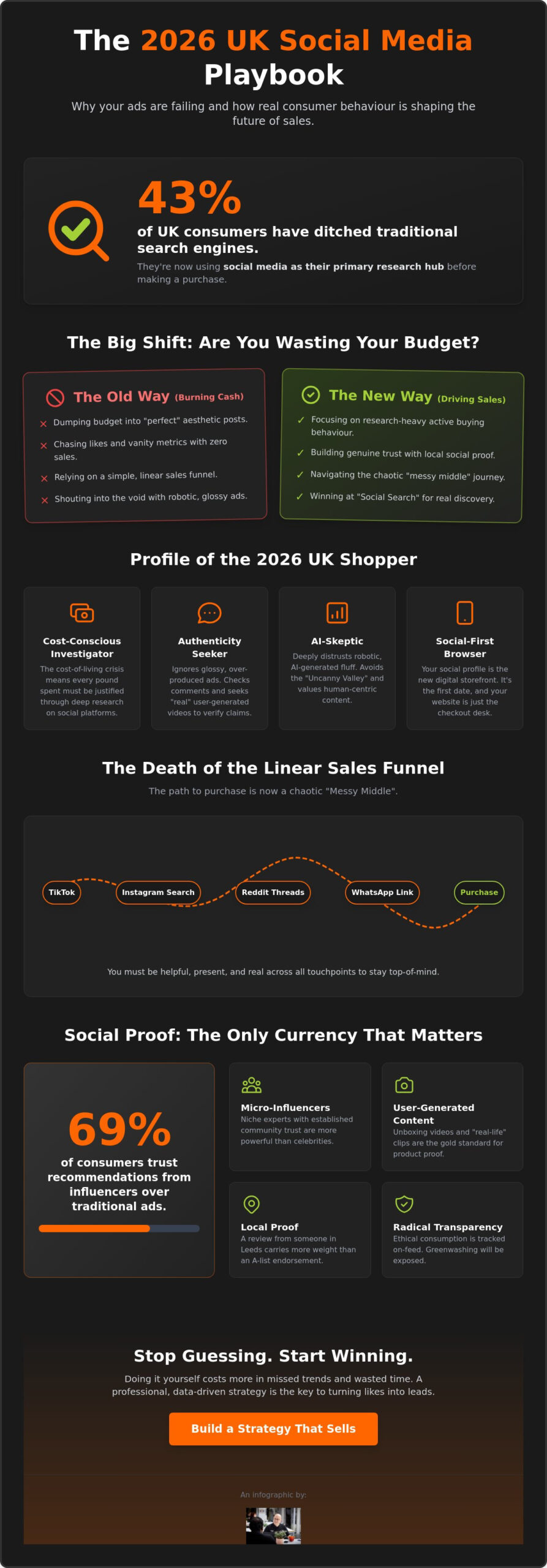
43% of UK consumers have ditched traditional search engines for social media. If you’re still dumping your entire marketing budget into “perfect” aesthetic posts that get likes but zero sales, you’re essentially setting your cash on fire. Understanding how social media affects consumer behaviour uk isn’t optional anymore; it’s the difference between a thriving brand and a dead one. You see the engagement spikes, but your bank account stays flat. You’re tired of chasing algorithm ghosts and wondering why your ads feel like a shout into a void.
It’s about survival in a market where Meta just slapped a 2% location fee on your ads and the government is prepping to ban under-16s from the scroll. You need a strategy that respects the 2026 shopper’s intelligence and their deep distrust of robotic, AI-generated fluff. We promise to show you exactly how UK consumers really make buying decisions so you can stop wasting your budget on filler content that nobody wants.
We’re going to dive into the shift toward private messaging, the rise of social search, and the simple steps to building brand trust that actually drives sales. No jargon. No ego. Just the facts you need to win.
Key Takeaways
- Stop wasting cash on fluff. See why UK shoppers have swapped passive scrolling for research-heavy active buying.
- Understand how social media affects consumer behaviour uk by using local social proof that actually builds trust.
- Kill the robots. Learn why UK consumers are dodging AI-generated ads and how to stay on the right side of the “Uncanny Valley”.
- Optimise for discovery. Stop relying on dead hashtags and start winning at “Social Search” to drive real sales.
- Stop the burnout. Find out why doing it yourself costs more in missed trends and wasted time than hiring an expert.
The State of the UK Scroller in 2026: Trends You Can’t Ignore
The UK scroller in 2026 isn’t the bored zombie of five years ago. They’ve evolved. We’ve moved past passive scrolling and straight into active social shopping. People aren’t just stumbling upon products; they’re using TikTok and Instagram as their primary research hubs. Why? Because the cost-of-living crisis turned everyone into a high-level investigator. Every pound spent needs to be justified. If you’re wondering how social media affects consumer behaviour uk, look at your own habits. You check the comments. You look for “real” videos. You ignore the glossy, over-produced ads that feel like they’re lying to you. You want the truth, and you want it fast.
The Online Safety Act has also changed the game. It’s forced platforms to be cleaner and more transparent, which actually makes users trust what they see a bit more. But that trust is fragile. Your digital storefront, your social profile, is now more important than your actual website. It’s where the first date happens. If your profile looks like a ghost town or a corporate brochure, they’re gone. Your website is just the checkout desk; social media is the entire shopping experience from discovery to decision.
The Death of the Traditional Sales Funnel
Forget the old funnel. The idea that someone sees an ad, clicks, and buys is a fairytale. In the UK market, the path to purchase is a chaotic “messy middle”. A user might see your video on TikTok, search for you on Instagram, read three Reddit threads, and then maybe buy through a WhatsApp link. When consumers are tightening their belts, they spend more time in this research phase. You need to stay top-of-mind without being annoying. Be helpful. Be present. Be real. Understanding how social media affects consumer behaviour uk means accepting that these non-linear, high-touch interactions are the new normal.
Transparency as a Transactional Requirement
In 2026, transparency isn’t a “nice to have”. It’s a requirement for the transaction to even happen. UK users are deeply aware of the link between social media and consumerism and how it impacts their local community. They want to know who made your product and where it came from. They’re tracking ethical consumption directly on their feeds using platform-integrated tools. If you try to fake it with “greenwashing”, you’re finished. One eagle-eyed user will call you out, and the algorithm will carry that takedown further than your best ad ever could. Authenticity is your only shield in a cynical market.
Psychology 101: Why Your UK Customers Actually Click
UK consumers aren’t stupid. They can spot a sales pitch from a mile away. If you want to understand how social media affects consumer behaviour uk, you have to look at the “why” behind the tap. It isn’t about flashy graphics anymore. It’s about psychology. Specifically, it’s about shifting from the loud, annoying FOMO (Fear of Missing Out) to the 2026 reality of JOMO (Joy of Missing Out). People are choosing to disconnect from the noise. They’re curating their feeds with intent. To get through, you need subtle nudges, not a digital megaphone. You need to be the brand that feels like a recommendation from a mate.
This is where micro-influencers win. They aren’t celebrities with millions of fake followers. They’re experts in tiny, niche communities. When they talk, people listen because the trust is already there. It’s local. It’s relatable. It’s exactly how how social media affects consumer behaviour uk in a way that actually moves the needle for your business. It’s about building a community of people who actually care about what you’re saying rather than just shouting into the void.
Social Proof: The Only Currency That Matters
Social proof is the backbone of the UK market. Forget the A-list celebrity endorsements. A review from someone in Leeds or a video from a mum in Surrey carries way more weight. 69% of consumers trust recommendations from influencers over traditional ads. This is because we want to see the product in the wild. We want user-generated content (UGC) that looks like it was filmed on a phone, not in a studio. Unboxing videos and “real-life use” clips are the gold standard. They prove the product works without the corporate gloss. If your content doesn’t look like it belongs in a friend’s feed, it’s getting scrolled past. Authenticity is the only way to bypass the “skip” button.
If you’re struggling to capture that authentic vibe, our social media management company can help you build a presence that feels human rather than robotic.
The “Friend Factor” in Business
UK shoppers buy from brands they feel they “know”. This is the “Friend Factor”. It’s about breaking the fourth wall. Show the behind-the-scenes chaos. Show the faces in your office. Talk like a person, not a press release. This shift is most obvious on LinkedIn and X. The stiff, corporate voice is dying. The human voice is winning. By influencing customer behaviour through rapport rather than cold transactions, you build a community that sticks around. You aren’t just a logo; you’re a local mentor and a helpful partner. That’s how you turn a one-time click into a long-term customer. It’s simple, effective, and completely jargon-free.
The Great AI Backlash: Why “Real” is the New “Viral”
The honeymoon is over. By June 2026, the UK public has hit peak AI fatigue. Research shows that while 74% of us have used AI in the last six months, a tiny 14% actually trust it to make decisions for us. This massive trust gap is fundamentally shifting how social media affects consumer behaviour uk. People are developing an “AI Radar”. They can smell a bot-generated caption or a Midjourney image from across the room. If your content feels like it was spat out by a prompt, you aren’t just losing likes. You’re losing your reputation. People want a pulse, not a pixel-perfect lie.
This is why raw, smartphone-shot video is currently kicking the teeth out of high-budget productions. A shaky hand and natural lighting feel honest. A £50k studio shoot feels like a curated deception. In a world of deepfakes and bot-filled comment sections, the messy truth is your biggest competitive advantage. If you can’t prove a human was involved in creating your content, you’re essentially invisible. It’s that simple.
Spotting the “Bot” and Losing the Lot
UK consumers are cynical by nature. Give them a generic AI influencer, and they’ll laugh you off the platform. They want the “Uncanny Valley” to stay far away from their feeds. Using AI for your core creative isn’t just lazy. It’s dangerous. Realness is the only marketing metric that guarantees long-term survival in 2026. If your audience suspects they’re being handled by an algorithm, they’ll bounce. Fast. They want to see the person behind the brand, not the machine.
Strategic AI vs. Creative AI
We aren’t saying bin the tech entirely. AI is fantastic for the heavy lifting. Use it for data sorting or identifying search trends. It’s brilliant for discovery and basic customer service inquiries. But the moment you let it touch your storytelling, you’ve lost the plot. AI can’t do emotional connection. It can’t do brand personality. 60% of 18-34-year-olds actively hunt for brands with a human element. You need a strategy that balances automation with human oversight. Here is the no-BS split for your business:
- Data: Let the bots crunch the numbers and find the patterns.
- Story: Let humans write the words and share the experiences.
- Production: Use AI to storyboard, but use a real person with a camera to film.
- Final Check: Never, ever post without a human eye verifying the “vibe” and authenticity.
This balance keeps you fast without making you a ghost in the machine. Your customers want to buy from people they can relate to. Give them what they want and stop hiding behind the prompts.
Turning Likes into Leads: A Practical UK Strategy
Likes are ego. Leads are rent. If you aren’t converting your followers into customers, you’re just running a very expensive hobby. In 2026, the gap between a “fan” and a “customer” is narrower than ever, but you have to know how to close it. This isn’t about tricking people. It’s about being useful. Here is how you stop the bleed and start the growth.
- Step 1: Audit your engagement. Are you talking at people or with them? 71% of UK users will switch brands if their social media inquiries go unanswered. If you’re just broadcasting sales pitches, you’re failing.
- Step 2: Move beyond the hashtag. We’re in the era of Social Search. People find you through keywords and intent, not just #trending topics.
- Step 3: Make it easy. The UK social commerce market is projected to reach over £24 billion in 2026. Use in-app checkouts and shoppable features. If they have to leave the app to buy, you’ve already lost half of them.
- Step 4: Leverage the community. 69% of consumers trust influencer recommendations. Use real people to tell your story.
- Step 5: Measure intent. Stop obsessing over likes. Look at saves, shares, and direct messages. Those are the signals that someone is actually ready to buy.
Social Search is the New Google
UK Gen Z and Millennials have officially ditched traditional search engines for TikTok and Instagram. They want video proof and real reviews before they part with their cash. This is a massive shift in how social media affects consumer behaviour uk. You need to treat your social bio like a landing page. Use keywords. Write captions that actually answer the questions your customers are asking. If you want to master the science of being found, check out our SEO services Surrey to see how search intent works in the 2026 landscape.
The Art of the “Soft Sell”
Nobody opens a social app because they want to be hit with a sales pitch. The “Buy Now” button is a privilege you have to earn by providing value first. Educational content is the ultimate lead magnet for UK service businesses. Show them how to solve a small problem for free. Use high-energy video production to tell a story that resonates. When you help people first, the sale becomes a natural next step rather than a forced transaction. It’s about building a relationship, not just a balance sheet.
Stop guessing what works and start seeing real results. Let’s chat about Social Media Management that actually drives your business forward.
Stop Guessing: Why Professional Social Management Wins
DIY social media is a trap. It feels free until you realize you’ve spent ten hours on a single video that only got a handful of likes from your relatives. That’s the hidden cost. It isn’t just about the time you lose; it’s about the burnout and the massive, expensive missed opportunities. Posting without a plan is just adding to the noise. You need a strategy that deeply understands how social media affects consumer behaviour uk so you can stop shouting and start selling. A professional social media management company doesn’t just “post content”. We spot the shifts before they peak. We were ready for the 2% Meta location fee long before it hit your ad bill. That’s the edge you need.
There is a massive difference between “posting” and “strategy”. Posting is what you do when you have a spare five minutes and a photo of your lunch. Strategy is what happens when you align your brand’s voice with the actual needs of the 2026 UK consumer. It’s about knowing when to be educational and when to go for the soft sell. We take the guesswork out of the equation so you can get back to actually running your business.
Data-Driven Decisions, Not Finger-in-the-Air Guesses
We don’t do “vibes”. We do data. We use advanced analytics to see exactly what is driving your sales and what is just wasting space. If a content pillar isn’t performing, we bin it. It’s that simple. We also know that platform-specific content is non-negotiable. What wins on LinkedIn will absolutely tank on TikTok because the audience intent is completely different. Understanding how social media affects consumer behaviour uk means knowing that a professional, blunt critique is better than a polite failure. We aren’t afraid to tell you if an idea sucks. We’d rather save your budget than protect your ego.
Your Social Media, Delivered
Managing your digital presence shouldn’t be a second job. We take the stress out of the grind. By integrating your social strategy with your web design, we create a seamless journey for your customers. No friction. No confusion. Just a clear path from a social scroll to a confirmed sale. We’re here to be your local mentor and your results-driven partner. Ready to cut the fluff and see what real management looks like? Let’s have a chat about your social media and get your brand moving in the right direction.
Time to Stop the Scroll and Start the Sale
The social landscape in 2026 is a battlefield of cynicism and short attention spans. You’ve seen the data. UK shoppers are ditching bots and over-produced ads for raw, human experiences. They’re using social platforms as search engines to find brands they can actually trust. Understanding how social media affects consumer behaviour uk isn’t just about knowing where to post. It’s about knowing how to be a real person in a digital world.
We’ve been at this since 2016. As an independent UK agency, we pride ourselves on results-driven, fluff-free strategy that actually moves the needle. No ego. No jargon. Just growth. Stop letting your ad budget leak into the void and start making every click count.
Get a free, No-BS social media audit for your UK business. It’s time to show the algorithm who’s boss and give your customers something worth buying. Let’s get to work.
Frequently Asked Questions
How exactly does social media change consumer behaviour in the UK?
Social media turns browsers into researchers. It’s no longer just a place for selfies; it’s a high-intent search engine. 43% of UK users now use social platforms for daily searches. This shift is a massive part of how social media affects consumer behaviour uk. You aren’t just selling a product. You’re providing the social proof and “real” content that people need before they justify spending their hard-earned cash.
Is social media marketing still effective for UK B2B businesses in 2026?
B2B marketing is still incredibly effective on LinkedIn and X, but the old corporate playbook is dead. Decision-makers are still people. They scroll after work and they hate being bored. If you use a human voice and share actual insights rather than press releases, you’ll win. It’s about building a niche community of trust rather than just collecting digital business cards that nobody looks at.
How much should a UK small business spend on social media ads?
There is no “one size fits all” number, but you should start by testing small. Remember that as of July 2026, Meta adds a 2% location fee to UK ad spend on top of VAT. Don’t set your money on fire by chasing broad impressions. Focus your budget on high-intent groups. The goal is always to see a solid return before you even think about scaling up.
Can I use AI to write my social media posts without losing customers?
You can use it for the boring stuff, but don’t let it touch your storytelling. Only 14% of UK consumers are comfortable with fully autonomous AI. If your captions feel like they were spat out by a bot, people will smell it. Use AI to sort data or find trends. Keep the creative part human. That “realness” is what actually drives sales in a cynical market.
What is the most popular social media platform for UK shoppers right now?
TikTok is the king of direct shopping right now, with 48% of UK users buying directly through the app. However, if you’re looking at brand interaction, WhatsApp is the winner. 85% of UK consumers chat with brands there at least once a week. You need to be where your customers are actually spending their time, not just where the most noise is happening.
How do I track if my social media is actually making money?
Stop staring at likes. They’re ego metrics. You need to track saves, shares, and direct message inquiries. These show “buying intent”. Use trackable links and keep a close eye on in-app checkout data. If your social isn’t leading to a conversation or a cart, it isn’t working. It’s about understanding how social media affects consumer behaviour uk by watching how people actually move toward a purchase.
What is the Online Safety Act and does it affect my business social media?
This law makes platforms cleaner and more transparent. It’s good news for legitimate brands because it builds user trust. However, it also brings tighter age verification requirements. The UK government is even banning social media for under-16s by Spring 2027. You need to be aware of these shifts so your targeting stays legal and your brand stays on the right side of the regulators.
How often should a UK brand post on social media for maximum impact?
Post as often as you can be genuinely helpful. If you have nothing to say, don’t post. One high-energy, “real” video will always beat five days of AI-generated filler. UK consumers have a high “BS detector” in 2026. They want quality over quantity. Focus on being a useful part of their feed rather than just another piece of noise they have to scroll past.
Share This Article
About the Author: Jonathan Bird