




In This Article
Your competitors are leaving their digital back doors wide open. You’re still standing on the porch wondering why they’re winning. Stop guessing. It’s time to see exactly where your rivals are dropping the ball. Most people think social listening tools for competitor analysis are only for global corporations with massive budgets. That’s total nonsense. Pure fluff. You don’t need a million-dollar enterprise suite to find out why customers are ditching the guy down the street and looking for a better option. You just need to know where to look.
We get it. You’re drowning in useless notifications. You’re tired of high-priced software that gives you charts but zero actual sales strategy. We agree that data is a waste of time if it doesn’t lead to a better ROI on your social spend. This guide promises to show you how to eavesdrop on the competition and steal their market share without the corporate jargon. We’re diving into the specific tools and strategies you need to identify competitor weaknesses and build a plan that stops reacting and starts leading. Real results. No ego.
Key Takeaways
- Stop playing defense. Learn why proactive listening puts money in your pocket while basic monitoring just wastes your time.
- Get the real dirt on the top-rated social listening tools for competitor analysis so you can pick the right weapon for your budget.
- Build “Keyword Clusters” that act like a digital wiretap to find exactly where your rivals are failing their customers.
- Avoid the “Data Puke” trap. Learn to spot the real sentiment behind the noise so you aren’t just counting useless mentions.
- A shiny dashboard won’t save a bad plan. Discover why you need a strategy that prioritizes actual leads over vanity metrics.
Social Listening vs. Monitoring: Why One Makes You Money and the Other Wastes Time
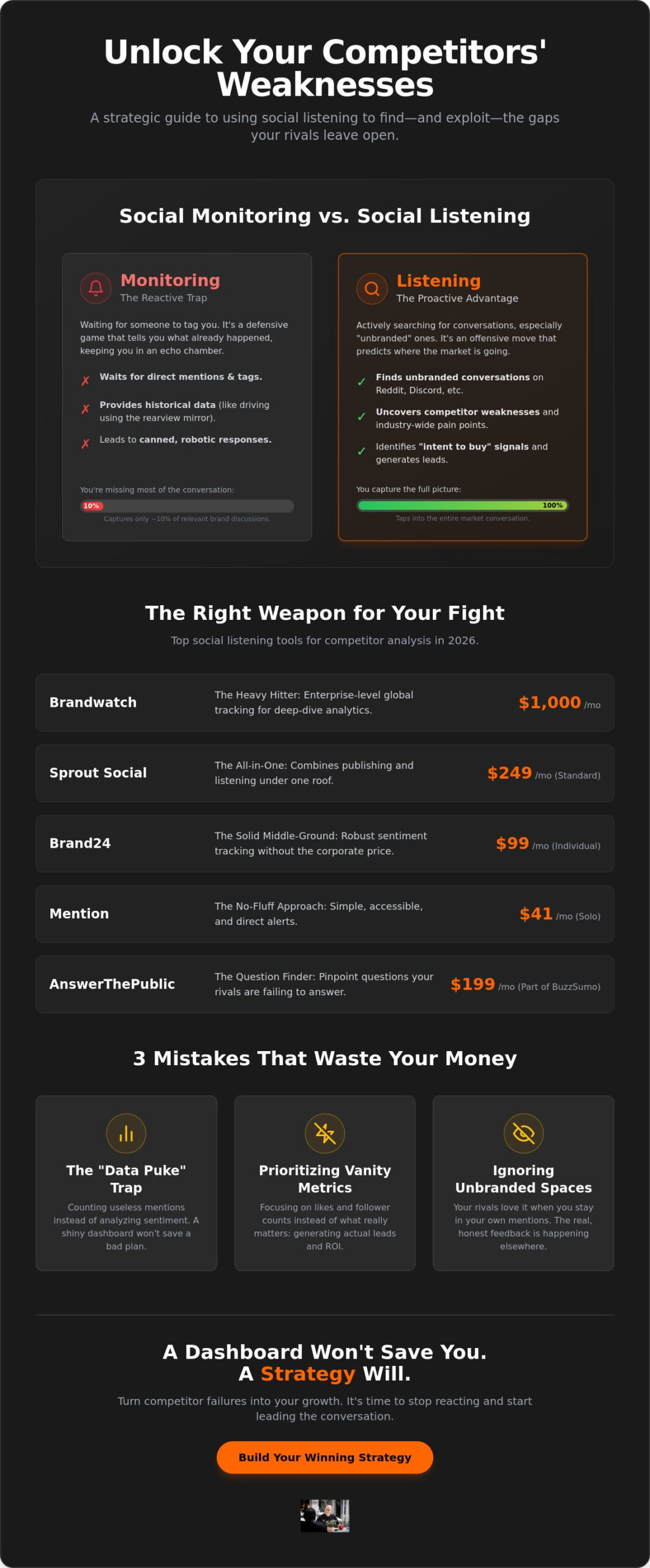
Monitoring is like waiting for a phone to ring. Listening is like bugging the room. Most businesses are stuck in the “monitoring” phase. They wait for a customer to tag them, then they reply with a canned response. It’s boring. It’s basic. And honestly, it’s a massive waste of potential. If you’re only reacting to tags, you’re playing a defensive game. You’re waiting for the world to come to you. That doesn’t build a market leader; it just maintains the status quo.
Social listening is the offensive move. It’s about finding out what people say when they don’t think you’re listening. In 2026, the most valuable conversations aren’t happening on your official page. They’re happening in “unbranded” spaces like Reddit threads, Discord servers, and private Telegram groups. This is where the raw, unfiltered truth lives. If you want to actually win, you need to use social listening tools for competitor analysis to find the gaps your rivals are too lazy to see. You’re looking for the stuff they aren’t tagged in, because that’s where the real honesty hides.
The Reactive Trap: Why Monitoring Isn’t Enough
If you only look at mentions, you’re missing about 90% of the actual conversation. Your rivals love it when you focus solely on your own notifications. It keeps you trapped in an echo chamber. You think you’re winning because your current followers are happy, but you’re blind to the thousands of people looking for a better solution elsewhere. Standard social media management often fails here because it prioritizes the “inbox zero” mentality over actual market intelligence.
Monitoring is a historical record. It tells you what already happened. Listening is a crystal ball. It tells you where the market is moving before your competitors even wake up. Relying on monitoring is like trying to drive a car while only looking in the rearview mirror. You might see where you’ve been, but you’re definitely going to hit a wall eventually.
Strategic Eavesdropping: The Listening Advantage
This is where social listening tools for competitor analysis become your secret weapon. By using social media analytics, you can identify industry-wide pain points before they become mainstream problems. You can spot “intent to buy” signals hidden in the comment sections of your rivals. This isn’t about being a digital stalker. It’s about being the most informed person in the room.
Imagine finding a thread where fifty people are complaining about a specific feature your competitor just removed. That isn’t just data. That’s a lead generation goldmine. You can pivot your strategy, adjust your messaging, and swoop in to offer exactly what those people are missing. You aren’t being a creep; you’re being a problem solver. You’re turning their failure into your growth. That is the difference between just being on social and actually making money from it.
The Best Social Listening Tools for Competitor Analysis in 2026
Stop burning money on shiny dashboards you never look at. The market is flooded with software promising to read your competitors’ minds, but most of it is just overpriced noise. To win, you need the right tool for your specific fight. Whether you are a local shop or a national player, your choice of social listening tools for competitor analysis should depend on your goals, not just your budget.
If you have deep pockets and need to track every whisper across the globe, Brandwatch is the heavy hitter. It starts at roughly $1,000 per month and offers enterprise-level spying that most small businesses simply don’t need. For teams that want everything in one place, Sprout Social is a beast. Their “Standard” plan starts at $249 per month, though you will need the higher-tier plans or add-ons to unlock the full listening suite. It’s perfect for keeping your publishing and eavesdropping under one roof.
For those who want a no-fluff approach, Mention is a winner. Their “Solo” plan is a manageable $41 per month, making it accessible for anyone who just needs to know who is talking. If you want to find the specific questions your rivals are too lazy to answer, AnswerThePublic (now part of the BuzzSumo family, starting at $199 per month) is your best friend. Finally, Brand24 offers a great middle-ground. Their “Individual” plan sits at $99 per month and provides solid sentiment tracking without a corporate price tag. If this tech stack sounds like a headache you’d rather delegate, our team handles Social Media Management with a focus on real leads, not just pretty graphs.
Enterprise Powerhouses vs. SME Essentials
You probably don’t need a £10k-a-month tool to beat the guy down the road. Most small and medium businesses get better results by focusing on three “must-have” features: sentiment analysis, share of voice (SOV), and real-time alert systems. Don’t ignore the hidden gems that cost absolutely nothing. The Meta Ad Library lets you see exactly what your rivals are spending money on right now. Google Trends is still a powerhouse for spotting industry shifts before they hit the mainstream. Use these social listening strategies to build a foundation before you start paying for the big guns.
AI Features: Hype vs. Reality in 2026
AI is the buzzword of the year, but let’s get real. In 2026, top-tier sentiment analysis tools have hit 80-90% accuracy on English text. That is great for filtering out the “noise” in massive data sets, but it isn’t a replacement for a brain. The “Predictive” trap is real. Software can tell you what people said, but it often fails to explain the “why.” Automated reporting might look impressive to a CEO, but unless a human interprets those numbers into an actual sales strategy, it’s just a digital paperweight. Tools give you the data; you provide the soul.
How to Execute a Competitive Analysis Strategy (Without Being a Creep)
Having the best social listening tools for competitor analysis is a great start. But a tool is just a hammer. If you don’t have a blueprint, you’re just hitting things and hoping for the best. You need a repeatable, aggressive strategy that turns raw data into market share. It isn’t about being a digital stalker. It’s about being better informed than the people trying to take your customers. Follow these five steps to build a strategy that actually works.
First, identify your real rivals. It isn’t always the global giant with the billion-pound budget. Your real competitor is the one outranking you for your core keywords or the one getting more engagement on the platforms where your audience hangs out. Look at the search results. Look at the local hashtags. That’s your real competition. Once you know who they are, you can start digging into their digital presence.
Defining Your Keyword Clusters
Don’t just track their brand name. That’s amateur hour. You need to go deeper by setting up keyword clusters. A keyword cluster is a group of related terms that reveal specific user intents. For example, track “Competitor Name + fail” or “Competitor Name + alternative.” This shows you exactly where people are getting frustrated. You can also track industry-wide problems. If everyone in your sector is complaining about “slow delivery times,” you can pivot your messaging to highlight your lightning-fast shipping. You aren’t just selling a product; you’re positioning yourself as the solution to their collective headache.
The Share of Voice (SOV) Metric
Share of Voice is the most important metric you’re probably ignoring. It tells you what percentage of the total industry conversation belongs to you versus your rivals. You don’t need a PhD in mathematics to figure this out. Just take your total brand mentions, divide them by the total mentions for all brands in your category, and multiply by 100. If your SOV is shrinking while your rivals’ is growing, you have a problem. Use this data to justify your next big marketing budget increase. It’s hard for a CEO to say no when you can prove the competition is literally louder than you are.
Finally, analyze their ad spend versus their organic engagement. Are they buying their way to the top because their organic content is garbage? That is a massive opportunity for you. Using social listening tools for competitor analysis allows you to see their paid strategy in context with their organic reach. Pivot your content to fill the gaps they’ve left wide open. If they are ignoring customer questions on TikTok, make that your primary channel. If their blog is a dry desert of corporate fluff, write something with actual personality. Stop reacting and start leading.
3 Mistakes That Turn Social Listening into a Giant Waste of Money
Buying social listening tools for competitor analysis is the easy part. Using them without looking like a total amateur is where most people trip up. It’s easy to get blinded by the shiny features and forget that the goal is to actually sell something. If you aren’t careful, you’ll end up with a high monthly bill and a mountain of data that means absolutely nothing. Real spying requires a sharp eye and a total lack of patience for vanity metrics. Don’t be the person who pays for a digital wiretap but never actually listens to the recording.
Curing the “Data Puke” Phenomenon
Stop trying to track every single mention of every single competitor. It’s a recipe for burnout. We call this the “Data Puke” problem. Your dashboard looks like a neon explosion, but you have no idea what to do with it. Focus on three actionable KPIs instead of fifty useless numbers. Maybe it’s share of voice, negative sentiment spikes, or specific feature requests. If it doesn’t help you make a decision, it’s just “Interesting Info.” Real “Business Intelligence” leads to a change in strategy. Set up a weekly “So What?” meeting for your marketing team. If they can’t explain why a metric matters to the bottom line, bin it immediately.
The Sentiment Fallacy
Mentions are a vanity metric. If a competitor gets 1,000 mentions in a day, don’t panic. If 900 of those are people complaining about their terrible customer service, they aren’t winning. They’re drowning. AI tools in 2026 are better, hitting around 80-90% accuracy on English text, but they still struggle with the nuances of human speech. A tweet saying “Wow, great job on the update, guys!” followed by a screenshot of a crashed app is a negative mention, even if the software thinks it’s positive. You can use this negative sentiment against your rivals in your next PPC campaign. Target their brand name with ads that highlight how you solve their biggest flaws.
Don’t forget that social listening is a two-way street. It isn’t just about spying; it’s about engaging. When you find someone complaining about a rival, don’t just take a note. Help them. Show them there’s a better way without being a pushy salesman. To keep your sanity, set up “Smart Alerts.” You don’t need an email every time a competitor breathes. Set thresholds for volume or sentiment so your inbox doesn’t explode. If you want a team that actually turns these insights into cash, our Social Media Management services focus on real growth, not just noise.
Why a Dashboard Won’t Save You (But a Strategy Will)
A dashboard is just a collection of pixels. It doesn’t close deals. It doesn’t fix a broken brand reputation. You can buy the most expensive social listening tools for competitor analysis on the market, but without a human brain to interpret the noise, you’re just looking at an expensive light show. Tools give you the “what.” They show you the spikes, the drops, and the mentions. Humans give you the “why.” They understand the nuance of a disgruntled customer or the subtle shift in industry sentiment that a machine might miss. Data is the ingredient, but strategy is the recipe.
At Delivered Social, we take a no-BS approach to growth. We don’t care about vanity metrics that look good in a boardroom but do nothing for your bank account. We focus on leads, not likes. If your current social strategy feels like you’re just shouting into a void, it’s time to change the game. Outsourcing your social media management actually saves you money because you aren’t just paying for a tool subscription. You’re paying for a team that knows how to turn a competitor’s failure into your next big win. We find the gaps and we fill them. Fast.
The Human Element of Social Intelligence
An agency sees patterns your internal team might be too close to notice. It’s easy to get tunnel vision when you’re working on your own brand every single day. We bring a fresh, slightly irreverent perspective that strips away the ego and looks at the cold, hard facts. Turning “Listening” into “Acting” requires rapid-response content. If a rival’s service goes down, you don’t wait three weeks for a content calendar approval. You post now. That is the Delivered Social difference. We hate jargon as much as you do, and we prioritize effectiveness over formality every single time.
Your Next Steps to Market Dominance
Ready to stop playing guessing games with your rivals? Here is your immediate action plan to start using social listening tools for competitor analysis like a pro:
- Audit your current tool stack. If you haven’t logged into a platform in thirty days, bin it. You’re wasting resources.
- Pick one competitor. Start a “Deep Listen” today. Look for their three most common customer complaints and build content that proves you do it better.
- Stop reacting. Move from monitoring your own tags to eavesdropping on the wider industry conversation.
- Book a chat with us. We’d love to show you exactly how we would handle your rivals and steal their spotlight.
Let’s have a real conversation about your goals. No 50-slide decks. No corporate fluff. Just a straightforward talk about how to make your brand the one everyone else is trying to spy on. You’ve got the tools. Now get the strategy.
Turn Your Competitors’ Noise Into Your Next Big Win
You’ve seen the tools. You know the strategy. Now you just have to do the work. It’s easy to get buried in data, but remember that social listening tools for competitor analysis only work if you actually use the insights to pivot your content and steal those leads. Don’t let your dashboard become another expensive digital paperweight. Focus on the sentiment, calculate your share of voice, and stop reacting to tags like a basic help desk. You’re here to lead the conversation, not just join it.
Our expert team in Guildford and Portsmouth lives for this stuff. We take a refreshingly blunt, no-BS approach to marketing that prioritizes tangible results and actual leads over vanity metrics. We don’t do 50-page slide decks; we do growth. If you’re ready to stop guessing and start dominating your market, we’re ready to help. Stop wasting money on tools you don’t use—let us manage your social strategy. You’ve got the blueprint. Now go out there and show your rivals how it’s done.
Frequently Asked Questions
Is social listening legal for competitor analysis?
Yes, social listening is completely legal as long as you are tracking publicly available data. You aren’t hacking into private servers; you’re just paying attention to what people say on open platforms. However, you must stay compliant with data privacy laws like GDPR and the CCPA. In 2026, GDPR fines have already topped €7.1 billion, so ensure your chosen social listening tools for competitor analysis handle data ethically and transparently.
How much do social listening tools cost in 2026?
Prices vary wildly depending on your needs. Entry-level tools like Awario start at around $24 per month, while mid-tier options like Brand24 sit at $99 per month for their individual plan. If you want enterprise-level data, Brandwatch starts at roughly $1,000 per month. You don’t always need the most expensive option to win. Pick a tool that matches your actual scale rather than paying for features you’ll never touch.
Can I do social listening for free?
You can, but it costs a lot of time. Free tools like Google Trends, the Meta Ad Library, and basic search alerts can give you a decent start without a monthly bill. You can also manually search hashtags and competitor brand names on Reddit or TikTok. It’s a great way to test the waters, but eventually, the manual labor will eat up the money you’re trying to save.
What is the difference between social listening and social monitoring?
Monitoring is reactive; listening is proactive. Monitoring is about checking your notifications and replying to tags like a digital help desk. Listening involves searching for conversations where you aren’t tagged, including industry trends and rival complaints. One keeps your current customers happy; the other finds you new ones by identifying the gaps your competitors are too lazy to fill. It’s the difference between defending and attacking.
How do I track competitor ads on social media?
The Meta Ad Library is your best friend here. It’s a free, public database where you can see every active ad any brand is running across Facebook and Instagram. You can also use the TikTok Creative Center to spot trending ads in your sector. This lets you see their offers, their creative style, and exactly what they’re spending money on right now. No more guessing their strategy.
What is a good “Share of Voice” percentage?
A good Share of Voice (SOV) is anything that exceeds your actual market share. If you own 5% of the market but own 15% of the industry conversation, you are punching above your weight. This is a lead indicator of future growth. Use social listening tools for competitor analysis to track this monthly. If your rivals are louder than you, it’s time to get aggressive with your content strategy.
How often should I perform a competitor analysis?
Listening should be a continuous process, but you should perform a deep-dive analysis every quarter. Set up real-time alerts for major shifts, like a competitor launching a new product or a sudden spike in negative sentiment. A quarterly review allows you to spot long-term trends and adjust your annual strategy. Don’t treat it as a “one and done” task; the digital landscape moves way too fast for that.
Share This Article
About the Author: Jonathan Bird































