




In This Article
If a customer searched for exactly what you offer right now, would your business actually show up — or would your competitors take that call instead? That question keeps a lot of UK small business owners up at night, and the honest answer is that most of them don’t know. They assume they’re visible. They’re often not.
You’re not alone in this. Most local businesses have never run a proper local SEO audit — a structured check of everything Google uses to decide whether your business shows up or gets skipped, and the guides that exist online are written for SEO professionals, not for the person who also handles the invoicing, the deliveries, and the customer complaints. This guide is different. We’re going to walk you through every stage of a local SEO audit, breaking it down into clear, actionable steps that any business owner can follow without needing a marketing degree.
By the end, you’ll know how to check your Google Business Profile, verify whether your business information is consistent across the web, assess your reviews, evaluate your website for local signals, and understand what your competitors are doing better than you. More importantly, you’ll know which fixes actually translate into phone calls, footfall, and enquiries — not just abstract ranking improvements.
If you’d rather have an expert do this with you, our free Social Media Clinics are designed exactly for this — a dedicated session where we review your Google presence, website performance, and social channels, and we guarantee you’ll learn something new.
What Is a Local SEO Audit, and Why Should UK Small Businesses Care?
What is a local SEO audit?
It’s a nearby search visibility assessment and a structured review of everything that affects whether your business appears when someone nearby searches for what you offer. It covers your Google Business Profile, the consistency of your business details across online directories, your website’s local signals, your reviews, and how you compare to the competitors currently outranking you.
The key word is “local.” This isn’t about ranking globally or nationally. It’s about showing up when someone in your town, city, or postcode searches for a plumber, a café, a solicitor, or whatever you do. Local search results are dominated by the Google Map Pack — the three businesses that appear with a map at the top of the results page. Getting into that pack, or improving your position within it, is what a geographical search visibility check is designed to help you do.
Most guides treat this as a technical exercise. We treat it as a revenue exercise. Every fix you make should be traceable to a commercial outcome: more calls, more visits, more enquiries. If a change doesn’t move one of those needles, it’s not a priority.
What is included in a local SEO audit?
A thorough nearby business search review covers six core areas: your Google Business Profile, your citations (the places your business name, address, and phone number appear online), your reviews, your website’s on-page local signals, your technical SEO health, and a competitive analysis of who’s outranking you and why. Each of these areas has a direct line to whether customers find you or find someone else.
Think of it like a health check for your business’s online presence. You wouldn’t ignore a persistent cough for two years — but most businesses ignore broken citations, an incomplete Google Business Profile, and a website that loads in six seconds on mobile, all of which are quietly costing them customers every single day.
Step 1: Audit Your Google Business Profile (This Is Where Most Businesses Lose)
How do I audit my Google Business Profile for local SEO?
Your Google Business Profile (GBP) is the single most important factor in local search rankings. According to Google’s own guidance on Business Profiles, completeness and accuracy directly influence how prominently your listing appears. Yet in our experience at Delivered Social, the majority of small business profiles we review during Social Clinics are incomplete, inconsistent, or simply never updated after the initial setup.
Start by logging into your GBP and working through this checklist:
Business name: Does it match exactly what appears on your shopfront, website, and other directories? Any variation — even an extra word or abbreviation — creates a trust signal problem for Google.
Primary and secondary categories: This is where most businesses leave money on the table. Your primary category should be as specific as possible. “Plumber” is weaker than “Emergency Plumber.” Use secondary categories to capture adjacent searches. A tool like GMB Everywhere (a free Chrome extension) lets you see exactly which categories your top-ranking competitors are using — and that intelligence alone can shift your visibility.
Business description: You have 750 characters. Use them. Include your location, your core services, and what makes you different. Don’t stuff keywords — write for the person reading it, not the algorithm.
Photos and posts: Profiles with recent photos and regular posts signal to Google that the business is active. Freshness matters. A profile last updated in 2021 tells Google — and potential customers — that you might not even be trading anymore.
Services and products: Fill these in completely. Google uses this data to match your profile to specific search queries. A café that lists “oat milk flat white” in its products is more likely to appear for that search than one that just says “coffee shop.”
Consider a community interest company like Waterlooville Community Events CIC. Before a proper GBP review, their profile was missing half their services, had no recent posts, and was using a generic category. After a structured update, their profile started appearing for event-specific searches in their area — searches that previously sent people straight to competitors. The phone started ringing for event enquiries they’d never received before.
Step 2: Check Your Citations — Is Your Business Information Consistent Everywhere?
Citations are any online mention of your business name, address, and phone number — collectively known as NAP. They appear on directories like Yell, Thomson Local, Yelp, TripAdvisor, Facebook, and dozens of industry-specific sites. The problem is that most businesses have accumulated citations over the years, often with slight variations: a different phone number, an old address, a misspelt street name.
Google cross-references these citations to verify that your business is legitimate and located where you say it is. Inconsistent NAP data creates doubt. That doubt suppresses your local search rankings. It’s not a dramatic penalty — it’s a slow, invisible drag on your visibility that compounds over time.
To check your citations, start with a manual search. Google your business name and scan the first three pages of results. Note every directory listing you find and check whether the name, address, and phone number match your current details exactly. Then do the same on Google Maps — search your address and see what listings appear nearby.
For a more thorough sweep, tools like BrightLocal’s Citation Tracker or Moz Local can crawl hundreds of directories and flag inconsistencies automatically. These are paid tools, but even the free tiers surface the most critical issues.
The fix is unglamorous but impactful. Claim every listing you find, correct the NAP data, and add any missing information. For a construction company like Black Creek Construction, cleaning up citation inconsistencies across 40+ directories was one of the first things we tackled — and it contributed to a measurable improvement in their local map pack visibility within eight weeks.
Step 3: Review Your Reviews — Quantity, Recency, and How You Respond
Reviews are a ranking signal and a conversion signal simultaneously. They influence whether Google shows your business prominently, and they influence whether a potential customer chooses you over the competitor listed next to you. According to BrightLocal’s Local Consumer Review Survey, the vast majority of consumers read online reviews before visiting a local business — and recency matters as much as overall rating.
When reviewing your feedback profile, look at four things:
Volume: How many reviews do you have compared to your top local competitors? If they have 80 and you have 12, that gap is hurting you. Google interprets review volume as a signal of business activity and trustworthiness.
Recency: A business with 50 reviews, all from 2019, looks dormant. A business with 20 reviews, three of which are from last month, looks active. Recency signals that real customers are still engaging with you.
Rating distribution: A 4.6 average with 60 reviews is more credible than a 5.0 average with 4 reviews. Don’t panic about the occasional negative review — how you respond to it matters far more than the review itself.
Response rate: Responding to every review — positive and negative — signals to Google that you’re an engaged, active business. It also signals to potential customers that you care. A one-line “thanks for your review!” is better than silence, but a specific, warm response is better still.
The question here isn’t just “how many reviews do I have?” It’s “what is my review strategy, and is it generating a consistent flow of new feedback?” If the answer is “I don’t have one,” that’s the fix. Ask customers directly, make it easy with a short link to your GBP review page, and build it into your post-purchase or post-service process.
Step 4: Look at Your Website — Service Pages, Local Signals, and Speed
Your website is the second pillar of local search visibility, and this is where things get more technical — but not so technical that you can’t understand what needs fixing. The goal here is to assess whether your website clearly tells Google (and visitors) what you do, where you do it, and why you’re the best option locally.
Service pages with local intent: Do you have dedicated pages for each of your core services? A single “Services” page that lists everything in bullet points is far weaker than individual pages for each service, each optimised for a specific local search query. A solicitor in Portsmouth should have a page titled something like “Family Law Solicitor in Portsmouth” — not just a generic “Family Law” page. This is what local intent means in practice.
NAP on your website: Your name, address, and phone number should appear on every page — typically in the footer. It should match your GBP and your citations exactly. This consistency reinforces your local relevance to Google.
Schema markup: Schema is structured data that you add to your website’s code to help Google understand what your business is, where it’s located, and what it offers. The LocalBusiness schema type is the most relevant for local businesses. If your website doesn’t have it, you’re missing a clear signal that your competitors may be sending. This is one area where getting professional help pays off quickly — it’s not something most business owners should attempt to implement themselves.
Page speed: Run your website through Google’s PageSpeed Insights tool. A site that takes more than three seconds to load on mobile is losing visitors before they’ve even seen your content. For local businesses, where a significant proportion of searches happen on mobile, this is a direct revenue issue. A slow website doesn’t just frustrate users — it ranks lower.
Broken links and keyword cannibalisation: Broken links (pages that return a 404 error) damage user experience and waste the authority your site has built. Keyword cannibalisation — where multiple pages on your site compete for the same search term — confuses Google and dilutes your ranking potential. Both are common, both are fixable, and both are worth checking.
For businesses where the website itself is the problem, local web design that supports your search visibility from the ground up makes a significant difference. We’ve seen businesses where a complete website rebuild, structured around local intent from the start, transformed their enquiry volume within a quarter.
Building trust through your website is also part of this picture. If visitors land on a slow, outdated, or confusing site, they leave — and that bounce signal feeds back into your rankings. Read more about building trust through your website to understand what visitors are actually looking for when they land on your pages.
Step 5: Assess Your Local Competitors — Who’s Outranking You and Why?
The most useful part of any local visibility review isn’t looking at your own business in isolation — it’s understanding why specific competitors are outranking you. This isn’t about copying them. It’s about identifying the gaps between what they’re doing and what you’re doing, and closing the ones that matter most.
Search for your primary service in your location. Look at the three businesses in the Map Pack. For each one, check their GBP: how many reviews do they have, how recently were they posted, how complete is their profile, and what categories are they using? Then look at their website: do they have dedicated service pages with local keywords, do they load quickly, and do they have schema markup?
You’re looking for patterns. If all three top-ranking competitors have 50+ reviews and you have 15, that’s a clear priority. If they all have dedicated service pages and you have one generic page, that’s another. Competitive analysis turns the process from a list of abstract fixes into a ranked action plan based on what’s actually working in your specific market.
GMB Everywhere is a free Chrome extension that makes this process significantly faster. Install it, search for your service locally, and it overlays category data, review counts, and profile completeness information directly onto the Google Maps results. It’s one of the most useful free tools available for this kind of competitive intelligence.
What to Do After Your Review — Prioritising Fixes That Actually Move the Needle
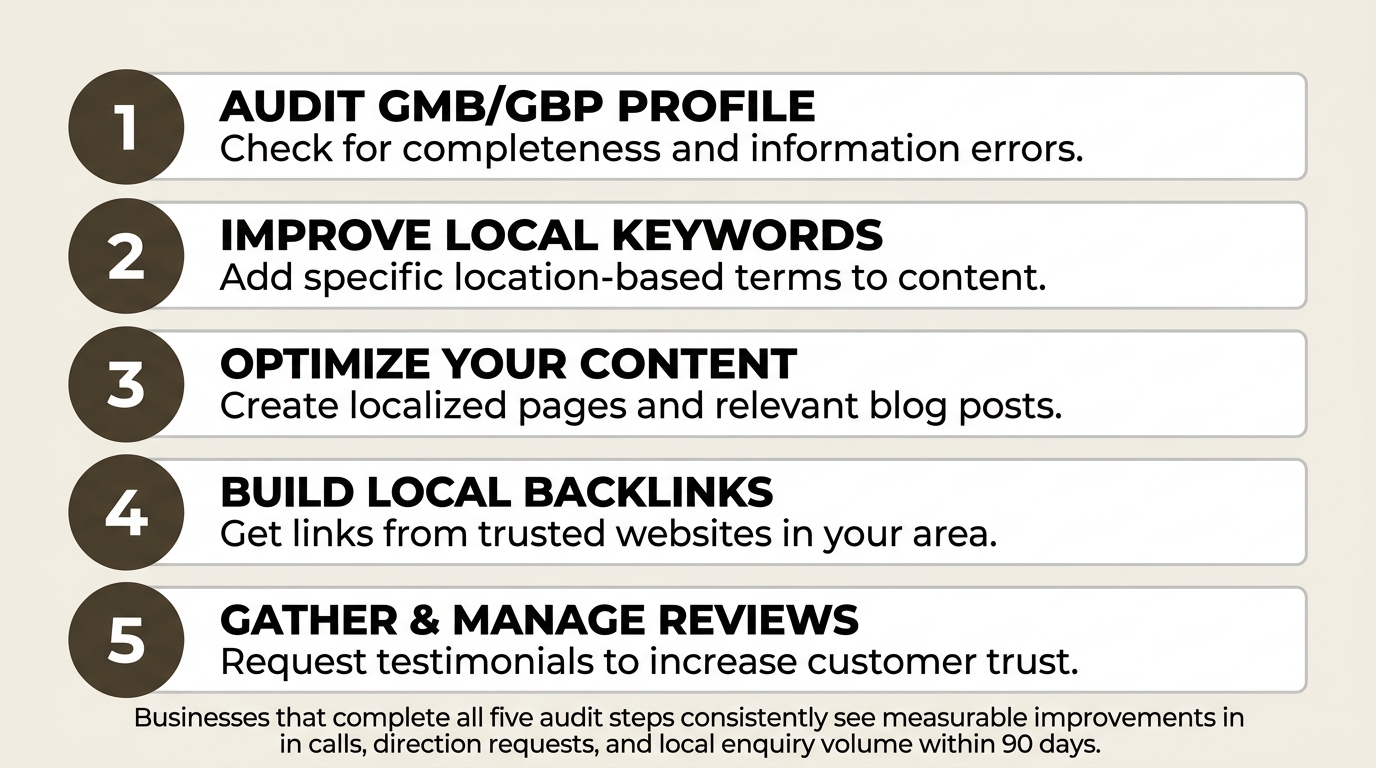
This is the section that almost no other guide covers — and it’s the most important one. Running the review is the easy part. Knowing what to fix first, and in what order, is where most business owners get stuck.
Here’s a simple prioritisation framework based on impact and effort:
Fix first (high impact, low effort): GBP completeness, NAP consistency across your top 10 directory listings, responding to all unanswered reviews, and adding your address to your website footer. These changes take hours, not weeks, and they send immediate positive signals to Google.
Fix next (high impact, higher effort): Building out dedicated service pages with local intent, implementing LocalBusiness schema markup, and launching a systematic review generation process. These take more time but have the most direct impact on enquiry volume.
Fix later (lower impact or requires specialist help): Backlink building, advanced technical fixes, and schema for specific service types. These matter, but they’re not where a small business should start.
Set a review cadence. This isn’t a one-time exercise. Google’s algorithm updates regularly, competitors change their strategies, and your own business evolves. A quarterly check of your GBP, citations, and review volume is a realistic minimum. A full review — including website and competitive analysis — once or twice a year is sensible for most small businesses.
Measure the right things. Don’t obsess over your ranking position. Track the metrics that connect to revenue: calls from your GBP listing (visible in your GBP insights), direction requests, website clicks from local search, and enquiry form submissions. These are the numbers that tell you whether your work is translating into real business outcomes.
DIY vs. Getting Professional Help — An Honest Comparison
You can absolutely do this yourself. The steps in this guide are designed to be actionable without any specialist knowledge. For many small businesses, a self-directed review will surface the most critical issues and give you a clear enough action plan to make meaningful progress.
The honest limitations of the DIY approach are time and depth. A thorough review takes several hours. Interpreting what you find — particularly on the technical side — requires experience. And implementing fixes like schema markup, page speed optimisation, or a structured backlink strategy requires skills that most business owners don’t have and shouldn’t need to develop.
There’s also the question of knowing what you don’t know. A business owner reviewing their own site will often miss the issues that are hardest to see from the inside — keyword cannibalisation, for example, or the fact that their primary service page is competing with a blog post for the same search term.
This is where understanding when to outsource your SEO becomes genuinely valuable. The rule of thumb we use at Delivered Social: if you’ve done the self-directed review, fixed the obvious issues, and you’re still not seeing movement in calls or enquiries after three months, it’s time to bring in professional support.
Our award-winning team works with businesses across the UK — from community organisations like Pompey In The Community and St Werburghs City Farm to professional services firms like Peters Cost Consultants and Chatsworth Mortgage Group. The pattern we see consistently is that businesses who’ve tried to manage their local visibility in isolation are often sitting on a handful of fixable issues that are costing them significant enquiry volume. A fresh pair of expert eyes changes that quickly.
If you want to see what a professional review looks like in practice, book a free Social Clinic with Delivered Social. We’ll assess your Google presence, website performance, and social channels in a dedicated session — and we guarantee you’ll learn something new about where your business is losing visibility.
Frequently Asked Questions
Can I do a local SEO audit for free? Yes, and you can cover the most important areas without spending anything. Google Business Profile insights are free within your GBP dashboard. PageSpeed Insights is a free Google tool. GMB Everywhere is a free Chrome extension for competitive analysis. For citation checking, a manual Google search of your business name will surface the most critical inconsistencies. Paid tools like BrightLocal or Moz Local add depth and speed, but they’re not essential for a first review. Delivered Social’s free Social Clinics also offer a no-cost professional assessment of your Google presence, website, and social channels — a useful option if you want expert eyes on your setup without any financial commitment.
How often should I run a local SEO audit? For most UK small businesses, a full review once or twice a year is a sensible baseline. However, certain elements should be checked more frequently. Your Google Business Profile should be reviewed monthly — look at your insights data, respond to new reviews, and add fresh photos or posts. Citation consistency should be checked any time your business details change (new phone number, new address, rebranding). A competitive check — looking at who’s in the Map Pack for your key searches — is worth doing quarterly, because competitor strategies shift and new businesses enter the market. The businesses that maintain strong local visibility treat this as an ongoing habit, not a one-off project.
How much does a local SEO audit cost? A DIY review costs nothing but your time. Professional assessments from agencies vary widely depending on depth and scope. A basic check from a freelancer might cover GBP and citations only. A thorough agency review will include website technical analysis, competitive benchmarking, schema assessment, and a prioritised action plan. Rather than quoting a range that may be out of date, the more useful question is: what will you do with the findings once you have them? A review without an action plan and the resources to implement it has limited value. Delivered Social’s approach bundles the insight into an ongoing service, so fixes get implemented rather than sitting in a document.
Your Local SEO Audit Starts Here
A local visibility review isn’t about chasing rankings for their own sake. It’s about making sure that when someone in your area needs what you offer, your business is the one that shows up, earns their trust, and gets the call. Every step in this guide — from your Google Business Profile to your service pages to your review strategy — connects directly to that outcome.
Start with your GBP today. It takes less than an hour to check completeness, update your categories, and respond to any unanswered reviews. That single hour can shift your visibility in ways that take months to achieve through other means. Then work through citations, reviews, and your website in the order that makes sense for your business’s specific gaps.
And if you want expert support to do this properly, explore our digital marketing packages — built for UK businesses that want measurable results without the guesswork.
Share This Article
About the Author: Jonathan Bird































