



Keep reading
Rather we just did it for you?
Let's get your business seen.
Social media, websites, SEO and ads from a team you can actually meet.
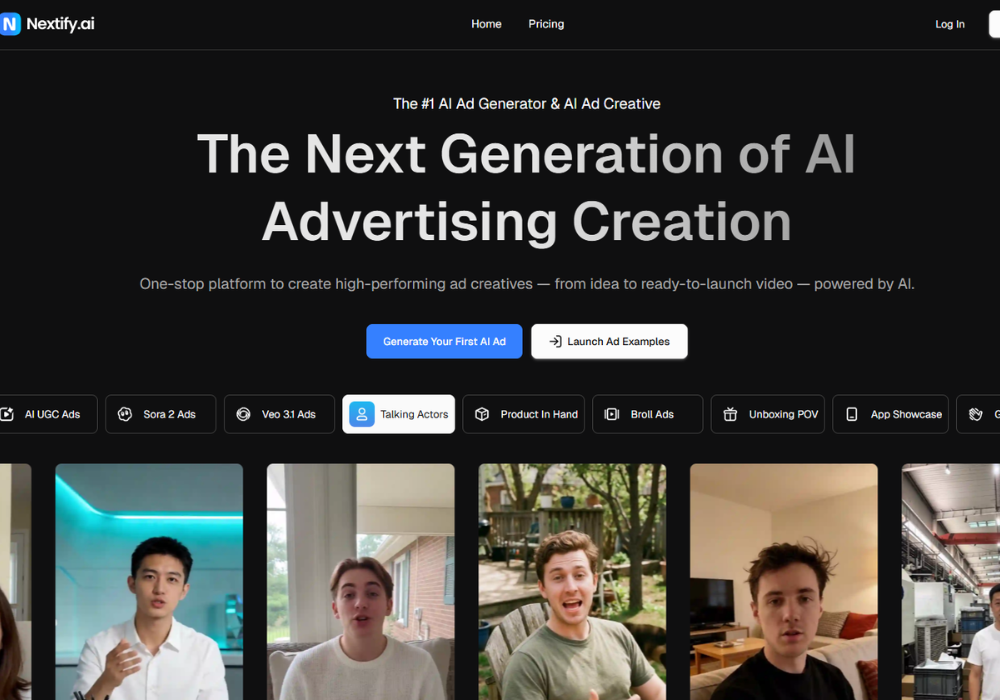
Video‑first platforms like TikTok, Instagram Reels, and YouTube Shorts have made one thing clear: if you’re not producing short‑form, human‑style ads, you’re losing attention—and revenue. For small teams and solo marketers, hiring creators, booking studios, and editing multiple ad variants is expensive and slow. Enter Nextify.ai: an AI avatar video generator that turns copy‑and‑product snapshots into full‑blown ad creatives in minutes, often with better‑than‑UGC‑style performance.
This isn’t just another “AI ad tool.” It’s a workflow‑shifting layer for performance‑led marketers who want to A/B test dozens of angles without touching a camera.
Why Avatar‑Driven Video Ads Are Growing
The move from static to “person‑in‑front” ads
Over the last three years, brands have quietly shifted from pure product‑shot creatives to “talking‑head” and UGC‑style formats. A 2025 report by IFPI and social‑ad analytics platforms found that caption‑driven, talking‑actor style videos outperform static product images by roughly 20–30% in engagement and CTR on TikTok and Meta feeds. The reason is simple: audiences trust a “person explaining the product” more than a faceless logo.
What’s changed in 2024–2026 is that brands no longer need real influencers for every angle. AI avatar video generators like Nextify.ai let you simulate those same UGC‑style talking‑head creatives at scale.
The efficiency gap in traditional ad production
Most growth marketers still operate this way:
- Brief real‑world creators or internal teams.
- Wait days or weeks for filming and editing.
- Produce 3–5 variants per offer.
- Manually swap captions, thumbnails, and hooks.
This model is expensive and hard to iterate. McKinsey estimates that performance‑driven brands now need to test 50–100+ ad variants per month to maintain stable ROAS on competitive platforms. That math doesn’t work with real‑world shoots, which is exactly where AI ad tools like Nextify.ai plug in.
How Nextify.ai Works in Practice
From text to avatar‑led video in minutes
Nextify.ai positions itself as an AI ad video generator focused on “no‑camera” creatives. You start either from a product image (or a short script) and let the system generate a talking‑actor‑style ad. The core flow is surprisingly simple:
- Upload a product‑scene image or short prompt.
- Choose an AI avatar (age, style, and tone).
- Select or tweak the script; the platform can auto‑generate hooks and copy.
- Pick a voice and language; Nextify.ai supports over 40 languages and hundreds of voice options.
- Hit generate, and a finished video with lip‑sync, background, and subtle B‑roll usually renders in minutes.
The result feels much closer to UGC‑style TikTok ads than to robotic explainer videos, which is why performance‑focused teams are using this as a “variant factory,” not just a novelty tool.
The role of the AI avatar video generator in your stack
An AI Avatar Video Generator doesn’t replace your entire creative stack, but it changes where you spend human effort. Teams tend to use it for:
- Rapid testing of hooks and angles (e.g., “problem vs solution,” “before/after,” “authoritative expert”).
- Localized, multi‑language creatives for global campaigns, because one avatar can speak in 40+ languages without re‑shooting.
- UGC‑style “talking actor” ads and product demos at scale, especially for e‑commerce, SaaS, and DTC offers.
Instead of debating storyboard details for weeks, marketers now iterate on scripts and avatar choices, then let the AI generate the rest. That compresses a multi‑week cycle into a couple of hours.
One Team’s Workflow With Nextify.ai
The “daily variant” routine
A DTC skincare brand running on TikTok and Meta shared an internal workflow built around Nextify.ai in 2026. Their setup looks like this:
Each morning, a growth marketer:
- Chooses 2–3 core hooks based on the previous day’s top‑performing ads.
- Writes 8–10 short scripts (about 15–30 seconds each) for each hook.
- Uses Nextify.ai to batch‑generate avatar‑led videos for each script, changing only the avatar, background, and voice.
This “script‑first” approach lets them test ideas, not just visual polish. The platform’s avatar library (over 1,000 digital actors in different styles and ages) means they can also test demographic‑specific looks without any extra filming.
Impact on testing velocity
Before using an AI avatar video generator, the team was running roughly 15–20 ad variants per week. After integrating Nextify.ai, they jumped to 60–80 variants per week, all while keeping the same editorial bar. While exact conversion lifts vary by offer and audience, they observed a 25–35% increase in CTR and a noticeable ROAS improvement on top‑performing angles, simply because they could identify winners faster.
This isn’t magic—it’s a data‑driven efficiency play. The tool doesn’t guarantee better hooks, but it guarantees more experiments in the same time window.
What Makes Nextify.ai Different From Other AI Ad Tools
Focus on ad‑style outcomes, not just “video creation”
Many AI video tools focus on editing, repurposing, or movie‑style storytelling. Nextify.ai sits closer to the “ad‑creation” side of the spectrum, with features tuned for performance marketing:
- Avatar‑first, UGC‑style layouts.
- Built‑in templates and voiceovers optimized for short‑form ads.
- Multi‑language support and easy batch generation, which are critical for scaling campaigns.
This makes it feel more like an AI ad tool for marketers than a generic “AI video editor” for hobbyists.
Trade‑offs compared to traditional creators
No tool is perfect, and Nextify.ai has clear trade‑offs. Early reviews and user feedback suggest:
- It excels at speed, volume, and UGC‑style ads, but it’s less suited for highly cinematic or narrative‑driven spots.
- Customization is broad but not as granular as a full‑service video editor; you trade total creative control for workflow speed.
For performance‑led marketers, that’s often an acceptable trade: you use Nextify.ai to fill the “testing” bucket and reserve heavy‑handed editing for only the highest‑performing angles.
How to Use an AI Avatar Video Generator Strategically
Treat it as a variant engine, not a creative crutch
The biggest mistake teams make is dumping raw product details into the generator and hoping the AI will “magically” make a great ad. A better approach is to:
- Write tight, hook‑first scripts yourself (or with a strategist).
- Use Nextify.ai to test multiple avatar styles, voices, and languages for the same script.
- Only escalate to human‑led editing once you see clear winners in the data.
This keeps the tool in the “execution” layer, not the “strategy” layer, which is where it performs best.
When to lean into multi‑language campaigns
One of the often‑underappreciated features of Nextify.ai is its multi‑language support: over 40 languages and hundreds of voices, with lip‑sync handled automatically. Instead of shooting separate campaigns for each region, brands can:
- Keep one core script structure.
- Generate localized versions via different voices and languages.
- Preserve avatar consistency across markets.
For global brands or indie creators targeting multiple regions, this can effectively double or triple their testing surface without doubling film‑day costs.
Where Nextify.ai Fits in the 2026 Marketing Stack
By 2026, many performance‑focused teams are using a hybrid stack:
- Human‑led storytelling for flagship campaigns and brand films.
- AI ad tools like Nextify.ai for high‑volume, short‑form, UGC‑style creatives.
In this context, an AI avatar video generator isn’t a “nice‑to‑have” novelty; it’s a scaling layer for creative production. For independent creators, small agencies, and lean in‑house teams, tools like Nextify.ai can push the boundaries of what’s possible within limited time and budget, turning AI‑driven workflows from a side experiment into a core lever for growth.































