




In This Article
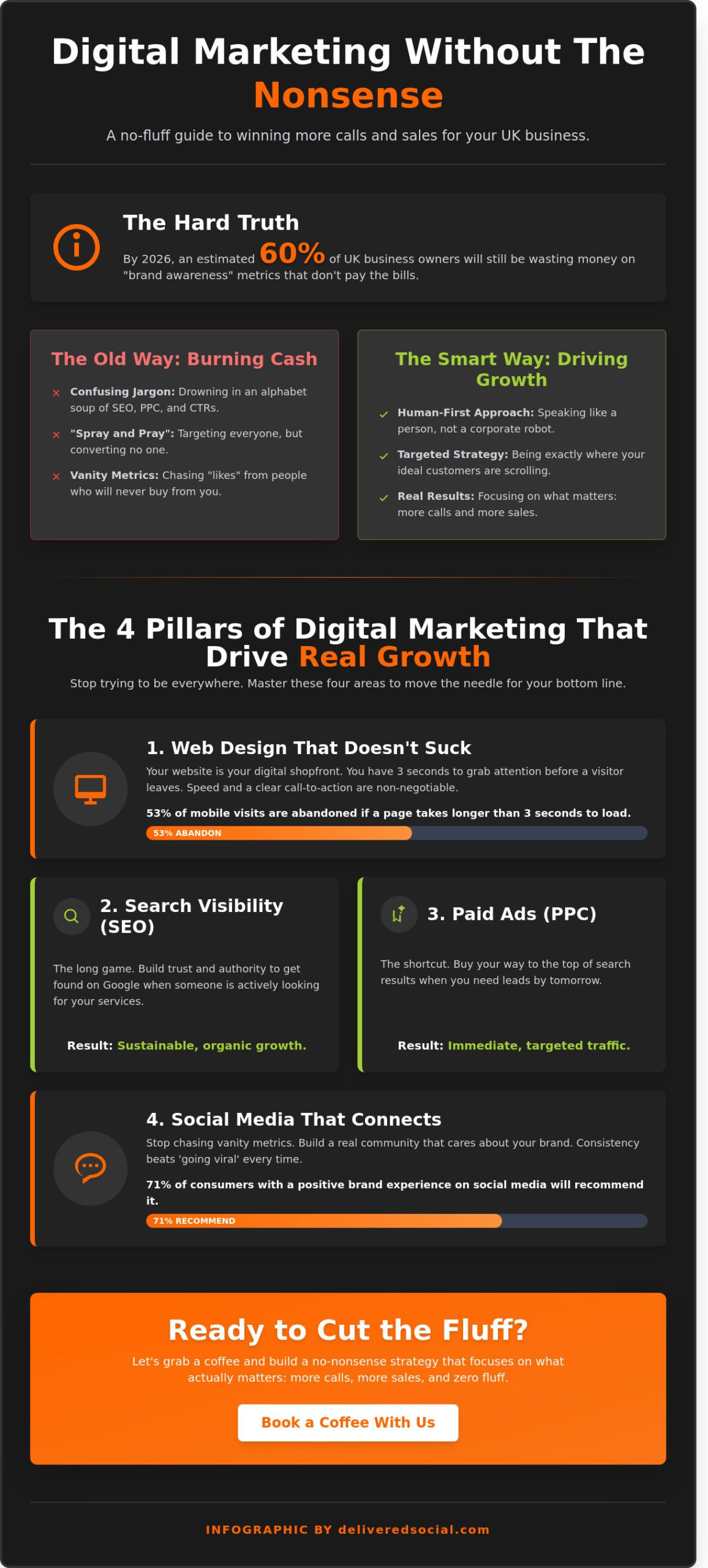
By January 2026, 60% of UK business owners will still be wasting their hard-earned cash on “brand awareness” metrics that don’t pay the mortgage. Most digital marketing has become a massive pile of jargon designed to make agencies look clever while your results stay flat. You’re likely fed up with the alphabet soup of SEO and PPC. It’s exhausting to feel like you’re falling behind while wasting money on fluff. You want real leads, not just a handful of “likes” from people who will never spend a penny with you.
We agree that the industry is bloated and boring. It’s time to stop the nonsense and focus on what actually works for your bottom line. We promise to give you a refreshingly blunt breakdown of how to win without the corporate headache. We’re going to look at the specific channels that move the needle and show you how to find a partner you can actually trust over a coffee. No ego, no fluff, just magic growth.
Key Takeaways
- Strip away the jargon and discover a version of digital marketing that actually makes sense for your business.
- Stop wasting your budget on “spray and pray” tactics that reach everyone but convert absolutely no one.
- Learn how to turn your website into a hard-working digital shopfront that drives real growth, not just vanity likes.
- Spot the “cowboy” agency red flags and hidden fees from a mile away to protect your hard-earned cash.
- Build a no-nonsense strategy that focuses on what actually matters: more calls, more sales, and zero fluff.
What is Digital Marketing? (The Version That Actually Makes Sense)
Forget the dusty textbooks and the 500-page manuals. Most people try to make this sound like rocket science, but it isn’t. At its heart, digital marketing is simply using the internet to find your people and have a chat. That is it. No fluff, no filler. It is about being exactly where your customers are already scrolling, whether that is on their phone at a bus stop in Manchester or on a laptop in a London coffee shop.
We’ve moved away from the old days of shouting. In the past, companies spent millions on TV and radio, screaming at everyone in the hope that 1% might care. It was expensive and mostly ignored. Now, we talk to someone specific. If you look up the academic definition of What is Digital Marketing?, you will see a list of channels and strategies. But for us, it is the most powerful tool for growth in 2026 because it lets you be relevant, not annoying. You aren’t interrupting their day; you are joining their conversation.
Breaking Down the Jargon
The marketing industry loves to confuse you. They use an alphabet soup of acronyms like SEO and PPC to make themselves feel important and keep you paying the bills. It’s nonsense. We prefer a human-first approach. This means talking like a person, not a corporate robot programmed in a boardroom. Digital marketing is a tool for connection, not just a set of technical tasks. When you stop worrying about sounding “professional” and start sounding “helpful,” the magic happens. Results follow when you treat your audience like humans instead of data points on a spreadsheet.
The Core Difference Between B2B and B2C
Who is signing the cheque? That is the only question that matters. If you are selling to other businesses (B2B), you are playing the long game. You are building relationships and trust over months, not minutes. It is about proving you won’t let them down. If you are selling to consumers (B2C), you need to create urgency and excitement for a quicker win. You want them to feel that “must-have” spark immediately. Your approach must change depending on who is at the other end of the screen. B2B needs logic and reliability; B2C needs emotion and speed. Get that wrong, and you are just burning cash.
The 4 Pillars of Digital Marketing That Drive Real Growth
Stop trying to be everywhere at once. It’s a waste of time and a massive waste of your hard-earned cash. Most businesses flush thousands of pounds down the toilet trying to master every single platform. You don’t need a presence on every niche app that pops up. You need to focus on what actually moves the needle for your bottom line. According to The 4 Pillars of Digital Marketing, success comes from balancing specific channels that reach people where they actually hang out. For most UK businesses in 2026, effective digital marketing means mastering four specific areas: your website, search visibility, social community, and paid ads.
Web Design That Doesn’t Suck
Your website is your digital shopfront. If it looks like it was built in 2005, people will leave before the first image even loads. A pretty site is a great start, but it’s useless if it doesn’t convert visitors into leads. You have exactly 3 seconds to grab someone’s attention before they hit the back button. This 3-second rule is brutal. In 2024, data showed that 53% of mobile visits are abandoned if pages take longer than three seconds to load. You need modern web design that prioritises speed and clear calls to action. Don’t make people think. Tell them exactly what to do next.
Search Engine Optimisation (SEO) and Pay-Per-Click (PPC) are two sides of the same coin. SEO is the long game. It’s about getting found when someone is actually looking for your services on Google. PPC is the shortcut. You buy your way to the top when you need results by tomorrow. Both require a strategy that avoids the usual marketing fluff. If you’re tired of the jargon, you should book a coffee with us to see how these fit your specific goals.
Social Media: More Than Just ‘Likes’
Stop chasing vanity metrics. A million likes won’t pay your mortgage if none of those people ever buy anything. Real digital marketing growth comes from building a community that actually gives a toss about your brand. Consistency beats ‘going viral’ every single time. 71% of consumers who have a positive experience with a brand on social media are likely to recommend it to others. It’s about being human, not a corporate robot. If you want the full breakdown on community building, check out this social media management company guide. It’s the ultimate resource for 2026.
Why Most Digital Marketing Strategies Suck (And How to Stop the Rot)
Let’s be honest. Most digital marketing is absolute rubbish. It’s expensive, dry, and yields zero results. The elephant in the room is that most campaigns fail because they lack a soul. They rely on the ‘Spray and Pray’ method. This involves blasting generic messages at everyone and hoping for the best. If you target everyone, you reach no one. It’s a massive waste of time and your hard-earned cash.
Ignoring data is the second biggest sin. If you can’t measure it, you shouldn’t be doing it. Period. Many businesses treat their strategy like a guessing game. They spend thousands without knowing which pound actually brought in a lead. Then there’s the content. Most corporate content is so boring it could put a caffeinated toddler to sleep. In a world where the average person sees over 5,000 ads daily, being “professional” often just means being invisible. You need to be human, not a brochure.
- The ‘Spray and Pray’ disaster: Blasting messages to the wrong people is just expensive noise.
- Data blindness: Running campaigns without tracking is like driving with a blindfold on.
- Corporate fluff: Boring content is the fastest way to lose a potential customer’s interest.
The Trap of Vanity Metrics
Having 10,000 followers is brilliant for the ego, but it means nothing if your bank account is empty. These are vanity metrics. They look pretty in a report but don’t pay the bills. A 2023 study by HubSpot revealed that 21 percent of marketers still struggle to prove ROI. Stop chasing ‘Engagement’ for the sake of it. Focus on the stats that actually matter for your bottom line, like conversion rates and customer lifetime value. If a number doesn’t correlate to a sale or a solid lead, it’s just fluff.
The ‘Set It and Forget It’ Mistake
Digital marketing is a marathon, not a one-off event. You can’t just set up a campaign and walk away. Algorithms change. Trends die. Your strategy needs to evolve as fast as the platforms do. We recommend regular chat sessions to review what’s working and what’s a total disaster. Data from the 2024 CMO Survey suggests that agile businesses see a 10 percent higher revenue growth than those stuck in their ways. Don’t let your strategy rot. Keep it fresh, keep it moving, and keep it honest. It’s the only way to win in 2026.
How to Build a Digital Strategy That Doesn’t Waste Your Budget
Stop throwing your hard-earned cash at every shiny object in the digital marketing world. Most businesses treat their budget like confetti. They toss it in the air and hope some of it sticks to a customer. It’s messy. It’s expensive. It’s totally unnecessary. A real strategy is about focus, not volume. You don’t need to be everywhere; you just need to be where it counts. Building a digital marketing plan that actually works requires looking at the data, not your gut feeling.
Starting with the ‘Why’
Every single penny you spend should be tied to a specific business outcome. If you can’t explain why you’re spending £500 on a specific ad set, don’t spend it. Use SMART goals to stay grounded. “Get more leads” is fluff. “Generate 20 new enquiries for boiler installations in Guildford by the end of June” is a goal. A successful strategy is one that balances long-term SEO with short-term PPC. You need to win today while building for tomorrow.
Allocating Your Ad Spend Wisely
You need to choose between ppc services and organic growth. Organic takes time. Paid search is instant but stops the moment you stop paying. Putting all your eggs in one platform’s basket is a recipe for a bad time. If Facebook changes its algorithm tomorrow and that’s your only source of leads, you’re stuffed. We recommend a ‘test and learn’ budget of around 10% to 20% of your total spend. Use this to try new things without risking the mortgage.
Pick your weapons carefully. Mastery beats being mediocre on five different platforms. If your customers are on LinkedIn, stay there. Don’t worry about TikTok just because some guru said it’s the future. Once you pick your channels, follow these steps:
- Define your goal: Decide if you want more phone calls, direct website sales, or just to get your name known in the local area.
- Know your audience: Stop guessing. Look at your existing data to see where your best customers actually hang out online.
- Execute and adjust: Launch your campaign and look at the numbers immediately. Don’t wait six months to check if it’s working.
- Measure what matters: Use tools like Google Analytics to see exactly where your leads come from. If a channel isn’t working after three months of solid effort, pivot.
Don’t let your ego keep you on a sinking ship. If the data says a campaign is failing, kill it. Reinvest that money into the channels that are actually putting money in your bank account. It’s not about being fancy. It’s about being effective.
Choosing a Digital Partner: Cut the Fluff and Get Results
Let’s be honest. Most agency pitches are a total snooze fest. They’re packed with shiny slides, meaningless graphs, and enough jargon to make your head spin. By 2026, the “cowboy” agency isn’t just a nuisance; it’s a genuine threat to your budget. These outfits love to hide behind complexity. They want you to think digital marketing is some kind of dark art that only they can master. It isn’t. It’s about strategy, hard work, and being human.
Spotting a cowboy is easier than you think. If they promise you a guaranteed #1 ranking on Google, they’re lying. Search algorithms are too volatile for anyone to make that claim with a straight face. Other red flags include hidden fees buried in a 20 page contract and a total lack of transparency regarding where your money actually goes. If they won’t show you the “how” behind the “what,” it’s time to walk away. You need a partner that listens to your specific problems rather than reciting a rehearsed script.
At Delivered Social, we’ve binned the stuffy boardrooms. We prefer “Social Clinics” and “Free Fruit.” We want to have a real chat about your business goals over a coffee, not a formal presentation that puts everyone to sleep. We focus on building a community because we know that local businesses thrive when they support each other. It’s about being accessible, helpful, and refreshingly blunt about what works and what doesn’t.
Questions to Ask Any Marketing Agency
Don’t be afraid to grill them. Start by asking for case studies, but ignore the pretty pictures. Look for the actual numbers. Did they increase leads by 25% or just get a few more “likes”? Next, find out who is actually doing the work. Many agencies use a senior director to win the pitch, then pass the account to a junior intern the next day. You deserve better than that. Finally, ask about communication. You shouldn’t have to chase them for an update. Clear, regular chats about results should be the standard, not a luxury.
The Delivered Social Difference
We provide digital marketing that doesn’t suck. Period. Our approach is built on honesty and actual results. We don’t believe in long term contracts that trap you into a relationship that isn’t working. Instead, we aim to earn your business every single month. If we aren’t delivering, you shouldn’t be paying. It’s that simple. We are here to help you grow without the headache or the corporate fluff. For a better look at how we can help your business thrive, check out our digital marketing agency surrey for our full list of services. Let’s get to work.
Stop Wasting Your Budget on Marketing Fluff
2026 is closer than you think, and the old way of doing things is already dead. You now know the 4 pillars that actually drive growth and how to spot a strategy that’s rotting from the inside out. Success comes down to cutting the nonsense and focusing on what moves the needle for your business. Since 2016, we’ve been proving that digital marketing doesn’t have to be a headache or a massive money pit.
We do things differently here. There are no long-term contracts to trap you; our results are what keep you around. You’ll get transparent, jargon-free reporting that makes sense to humans, not just algorithms. We’ve been at this for 8 years, stripping away the ego and the alphabet soup to deliver real growth for our clients across the UK. It’s time to stop guessing and start winning.
Ready for digital marketing that doesn’t suck? Let’s have a chat!
You’ve got this, and we’re here to make sure it happens.
Frequently Asked Questions
What is digital marketing exactly?
Digital marketing is simply the process of using the internet to find, engage, and convert your target audience into paying customers. It covers everything from your website and emails to social media and search engines. In 2026, it’s about being where your customers are without being a nuisance. If you aren’t visible online, you don’t exist to the 98 percent of UK consumers who research brands on their phones before buying.
How much should I spend on digital marketing?
Most UK small businesses should aim to spend between 7 and 12 percent of their total turnover on marketing to see real growth. If you’re a startup, that number often jumps to 20 percent to gain initial traction. Don’t just throw money at a wall and hope it sticks. Focus on your return on investment rather than just the total cost. A £500 monthly spend that brings in zero leads is a waste, while a £5,000 spend that generates £25,000 in sales is a win.
How long does it take to see results from SEO?
You should expect to wait between 4 and 12 months to see significant results from a new SEO campaign. SEO is a marathon, not a sprint, because Google needs time to trust your site. According to a study by Ahrefs, only 5.7 percent of newly published pages reach the top 10 search results within a year. It’s frustrating, but the long term payoff of organic traffic is worth the patience.
Is social media marketing still worth it for small businesses?
Social media is absolutely worth it if you stop treating it like a digital billboard. UK users spend an average of 110 minutes per day on social platforms, so your customers are definitely there. The trick is to be human and helpful instead of just shouting about your latest offers. Focus on one or two platforms where your audience actually hangs out rather than trying to be everywhere at once and failing at all of them.
What is the difference between SEO and PPC?
The main difference is that SEO focuses on earning organic traffic while PPC involves paying for every click you get. SEO takes months to build momentum, but it provides long term value that doesn’t disappear the moment you stop paying. PPC gives you instant visibility at the top of Google for a price. Most successful UK brands use a mix of both to dominate the search results.
Do I really need a new website for my digital marketing to work?
You need a new website if your current one takes longer than 3 seconds to load or looks like it was built in 2005. Google data shows that 53 percent of mobile visitors leave a site if it takes more than 3 seconds to load. If your site is broken or confusing, any money you spend on digital marketing is basically being set on fire. Your website is your 24/7 salesperson; make sure it doesn’t suck.
What are the most important digital marketing trends for 2026?
The biggest shifts in 2026 revolve around AI-driven search and zero-click content where users get answers without leaving the search results. Video content continues to dominate, with 82 percent of all internet traffic now being video based. You also need to prepare for voice search as more UK households adopt smart speakers. Forget the fluff and focus on creating content that actually answers specific user questions quickly and accurately.
How do I know if my digital marketing agency is doing a good job?
Your agency is doing a good job if they are bringing you more leads and sales, not just likes or impressions. Demand a monthly report that shows a clear link between their work and your bottom line. If they use too much jargon or hide behind brand awareness stats without showing any real growth, it’s time to have a serious chat. A good agency should feel like a partner, not a mysterious monthly expense.
Share This Article
About the Author: Jonathan Bird































