



In This Article
Burned by Bad SEO? What UK Small Businesses Need to Know Before Hiring Again
You’ve paid an SEO agency, waited six months, and your phone still isn’t ringing. Sound familiar? If it does, you’re not alone – and you’re not the problem. Thousands of UK small business owners have handed over their marketing budget, received a monthly PDF full of graphs they don’t understand, and seen precisely zero change in their enquiries.
We get it. The frustration is real, and the trust damage runs deep. But here’s the thing: SEO, done properly, is one of the most powerful ways a small business can show up where it matters and drive consistent, qualified leads without paying for every single click.
This guide is for business owners who’ve been burned before and want to go in smarter next time. We’ll show you what measurable SEO results actually look like month-to-month, walk you through the exact questions you must ask before signing anything, and explain how SEO fits into a full digital marketing strategy that drives real leads, not just traffic. If you’re already thinking about getting a proper audit of where you stand, our free Social Media Clinics are a great place to start – no obligation, no jargon, guaranteed insights.
Why Most Small Businesses Feel Let Down by Their SEO Agency (And What Goes Wrong)
The SEO industry has a trust problem. It’s not hard to see why. Search engine optimisation is invisible work – changes to site structure, keyword targeting, and link building don’t produce instant results, which makes it easy for bad actors to hide behind “it takes time” for months on end.
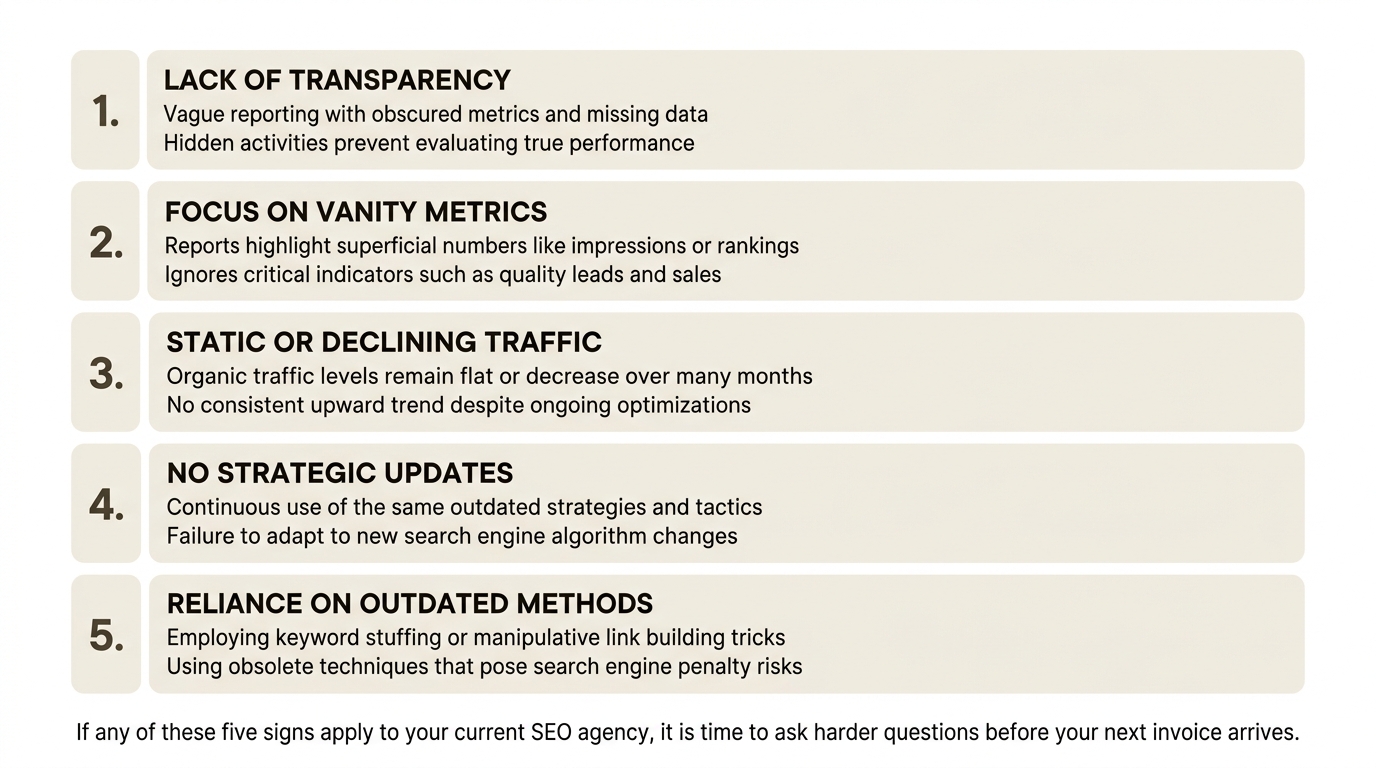
The most common failure pattern we see is this: a small business signs a 12-month contract, receives monthly reports showing “improvements” in metrics that don’t connect to revenue, and eventually cancels – having spent thousands with nothing to show for it. The reports look impressive. The results aren’t there.
There are three root causes behind most SEO disappointments. First, the agency was optimising for vanity metrics – rankings for keywords nobody searches, or traffic from audiences who would never buy. Second, the work was generic: the same templated strategy applied to every client regardless of their market, location, or competition. Third, and most damaging, there was no integration with the rest of the business’s marketing. SEO treated as a silo rarely moves the needle the way it should.
According to Semrush’s SEO statistics research, over 90% of web pages get zero organic traffic from Google. That’s not because SEO doesn’t work – it’s because most SEO work isn’t targeted or strategic enough to break through.
What a Good SEO Agency for Small Business Actually Does Month-to-Month
A good SEO agency doesn’t disappear after the onboarding call. Here’s what genuine, accountable work looks like across the core disciplines.
Technical SEO is the foundation. This means ensuring your website loads quickly, is crawlable by Google, has no broken links or duplicate content issues, and is structured in a way that search engines can understand. A website audit in month one should surface specific, prioritised fixes – not a 40-page report that leaves you more confused than when you started.
On-page optimisation means every page on your site is built around a specific search intent. Title tags, meta descriptions, header structure, internal linking, and content depth all need to work together. This isn’t a one-time job – it’s ongoing as your business evolves and as Google’s understanding of content quality changes.
Content marketing is where many small business SEO campaigns either win or lose. Creating genuinely useful, specific content that answers the questions your customers are actually asking builds authority over time. This is also where AI search and voice search are changing the game – customers increasingly ask full questions, and your content needs to answer them directly.
Link building remains one of the strongest ranking signals Google uses. Earning links from relevant, authoritative websites tells Google your business is credible. The key word is “earning” – bought links or low-quality directory spam can actively harm your rankings.
Every month, you should receive a report that connects this activity to outcomes you actually care about: enquiry form submissions, phone calls, footfall, or online sales. If your agency can’t draw that line, ask them to.
Local SEO vs Organic SEO: Which One Does Your Small Business Actually Need?
What is the difference between local SEO and regular SEO for small businesses?
This is one of the most important questions a small business owner can ask, and it’s rarely answered well. Local SEO and organic SEO are related but distinct disciplines, and choosing the wrong focus wastes time and money.
Local SEO is about appearing in searches with geographic intent – “plumber in Portsmouth,” “accountant near me,” “coffee shop Guildford.” It centres on your Google Business Profile, local citations (consistent name, address, and phone number across directories), and reviews. If your customers are physically near you, or if you serve a specific geographic area, local SEO is your highest-priority investment.
Organic SEO targets broader, non-location-specific searches. It’s about ranking for terms like “how to choose a mortgage broker” or “best project management software for construction.” This is the right focus if your business sells nationally, operates online, or wants to build authority in a topic area rather than a geography.
Most UK small businesses need both, but in different proportions. A local tradesperson needs 80% local SEO focus. An e-commerce brand selling across the UK needs the inverse. The mistake most agencies make is applying a one-size-fits-all strategy without asking this question first.
Your Google Business Profile is the single most important asset for local SEO. It controls what appears in the map pack – those three business listings that appear above organic results for local searches. Getting this right, with accurate categories, regular posts, and a steady stream of genuine reviews, can transform your local visibility faster than almost any other SEO activity.
The Questions You Must Ask Before Hiring an SEO Agency
Is it worth hiring an SEO agency for a small business?
Yes – but only if you hire the right one. The question isn’t whether SEO works; it’s whether the agency you’re considering will do it properly, report on it honestly, and connect it to your actual business goals. Here are the questions that separate good agencies from the rest.
“Can you show me results you’ve achieved for businesses similar to mine?” Not generic case studies. Specific examples, with before-and-after data, from businesses in your sector or of your size. If they can’t produce these, that tells you something important.
“What metrics will you report on, and how do they connect to revenue?” Rankings and traffic are inputs. Enquiries, leads, and sales are outputs. Any agency worth working with should be able to explain how their work translates into the second category.
“What does the contract look like, and what happens if I want to leave?” Long lock-in contracts with punishing exit clauses are a red flag. Good agencies are confident enough in their work to offer reasonable terms.
“Who will actually be doing the work?” Many agencies sell on the strength of senior staff and then hand the account to a junior team member. Know who your day-to-day contact is and what their experience level is.
“How do you approach local SEO versus broader organic SEO for my type of business?” If they can’t answer this question specifically for your situation, they’re applying a template, not a strategy.
If you want a no-pressure way to understand where your business currently stands before committing to anything, our free Social Clinic sessions audit your Google presence, website performance, and social channels – and we guarantee you’ll learn something new.
Red Flags That Should Send You Running – Hidden Charges, Vague Reports, and Empty Promises
What should I look for in an SEO agency for my small business?
Beyond the positive signals, there are specific warning signs that should make you walk away from an SEO agency before you sign anything.
Guaranteed number-one rankings. No agency can guarantee a specific position on Google. Anyone who does is either lying or planning to use tactics that will eventually get your site penalised. Google’s own guidelines make clear that no one can guarantee rankings.
Hidden charges. You agree a monthly fee, then discover that content creation, link building, or reporting are all “extras.” At Delivered Social, we operate on a no hidden charges basis – what you’re quoted is what you pay. That’s not the norm in this industry, and it should be.
Vague, jargon-heavy reports. If your monthly report is full of technical terms you don’t understand and doesn’t clearly show what changed and why it matters, that’s not transparency – it’s camouflage. Good reporting is plain English, specific, and tied to your goals.
No mention of your competitors. SEO is a competitive discipline. If your agency isn’t regularly analysing what your competitors are doing and adjusting your strategy accordingly, they’re working in a vacuum.
Pressure to sign long contracts immediately. A confident agency will give you time to make a considered decision. High-pressure sales tactics are a sign that the product doesn’t sell itself.
Think about what it means to work with an agency that treats your business like their own. That’s the standard worth holding out for. You can also explore what small businesses should consider outsourcing to understand where SEO fits within a broader decision about your marketing investment.
Why SEO Works Better When It’s Part of a Bigger Digital Strategy
Here’s something most SEO-only agencies won’t tell you: SEO in isolation underperforms. The businesses that see the strongest results from search engine optimisation are the ones where SEO is working alongside social media, paid advertising, and a well-designed website.
Consider how this plays out in practice. A potential customer searches for your service, finds your website through organic search, and lands on a page that loads slowly, looks dated, and doesn’t clearly explain what you do. They leave. Your SEO worked – your website didn’t. The two have to work together.
Social media marketing amplifies SEO in ways that are often underestimated. Content that gets shared builds brand signals. A strong social presence means that when someone finds you through search and then checks your Instagram or Facebook, they see an active, credible business. That trust factor directly affects whether they pick up the phone.
Pay Per Click (PPC) and SEO are natural partners, not competitors. PPC gives you immediate visibility while your organic rankings build. The keyword data from PPC campaigns also informs your SEO content strategy – you learn which terms actually convert, not just which ones get clicks.
This is why Delivered Social’s approach bundles SEO with social media management, website design, and paid social into integrated packages. Not because it’s a convenient upsell, but because the evidence from working with clients across sectors – from The Mary Rose museum to Pompey In The Community to Chatsworth Mortgage Group – consistently shows that integrated strategies outperform siloed ones. You can see the breadth of that work in our client showcase.
Real Results: How UK Small Businesses and Charities Have Grown Through SEO
Abstract promises about SEO are easy to make. Here’s what the work actually looks like when it’s done properly.
Take a community interest company like Waterlooville Community Events CIC. Organisations like this often have minimal marketing budgets and rely heavily on local awareness. The challenge is showing up in local searches when residents are looking for events and community activities in their area. With a properly optimised Google Business Profile, locally targeted content, and consistent citation building, a business like this can move from invisible to prominent in local search results within a few months – without a large budget.
Peters Cost Consultants is a different kind of example. A B2B professional services firm needs to rank for specific, intent-driven searches – terms that signal a potential client is actively looking for cost consultancy support on a project. Here, the SEO work centres on content that demonstrates expertise: detailed articles that answer the questions a procurement manager or project director would ask. This kind of content builds authority over time and attracts exactly the right kind of enquiry.
Then there’s the charity sector. Working with organisations like the Nasio Trust and Vision Support, the goal isn’t leads in the commercial sense – it’s visibility for causes that need public awareness and donor engagement. SEO for charities means appearing when people search for volunteering opportunities, donation pages, or specific support services. The mechanics are the same; the purpose is different. And the results matter just as much.
According to Moz’s foundational SEO resource, the first organic result on Google receives roughly 10 times more clicks than the tenth result. The difference between page one and page two isn’t marginal – it’s the difference between being found and being invisible.
How Delivered Social Approaches SEO for Small Businesses – Without the Technobabble
Can I do SEO myself or do I need an agency?
You can absolutely do some SEO yourself – and if budget is genuinely tight, starting with your Google Business Profile, ensuring your website loads quickly on mobile, and writing clear, specific content about what you do and where you do it will take you further than most people realise. There are good free tools available, and the basics are learnable.
But there’s a point where DIY SEO hits a ceiling. Technical SEO issues – crawl errors, site architecture problems, Core Web Vitals failures – require specialist knowledge and tools to diagnose and fix properly. Link building at any meaningful scale requires relationships and outreach that take significant time. And keeping up with Google’s algorithm updates, including the growing influence of AI search on how results are generated, is a full-time job in itself.
The honest answer is: do what you can yourself to understand the basics, then bring in an agency for the work that requires expertise and time you don’t have. The key is finding an agency that explains what they’re doing in plain English, reports on outcomes you actually care about, and doesn’t lock you into a contract that benefits them more than you.
At Delivered Social, we work with UK small businesses, charities, and community organisations to build digital marketing strategies that are award-winning in their results and honest in their delivery. No hidden charges. No technobabble. No vague promises about rankings that never materialise. Just measurable results, explained clearly, as part of a strategy that covers SEO, social media, website design, and paid advertising working together.
If you want to understand where your business stands right now – before committing to anything – book a free Social Clinic. We’ll audit your Google presence, your website performance, and your social channels, and we guarantee you’ll learn something new. It’s the smartest first step you can take. Explore our digital marketing packages to see how SEO fits into a full strategy built for businesses like yours.
Frequently Asked Questions
How much does SEO cost for a small business in the UK?
SEO costs for UK small businesses vary widely depending on the scope of work, the competitiveness of your market, and whether you’re focusing on local SEO, broader organic SEO, or both. What matters more than the headline figure is understanding exactly what’s included, what’s not, and how results will be measured. Be cautious of very low-cost packages that promise significant results – the economics rarely add up. As Damon at omniSEO in Cardiff puts it: “cheap SEO is like cheap surgery.” Equally, high cost doesn’t guarantee quality. Ask for a clear breakdown of what activity your budget covers each month and how that activity connects to your business goals.
How long does SEO take to show results for a small business?
For most small businesses, meaningful SEO results – measurable increases in organic traffic and enquiries – typically take between three and six months to appear, with more competitive markets taking longer. Local SEO, particularly Google Business Profile optimisation, can show results faster, sometimes within four to eight weeks. The important caveat is that “results” should be defined upfront: what specific metrics will you track, and what does success look like for your business? An agency that can’t answer this question before starting the work is one to avoid. SEO is a long-term investment, but it should never be an indefinite one with no accountability checkpoints.
Share This Article
About the Author: Jonathan Bird































