


In This Article
Most manufacturing companies treat social media like a digital brochure that nobody asked for. It’s usually a graveyard of stock photos and “happy Monday” posts that get zero traction. You probably feel like social media is a massive waste of time because your products are too technical for Instagram. You’re watching your organic reach on LinkedIn tank to a measly 1.6 percent while you struggle to find skilled engineers. It’s time to stop. Building a real social media strategy for manufacturing companies doesn’t mean acting like a lifestyle influencer. It means showing off your expertise and proving you’re the best in the business.
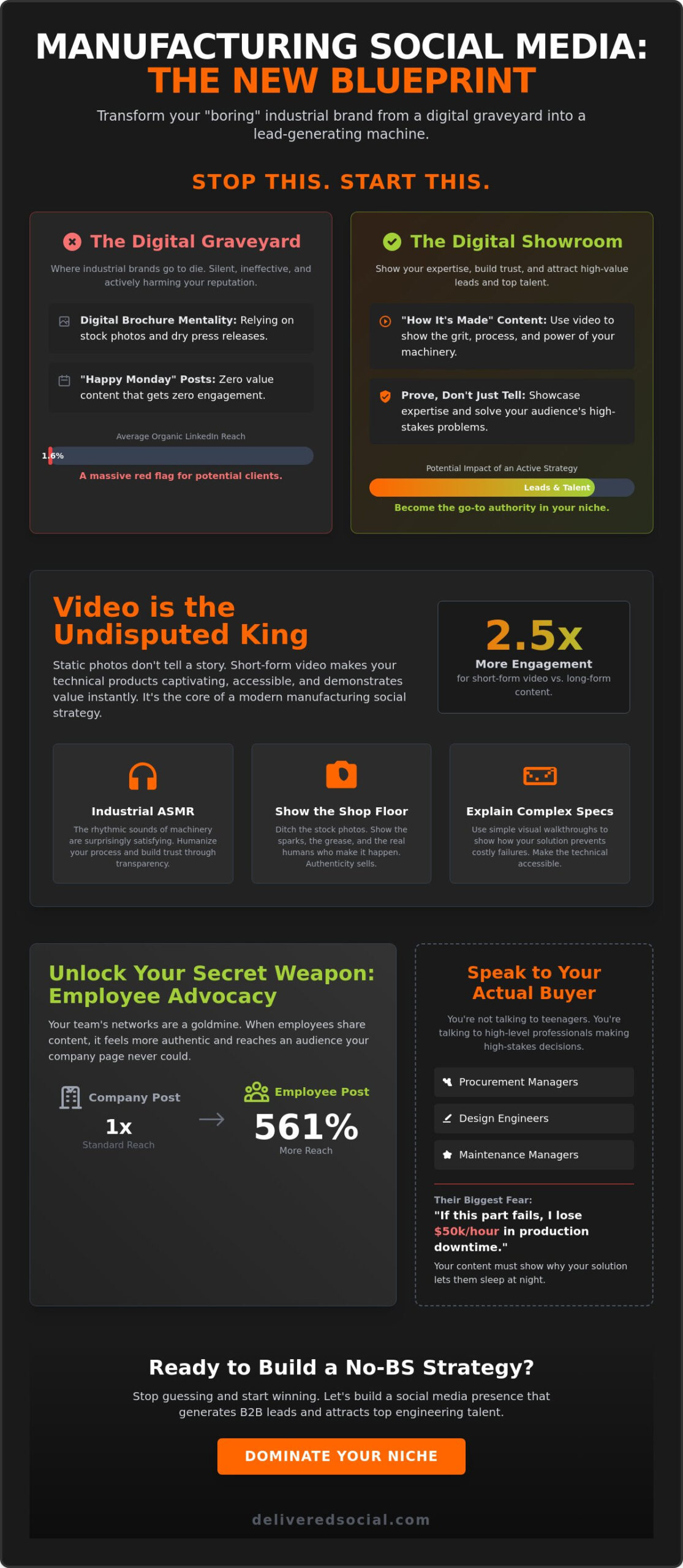
We get it. You’re busy making things that matter, and “content creation” feels like a distraction from the shop floor. But here is the truth. Your customers are doing their research online long before they ever call your sales team. We’re going to show you how to transform your “boring” industrial brand into a lead-generating machine. We’ll break down why short-form video is your new best friend for engagement and how to leverage employee advocacy to get 561 percent more reach. No corporate jargon. No fluff. Just a straight-up plan to dominate your niche and win the talent war.
Key Takeaways
- Stop acting like a digital brochure. A real strategy bridges the gap between your engineering genius and your sales targets.
- Video is king. Use ‘Industrial ASMR’ and shop-floor footage to make your technical products weirdly addictive to watch.
- Quit trying to be everywhere. Master a focused social media strategy for manufacturing companies that turns LinkedIn into a high-octane networking hub.
- Win the talent war. Show Gen Z engineers your company culture on Instagram before they even think about looking at a job board.
- Focus on what matters. Learn why ‘likes’ are a vanity metric and how to build a presence that actually generates B2B leads.
Why Most Manufacturing Social Media is a Total Snoozefest (and How to Fix It)
Most manufacturing pages look like they were designed by a robot with a hangover. You see a pixelated logo, a photo of a beige office building, and a post from 2022 about a company picnic. It’s painful to look at. A real social media strategy for manufacturing companies isn’t about being “cool” for the sake of it. It’s the functional bridge between your engineering team’s genius and your sales team’s growth targets. It’s how you prove you can solve a high-stakes problem before a prospect even picks up the phone. This is the modern reality of industrial marketing.
Falling into the dormant account trap is a silent killer for your brand. If a procurement manager checks your LinkedIn and sees nothing but crickets, they don’t think you’re “busy.” They think you’re out of business or just don’t care about the details. A dusty profile is a massive red flag. Stop treating your feed like a digital dumping ground for dry press releases or corporate awards that nobody outside your boardroom cares about. Your audience wants to know how you fix their production bottlenecks, not that you won “Supplier of the Quarter” in 2019.
There’s a common myth that technical products are “too boring” for social media. That’s total nonsense. Your technical specs are actually your best content. There is an entire world of professionals who want to see the tolerances of a CNC machine or the chemical composition of a new alloy. When you stop hiding behind corporate fluff and start showing the actual work, people pay attention.
The Shift from Brochure to Showroom
Industrial buyers are humans. They have a deep, psychological itch for “How It’s Made” style content. They want to see the sparks flying, the grease on the floor, and the raw power of your machinery in action. Ditch the shiny stock photos of models in clean hardhats who have clearly never stepped foot in a factory. Turn your feed into a showroom. Show the grit. Show the process. Show the actual humans who make the magic happen. Authentic, behind-the-scenes footage builds a level of trust that a polished brochure can’t touch.
Identifying Your Actual B2B Audience
You aren’t trying to go viral with teenagers. You’re talking to procurement managers, maintenance managers, and design engineers. These people deal with long sales cycles and high-pressure decisions. They need to know your component won’t fail at 3 AM. Your ideal buyer’s biggest headache is usually: “If this part fails, my entire production line stops and I lose fifty grand an hour.” Speak directly to that fear. Show them why your solution is the only one that lets them sleep at night.
The ‘Show, Don’t Just Tell’ Framework: Using Video to Humanise the Machine
Video is the undisputed king of any social media strategy for manufacturing companies in 2026. Static photos of a component don’t tell a story. A 15-second clip of that same part being precision-machined with sparks flying? That’s gold. Short-form video generates approximately 2.5 times more engagement than long-form content. It’s fast. It’s punchy. It’s exactly what B2B buyers want when they’re scrolling through a busy feed. You don’t need a massive script. You just need to show the work.
Industrial ASMR is a real thing. It sounds strange, but people find the rhythmic clinking of a conveyor or the hiss of a pneumatic press strangely satisfying to watch. This isn’t just for “likes” or vanity metrics. It’s about humanising your machinery. When you show the raw, unedited reality of your shop floor, you’re being transparent. Transparency builds a level of trust that a glossy brochure simply can’t touch. Trust is what closes high-value contracts in the manufacturing world.
Video also bridges the gap between your lead engineer and a procurement manager who doesn’t have a technical degree. You can Leverage Digital Strategies For Brand-Building by using simple visual walkthroughs to explain complex technical specs. If you can show a buyer exactly how your solution prevents a fifty-grand-an-hour production line failure, you’ve already won the argument. It’s about making the technical accessible without losing the authority.
Short-Form Video for Industrial Giants
You don’t need a Hollywood crew for every post. Reels and TikTok are perfect for quick process highlights or a “day in the life” of your floor manager. Grab a smartphone. Find a spot with decent light. Record the action. It’s that simple. Time-lapse videos are another massive win for manufacturers. Watching a massive project go from raw steel to a finished assembly in thirty seconds is incredibly compelling. It proves your capability and scale in a format that’s easy to digest and share.
Professional Video Production vs. Raw Content
There’s a time for raw footage and a time for the big guns. For your daily engagement and “behind the curtain” updates, stick to the smartphone. It feels real and authentic. But when you’re launching a flagship product or telling your brand’s origin story, you need a professional video production team. High-stakes brand films need that extra polish to command authority in the boardroom. The trick is balancing the two. Too much polish looks fake; too much raw footage looks amateur. If you want to get this balance right, our Video Production services are designed to make you look like the industry leader you are.
Platform Prioritisation: Where Your B2B Buyers Actually Hang Out
Stop trying to be everywhere. It’s a trap. Most firms spread themselves too thin and end up looking mediocre on five different platforms. You don’t need a presence on every shiny new app. You need a social media strategy for manufacturing companies that focuses on where the decision-makers actually spend their time. If your buyers are procurement heads and design engineers, focus equals results. Doing one platform brilliantly is better than being invisible on four.
LinkedIn is your non-negotiable hub. With over 1.2 billion users, it’s the undisputed king of B2B networking. But don’t just dump content on your company page and hope for the best. Organic reach for company pages has dropped to a tiny 1.6 percent. You have to get your people involved. Content shared by employees gets 561 percent more reach than corporate posts. It’s about personal authority and real human connections, not just corporate broadcasting.
LinkedIn: The Industrial Networking Powerhouse
Your MDs and Sales Directors need sharp, professional profiles. They are the face of the business. Join industry groups, but don’t just spam links to your latest product page. Actually contribute to the conversation. Answer technical questions. Be the helpful expert. When you’re ready to scale, use LinkedIn ads to target specific job titles at specific companies. It’s laser-focused marketing that cuts through the noise and puts your brand in front of the people who sign the cheques.
YouTube as a Technical Manual
YouTube is the second largest search engine on the planet. Engineers don’t just want to be sold to; they want to solve problems. Your service department’s FAQs are a goldmine for content. If people are calling to ask how to calibrate a specific machine or optimise a production line, make a video about it. This is evergreen content. It works for you 24/7 while your sales team is asleep. Good SEO for YouTube ensures you get found exactly when an engineer is searching for a solution to their latest technical headache.
Instagram and Facebook are your secondary tier. These platforms are perfect for community building and “employer branding.” Use them to show off your company culture and the people behind the machines. You aren’t necessarily looking for a million-pound contract here. You’re building the authority and the “cool factor” that makes those contracts easier to close elsewhere. It’s about proving you’re a modern, thriving business that people actually want to work with.
Social Media for Recruitment: Solving the Manufacturing Skills Gap
Recruitment in the industrial sector is a nightmare right now. You’re likely fighting over the same small pool of skilled engineers while your recruitment agency fees spiral out of control. It’s a mess. But here is the thing. A smart social media strategy for manufacturing companies isn’t just a tool for finding new customers. It’s your most powerful weapon for finding the people who will actually build your products. If you’re still relying on dry job boards and hoping for the best, you’re already behind the curve.
Gen Z engineers and tech-savvy apprentices don’t start their job search on a dusty careers page. They go to Instagram. They go to TikTok. They want to see the vibe of the shop floor before they ever hit “apply.” They’re looking to see if your facility is a dark, greasy relic of the past or a high-spec hub of innovation. If your social presence is non-existent, they’ll assume your tech is too. Building an employer brand is about proving that your factory is a place where people actually want to spend forty hours a week.
Attracting the Next Generation of Engineers
You need to make manufacturing look as “cool” as it actually is. Stop posting generic “we are hiring” graphics. Instead, show off your cobots, your 3D printing capabilities, and your high-spec CNC machines in action. Highlighting career progression through real storytelling is vital. Show an apprentice who is now a lead technician. Talk about the complex problems they solve every day. When you shift the narrative from “dirty manual labour” to “high-tech problem solving,” you start attracting the talent that usually heads for Silicon Valley.
Employee Advocacy: Your Best Salespeople are on the Shop Floor
People trust people. They don’t trust faceless corporate logos. Your best recruiters aren’t in HR; they’re the people running your production lines. Encourage your staff to share their wins on LinkedIn. Whether it’s a finished assembly they’re proud of or a new certification they’ve earned, that raw social proof is worth more than a thousand polished job ads. This “human factor” puts a face to your brand. It builds a culture that people want to be part of, which naturally reduces turnover and attracts passive candidates who weren’t even looking for a move.
If your recruitment efforts are stalling and your talent pipeline is looking thin, it’s time to get serious. We can help you build a presence that makes the best engineers in the country want to work for you. Take a look at our Social Media Management services to see how we turn shop floors into talent magnets.
Building a No-BS Manufacturing Strategy with Delivered Social
Building a social media strategy for manufacturing companies shouldn’t feel like a chore. It should feel like an investment. Most agencies will try to dazzle you with “reach” and “impressions.” We won’t. Reach is great, but it doesn’t pay for new machinery or cover the payroll. You need a partner who understands that “likes” are just vanity metrics. We focus on the numbers that actually move the needle: high-quality B2B leads, genuine engagement from decision-makers, and a recruitment ROI that makes sense. Our approach is results-driven, fluff-free, and intentionally high-energy. We strip away the corporate jargon and get straight to the work that generates revenue.
We take the pain out of the process from day one. It starts with a blunt audit of where you are right now. Then, we move into execution. Whether you need help with technical content or full-scale social media management, we handle the heavy lifting. We make sure your technical expertise is front and centre. It’s about taking the genius of your engineering team and translating it into content that sells. We don’t just post for the sake of it; we post to win.
Integrated Marketing: Beyond Just Social
A great social media presence is useless if it leads to a website that looks like a relic from 2005. Your digital presence needs to be a cohesive machine. Social media traffic should feed directly into your SEO services, boosting your authority and driving organic growth. This is why working with a digital marketing agency that sees the big picture is vital. We ensure your website is ready for the traffic social media sends its way. If your site isn’t converting, your social media effort is just wasted energy.
Stop Talking and Start Doing
The biggest mistake you can make is waiting for the “perfect” time to start. There is no perfect time. There is only right now. We challenge you to a 30-day manufacturing social media challenge. Post one raw video, one technical tip, or one behind-the-scenes shot every day. Don’t worry about Hollywood production values. “Imperfect and active” beats “perfect and dormant” every single time. Your audience wants to see the real you, not a polished corporate mask.
Ready to stop being the best-kept secret in your industry? Let’s have a chat. No high-pressure sales pitches and no corporate fluff. Just a straight-up look at your potential and a plan to get you there. Reach out today and let’s start building something that actually works for your business.
Stop Being Invisible and Start Dominating Your Niche
Manufacturing is about solving high-stakes problems with precision. Your digital presence should reflect that same level of expertise. We’ve covered why you need to ditch the dusty brochures, embrace the power of “Industrial ASMR” video, and focus your energy where your buyers actually spend their time. It’s about showing the grit, the sparks, and the human faces that make your business a leader. Executing a high-impact social media strategy for manufacturing companies doesn’t require a corporate committee; it just requires a plan that prioritises real-world results over vanity metrics.
At Delivered Social, we take a blunt, no-BS approach to digital growth. Our full-service video production and creative team knows exactly how to make heavy machinery look like the cutting-edge tech it is. We have a proven track record with B2B and industrial clients who are tired of the same old agency fluff. We don’t do boring. We do growth that actually shows up on your bottom line.
Ready for a social media strategy that doesn’t suck? Let’s chat. You’ve built an incredible business. It’s time the rest of the industry saw it in action. Let’s get to work and make it happen.
Frequently Asked Questions
Is social media worth it for B2B manufacturing companies?
Absolutely. Your customers are already looking for you online before they ever think about picking up the phone. A solid social media strategy for manufacturing companies ensures you’re the one they find when they start their research. It’s about building a digital footprint that proves you’re a real, thriving business. Without it, you’re just a name on a spreadsheet that’s easily ignored by modern procurement teams.
Which social media platform is best for industrial businesses?
LinkedIn is the non-negotiable leader for reaching procurement managers and executives. It’s where 85 percent of B2B marketers saw their best results in 2025. YouTube is a close second for technical demonstrations and “how-to” content that engineers love. Don’t ignore Instagram; it’s the perfect place to show off your shop floor culture to potential new hires who want to see your modern tech in action.
How much time should a manufacturing company spend on social media?
You don’t need to live on your phone to see results. Focus on quality over quantity. Spending three to five hours a week on targeted engagement and strategic posting is plenty for most mid-sized firms. The goal is to stay active so your profile doesn’t look like a ghost town. Consistency matters more than dumping ten posts in one day and then disappearing for a month.
Can social media actually generate leads for technical products?
Yes, but don’t expect a “buy now” button to do the heavy lifting. It generates leads by positioning your brand as the expert solution to a specific technical problem. When an engineer sees your machine solving a bottleneck they’re currently facing, you’ve started the sales conversation. It’s about warming up high-value prospects throughout their long research phase until they’re ready to talk specs.
What kind of content should a factory post on social media?
Post the stuff that actually happens on your floor. Show the sparks flying, the precision of your CNC machines, and the faces of the people making it happen. Technical “quick tips” that solve common maintenance issues are also huge for engagement. People love seeing the process. If a piece of machinery is interesting to your shop manager, it’s probably going to be interesting to your customers too.
How do I measure the ROI of my social media strategy?
Stop looking at “likes” and start looking at your CRM. Track how many new enquiries mention your LinkedIn posts or how many job applicants saw your Instagram feed. Look at your website traffic from social sources to see who is actually clicking through. If your recruitment fees are dropping because people are applying directly through your social channels, that’s a massive, tangible win for your bottom line.
Should we use LinkedIn Ads for manufacturing?
Use them if you want to target specific job titles at specific companies with surgical precision. The average cost-per-click on LinkedIn is currently $5.26, so it’s an investment, but the lead quality is often much higher than on general platforms. It’s a high-octane tool for getting your solution in front of the exact person who has the power to sign off on a major contract.
How can social media help with the manufacturing skills gap?
It’s your best recruitment tool for the next generation. By showing off your modern tech and a positive work environment, you make manufacturing look like the high-tech career it actually is. Gen Z engineers want to work with cobots and 3D printers. If they see that in your feed, they’ll choose you over a competitor who still looks like they’re stuck in the dark ages.
Share This Article
About the Author: Jonathan Bird































