



Keep reading
Rather we just did it for you?
Let's get your business seen.
Social media, websites, SEO and ads from a team you can actually meet.
UK Charity Website Design: Built for Mission, Not Just Looks
Your charity’s website isn’t just a digital brochure – it’s the difference between someone donating, volunteering, or clicking away to a cause that made it easier. If your site isn’t converting visitors into supporters, you’re not alone. Most charity websites are built to look presentable, not to perform. And that gap costs real money, real volunteers, and real impact.
This guide shows you exactly what the best UK charity websites do differently. We’ll cover the must-have features your site needs to actually work, the Google Ads Grant opportunity worth up to £7,500 per month that most small charities completely miss, and the questions you should ask any agency before signing a contract. By the end, you’ll know how to make every penny of your budget count – and how to build a website that works as hard as your team does.
If you’re already thinking about getting your charity’s digital presence sorted, take a look at our dedicated charity services page to see how we support third sector organisations from day one.
Why Your Charity Website Is Your Most Important Fundraising Tool
Your website is open 24 hours a day. Your fundraising team isn’t. That asymmetry matters more than most charity leaders realise. A well-built site can process donations, recruit volunteers, answer questions, and build trust with potential supporters while your staff are focused elsewhere.
The best charity websites share a few things in common: they communicate their mission within seconds of landing on the homepage, they make the next action obvious (donate, volunteer, get help), and they load fast enough that a supporter on a mobile phone doesn’t give up waiting. According to research from Charity Digital, the majority of charity website traffic now comes from mobile devices – yet many third sector sites are still built with desktop-first thinking.
There’s also a trust dimension that’s unique to charities. Visitors to a charity website are often in a vulnerable moment – they may be seeking help, grieving, or deciding whether to give money to a cause they care about. A site that feels outdated, slow, or confusing doesn’t just lose a click. It loses confidence. That’s why user experience (UX) design for charity websites isn’t a luxury – it’s the foundation everything else is built on.
Think about what you want your website to actually do. Increase donations? Recruit volunteers? Provide resources to people who need them? Each goal requires different design decisions, different calls to action, and different content. Getting clear on purpose before you brief an agency is the single most important thing you can do to protect your budget.
What Every UK Charity Website Needs to Actually Work (Feature Checklist)
There’s a long list of features that get sold to charities as essential. Most aren’t. Here’s what genuinely moves the needle, based on what we’ve seen work across the third sector.
Clear, prominent calls to action. Every page should have one primary action you want the visitor to take. Not three. Not five. One. Whether that’s “Donate Now”, “Volunteer With Us”, or “Get Support”, the button needs to be visible without scrolling and written in plain language. Charity websites that bury their donation button below three paragraphs of history lose supporters before they’ve had a chance to connect.
Responsive design across all devices. Your site must work flawlessly on a phone, a tablet, and a desktop. This isn’t optional – it’s a baseline. Google uses mobile-first indexing, which means a site that performs poorly on mobile will rank lower in search results, reducing the organic traffic you’d otherwise receive for free.
A content management system (CMS) your team can actually use. WordPress remains the most widely used CMS for charity websites in the UK, and for good reason. It’s flexible, well-supported, and doesn’t require a developer every time you want to update a news post or change an event date. Whatever platform your site is built on, your team should be able to manage day-to-day content without needing technical help.
Donation forms that keep supporters on your site. Third-party donation platforms have their place, but every redirect away from your site is a risk. Custom donation forms that keep the user journey on your domain give you more control, more data, and a more consistent brand experience. If you need CRM integration with tools like Salesforce or Beacon, that should be scoped into the build from the start – retrofitting it later is expensive.
Fast load times and clean site structure. Page speed affects both user experience and search rankings. A site that takes more than three seconds to load on mobile will lose a significant portion of visitors before they’ve seen a single word of your content. Clean navigation, logical page hierarchy, and well-structured URLs also make it easier for Google to crawl and index your site – which matters enormously if you’re planning to use the Google Ads Grant.
Google Analytics integration. You cannot improve what you cannot measure. Every charity website should have Google Analytics set up from day one, with goal tracking configured for donations, form submissions, and key page visits. This data tells you what’s working, what isn’t, and where to focus your next round of improvements.
The Google Ads Grant Opportunity Most Charities Are Missing
Here’s something that almost no charity web design agency talks about: the design of your website directly determines whether you can access – and keep – the Google Ads Grant.
The Google Ads Grant gives eligible UK charities up to $10,000 (roughly £7,500) per month in free Google Search advertising. That’s free traffic to your website, every single month, from people actively searching for the services or causes you support. Most small charities either don’t know it exists, or they apply and then fail to maintain the account because their website isn’t built to support it.
To qualify and stay compliant, your website must meet specific requirements. It must have a clear mission statement. It must not be primarily a commercial site. It must load quickly and be free of broken links. Critically, every page that a Google Ad points to – called a landing page – must be directly relevant to the ad’s content and must have a clear call to action. A generic homepage with no specific focus will underperform badly as a Grant landing page, wasting your entire monthly budget.
This is where website design and paid advertising strategy become inseparable. When we built the new website for Vision Support, a charity supporting people with sight loss, we built it specifically with their Google Ads Grant in mind. The site structure, the landing pages, the calls to action – all of it was designed to maximise the performance of their Grant campaigns from day one. The result was a website that didn’t just look good; it actively worked to bring in the people who needed Vision Support’s services most.
If you’re working with an agency that treats your website and your Google Ads as separate projects, you’re leaving money on the table. The two need to be planned together. Your site structure should reflect the search terms your Grant campaigns will target. Your landing pages should match the intent of the people clicking your ads. And your conversion tracking should be set up so you can prove the Grant is delivering real impact – which Google requires you to demonstrate to keep the account active.
For charities thinking about how to get the most from their digital budget, understanding what to outsource to a digital agency versus what to manage in-house is a useful starting point. The Grant strategy is almost always worth outsourcing – the compliance requirements alone are a full-time job if you’re not already familiar with Google Ads.
What is the Google Ads Grant and how does it work with a charity website?
The Google Ads Grant is a programme run by Google that provides registered charities with up to $10,000 per month in free Google Search advertising credits. To use it effectively, your charity website must have dedicated landing pages that match the intent of your ad campaigns, fast load speeds, clear calls to action, and no broken links or low-quality content. The Grant is not automatic – you apply through Google for Nonprofits, and your account must maintain a minimum click-through rate and meet quality score thresholds to stay active. Building your website with the Grant in mind from the start is the most efficient way to make it work.
Accessibility Isn’t Optional: What UK Charity Websites Must Get Right
Under the Equality Act 2010, charities have a legal duty to make reasonable adjustments to ensure their services are accessible to people with disabilities. For a charity website, this means meeting the Web Content Accessibility Guidelines (WCAG) – the internationally recognised standard for digital accessibility.
This matters more for charities than almost any other type of organisation. Many charities serve people with visual impairments, cognitive disabilities, or physical conditions that affect how they use the internet. A website that isn’t accessible doesn’t just fail a legal test – it actively excludes the people you’re trying to help.
Practically, WCAG compliance means: sufficient colour contrast between text and backgrounds, alt text on all images, keyboard navigability for users who can’t use a mouse, captions on video content, and clear heading structures that work with screen readers. It also means avoiding auto-playing audio or video, which can be disorienting for users with certain conditions.
When we built the website for VOICES Charity, accessibility was central to the brief. VOICES supports people who have experienced trauma, and the site needed to feel safe, calm, and easy to navigate for users who might be in a distressed state. The team at Delivered Social worked closely with VOICES throughout the build to ensure every design decision served the people using the site, not just the people commissioning it. As Tara from VOICES put it: “You may not be aware of how many people you are helping and even saving by creating this amazing website.”
Accessibility also has a direct impact on your Google Ads Grant performance. Google’s quality score algorithm rewards pages that provide a good user experience – and accessibility is a core component of that. A site that’s hard to use for people with disabilities will also tend to have higher bounce rates and lower engagement, both of which drag down your Grant account’s performance metrics.
For more on how to build trust through your website design, our guide on how to build trust through your charity website covers the specific design signals that make visitors feel confident enough to donate or engage.
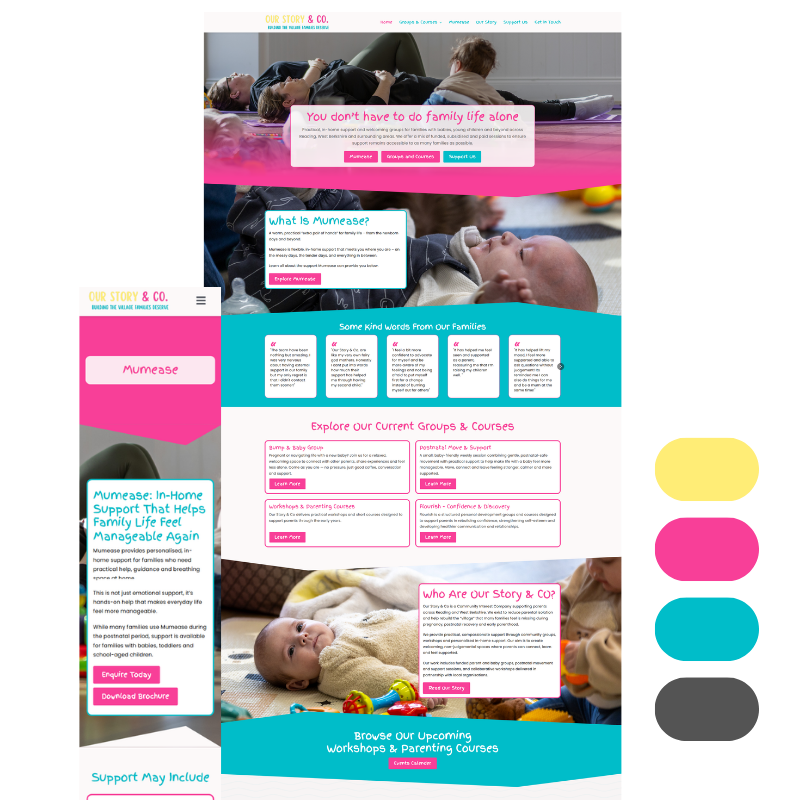
Our Story and Co, actual clients of Delivered Social and their brand new charity website
How to Choose a Charity Web Design Agency in the UK (Questions to Ask)
Most charity web design agencies will show you a portfolio and quote you a price. That’s not enough information to make a good decision. Here are the questions that actually matter.
Have you built websites specifically for charities, and can you show me examples? Generic web design experience doesn’t translate automatically to the third sector. Charity websites have specific requirements around donation processing, accessibility, CMS usability for non-technical staff, and Grant compliance. Ask to see real charity projects, not just commercial ones.
Do you understand the Google Ads Grant, and can you build my site to support it? If the agency looks blank when you mention the Grant, walk away. This is a £7,500/month opportunity that requires specific technical and structural decisions at the build stage. An agency that doesn’t factor it in is leaving your charity significantly worse off.
Who will actually build my site, and will I have a named contact throughout? Many agencies sell the work and then hand it to a junior team or a freelancer. Ask specifically who will be working on your project. When Run Walk Local Portsmouth came to us for a full website rebuild, they worked directly with Thomas and Edwin throughout the build, with regular progress updates at every stage. That level of transparency matters – especially when you’re a small charity with limited time to manage a complex project.
What happens after launch? A website that isn’t maintained, updated, and supported will degrade quickly. Ask about hosting, security updates, content support, and what the process is if something breaks. No hidden charges should be the baseline expectation, not a selling point.
Can you support our wider digital presence beyond the website? Your website is the hub, but it needs spokes. Social media, SEO, paid advertising, and content production all feed traffic to your site and amplify its impact. An agency that can support all of these – ideally in a bundled package – will deliver far more value than one that builds the site and disappears.
How do I choose a charity web design agency in the UK?
Look for an agency with a proven track record of charity-specific projects, not just general web design experience. Ask directly whether they understand the Google Ads Grant and can build your site to support it. Check that they offer transparent pricing with no hidden charges, a named contact throughout the project, and post-launch support. The best agencies will treat your website as part of a wider digital strategy, not a standalone deliverable.
What Does Charity Website Design Cost in the UK?
Costs vary significantly depending on the complexity of the build, the features required, and the agency you choose. A basic charity website with a CMS, responsive design, and donation forms will cost less than a fully custom build with CRM integration, member areas, and bespoke functionality.
What matters more than the upfront cost is the total value delivered. A website that’s built to support your Google Ads Grant can generate the equivalent of thousands of pounds in free advertising every month. A site that’s built cheaply but fails to convert visitors, loads slowly, or falls foul of Grant compliance requirements will cost you far more in lost opportunity than you saved on the build.
For newly registered charities or those with very limited budgets, it’s worth knowing that some agencies offer packages specifically designed for the third sector, with no hidden charges and support built in from the start. Free initial consultations – like the Social Clinics we offer at Delivered Social – can also help you understand exactly what your site needs before you commit to any spend.
Josh Halsey, founder of Chatsworth Mortgage Group, described his experience as a brand new business owner: “There were so many things I needed help with. I am so happy with my website and I could not recommend Delivered Social enough.” The same principle applies to new charities – getting the right support at the start saves significant time and money later.
Real Charity Websites We’ve Built – and What Made Them Work
The best way to understand what good charity website design looks like in practice is to look at real projects, not stock photography and generic case study summaries.
When Vision Support approached us, they needed more than a new website. They needed a digital platform that would work in tandem with their Google Ads Grant to reach people with sight loss across their region. We travelled to Chester to film on-location content with their team, ensuring the site had authentic, high-quality visuals that reflected the real people behind the charity. The site was built with Grant-ready landing pages, clear navigation for users with visual impairments, and a structure that Google’s crawlers could index efficiently. Kate from Vision Support said: “They have a great attitude and are so creative.” That creativity wasn’t decorative – it was functional, designed to convert visitors into people who felt connected enough to reach out.
For VOICES Charity, the challenge was different. The site needed to serve people in crisis, which meant every design decision had to prioritise clarity, calm, and ease of use above everything else. The team at Delivered Social supported VOICES through every stage of the build, from initial brief to final launch. The result was a website that Tara from VOICES described as potentially “helping and even saving” people – a reminder that for charities, the stakes of getting this right are genuinely high.
Both projects share a common thread: the website was never treated as a standalone deliverable. It was built as the foundation for a broader digital strategy, with SEO, content, and paid advertising all considered from the start. That’s the difference between a website that looks good on launch day and one that keeps working harder for your charity months and years later.
You can see more of our charity and client work on our project showcase, including the full range of website builds and digital campaigns we’ve delivered.
Beyond Launch: Why Your Website Needs Ongoing Content and Social Support
A website launch is not the finish line. It’s the starting gun. The charities that get the most from their digital investment are the ones that treat their website as a living platform, not a one-time project.
Search engines reward fresh, relevant content. A charity that publishes regular updates, impact reports, volunteer stories, and news will consistently outrank one that launched a beautiful site and then left it static. This matters directly for your Google Ads Grant – Google requires Grant accounts to maintain a minimum click-through rate, and landing pages with current, relevant content perform significantly better than outdated ones.
Social media amplifies your website’s reach. Every piece of content you publish on your site is an opportunity to drive traffic from Facebook, Instagram, LinkedIn, or X. A coordinated content strategy that connects your social channels to your website creates a compounding effect: more traffic, more engagement, better search rankings, and a stronger case to Google that your Grant account is delivering real value.
Video and photography also play a bigger role than most charities realise. Authentic visual content – real people, real stories, real impact – builds the kind of trust that stock imagery never can. It also performs better in social media feeds, in Google Ads, and on landing pages. Our award-winning team can handle content production as part of your wider package, so your website always has the material it needs to stay compelling.
The charities that show up where it matters – in search results, in social feeds, in the inboxes of potential donors – are the ones that treat their digital presence as an ongoing investment, not a one-off expense. If you’re ready to build a website that works harder for your mission, get in touch with our team today and let’s talk about what’s possible.
Frequently Asked Questions
What features should a charity website have?
A charity website needs clear calls to action on every page, responsive design that works across all devices, a CMS that non-technical staff can manage, fast load speeds, and donation forms that keep supporters on your site. Accessibility features meeting WCAG standards are also essential, both legally and practically. If you plan to use the Google Ads Grant, your site also needs dedicated landing pages matched to your ad campaigns, clean URL structure, and Google Analytics with goal tracking configured from day one.
Can charities get free website design in the UK?
Some agencies offer discounted or pro bono work for charities, and there are grant programmes that can fund website builds. The Google Ads Grant doesn’t pay for the website itself, but it provides up to £7,500 per month in free advertising once your site is live and compliant. Some digital agencies, including Delivered Social, offer free initial consultations (Social Clinics) that can help you understand your options before committing to any spend. It’s worth exploring whether your charity qualifies for any technology grants through bodies like the National Lottery Community Fund before approaching agencies.
What CMS is best for a charity website?
WordPress is the most widely used CMS for charity websites in the UK and remains the most practical choice for most organisations. It’s flexible enough to support donation forms, member areas, and CRM integrations, while being accessible enough for non-technical staff to manage day-to-day content. The key is ensuring the build is set up correctly from the start – a poorly configured WordPress site can be slow, insecure, and difficult to maintain. Whatever CMS you choose, your team should be able to update content, add pages, and manage events without needing a developer every time.
Do charity websites need to be accessible under UK law?
Yes. Under the Equality Act 2010, charities have a legal duty to make reasonable adjustments to ensure their services are accessible to people with disabilities. For websites, this means meeting the Web Content Accessibility Guidelines (WCAG) – the internationally recognised standard covering colour contrast, keyboard navigation, screen reader compatibility, alt text, and more. Public sector bodies have stricter statutory obligations, but charities serving vulnerable audiences face both legal and reputational risk if their sites exclude users with disabilities. Accessibility also improves your Google Ads Grant performance, as Google rewards pages that deliver a good user experience.
































