





In This Article
Scroll through your feed and you’ll notice something: ads are everywhere, but nobody is paying attention. Consumers have mastered the art of tuning them out—whether it’s through ad blockers, skipping buttons, or simply scrolling past without a glance. The old playbook of “shout louder, sell harder” has lost its edge.
What hasn’t lost power is storytelling. Humans are wired for it. We lean in when we hear a personal journey, a struggle, or a triumph.
Unlike ads, stories don’t feel like someone is selling to you—they feel like someone is connecting with you. And in the digital age, where competition for attention is fierce, authentic narratives have become the most effective tool brands can use.
Keep on reading to learn how stories shape memory, influence emotion, and inspire action in ways that ads never could.
The Psychology of Storytelling in the Digital Age
Storytelling isn’t a marketing tactic—it’s a human instinct. For thousands of years, stories were how knowledge was passed down, communities were built, and values were shared. Today, neuroscience proves what our ancestors already knew: stories stick. As Kirstie Hall, CMO at Fursonafy, says, “People don’t usually remember the most polished message or the smartest campaign line. They remember the part that felt real. A story gives people something they can picture, connect with, and carry with them after they’ve moved on from the post or ad.”
Studies show that people remember stories 22 times more than facts alone. That’s because stories activate more areas of the brain, engaging both rational thought and emotional response. When someone hears a compelling story, their brain releases oxytocin—the same chemical tied to empathy and bonding.
Digital platforms have supercharged this natural tendency. A heartfelt founder’s story on LinkedIn, a short-form TikTok showing behind-the-scenes struggles, or a YouTube video documenting customer transformations—these aren’t just “posts.” They’re modern campfires, places where people gather to feel something real.
The digital twist is scale. A story that once reached a village now reaches millions in seconds. This amplification makes storytelling not just a nice-to-have, but a core competitive advantage.
Over the past five years, interest in storytelling-driven campaigns has surged by nearly 50%, with search volumes climbing steadily.
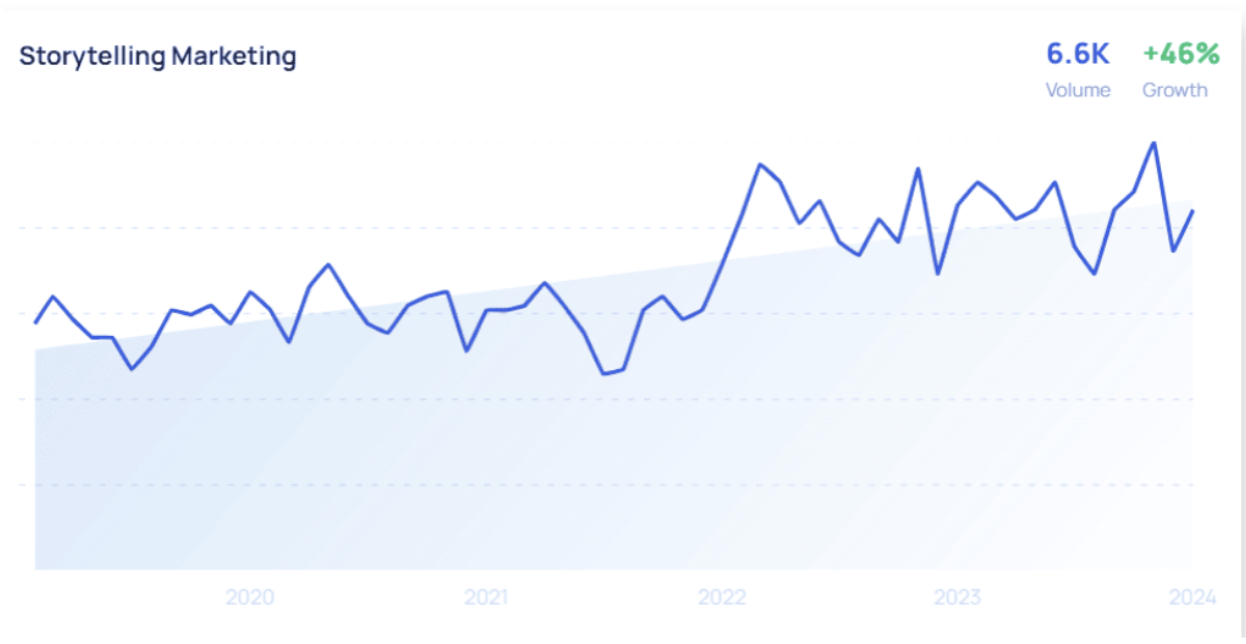
Source: Leapmesh
That kind of growth signals more than curiosity; it shows a shift in how businesses and audiences alike are rethinking what effective marketing looks like. Instead of chasing clicks with generic ads, brands are leaning into stories that spark connection, build trust, and stay memorable long after the scroll. That kind of shift also reflects what creative teams are seeing firsthand when they work on brand messaging across digital channels.
Nibin Varghese, Creative Director at Bless Web Designs, adds, “When you’re building websites or shaping a brand’s online presence, you quickly realize that design alone isn’t what people remember. What stays with them is the story behind the brand. If visitors understand the journey or the purpose behind a company, the entire experience feels more meaningful.”
Why Authenticity Matters More Than Ever
The internet has given consumers more power than ever before. With a single Google search or Reddit thread, people can uncover whether a brand is genuine or just putting on a polished act. That’s why authenticity has become the currency of modern marketing. Rachel Sinclair, Acquisitions Director at US Gold and Coin, mentions, “When people invest in something valuable — whether it’s gold, collectibles, or even a brand they want to trust — they rarely rely on marketing alone. They look for signals of authenticity. In our industry, transparency and real history matter more than polished claims, and the same principle applies to how brands communicate online.”
Authenticity means telling stories that are messy, raw, and real. Not every founder journey is glamorous. Not every customer experience is flawless. Yet, when brands embrace transparency, people lean in. They see themselves reflected in those imperfect but honest narratives.
Consider the difference between a glossy ad campaign showing models sipping coffee in perfect lighting, versus a café owner sharing their 5 a.m. grind of roasting beans, experimenting with flavors, and interacting with locals. The first looks nice, but it feels staged. The second feels human—and therefore trustworthy.
Consumers reward brands that show vulnerability. That could be admitting mistakes, revealing struggles, or spotlighting the people behind the logo. Ads might tell you what to buy. Authentic stories show you why it matters. Karen Noryko, Career Content Director at Jobtrees.com, adds, “When we look at how professionals research companies or career paths, the content that resonates most is rarely the polished corporate message. What people respond to are honest stories about how someone built their career, faced challenges, and figured things out along the way. That kind of transparency makes information feel credible rather than manufactured.”
Stories as the New Social Proof
Social proof has always been the backbone of persuasion. People trust people more than they trust companies. But social proof in 2025 has evolved beyond static reviews and star ratings. Now, it’s all about stories.
According to Ashley Durmo, CEO of Chalet, “When people are exploring lifestyle brands or experiences, they rarely make decisions based on a brand’s own message alone. What usually influences them is hearing someone else describe their experience in a real, relatable way. A personal story about how something fits into someone’s life often carries more weight than a perfectly crafted promotion.”
When buyers narrow down their options, the decision isn’t final. Most still do another round of research—and it’s in this stage that social proof carries the most weight.
Reviews, expert opinions, comparison sites, and customer testimonials can sway nearly every shopper, with close to 9 in 10 saying these sources shape their final choice. It’s a reminder that reputation isn’t just about getting on the shortlist—it’s about winning trust when it matters most, explains Jake Ryland, Senior Consultant at Bullet Proof Supply Store.
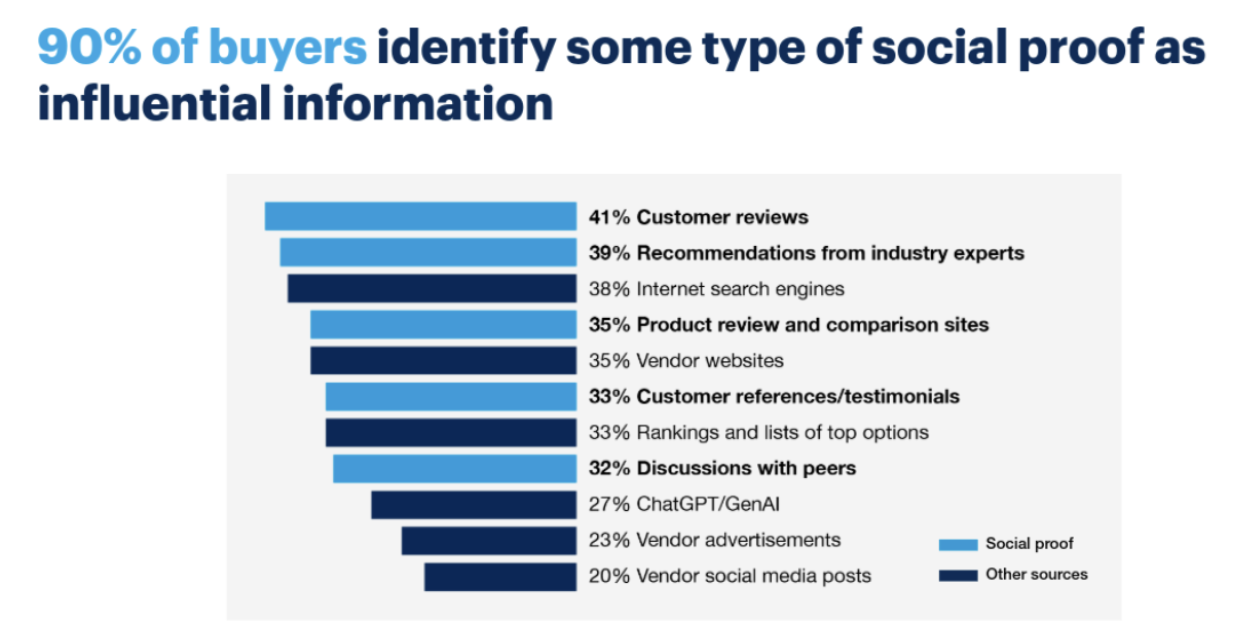
Source: Gartner
When a customer posts a TikTok about how a skincare product helped them regain confidence, it carries more weight than a celebrity endorsement. When a business professional shares their career transformation because of an online course, that story resonates far deeper than a polished testimonial on a website.
Platforms like TikTok, Instagram Reels, and YouTube Shorts have turned everyday users into storytellers. This shift has made authentic customer stories one of the most powerful growth engines for brands. They don’t just validate a product’s quality—they build community.
Htet Aung Shine, Co-Founder of NextClinic, shares, “When people talk about their experiences with a service or platform, what makes others pay attention is the story behind it. In industries like healthcare or digital services, trust grows when someone explains how a product or service actually helped them solve a real problem. Those stories feel far more credible than any marketing claim.”
Social proof used to be a star rating. Today, it’s a narrative. And those narratives not only spread faster but also feel more believable because they come from real people, not marketing departments.
Emotional Resonance vs. Transactional Messaging
Traditional ads are transactional by design. They highlight features, discounts, or urgency. But the problem is, people don’t form lasting connections with discounts—they form connections with emotions.
In an interview, LJ Tabango, Founder & CEO of Leak Experts USA, mentions, “When homeowners call us about a leak, it’s rarely just about a pipe or a repair. There’s usually a story behind it — maybe water damaged something meaningful in their home or they’re worried about a bigger issue spreading through the property.”
Stories win because they create resonance. They don’t just tell someone what a product does; they show how it feels to use it, or how it changes a life. A nonprofit doesn’t get donations by listing its operating budget—it compels action by sharing the story of one individual whose life was transformed.
For businesses, the lesson is clear: emotion beats transaction. Transactional messaging might get a click, but emotional storytelling builds loyalty, advocacy, and long-term growth.
In the digital world, storytelling also plays a role in how people interpret information itself.
“When we analyze writing patterns, it’s clear that human stories follow a very different rhythm than purely informational content. Real experiences tend to include nuance, personal context, and small imperfections that make them believable. That’s one reason narratives feel more trustworthy to readers — they mirror how people naturally communicate,” mentions Edward Tian, CEO of GPTZero.
Digital Platforms as Storytelling Arenas
Every major digital platform has become a stage for storytelling. LinkedIn is no longer just for résumés—it’s where founders share vulnerable posts about lessons learned. Instagram is less about static photos and more about Reels that capture micro-moments. TikTok has redefined how narratives unfold, making short, punchy, authentic content the new storytelling format.
Desmond Dorsey, Chief Marketing Officer at Bayside Home Improvement, adds, “When people research companies online, especially in home improvement or local services, they’re not just comparing offers. They’re looking for signals they can trust. A simple story about a project, a homeowner’s challenge, or how a team solved a problem often resonates far more than a standard promotional message.”
What makes these platforms so powerful is their ability to match stories with audiences through algorithms. A single heartfelt post can travel across borders, reaching people who’ve never heard of the brand before. Unlike traditional ads, where exposure is limited to budget, authentic stories can organically go viral because they resonate.
Algorithms don’t simply push content randomly; they amplify the posts that trigger engagement. When people pause to watch, comment, or share something that feels relatable, platforms interpret that interaction as a signal of value. That’s why a simple story about someone’s experience can sometimes outperform professionally produced advertising.
In many ways, these platforms function like digital word-of-mouth. A story shared by one person can reach thousands of others who have similar interests or challenges.
In an interview, Nikita Gabdrakhmanov, Chief Flight Instructor at Wayman College of Aeronautics, shares, “In aviation training, stories are often how lessons stick with students. When an instructor explains a concept through a real flight experience, students remember it much better than when it’s presented only as theory. Online platforms work in a similar way—people connect with experiences and narratives more than abstract information.”
Even more interesting, each platform rewards different storytelling formats. Twitter/X favors brevity and punchy narratives, while YouTube allows creators to build deeper stories through longer videos that explore experiences in detail.
TikTok, on the other hand, thrives on speed and authenticity. Quick, relatable moments often perform better than carefully scripted content because they feel spontaneous and real.
Bill Sanders, from QuickPeopleLookup, adds, “When people search for information about someone or something online, they usually want context, not just facts. The same idea applies to storytelling on social media. A short narrative that explains a situation or experience helps people understand and remember the information far more easily.”
Brands that understand how to tailor their narratives to each platform unlock exponential reach. Instead of forcing ads onto unwilling audiences, they plant stories in digital ecosystems where people are already primed to engage.
How Data Makes Storytelling Smarter
Authenticity might be the soul of storytelling, but data is the compass. In 2025, the most effective narratives aren’t crafted in isolation—they’re informed by real-time insights.
Ákos Doleschall, Managing Director at Hustler Marketing — Ecommerce Email Marketing experts, adds, “When we analyze email campaigns for ecommerce brands, the stories that perform best are usually rooted in real customer behavior. Data shows what people care about—whether it’s convenience, savings, or solving a daily frustration. Once you see those patterns, it becomes much easier to shape a narrative that actually connects instead of guessing what might resonate.”
Data reveals what resonates. It shows which stories spark engagement, which platforms amplify reach, and which messages lead to actual conversions.
For example, an AI tool might analyze thousands of customer comments and highlight recurring themes—say, how a product saves time for working parents. That insight becomes the seed for a powerful narrative that speaks directly to that audience’s pain point.
Dan Rogers, Creative Director at Rebus Puzzles, notes, “Creative storytelling often starts with understanding how people think and what captures their attention. In puzzle design, a small clue or pattern can guide someone toward the solution. Marketing works in a similar way—when you notice recurring signals in audience behavior, those signals can guide the story you tell.”
What’s more, personalization powered by data allows brands to scale stories without losing authenticity. Instead of blasting the same message to everyone, companies can deliver tailored narratives to different segments.
A startup founder story might look one way for investors, another way for customers, and yet another way for potential hires—all rooted in truth, but told with nuance.
Eli Harel, Partner at Lice Busters, says, “In service businesses, every client interaction tells a slightly different story. Some families come to us stressed and looking for reassurance, others just want quick, clear solutions. When you pay attention to those patterns, you start understanding which stories and messages resonate with different people.”
Data doesn’t replace the art of storytelling. It sharpens it. By marrying emotional resonance with analytical insight, brands can tell the right story, to the right audience, at the right time.
The Role of Founders and Leaders in Narrative-Building
In an era where faceless brands are distrusted, the people behind the company have become the storytellers-in-chief. Founders, executives, and even employees now play a central role in shaping brand narratives.
“When founders or experts share their own experiences in media interviews or journalist quotes, the story naturally carries more credibility. In digital PR and HARO outreach, the responses that stand out are usually the ones where someone speaks from real experience rather than just repeating general advice,” shares Rameez Ghayas Usmani, Award-Winning HARO Link Builder & CEO of HARO Link Building.
When a CEO shares their personal journey—failures, lessons, and wins—it humanizes the company. Elon Musk’s tweets, Satya Nadella’s vision for AI, or Whitney Wolfe Herd’s advocacy for women in tech—these aren’t just updates. They’re leadership storytelling that resonates far beyond balance sheets.
For startups especially, founder-led storytelling is a differentiator. With limited budgets, they can’t always outspend competitors on ads. But they can out-connect them with authentic narratives shared directly by the people building the product.
This shift has made leadership visibility not just a PR tactic, but a business strategy. The leaders who step forward as storytellers create emotional alignment with their audiences—whether that audience is made of investors, employees, or customers.
Michael Tertoole, Founder & CEO of Hollywood Photo Booth even said, “In event entertainment, people often remember the experience around a brand more than the service itself. When founders or teams share the stories behind those experiences—how an event came together or the moments guests enjoyed—it helps audiences connect with the brand on a more personal level.”
Storytelling as a Driver of Long-Term Brand Equity
Ads may deliver short-term spikes, but stories build long-term equity. They create associations in people’s minds that go far beyond product features. Think of Nike—it doesn’t just sell sneakers; it sells perseverance through “Just Do It.” Patagonia doesn’t just sell outdoor gear; it sells environmental activism.
“In fashion, especially with traditional clothing like sarees, people rarely connect with a product based only on fabric or price. What resonates more is the story behind it—the cultural inspiration, the craftsmanship, or how a design fits into someone’s life moments. When brands share those narratives, the clothing becomes more than an item; it becomes part of a personal story,” says experts from Lashkaraa.com —Modern Sarees specialists.
These enduring narratives transform companies into movements. They build trust, loyalty, and advocacy that competitors can’t easily copy. A competitor can match your price or your features, but they can’t replicate your story.
“When people research information online, they’re usually trying to understand context, not just collect facts. The same thing happens with brands. A story gives meaning to the information people see, and that meaning is often what makes something memorable,” explains Bill Sanders, from TruePeopleSearch.
For businesses thinking about sustainability and longevity, storytelling is no longer optional—it’s the strategy. The brands that embed authentic narratives into their DNA don’t just win campaigns. They win decades.
Conclusion
Authenticity has become the true differentiator. People don’t want to be sold to; they want to be understood. That’s why authentic narratives outperform ads—they create emotional resonance, inspire trust, and linger in memory long after a transaction.
Brands that embrace storytelling as a strategic tool aren’t just keeping up with changing consumer preferences—they’re building the kind of connections that stand the test of time. A well-placed ad might grab attention, but a story builds belonging.
For businesses looking ahead, the message is clear: if you want to cut through the noise, stop shouting like an advertiser and start sharing like a storyteller. The future belongs to brands that dare to be real.
Share This Article
About the Author: Alice Little































