




Keep reading
Rather we just did it for you?
Let's get your business seen.
Social media, websites, SEO and ads from a team you can actually meet.
How commercial floor graphics and removable floor graphics influence traffic, dwell time, and sales in retail, QSR, malls, and venues.
A shopper enters a store, cuts left toward a promotional endcap, pauses near a queue line, then adds one more item before checkout. In a stadium concourse, fans follow branded arrows to a merch stand instead of drifting toward the nearest exit. In a mall, a dead corridor becomes a paid media surface because the floor starts doing what wall signage often cannot: it intercepts movement at the exact moment decisions are made.
That is why commercial floor graphics are no longer just decorative print. They are part signage, part behavioral design, part retail operations tool. For multi-location chains, QSR operators, venue managers, and trade marketing teams, the floor has become monetizable space—measurable not only by visibility, but by movement, dwell, and conversion.
This matters most in environments where attention is fragmented and time is short. Removable floor graphics and other temporary floor graphic film solutions give operators a way to launch campaigns quickly, redirect traffic without construction, and test performance without committing to permanent fixtures. For brands trying to influence the path from entrance to purchase, the walking route itself is now media.
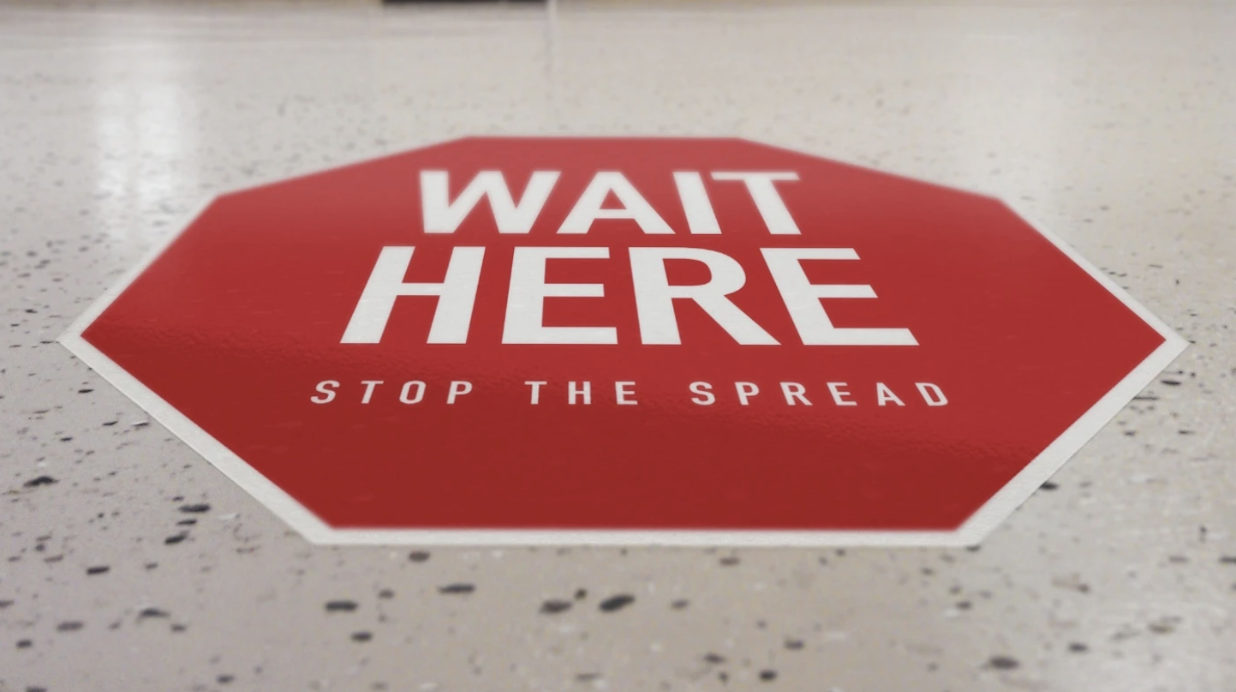
The US market has changed: traffic alone is no longer enough
Across US retail, QSR, airports, malls, and event venues, the problem is not always a lack of foot traffic. Often, it is inefficient traffic. People enter, but do not convert. They queue, but do not upsell. They circulate, but miss high-margin zones. They pass sponsor activations without stopping.
That is where floor graphics, adhesive floor signs, and floor signage film have gained strategic value. Unlike eye-level signage, floor media works inside the natural line of movement. People do not need to stop and “notice” it in the traditional advertising sense. They encounter it while navigating, waiting, turning, or scanning for direction.
In high-density settings, that matters. A wall poster competes with product shelves, screens, ceiling clutter, other shoppers, and staff interaction. A floor graphic occupies less contested visual space. It can also do two jobs at once: direct traffic and deliver a promotional message.
For mall operators and commercial real estate managers, that opens a second opportunity. Floors are not just wayfinding assets. They can also be revenue inventory—especially in underperforming zones where tenant visibility is weak. For brand teams, this turns the store or venue into a measurable activation map rather than a static layout.
What makes floor media work
Heatmap logic: the best space is where feet already go
The strongest floor campaigns begin with movement, not artwork. Retailers and venue operators increasingly think in heatmap terms: entry points, queue buildup, hesitation zones, bottlenecks, turn points, and dwell pockets.
That is why durable floor graphic film often performs well near high-friction decision points—checkout lanes, category transitions, escalator exits, beverage coolers, and concourse intersections. The goal is not to blanket every surface. It is to place messages where traffic density and decision likelihood overlap.
For a grocery store, that may mean promotional floor decals leading from the store entrance to produce, then from produce to prepared meals. For a QSR brand, it may mean queue-lane prompts that reinforce add-ons before the customer reaches the counter. For an arena, it may mean sponsor-led paths connecting gates to merch, concessions, and restrooms.
Dwell-time beats glance-time
Traditional ads are often judged by whether someone noticed them. Floor media works differently. It benefits from dwell conditions.
A person standing in line, waiting at self-checkout, scanning overhead menus, or looking for the correct corridor is already in a slowed-down state. In that moment, adhesive floor graphics can hold attention longer than a fast-passing poster or digital screen competing for eye-level space.
That does not mean every design should be loud. In fact, the best-performing floor systems are often simple: directional arrows, bold contrast, short copy, category colors, and one clear instruction. The more crowded the environment, the more valuable visual discipline becomes.
Directional influence is where signage becomes behavioral UX
A good floor campaign does not merely announce. It nudges.
Arrows, pathways, footprints, color blocks, and zone markers subtly influence path choice. This is especially valuable when operators want to shift flow toward:
- higher-margin departments
- underused corridors
- sponsored activation areas
- seasonal displays
- faster service lines
That is where floor signage, floor signage graphic film, and removable floor decals become operational tools, not just marketing materials. In the right context, they reduce confusion, smooth congestion, and improve commercial outcomes at the same time.
The main formats brands are using now
Removable floor graphics for campaign speed and testing
For seasonal retail, limited-time offers, product launches, and event activations, removable systems are often the first choice. Removable floor graphics and removable floor graphic materials allow operators to launch quickly and remove cleanly at campaign end.
Why it matters:
- useful for short retail windows
- lower commitment for test campaigns
- faster rollout across multiple sites
- easier coordination with changing promotions
Best use cases:
- holiday retail campaigns
- sponsor activations
- movie or product launches
- temporary queue messaging
- exhibition and trade show traffic routing
Durable floor graphic film for high-traffic environments
Short-term media is not enough in every location. Airports, stadiums, grocery stores, and large-format retail often need durable floor graphic film built for sustained wear, frequent cleaning, and heavy pedestrian load.
Why it matters:
- protects campaign life in demanding settings
- reduces replacement frequency
- supports long-running wayfinding systems
- better for repeated operational use
Best use cases:
- grocery navigation
- airport corridors
- stadium concourses
- permanent or semi-permanent branded wayfinding
- warehouse retail and membership clubs
Outdoor floor graphics and exterior floor graphics
Not all floor media begins inside the building. Outdoor floor graphics and exterior floor graphics are increasingly used to extend the journey from parking area, sidewalk, venue perimeter, or entry plaza into the interior experience.
Why it matters:
- captures traffic before entry
- helps guide event crowds
- supports curbside, pickup, or queue organization
- creates continuity between exterior and interior branding
Best use cases:
- stadium gate routing
- mall event entrances
- retail pickup zones
- sidewalk promotions
- temporary crowd control
Heavy duty floor stickers for operational zones
In some environments, the need is less about promotion and more about control. Heavy duty floor stickers and hard-wearing adhesive floor sign systems are used where clarity matters more than visual flourish.
Why it matters:
- improves traffic discipline
- reduces hesitation at decision points
- supports safety and flow
- works well in back-of-house or mixed-use commercial space
Best use cases:
- fulfillment and pickup zones
- warehouse retail
- event load-in or service paths
- high-volume queue systems
The economic reality: how floor graphics are budgeted
For most buyers, the question is not whether floor graphics look good. It is whether they justify deployment cost across one site—or 50, or 200.
In practice, floor graphic quotes are usually built around five variables:
- square footage
- material specification
- surface condition
- installation complexity
- campaign duration and removal needs
A national rollout also adds program management, shipping coordination, site surveys, and consistency controls.
| Project type | Typical scope | Common material logic | Cost pressure |
|---|---|---|---|
| Single-store promotion | 50–150 sq ft | Temporary floor graphic film or removable floor decals | Low to medium |
| Queue-lane upsell program | 100–300 sq ft | Durable laminate + slip-rated print | Medium |
| Grocery navigation system | Multi-zone, repeated paths | Durable floor graphic film | Medium to high |
| Stadium or event concourse activation | 300–1,500+ sq ft | Short-term but high-wear materials | Medium to high |
| Multi-location chain rollout | 10–300 locations | Standardized material kit + installation program | High total, lower per-site efficiency at scale |
The important point: buyers should not compare quotes only by print price. The cheaper option often fails in one of three places—surface compatibility, installation quality, or campaign lifespan. Once reprints, site disruption, or premature failure enter the picture, the “cheap” quote stops being cheap.
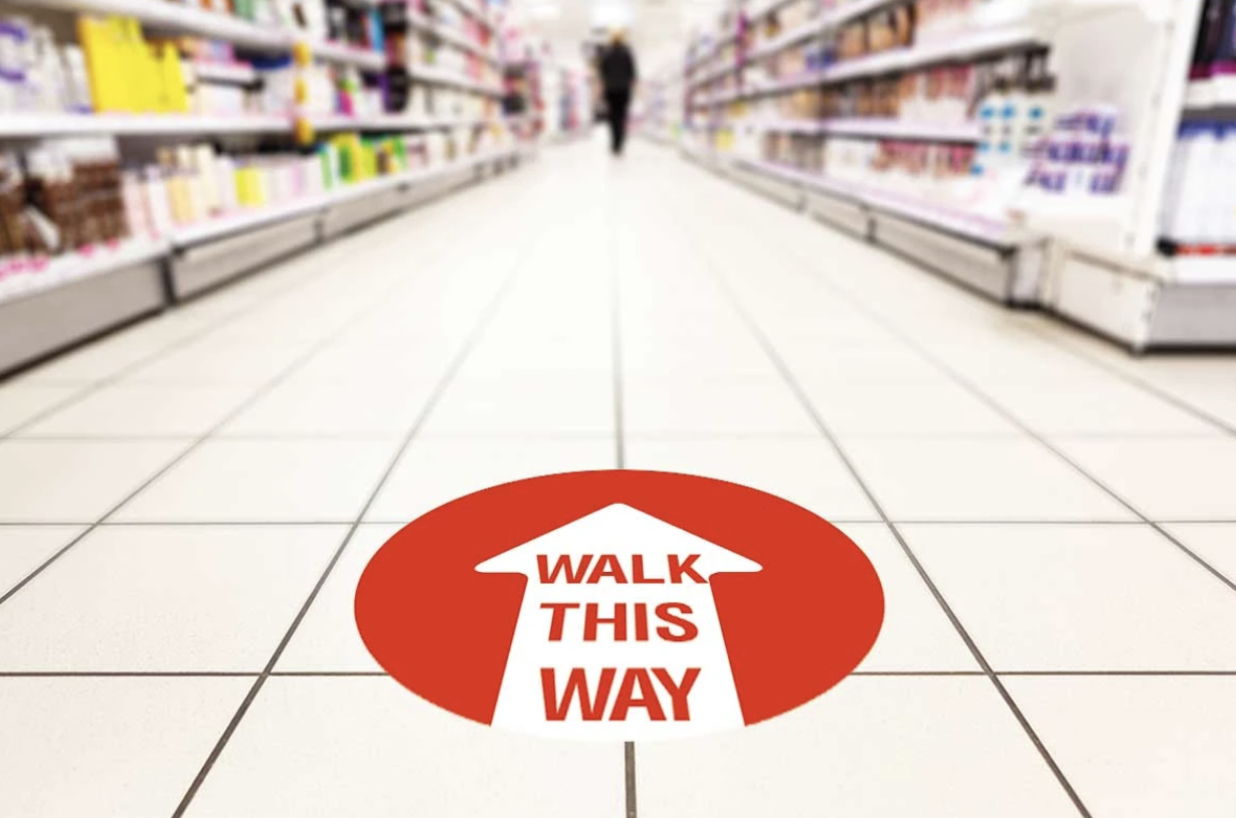
How operators should think about implementation
For retail and QSR decision makers, the right question is not “Where can we place a floor graphic?” It is “Which movement decision are we trying to change?”
Start there.
Prioritize the business objective, not the artwork
A floor campaign usually serves one of four goals:
- increase conversion in a category zone
- increase average order or basket size
- redirect flow toward underused areas
- improve wayfinding and reduce confusion
If the objective is unclear, the graphics become decoration. If the objective is clear, the layout, copy, and material choice become easier.
Match material to environment
A premium design on the wrong substrate is an operational mistake. Temporary floor graphic film may work perfectly for a two-week retail event but fail in a grocery lane with constant cart traffic. Adhesive floor signs for indoor polished flooring are not the same as outdoor floor graphics exposed to weather and grit.
Standardize for scale
Multi-unit brands should avoid site-by-site improvisation. They need repeatable templates:
- standard placement rules
- consistent messaging hierarchy
- approved materials by surface type
- installation documentation
- removal and refresh protocol
That is how a 20-store test becomes a 200-site program without quality drift.
Two realistic scenarios
Scenario 1: QSR chain fixes queue drop-off
A regional quick-service chain notices a pattern: high lunch traffic, flat add-on sales, and queue congestion near the menu board. Instead of changing the store layout, it deploys removable floor graphics in the queue path.
The graphics do three things: they straighten the line, segment waiting positions, and introduce timed upsell prompts before the customer reaches the counter. One path highlights combo upgrades. Another directs mobile pickup users away from the main queue.
The result is operational, not cosmetic. Faster line behavior. Cleaner flow. Better exposure to add-on messaging in the final seconds before order placement.
Scenario 2: Mall operator monetizes a dead corridor
A US mall has uneven traffic distribution. The primary fashion wing performs well; a secondary corridor underdelivers, affecting smaller tenants. Management uses floor signage and sponsor-funded adhesive floor graphics to create a guided route tied to a seasonal activation.
The floor path leads visitors from the atrium through the weaker corridor toward a branded pop-up zone. Tenants along that route benefit from increased pass-through. The mall benefits twice: better traffic distribution and a monetized media placement program.
Where a provider like Signs7 fits
For this kind of work, buyers do not just need a printer. They need a system partner who understands rollout logic, material fit, installation consistency, and national execution.
That is the value of a company like Signs7, a nationwide printing and signage installation company at Signs7.com. For brands operating across multiple locations, the challenge is rarely one graphic in one store. The challenge is controlling quality, timing, and consistency across many environments—without turning a campaign into an operations problem.
That is especially relevant for retail chains, QSR brands, venue operators, and commercial property teams running programs where floor media must perform both commercially and operationally.
Conclusion
The most effective floor graphics are not an afterthought. They are part of the customer journey architecture.
For operators in retail, food service, real estate, and live events, the value is straightforward: shape movement, improve visibility at decision points, and turn existing foot traffic into more measurable outcomes. When done properly, commercial floor graphics do more than decorate a surface. They influence path choice, dwell behavior, and conversion.
If your organization is evaluating a rollout, pilot program, or multi-site activation, the right next move is not more guesswork. Book a consultation and assess the floor as performance media, not just print.
FAQ
What are commercial floor graphics used for?
Commercial floor graphics are used for wayfinding, promotions, queue management, sponsor visibility, and shopper influence inside high-traffic spaces. They are common in retail, QSR, malls, airports, stadiums, and event venues where movement patterns directly affect conversion.
Are removable floor graphics durable enough for retail stores?
Yes, for the right campaign length and traffic conditions. Removable floor graphics are well suited for short-term promotions, seasonal campaigns, and test rollouts, but high-traffic stores may require more durable film and laminate systems.
What is the difference between removable floor decals and durable floor graphic film?
Removable floor decals are designed for easier short-term application and cleaner removal. Durable floor graphic film is built for longer wear, heavier foot traffic, and environments where cleaning frequency and abrasion are higher.
Can outdoor floor graphics be used at entrances and sidewalks?
Yes, but they must be specified for exterior conditions. Outdoor floor graphics and exterior floor graphics need materials and adhesive systems suitable for weather, surface texture, and pedestrian exposure.
How do brands measure ROI from floor graphics?
Most teams track a mix of traffic behavior and commercial outcomes: footfall through target zones, dwell time, queue behavior, SKU lift, upsell rate, redemption, or sales changes in exposed areas. Advanced programs may also use QR or digital overlays to connect offline movement with online attribution.
What should multi-location brands look for in a floor graphics provider?
They should look for material expertise, national installation capability, standardized deployment processes, and program management. Consistency across locations matters as much as print quality.
Are heavy duty floor stickers better for venues and grocery stores?
Often, yes. Heavy duty floor stickers are usually more appropriate where traffic is dense and constant, especially in venues, grocery stores, and other environments where the floor must withstand repeated wear and cleaning.
































