



Keep reading
Rather we just did it for you?
Let's get your business seen.
Social media, websites, SEO and ads from a team you can actually meet.
If you’ve ever stared at a keyword research tool, wondering where on earth to start, you’re in good company. Keyword research is one of those things that sounds straightforward until you actually sit down to do it, and then suddenly you’re drowning in search volumes, competition scores, and a list of five hundred potential keywords with no clear idea of which ones actually matter for your business.
Here’s the good news: choosing the right keywords for SEO doesn’t have to be complicated. What it does require is a clear understanding of what keywords actually are, how people are searching in 2026 (which has changed more than most people realise), and a practical process for identifying the terms that will genuinely move the needle for your business rather than just inflating your traffic numbers with visitors who’ll never buy from you.
This is that guide. No fluff, no generic advice you’ve read a hundred times before. Just a straight-talking, practical walkthrough of how to do keyword research properly in 2026.
.ds-poll-heading { font-size: 11px; font-weight: 700; letter-spacing: 0.1em; text-transform: uppercase; color: #ff6a00; margin: 0 0 0.6rem; }
.ds-poll-question { font-size: 17px; font-weight: 600; color: #1a1a1a; margin: 0 0 0.4rem; line-height: 1.4; }
.ds-poll-subtitle { font-size: 13px; color: #777; margin: 0 0 1.25rem; }
.ds-poll-grid { display: grid; grid-template-columns: repeat(auto-fit, minmax(175px, 1fr)); gap: 10px; }
.ds-poll-btn {
background: #ffffff;
border: 1px solid #ddd;
border-radius: 10px;
padding: 13px 15px;
cursor: pointer;
text-align: left;
transition: border-color 0.15s, background 0.15s;
font-size: 14px;
color: #1a1a1a;
line-height: 1.4;
display: flex;
flex-direction: column;
gap: 5px;
font-family: sans-serif;
}
.ds-poll-btn:hover { border-color: #ff6a00; background: #fff4ed; }
.ds-poll-btn.ds-selected { border: 2px solid #ff6a00; background: #fff4ed; color: #a03d00; }
.ds-poll-btn:disabled { cursor: default; }
.ds-poll-icon { font-size: 17px; }
.ds-poll-results { margin-top: 1.25rem; display: none; flex-direction: column; gap: 10px; }
.ds-poll-results.ds-show { display: flex; }
.ds-result-row { display: flex; flex-direction: column; gap: 4px; }
.ds-result-label { font-size: 13px; color: #555; display: flex; justify-content: space-between; font-family: sans-serif; }
.ds-result-bar-wrap { background: #f0f0f0; border-radius: 4px; height: 8px; overflow: hidden; }
.ds-result-bar { height: 8px; border-radius: 4px; background: #ff6a00; transition: width 0.6s ease; }
.ds-poll-thanks { font-size: 14px; color: #a03d00; font-weight: 600; margin-top: 1rem; display: none; font-family: sans-serif; }
.ds-poll-thanks.ds-show { display: block; }
.ds-poll-total { font-size: 12px; color: #999; margin-top: 0.4rem; font-family: sans-serif; }
Quick question
Where are you right now with your keyword research?
Pick the one that fits best. Takes 2 seconds.
Thanks for voting! Read on — this guide covers wherever you are right now.
document.addEventListener(‘DOMContentLoaded’, function() {
var dsVotes = [48, 56, 33, 41, 29, 22];
var dsHasVoted = false;
var dsLabels = [
“Never really done it properly”,
“Done it but not sure if it’s working”,
“Ranking but want to go further”,
“Worried about AI changing everything”,
“Leaving it to an agency”,
“Got a solid strategy already”
];
for (var i = 0; i < 6; i++) {
(function(idx) {
document.getElementById('dsBtn' + idx).addEventListener('click', function() {
dsVote(idx);
});
})(i);
}
function dsVote(idx) {
if (dsHasVoted) return;
dsHasVoted = true;
dsVotes[idx]++;
var btns = document.querySelectorAll('.ds-poll-btn');
btns.forEach(function(b) { b.disabled = true; b.style.opacity = '0.6'; });
document.getElementById('dsBtn' + idx).classList.add('ds-selected');
document.getElementById('dsBtn' + idx).style.opacity = '1';
var total = dsVotes.reduce(function(a, b) { return a + b; }, 0);
var container = document.getElementById('dsResultBars');
container.innerHTML = '';
dsVotes.forEach(function(v, i) {
var pct = Math.round((v / total) * 100);
var row = document.createElement('div');
row.className = 'ds-result-row';
row.innerHTML =
'
‘ +
‘
‘;
container.appendChild(row);
});
document.getElementById(‘dsPollTotal’).textContent = total + ‘ people have voted’;
document.getElementById(‘dsPollResults’).classList.add(‘ds-show’);
document.getElementById(‘dsPollThanks’).classList.add(‘ds-show’);
setTimeout(function() {
document.querySelectorAll(‘.ds-result-bar’).forEach(function(bar) {
bar.style.width = bar.getAttribute(‘data-pct’) + ‘%’;
});
}, 100);
}
});
What Are SEO Keywords and Why Do They Still Matter?
SEO keywords are the words and phrases people type (or increasingly, speak) into search engines when they’re looking for something. They’re the bridge between what your potential customers are searching for and the content you’ve created to answer those searches. Get this right and your website becomes a magnet for exactly the right people at exactly the right moment. Get it wrong and you end up with either no traffic at all or plenty of traffic that never converts into anything useful.
Keywords still matter enormously in 2026, but the way we think about them has shifted. Google’s understanding of language and intent has become significantly more sophisticated over the past few years. It’s no longer about matching exact phrases on a page – it’s about demonstrating genuine expertise and relevance around a topic. That means your keyword strategy needs to think in terms of topics and intent clusters, not just individual terms.
How Search Has Changed in 2026
Before we get into the mechanics of keyword research, it’s worth talking about something most guides ignore entirely: how the search landscape itself has changed, because it has a direct impact on how you should approach keyword selection.
AI-powered search has become mainstream. Google’s AI Overviews (formerly Search Generative Experience) now appear at the top of results for a huge range of queries, providing direct answers without users needing to click through to a website. This has had a real impact on traffic for informational queries, particularly the simple “what is” and “how does” type questions that used to drive decent organic traffic.
What this means in practice is that purely informational keywords with simple, factual answers are becoming less valuable as traffic drivers. The keywords that still deliver genuine clicks and visits in 2026 are the ones where users need more than a quick AI summary – complex comparisons, nuanced advice, local searches, transactional queries, and content that requires genuine depth and expertise to do justice.
People are also searching differently. Voice search, conversational queries, and the influence of people asking ChatGPT and similar tools before turning to Google have all shifted search patterns. Queries are getting longer and more conversational. “Best SEO agency” is becoming “which SEO agency is best for a small eCommerce business in the UK.” Your keyword strategy needs to reflect this.
The Different Types of SEO Keywords
Understanding the different types of keywords is essential before you start any research. Each type serves a different purpose and targets users at different stages of their buying journey.
.ds-table { width: 100%; border-collapse: collapse; font-size: 14px; }
.ds-table thead tr { background: #ff6a00; }
.ds-table thead th { color: #fff; font-weight: 700; padding: 14px 16px; text-align: left; font-size: 13px; letter-spacing: 0.03em; }
.ds-table tbody tr:nth-child(odd) { background: #ffffff; }
.ds-table tbody tr:nth-child(even) { background: #fff8f4; }
.ds-table tbody tr { border-bottom: 1px solid #ffd4b3; transition: background 0.15s; }
.ds-table tbody tr:hover { background: #fff0e6; }
.ds-table tbody td { padding: 13px 16px; color: #1a1a1a; vertical-align: top; line-height: 1.5; }
.ds-table tbody td:first-child { font-weight: 700; white-space: nowrap; color: #ff6a00; }
.ds-table tbody td:nth-child(2) { color: #555; font-size: 13px; }
.ds-table tbody td:nth-child(3) { color: #555; font-size: 13px; }
.ds-table tbody td:last-child { color: #555; font-size: 13px; }
.ds-table-note { font-size: 12px; color: #999; margin-top: 10px; font-family: sans-serif; }
| Keyword type | What it is | Example | Best used for |
|---|---|---|---|
| Short-tail (head) | Broad, one or two word terms | “SEO agency” | Brand awareness, high competition |
| Long-tail | Specific, multi-word phrases | “affordable SEO agency for small business UK” | Targeted traffic, higher conversion |
| LSI (semantic) | Related terms that add context | “search engine optimisation”, “organic rankings” | Supporting main keywords, avoiding stuffing |
| Geo-targeted | Location-based terms | “SEO agency Portsmouth” | Local businesses, map pack rankings |
| Branded | Include your company name | “Delivered Social pricing” | Reputation, high-intent existing audience |
| Transactional | Purchase or action intent | “buy SEO package UK” | Bottom of funnel, direct conversions |
| Informational | Research and question-based | “how does keyword research work” | Top of funnel, building authority |
| Navigational | Searching for a specific site | “Delivered Social contact” | Brand presence, direct traffic |
Each keyword type serves a different purpose — a strong strategy uses a mix of all of them.
The mistake most businesses make is focusing almost exclusively on short-tail keywords because they have the highest search volumes. In reality, long-tail and transactional keywords are where most of the genuine commercial value sits, particularly for small and medium-sized businesses who can’t realistically compete with established players for the biggest terms.
Why Search Intent Is the Most Important Thing to Get Right
Search intent is the reason behind a query – what the person actually wants when they type something into Google. It sounds obvious, but getting this wrong is one of the most common and costly mistakes in keyword research.
There are four types of search intent worth understanding. Informational intent is when someone wants to learn something. Navigational intent is when they’re looking for a specific website or page. Commercial intent is when they’re researching options before making a decision. And transactional intent is when they’re ready to buy or take action.
The reason this matters so much is that Google is very good at matching results to intent. If you try to rank a product page for an informational query, or a blog post for a transactional one, you’ll struggle regardless of how well optimised the page is. The format and type of content needs to match what Google believes users want to see for that search.
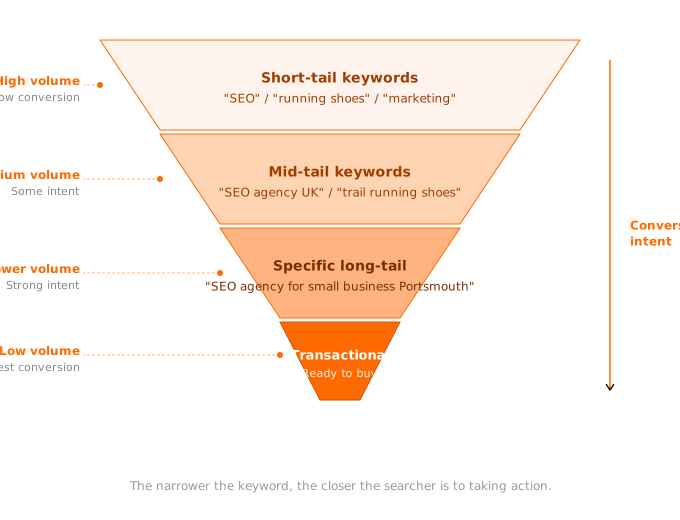
Before you target any keyword, ask yourself: what does someone actually want when they search this? What stage of the buying journey are they at? And does the content you’re planning to create genuinely match that intent?
The Best Keyword Research Tools in 2026
You need the right tools to do this properly. Here’s an honest comparison of the main options:
.ds-table2 { width: 100%; border-collapse: collapse; font-size: 14px; }
.ds-table2 thead tr { background: #ff6a00; }
.ds-table2 thead th { color: #fff; font-weight: 700; padding: 14px 16px; text-align: left; font-size: 13px; letter-spacing: 0.03em; }
.ds-table2 tbody tr:nth-child(odd) { background: #ffffff; }
.ds-table2 tbody tr:nth-child(even) { background: #fff8f4; }
.ds-table2 tbody tr { border-bottom: 1px solid #ffd4b3; transition: background 0.15s; }
.ds-table2 tbody tr:hover { background: #fff0e6; }
.ds-table2 tbody td { padding: 13px 16px; color: #1a1a1a; vertical-align: top; line-height: 1.5; }
.ds-table2 tbody td:first-child { font-weight: 700; white-space: nowrap; color: #ff6a00; }
.ds-table2 tbody td:nth-child(2) { color: #555; font-size: 13px; }
.ds-table2 tbody td:nth-child(3) { color: #555; font-size: 13px; }
.ds-table2 tbody td:last-child { font-size: 13px; font-weight: 700; color: #1a1a1a; }
.ds-table2-note { font-size: 12px; color: #999; margin-top: 10px; font-family: sans-serif; }
| Tool | Best for | Standout feature | Approximate cost |
|---|---|---|---|
| Google Keyword Planner | Beginners, PPC crossover | Free, direct from Google | Free |
| Ahrefs | In-depth research, competitor analysis | Keyword difficulty scoring, SERP analysis | From £99/month |
| SEMrush | All-in-one SEO and competitor intel | Keyword gap analysis, topic clusters | From £99/month |
| Moz Keyword Explorer | Straightforward research | Priority score combining multiple metrics | From £79/month |
| Answer the Public | Question-based and long-tail discovery | Visual question mapping | From £79/month |
| Google Search Console | Tracking existing performance | Real data on what you already rank for | Free |
| Ubersuggest | Budget-friendly smaller businesses | Good starting point, lower cost | From £20/month |
| ChatGPT / AI tools | Brainstorming and intent mapping | Fast ideation, conversational query generation | Varies |
Prices correct at time of publication. Most tools offer a free trial worth taking advantage of before committing.
A word on using AI tools for keyword research: they’re genuinely useful for brainstorming and understanding how people might phrase questions conversationally, but they don’t give you real search volume or competition data. Use them alongside a proper keyword tool, not instead of one.
How to Do Keyword Research: A Step-by-Step Process
Here’s how to approach keyword research practically, from scratch.
Start by getting clear on your business goals before you touch a single tool. What do you actually want your SEO to deliver? More enquiries for a specific service? eCommerce sales for a particular product range? Local visibility in a specific area? Your keyword strategy needs to be anchored to a commercial objective, not just a desire for more traffic.
Next, brainstorm your seed keywords. These are the broad terms that describe what you do. Think about your services, your products, your locations, and the problems you solve. Don’t overthink this stage – you’re just building a starting list to feed into your research tools.
Take those seed keywords into your tool of choice and start exploring. Look at what comes up, pay attention to related searches and questions, and build out a longer list of potential targets. At this stage, more is more – you can narrow it down later.
Now start filtering by intent. Go through your list and categorise each keyword by the type of intent behind it. This immediately tells you what kind of content you’d need to create to target it and whether it’s realistically going to drive the kind of visitor you actually want.
Then look at the metrics. Search volume tells you how many people are searching for that term per month. Keyword difficulty tells you how hard it will be to rank for it. These two numbers together help you identify the sweet spots – keywords with decent search volume that aren’t impossibly competitive.
Pay particular attention to long-tail opportunities. A keyword getting 200 searches a month with low competition and clear transactional intent is often worth more than a keyword getting 10,000 searches a month that’s dominated by huge brands and would take years to crack.
Analyse your competitors too. Put your main competitors’ websites into a tool like Ahrefs or SEMrush and see what keywords they’re ranking for. Look for gaps – terms they’re ranking for that you’re not – and terms they’re not targeting that represent a genuine opportunity.
Group your final keyword list by topic clusters rather than treating each keyword as a standalone target. Google increasingly understands topics and rewards websites that demonstrate comprehensive expertise across a subject area. A cluster of related keywords can often be addressed by a single well-structured piece of content rather than requiring a separate page for every term.
Common Keyword Research Mistakes to Avoid in 2026
Even experienced marketers fall into these traps, so it’s worth being aware of them.
Chasing volume over intent is probably the most common one. A keyword with 50,000 monthly searches sounds impressive until you realise the people searching it aren’t anywhere near ready to buy what you sell. Always ask what a searcher actually wants before you get excited about a number.
Ignoring long-tail keywords is still rife, even in 2026. The instinct is to go after the biggest terms, but the reality is that long-tail keywords are where most conversions happen. Someone searching “running shoes” is browsing. Someone searching “women’s wide fit trail running shoes under £100” knows exactly what they want.
Keyword stuffing is still happening and still being penalised. Google’s algorithms are sophisticated enough to identify content that’s been written around keywords rather than around the reader. Write for your audience first and let the keywords sit naturally within that.
Neglecting to update your keyword strategy is a silent killer. Search trends shift, new competitors enter the market, Google updates its algorithm, and the queries your audience uses evolve over time. Your keyword research should be revisited at least every six months, not treated as a one-time exercise.
Forgetting about your existing rankings is another missed opportunity. Before you start hunting for new keywords, look at what you’re already ranking for in Google Search Console. There are often keywords where you’re sitting on page two or three that could move to page one with relatively modest optimisation work – and that’s a much faster win than trying to rank for something brand new.
Finally, ignoring the impact of AI on search intent is a very 2026 mistake. As AI Overviews handle more simple informational queries, the keywords worth targeting are increasingly the ones that require nuanced, expert, or localised content that an AI summary can’t fully satisfy. Think about what a user would still need to click through to your site for, even after seeing an AI-generated overview.
How to Use Keywords Once You’ve Chosen Them
Choosing the right keywords is only half the job. You then need to use them effectively across your website. The fundamentals here are straightforward but worth spelling out clearly.
Your primary keyword for any page should appear in the page title, the H1 heading, the meta description, and naturally within the first paragraph of the content. Supporting and related keywords should appear in H2 subheadings and throughout the body content where they fit naturally.
Don’t neglect image alt text, URL structure, and internal links – these all contribute to how Google understands the relevance of your page for a given term. And make sure every piece of content you create is targeting a specific keyword intent. A page trying to serve both informational and transactional intent at the same time typically does neither particularly well.
Tracking and Refining Your Keyword Strategy
SEO is not a set-it-and-forget-it exercise. Once your content is live, use Google Search Console to monitor which queries are driving impressions and clicks. Use Google Analytics to track whether the traffic those keywords bring is actually engaging with your site and converting.
If a piece of content is ranking on page two for its target keyword, look at what the pages above it are doing differently and refine accordingly. If a keyword you targeted isn’t driving the traffic you expected, revisit whether the intent match is right or whether the competition is simply too strong at your current level of domain authority.
The businesses that win at SEO long term are the ones that treat keyword research as an ongoing process rather than a one-time task. The landscape shifts constantly, and the strategy that’s working today will need adjusting tomorrow. Build the habit of reviewing your keyword performance regularly and you’ll stay ahead of competitors who treat it as something they did once and forgot about.
At Delivered Social, we help businesses across the UK build keyword strategies that are grounded in commercial reality rather than vanity metrics. If you’d like to talk through your SEO strategy for 2026, we’d love to have that conversation.
































