





In This Article
Top 5 Best AI Search Tracking Tools for LLM Visibility
The search market in 2026 looks nothing like the list of blue links from a few years ago. You have likely noticed that conversational answers now dominate the top of every results page. It is no longer enough to just rank first because you need to be the answer itself.
Staying ahead in 2026 requires more than basic keyword checks. You will learn how to monitor your brand across the most popular generative engines. Today on Delivered Social, Let’s look at the top 5 tools that make Generative Engine Optimization (GEO) and AI Search Monitoring simple and effective.
Why AI Search Monitoring Is the New Standard for Seo Tools
Traditional search is evolving into a conversational experience where LLMs provide direct answers instead of just links. You must recognize that users are no longer clicking through multiple sites to find a single fact. This shift means your AI search visibility and LLM visibility are now tied to how well an AI model understands your brand and its messaging. AI search monitoring helps you track this.
Market data supports this urgency for every modern marketing team. According to Data found on the web, AI-driven search queries are projected to capture between 2% and 5% of total search volume by 2026. This growth is only the beginning of a larger transformation in AI search rankings.
By tracking AI search visibility, you can identify which content pieces are being cited and which are being ignored by major models. This insight helps you stop wasting time on content that AI Chatbots are not considering as a good source, improving your LLM visibility.
1. Radarkit.ai
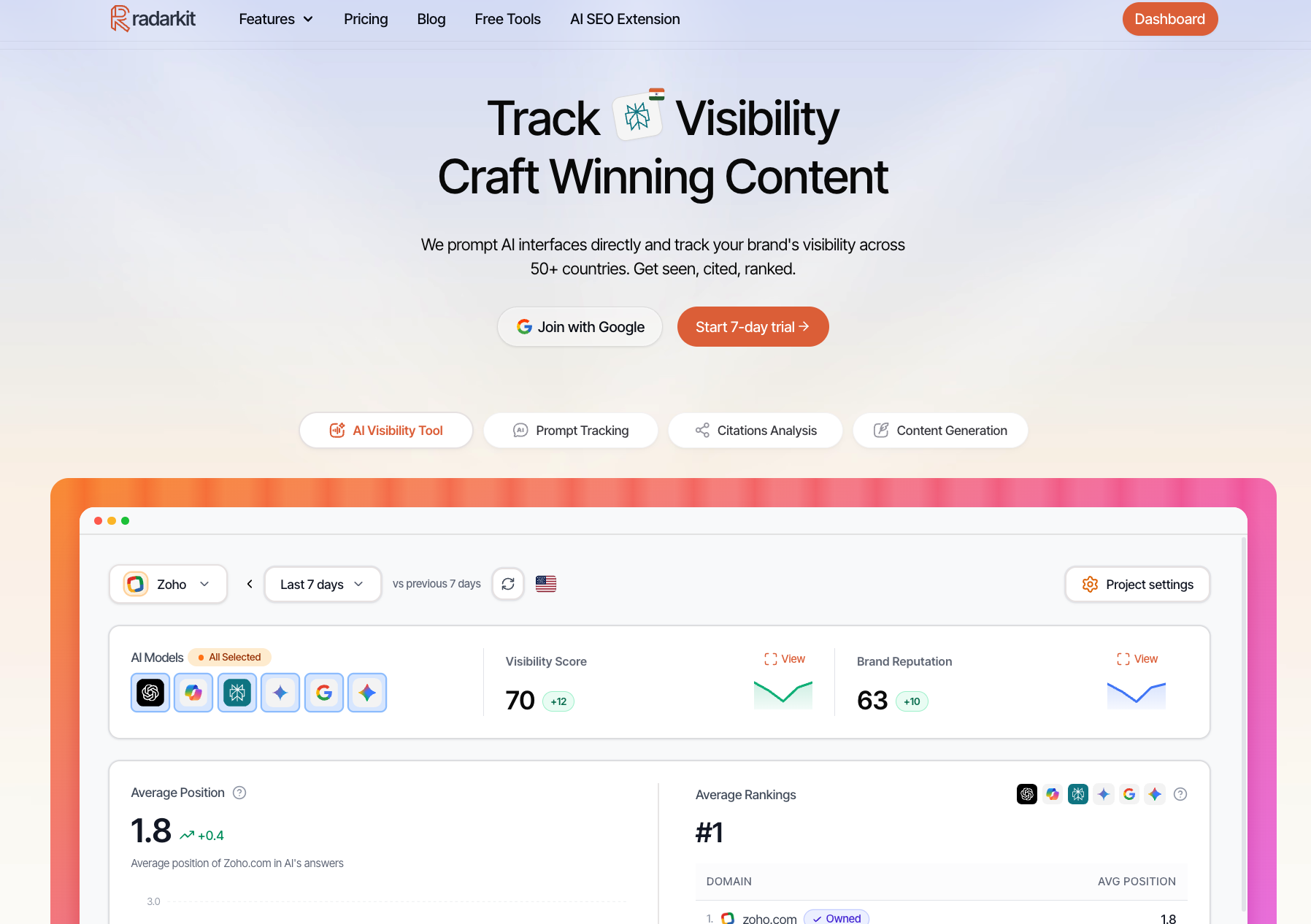
Radarkit.ai (part of the Alpha startup at Web Summit Qatar) is the best AI search tracker in the market right now. What makes Radarkit different is its accuracy and the fact that it uses real browser tracking instead of APIs to get actual AI responses from 40+ countries, including citation tracking.
Notable features:
- AI Share of Voice: Identify exactly which sites AI Chatbots trust most for your query vs. competitors
- Location-Based Tracking: Simulate real-time queries from 40+ countries using residential proxies to catch local citations and local data.
- NLP & Fact-Based Content: Create content using the specific NLP terms and entities found in most cited sources to rank in AI search engines.
- Query Fanouts Tracking: Tracks which keywords AI Chatbots search in background when your main prompt is being researched. Utilise it to create citable content.
- AI Traffic Monitoring: See which AI platforms (ChatGPT, Perplexity, Gemini, Copilot) send actual visitors to your site
Pricing:
Cost Per prompt : $1.93
Free Plan : 7 Days free.
Lite Plan: $29/mo (15 prompts tracked, 2 projects, 72-hour refresh)
Growth Plan: $79/mo (50 prompts tracked, 5 projects, daily refresh)
Pro Plan: $139/mo (100 prompts tracked, 10 projects, daily refresh)
All plans include detailed citation data, 50+ locations, actionable AI insights, and human support. 7-day free trial available.
Our Rating: 4.8/5
2. PEEC AI
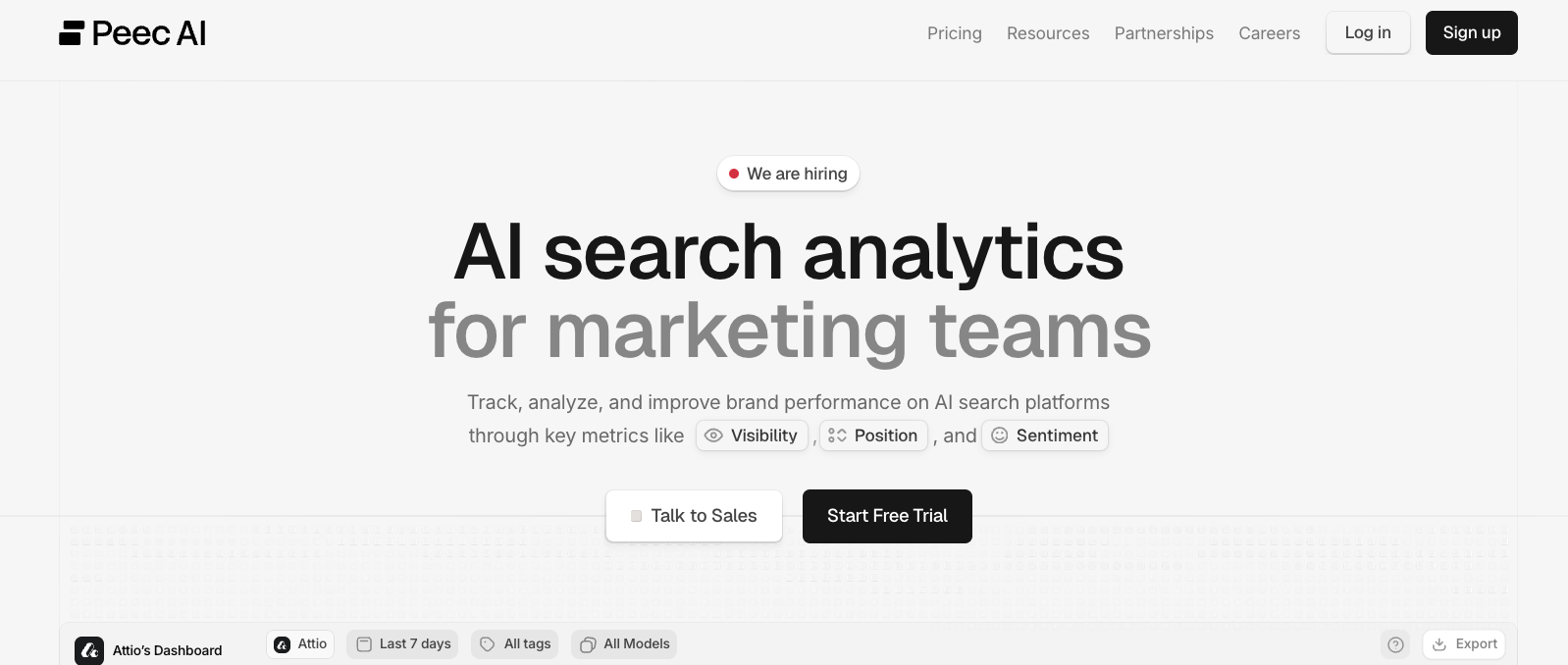
PEEC AI is a basic AI search tracking tool built for marketing teams who want to track their brand in ChatGPT, Perplexity, and Google AI Overviews. It tracks your prompts daily and shows you where your brand appears across different AI models, but does not include any content creation or query fanout features.
Notable features:
- Daily Prompt Tracking: Automatically runs your prompts across AI models every day to see if you show up
- Multi-Country Coverage: Track your brand visibility across unlimited countries from one dashboard
- Competitor Benchmarking: Compare your brand mentions against competitors in real time
- Answer Analysis: See up to 9,000 AI answers per month depending on your plan
Cost Per prompt : $4.8
Pricing: €89/mo (~$106/mo) for 25 prompts, €199/mo (~$237/mo) for 100 prompts, €499/mo (~$593/mo) for 300 prompts
Our Rating: 3.9/5
PEEC is on the expensive side and lacks AI content writer, query fanout tracking, and residential proxy support for accurate location-based results.
3. Otterly AI
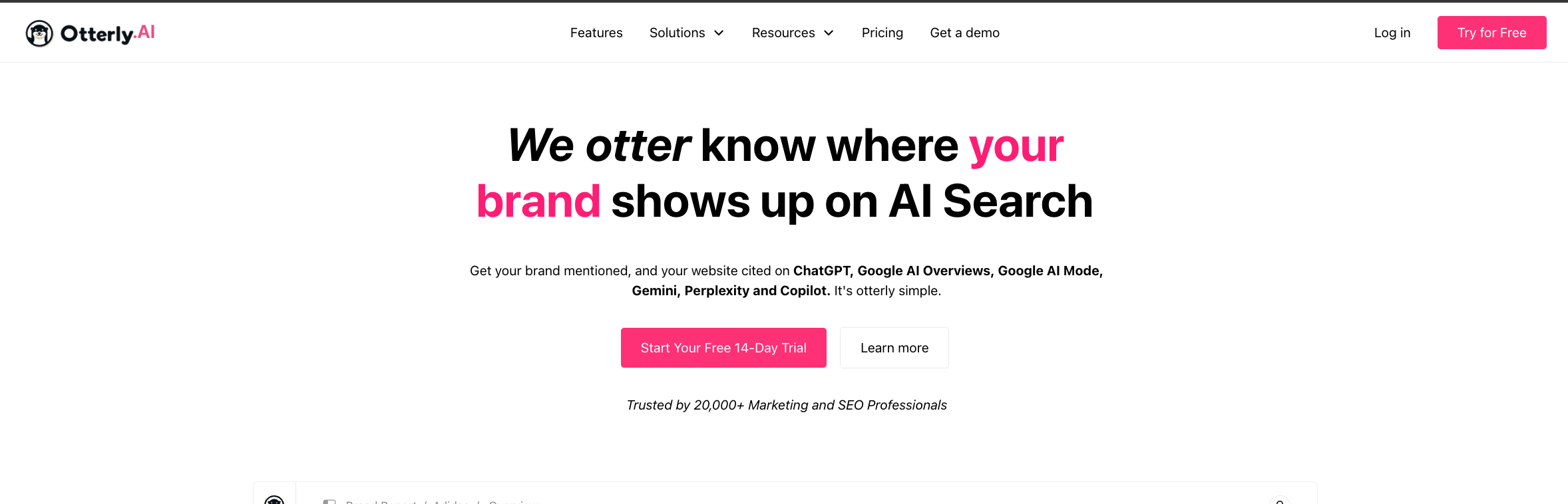
Otterly AI focuses on tracking your brand mentions across answer engines like ChatGPT, Google AI Overviews, and Microsoft Copilot. It is built specifically for monitoring how AI engines talk about your brand, but it is purely a monitoring tool with no content creation or AI content optimization features.
Notable features:
- Answer Engine Focus: Designed specifically for AI-powered search experiences rather than traditional SEO
- Citation Tracking: Shows which websites AI models cite when answering questions in your niche
- Visibility Snapshots: Captures the exact text AI generates about your brand so you can review context
- GPT-4 and Gemini Pro Monitoring: Tracks the major AI models powering ChatGPT and Google Gemini
Cost Per prompt : $1.93
Pricing: $29 ( 15 prompts ), $189 ( 100 prompts ),$489 ( 400 prompts ),
Our Rating: 4.0/5
Otterly is good for simple brand monitoring but lacks content writer, query fanout tracking, and AI traffic analytics features.
4. Profound AI
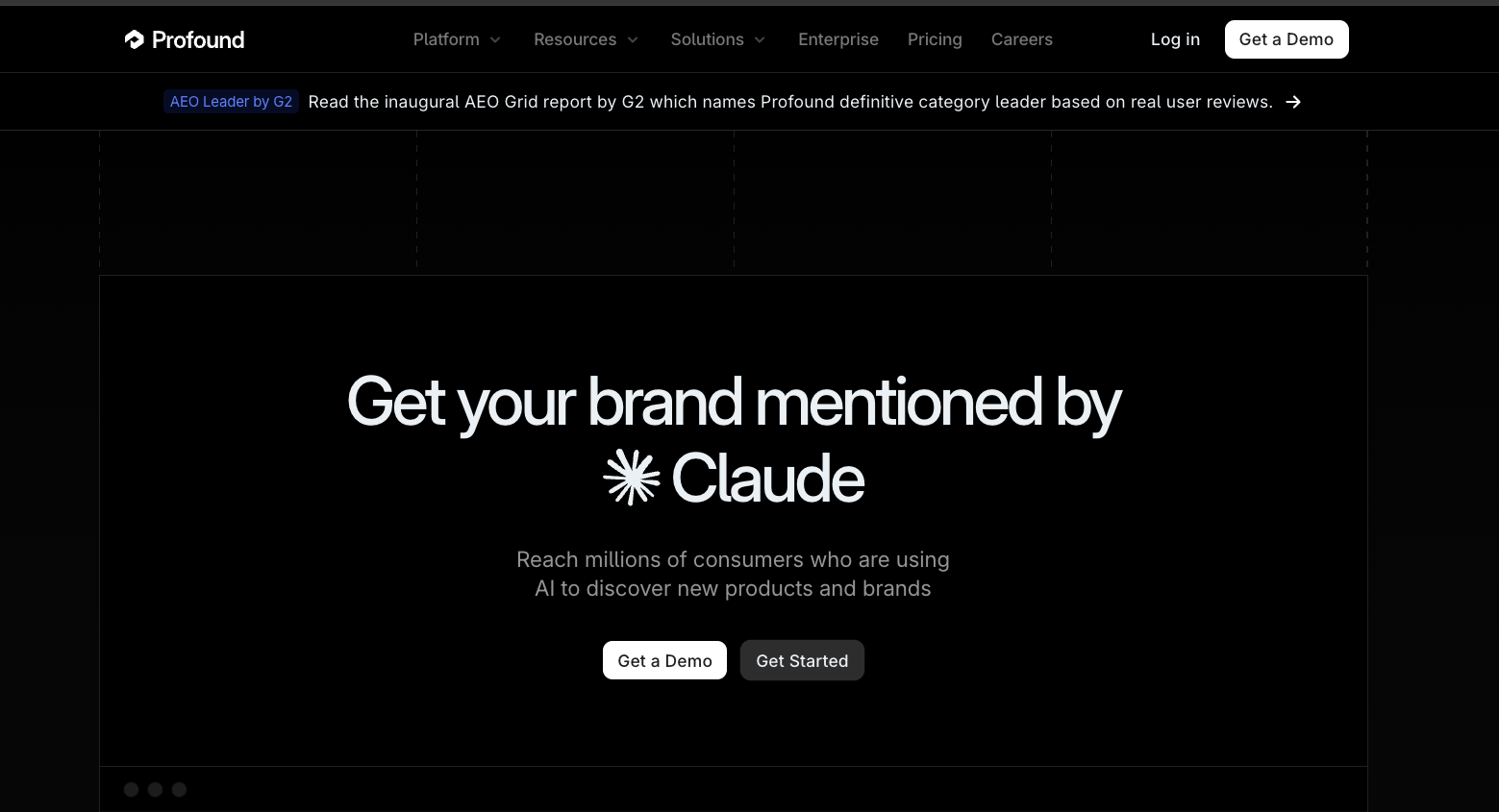
Profound AI offers a premium suite for large teams that need deep analytics across ChatGPT, Gemini, and Copilot. It has a beautiful interface but comes at enterprise pricing ($500+ per month) that is better suited for big brands with serious budgets. No content creation features are included.
Notable features:
- Clean Dashboard: Beautiful, modern interface that displays AI citation data clearly
- Multi-LLM Coverage: Tracks visibility in ChatGPT, Google Gemini, and Microsoft Copilot
- ChatGPT Shopping Tracking: Monitors how products appear in ChatGPT shopping recommendations
- Agent Analytics: Shows which AI crawlers are accessing your website and how often
Cost Per prompt : $3.99
Pricing: $99 ( Only chatgpt tracking with 50 Prompts ), 399 ( 3 models, 100 prompts ) Enterprise-level pricing (typically $500+ per month, exact pricing on request)
Our Rating: 3.8/5
Profound is very expensive for small teams but has all the features like query fanouts, content writer, location based tracking.
5. Scrunch AI
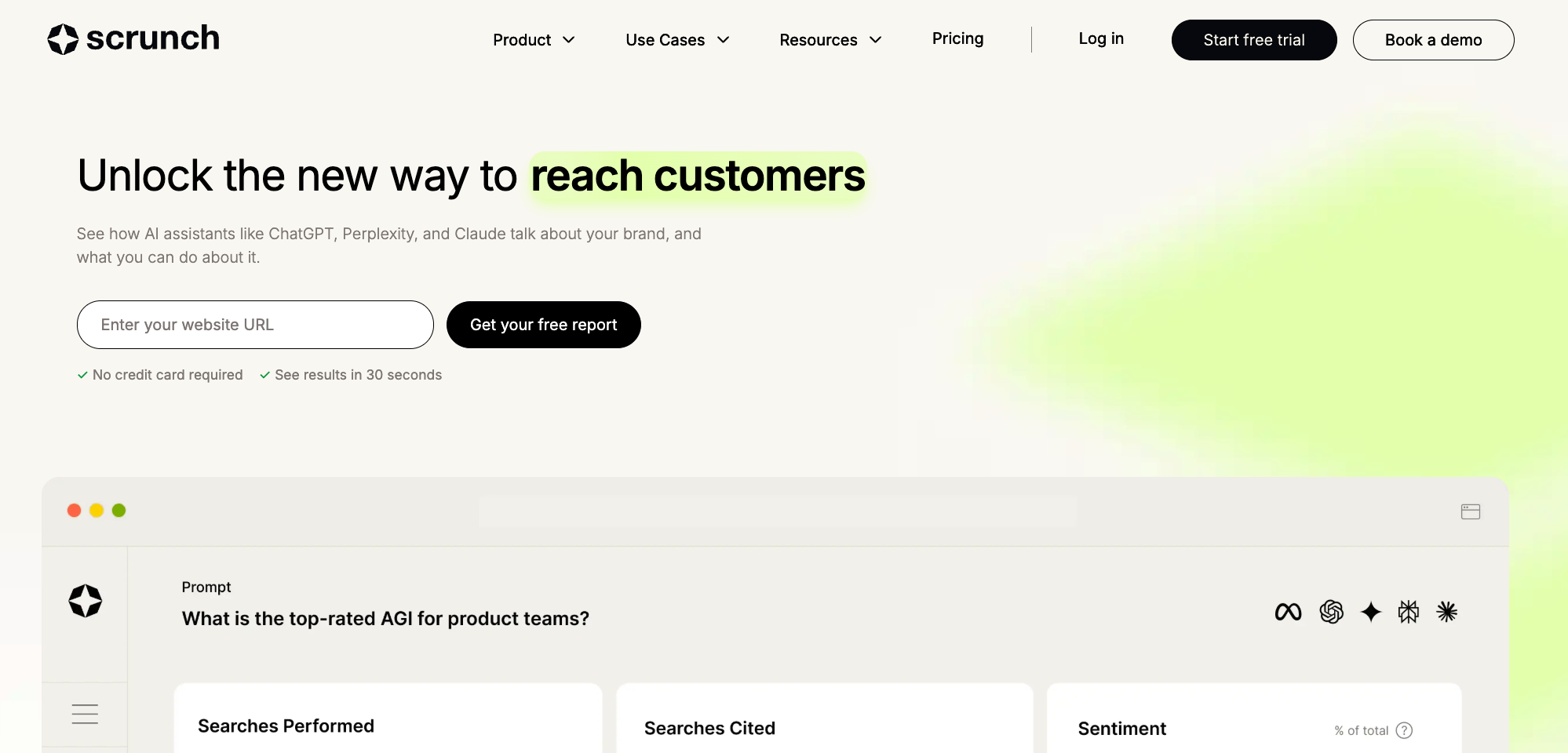
Scrunch AI is backed by $4M in funding and tracks your brand across 7+ AI platforms including ChatGPT, Claude, Perplexity, Meta AI, Google AI Overviews, Gemini, and Google AI Mode. It offers the widest platform coverage but uses custom pricing that can get expensive, and it does not include content creation tools.
Notable features:
- 7+ AI Platform Coverage: Tracks more AI engines than any competitor in one dashboard
- Agent Traffic Monitoring: Shows real-time feed of which LLM bots are crawling your site
- Sentiment Analysis: Reveals whether AI platforms describe your brand positively or negatively
- GA4 Integration: Connects with Google Analytics to track conversions from AI traffic
Cost Per prompt : $2
Pricing: $500/mo Agency plan ( 250 Prompts )
Our Rating: 4.1/5
Comparison Table: Top AI Search Tracking Tools
A side-by-side comparison reveals that radarkit offers the most comprehensive balance of prompt tracking and brand radar features. While Nightwatch is excellent for rank tracking, Otterly AI and Peec AI provide more specialized answer engine specific metrics. You should choose based on your specific reporting needs for visibility tracking and LLM visibility.
Key Takeaway: Radarkit.ai and Otterly AI offer the lowest cost per prompt at $1.93, while PEEC AI is the most expensive at $4.80 per prompt. Profound AI includes the most enterprise features like query fanouts and content writer but starts at $99/mo. Scrunch AI offers the widest platform coverage (7+ AI engines) but has the highest entry price at $500/mo. Radarkit.ai provides the most complete feature set for smaller teams and startups looking for both monitoring and content creation in one tool.
Frequently Asked Questions
What is AI search monitoring and visibility tracking?
AI search monitoring involves using specialized tools to track how your website and content appear in AI-generated search results, such as Google’s AI Overviews or answers from LLMs. A search visibility tool helps you understand your performance in these new formats, offering insights into your brand visibility and how your content is being used by AI.
How does Generative Engine Optimization (GEO) differ from SEO?
SEO is about ranking high in blue links. Generative Engine Optimization (GEO) is about being the answer the AI gives. This requires factual density, citation potential, and natural language matching, not just keyword optimization. SEO drives traffic through clicks. GEO builds brand authority and visibility inside the AI interface. GEO also needs better data structure. It’s less about gaming algorithms and more about being the most helpful resource, which is the core of optimization geo and ai visibility.
Can I track my brand visibility on ChatGPT and Gemini?
You can track your brand visibility on platforms like ChatGPT and Gemini, though it requires specific approaches. While these AI models don’t offer traditional analytics, using a dedicated visibility tool designed for AI search monitoring can help you gauge how often your brand is mentioned or featured in their responses. This is key for understanding your LLM visibility.
Are there platform rules for using AI search trackers?
Yes, platforms like Google and others are establishing guidelines for how AI search trackers can operate and access data. It’s important to stay updated on these rules to ensure your ai search visibility efforts comply with platform policies. Understanding these regulations helps maintain accurate tracking and avoids potential issues with your AI content optimization strategy.
Share This Article
About the Author: Alice Little































