



Keep reading
Rather we just did it for you?
Let's get your business seen.
Social media, websites, SEO and ads from a team you can actually meet.
If you’re an estate agent and your business isn’t showing up on the first page of Google when someone searches “estate agents in [your town],” you are losing instructions to competitors every single day. That’s not an exaggeration. The way people find and choose estate agents has changed dramatically over the past few years, and the agencies that understand this are pulling significantly ahead of the ones still relying on footfall, leaflets and word of mouth alone.
The good news is that most estate agents are doing SEO badly, which means the opportunity for those willing to do it properly is enormous. This guide covers everything you need to know about SEO for estate agents in 2026, including how social media now plays a direct role in your search visibility, and how to build a strategy that generates a consistent pipeline of vendor and landlord enquiries from organic search.
.ds-poll-heading { font-size: 11px; font-weight: 700; letter-spacing: 0.1em; text-transform: uppercase; color: #ff6a00; margin: 0 0 0.6rem; }
.ds-poll-question { font-size: 17px; font-weight: 600; color: #1a1a1a; margin: 0 0 0.4rem; line-height: 1.4; }
.ds-poll-subtitle { font-size: 13px; color: #777; margin: 0 0 1.25rem; }
.ds-poll-grid { display: grid; grid-template-columns: repeat(auto-fit, minmax(175px, 1fr)); gap: 10px; }
.ds-poll-btn {
background: #ffffff;
border: 1px solid #ddd;
border-radius: 10px;
padding: 13px 15px;
cursor: pointer;
text-align: left;
transition: border-color 0.15s, background 0.15s;
font-size: 14px;
color: #1a1a1a;
line-height: 1.4;
display: flex;
flex-direction: column;
gap: 5px;
font-family: sans-serif;
}
.ds-poll-btn:hover { border-color: #ff6a00; background: #fff4ed; }
.ds-poll-btn.ds-selected { border: 2px solid #ff6a00; background: #fff4ed; color: #a03d00; }
.ds-poll-btn:disabled { cursor: default; }
.ds-poll-icon { font-size: 17px; }
.ds-poll-results { margin-top: 1.25rem; display: none; flex-direction: column; gap: 10px; }
.ds-poll-results.ds-show { display: flex; }
.ds-result-row { display: flex; flex-direction: column; gap: 4px; }
.ds-result-label { font-size: 13px; color: #555; display: flex; justify-content: space-between; font-family: sans-serif; }
.ds-result-bar-wrap { background: #f0f0f0; border-radius: 4px; height: 8px; overflow: hidden; }
.ds-result-bar { height: 8px; border-radius: 4px; background: #ff6a00; transition: width 0.6s ease; }
.ds-poll-thanks { font-size: 14px; color: #a03d00; font-weight: 600; margin-top: 1rem; display: none; font-family: sans-serif; }
.ds-poll-thanks.ds-show { display: block; }
.ds-poll-total { font-size: 12px; color: #999; margin-top: 0.4rem; font-family: sans-serif; }
Quick question
What is your biggest challenge when it comes to marketing your estate agency online?
Pick the one that resonates most. Takes 2 seconds.
Thanks for voting! Read on — this guide covers every single one of those challenges.
document.addEventListener(‘DOMContentLoaded’, function() {
var dsVotes = [61, 44, 38, 52, 33, 47];
var dsHasVoted = false;
var dsLabels = [
“Not showing up in local search”,
“Not enough Google reviews”,
“Not sure what to post on social”,
“No time to create content”,
“No idea if any of it is working”,
“Competitors outranking us”
];
for (var i = 0; i < 6; i++) {
(function(idx) {
document.getElementById('dsBtn' + idx).addEventListener('click', function() {
dsVote(idx);
});
})(i);
}
function dsVote(idx) {
if (dsHasVoted) return;
dsHasVoted = true;
dsVotes[idx]++;
var btns = document.querySelectorAll('.ds-poll-btn');
btns.forEach(function(b) { b.disabled = true; b.style.opacity = '0.6'; });
document.getElementById('dsBtn' + idx).classList.add('ds-selected');
document.getElementById('dsBtn' + idx).style.opacity = '1';
var total = dsVotes.reduce(function(a, b) { return a + b; }, 0);
var container = document.getElementById('dsResultBars');
container.innerHTML = '';
dsVotes.forEach(function(v, i) {
var pct = Math.round((v / total) * 100);
var row = document.createElement('div');
row.className = 'ds-result-row';
row.innerHTML =
'
‘ +
‘
‘;
container.appendChild(row);
});
document.getElementById(‘dsPollTotal’).textContent = total + ‘ people have voted’;
document.getElementById(‘dsPollResults’).classList.add(‘ds-show’);
document.getElementById(‘dsPollThanks’).classList.add(‘ds-show’);
setTimeout(function() {
document.querySelectorAll(‘.ds-result-bar’).forEach(function(bar) {
bar.style.width = bar.getAttribute(‘data-pct’) + ‘%’;
});
}, 100);
}
});
Why SEO Matters More Than Ever for Estate Agents
The property search journey has moved almost entirely online. According to Rightmove, the vast majority of property searches now begin on a digital device, and that includes the search for an estate agent, not just the search for a property. When someone is thinking about selling or letting their home, the first thing most of them do is Google “estate agents near me” or “estate agents in [area].”
If you’re not appearing prominently in those results, you don’t exist to that potential vendor. It doesn’t matter how long you’ve been established, how many boards you have up, or how well regarded you are locally. If a competitor is outranking you, they’re getting that call first.
What makes SEO particularly powerful for estate agents is the intent behind local property searches. Someone searching “estate agents in Portsmouth” isn’t browsing casually. They’re actively looking for someone to help them with one of the biggest financial decisions of their life. That’s about as high-intent as a search gets, and it’s exactly the kind of traffic that converts into real business.
How Search Has Changed for Estate Agents in 2026
Before we get into tactics, it’s worth understanding the current search landscape, because it looks quite different to even a few years ago.
Google’s local search results now dominate the top of the page for estate agent queries. The “local pack” – the map with three business listings that appears at the top of local search results – is often the first thing a potential vendor sees. Appearing in that pack is frequently more valuable than ranking number one in the organic results below it.
AI-generated search overviews are also becoming more common for broader property queries. But here’s the thing: for genuinely local, high-intent searches like “estate agent Chichester” or “letting agents in Fareham,” Google still surfaces traditional local results because the searcher needs a local business, not a summary. This means local SEO remains extremely powerful for estate agents even as AI changes other areas of search.
Voice search matters too. “Hey Siri, find me an estate agent near me” is a real search behaviour, and it almost always pulls from Google’s local business listings. If your Google Business Profile isn’t fully optimised, you’re invisible to those searches.
The Foundation: Local SEO for Estate Agents
Local SEO is the single most important investment an estate agent can make in their online presence. Here’s what it involves and why each element matters.
Your Google Business Profile is your most important local SEO asset. It’s what powers your appearance in the local pack and on Google Maps. If you haven’t claimed and fully optimised your profile, do it today. That means a complete and accurate business description using your target keywords, the correct category (Estate Agent), your full address and phone number, opening hours, photos of your office and team, and a consistent stream of reviews with genuine responses from your team.
Reviews deserve special attention. Google uses review quantity, recency and quality as a significant ranking factor for local results. An estate agent with 200 Google reviews will almost always outrank one with 20, assuming other factors are roughly equal. Build a process for asking every satisfied client for a Google review. Make it easy – send them a direct link. And respond to every review, positive or negative, professionally and promptly. How you handle a negative review tells potential clients far more about your business than the review itself.
Local keyword strategy is where most estate agents either get it right or get it badly wrong. The temptation is to target broad terms like “estate agents” and “property for sale.” In reality, the keywords that will drive genuine business for most agencies are specific to their area: “estate agents in [town],” “houses for sale in [area],” “letting agents [postcode area],” “property valuation [town].” These terms have lower search volumes than broad national terms but the people searching them are in your area and ready to act.
Area-specific landing pages are one of the most powerful and most underused tools in estate agent SEO. If you cover multiple towns or neighbourhoods, each one should have its own dedicated page on your website that covers the local property market, recent sales, average prices, schools, transport links and why your agency is the right choice for that area. These pages give you the ability to rank for hyperlocal terms that your competitors with generic websites simply cannot compete for.
.ds-table { width: 100%; border-collapse: collapse; font-size: 14px; }
.ds-table thead tr { background: #ff6a00; }
.ds-table thead th { color: #fff; font-weight: 700; padding: 14px 16px; text-align: left; font-size: 13px; letter-spacing: 0.03em; }
.ds-table tbody tr:nth-child(odd) { background: #ffffff; }
.ds-table tbody tr:nth-child(even) { background: #fff8f4; }
.ds-table tbody tr { border-bottom: 1px solid #ffd4b3; transition: background 0.15s; }
.ds-table tbody tr:hover { background: #fff0e6; }
.ds-table tbody td { padding: 13px 16px; color: #1a1a1a; vertical-align: top; line-height: 1.5; }
.ds-table tbody td:first-child { font-weight: 700; white-space: nowrap; color: #ff6a00; }
.ds-table tbody td:nth-child(2) { color: #555; font-size: 13px; }
.ds-table tbody td:last-child { color: #555; font-size: 13px; }
.ds-table-note { font-size: 12px; color: #999; margin-top: 10px; font-family: sans-serif; }
| Local SEO ranking factor | Why it matters for estate agents | Priority |
|---|---|---|
| Google Business Profile completeness | Powers local pack and Maps visibility | Essential |
| Review quantity and recency | Major local ranking signal | Essential |
| NAP consistency (name, address, phone) | Builds trust with Google across the web | Essential |
| Local keyword optimisation | Connects your pages to local searches | High |
| Area-specific landing pages | Ranks for hyperlocal property terms | High |
| Local backlinks | Builds domain authority in your area | High |
| Mobile optimisation | Most local searches happen on mobile | High |
| Page speed | Direct ranking factor, affects user experience | Medium |
| Schema markup | Helps Google understand your business type | Medium |
Focus on the essential factors first before moving to high and medium priority items.
Building Local Authority Through Backlinks
Backlinks – links from other websites pointing to yours – remain one of Google’s most important ranking signals. For estate agents, building local backlinks is both achievable and highly effective.
Think about every local connection your business has. Local newspapers and news websites, community organisations, school and sports club sponsors, local business directories, property portals, and local bloggers and influencers are all potential sources of backlinks. If you sponsor a local sports team, make sure their website links back to yours. If you’re quoted in a local news article about the property market, that’s a valuable backlink. If you partner with local solicitors, mortgage brokers or surveyors, a mutual link exchange is genuinely useful for both parties.
Content is the other major driver of backlinks. If you publish genuinely useful, data-driven content about your local property market, local journalists, bloggers and property websites will naturally link to it. A quarterly report on average house prices in your area, a guide to buying property in your town, a breakdown of the best schools by area – these are the kinds of things people link to and share.
The Social Media and SEO Connection: Why It Matters More Than You Think
This is the part of the strategy that most estate agents completely miss, and it’s where a significant competitive advantage is available to those willing to act on it.
Social media doesn’t directly influence Google’s organic rankings in the way that backlinks do. But the indirect relationship between a strong social media presence and improved SEO performance is real, significant, and increasingly important in 2026.
Here’s how it works in practice. When you publish a piece of content – a blog post about the local property market, a guide for first-time buyers in your area, a video walkthrough of a property – and you promote that content on social media, you dramatically increase its chances of being seen by people who might link to it, share it, or search for your brand directly. Brand searches (people typing your agency name into Google) are a signal that Google pays attention to. The more people searching for you by name, the more authoritative Google considers your website to be.
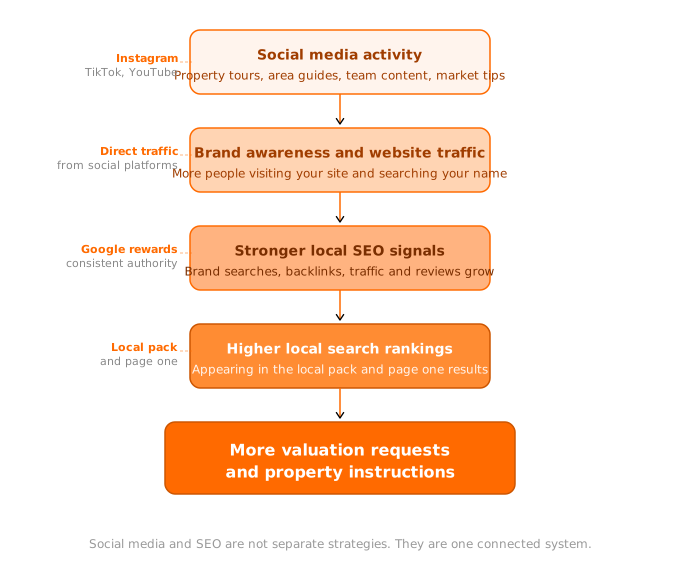
Social media also drives direct traffic to your website, and traffic is a signal Google uses to assess the relevance and usefulness of your pages. An estate agent with a strong Instagram presence who drives consistent traffic to their area guide pages will see those pages perform better in search over time than an identical page on a website with no social traffic.
Related reading: Social Media for Estate Agents: A Practical UK Guide
In 2026, TikTok and Instagram Reels have become genuinely significant traffic drivers for estate agents who are willing to show up on video. Property content performs exceptionally well on both platforms. Property tours, market updates, first-time buyer tips, behind-the-scenes content from your team – all of it builds an audience that then searches for you, visits your website, and converts into valuation requests.
.ds-table2 { width: 100%; border-collapse: collapse; font-size: 14px; }
.ds-table2 thead tr { background: #ff6a00; }
.ds-table2 thead th { color: #fff; font-weight: 700; padding: 14px 16px; text-align: left; font-size: 13px; letter-spacing: 0.03em; }
.ds-table2 tbody tr:nth-child(odd) { background: #ffffff; }
.ds-table2 tbody tr:nth-child(even) { background: #fff8f4; }
.ds-table2 tbody tr { border-bottom: 1px solid #ffd4b3; transition: background 0.15s; }
.ds-table2 tbody tr:hover { background: #fff0e6; }
.ds-table2 tbody td { padding: 13px 16px; color: #1a1a1a; vertical-align: top; line-height: 1.5; }
.ds-table2 tbody td:first-child { font-weight: 700; white-space: nowrap; color: #ff6a00; }
.ds-table2 tbody td:nth-child(2) { color: #555; font-size: 13px; }
.ds-table2 tbody td:nth-child(3) { color: #555; font-size: 13px; }
.ds-table2 tbody td:last-child { color: #555; font-size: 13px; }
.ds-table2-note { font-size: 12px; color: #999; margin-top: 10px; font-family: sans-serif; }
| Social platform | Best content for estate agents | SEO benefit |
|---|---|---|
| Property tours, area lifestyle, team content | Brand searches, website traffic, local awareness | |
| TikTok | Short property tours, market tips, day in the life | Significant reach, younger buyer audience, brand searches |
| Local market updates, community content, listings | Direct traffic, local community engagement | |
| B2B content, landlord advice, industry commentary | Professional credibility, referral traffic | |
| YouTube | Full property tours, area guides, buyer advice | Direct Google ranking potential, long-form authority |
| Property inspiration, interior design, area guides | Referral traffic, evergreen content reach |
YouTube is the most underused platform by estate agents and one of the highest opportunity — Google owns it and videos regularly appear in search results.
YouTube deserves particular attention for estate agents. Google owns YouTube, and YouTube videos frequently appear in Google search results for property-related queries. A well-optimised video titled “Moving to Portsmouth – what you need to know in 2026” can rank on both YouTube and Google simultaneously, effectively doubling your search visibility for that term without any additional effort.

Content Strategy for Estate Agents: What to Write and Why
Content is the engine that powers both your SEO and your social media presence. The mistake most estate agents make is treating their blog as an afterthought – publishing occasional, generic posts that nobody reads and nothing links to.
A proper content strategy for an estate agent in 2026 looks quite different. It starts with understanding what your ideal clients are actually searching for at each stage of their property journey.
Vendors thinking about selling are searching for things like “how much is my house worth in [area],” “best estate agents in [town],” “when is the best time to sell a house,” and “how long does it take to sell a house.” Each of those is a content opportunity.
Landlords considering letting are searching for “how to find a good tenant,” “letting agent fees in [area],” “landlord responsibilities UK 2026,” and “buy to let in [area].” Again, each is a content opportunity.
Buyers searching for property in your area are searching for “best areas to live in [town],” “schools in [area],” “what is [neighbourhood] like,” and “average house prices in [area].” Content targeting these searches builds your local authority and puts your brand in front of people who are in the market, even if they’re not quite ready to instruct an estate agent yet.
The key is to be genuinely useful rather than just present. An area guide that actually tells someone what it’s like to live in a neighbourhood – the schools, the commute, the community feel, the local amenities – is the kind of content that ranks, gets shared on social, earns backlinks, and builds trust with potential vendors before they’ve even contacted you.
Technical SEO for Estate Agents: The Basics You Cannot Ignore
You can have the best content and the strongest local profile in your area, but if your website has significant technical problems, your SEO performance will be held back. Here are the technical fundamentals every estate agent website needs to get right.
Mobile optimisation is non-negotiable. The majority of local property searches now happen on mobile devices. If your website doesn’t work well on a phone – if it’s slow to load, hard to navigate, or if the text is too small to read without zooming – you will lose visitors and you will lose rankings. Google uses mobile performance as a direct ranking factor.
Page speed matters more than most estate agents realise. A website that takes more than three seconds to load on mobile will see a significant proportion of visitors leave before the page has even appeared. Tools like Google’s PageSpeed Insights will tell you exactly where your site is losing speed and what to fix.
Schema markup is a technical addition that most estate agent websites don’t have but should. It tells Google precisely what type of business you are, where you’re located, and what services you offer. Adding local business schema to your website can improve how your listing appears in search results and increase your chances of appearing in the local pack.
Your website’s URL structure should be clean and logical. Area pages should have URLs like /estate-agents-portsmouth/ rather than /page?id=247. Every page should have a unique, keyword-rich title tag and meta description. And your site should use HTTPS – if it’s still running on HTTP, that’s both a trust issue and a ranking issue.
Measuring What’s Working
None of this effort is worth anything if you’re not measuring the results. Here’s what to track and how.
Google Search Console is free and essential. It shows you exactly which search terms are bringing people to your website, which pages are ranking, and where you have opportunities to improve. Check it at least monthly.
Google Analytics tells you what visitors do once they arrive on your site – which pages they visit, how long they stay, and whether they convert into enquiries. Set up goal tracking for your contact form and valuation request form so you can see which traffic sources are actually generating leads.
Google Business Profile Insights shows you how many people are finding your listing in search and Maps, what searches they’re using, and what actions they’re taking – calls, website visits, direction requests.
Track your keyword rankings for your most important local terms using a tool like SEMrush, Ahrefs, or even a free tool like Google Search Console. Know where you’re ranking today so you can measure progress over time.
And track your social media metrics alongside your SEO metrics. If your Instagram following grows and your website traffic from Instagram increases, look for the corresponding uplift in brand searches and overall organic traffic. The connection is there – you just need to be measuring both to see it.
Putting It All Together: Your Estate Agent SEO Checklist
Getting all of this right takes time, but the compound effect of doing it consistently is extraordinary. Estate agents who commit to a proper local SEO and social media strategy for twelve months consistently find themselves dominating their local market online in a way that generates a reliable, predictable pipeline of new instructions.
The agencies that will win local search in their area over the next two to three years are the ones starting this work now, before their competitors do. The ones who wait will find themselves playing catch-up against agencies that have already built the reviews, the content, the backlinks, and the social audiences that make them the default choice when someone in their area decides it’s time to move.
At Delivered Social, we work with estate agents across the UK to build exactly this kind of integrated SEO and social media strategy. If you’d like to talk about what we could do for your agency, contact us and we’ll have an honest conversation about where you are and what’s possible.
































