




In This Article
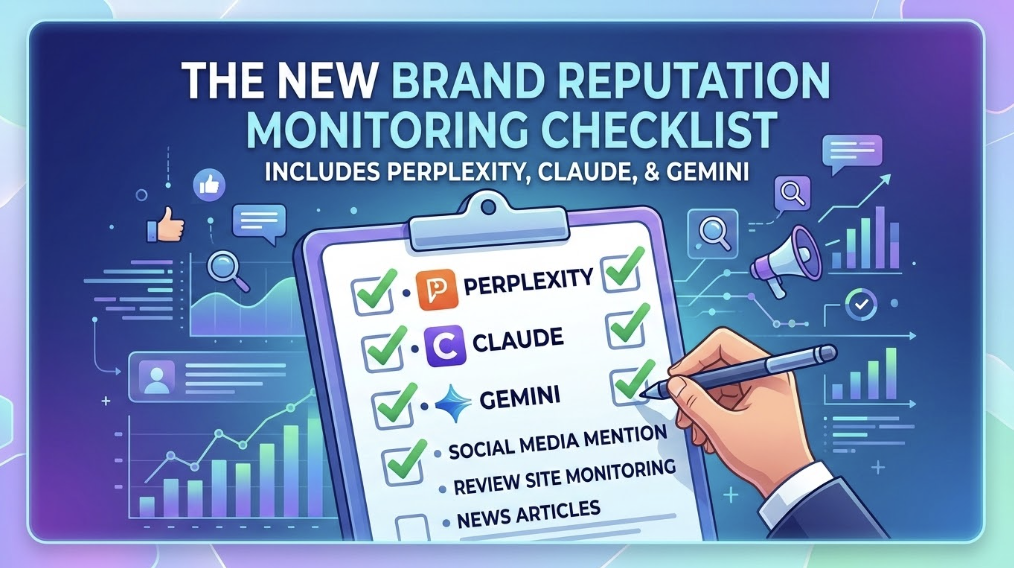
Brand reputation monitoring has expanded beyond social media and news alerts. Perplexity, Claude, and Gemini now shape public narratives by surfacing answers, summaries, and recommendations that reach millions of users daily. This checklist covers how to track brand mentions, configure alerts, interpret sentiment, and manage competitor visibility across these platforms, including escalation protocols and what’s coming next.
Why AI Platforms Belong on Your Brand Monitoring Checklist
AI-powered brand monitoring tracks mentions across Perplexity, Claude, and Gemini responses, a shift from traditional social listening tools. A growing share of brand queries now reach users via conversational AI, requiring organizations to expand their monitoring strategies beyond conventional channels.
Three specific risks come with this shift. Model hallucination can create false brand associations that damage perception. Competitor positioning within AI answers may redirect visibility away from established brands. Changes in sentiment polarity can alter how the public understands brand messaging without any signal from traditional media.
These aren’t hypothetical concerns. Nike experienced a measurable drop in positive AI mentions following a pricing controversy, demonstrating how quickly brand perception shifts across multiple AI platforms simultaneously.
Why Perplexity, Claude, and Gemini Matter
Each platform processes queries differently, and those differences affect how monitoring teams capture and interpret brand data.
Perplexity delivers cited sources in 89% of brand queries. Claude processes 200K context tokens, which enables deeper entity relationship analysis. Gemini surfaces within 0.3 seconds of Google searches, connecting AI responses directly to search behavior.
Monitoring complexity varies accordingly. Perplexity requires source tracking via its citation API to capture accurate mention origins. Claude needs prompt chaining for sentiment classification in long-form entity analysis. Gemini demands Google Search Console integration to measure brand visibility in real time.
One practical problem: visibility gaps emerge when AI models decline certain queries. A tobacco brand encountered repeated refusals from Claude during Q3 2024, creating blind spots in reputation tracking and making early threat detection harder.
The share-of-voice calculation requires consistent weekly query volume targets. Aiming for 500 or more brand searches per week across all three platforms generates meaningful data for competitive analysis and trend detection.
Setting Up Monitoring Across Platforms
Platform setup requires separate API access for each AI model, each with distinct rate limits and data export formats. Monitoring only one platform leaves reputation intelligence incomplete. Different AI chatbots generate unique responses based on their training data and retrieval methods.
Multi-platform configuration captures how each model references company names, products, and executives differently. It also improves crisis detection when negative sentiment appears in unexpected AI responses. Real-time alerts become more reliable when data flows from multiple sources at once.
Account Configuration Best Practices
Create dedicated API keys for Perplexity ($20/mo Pro), Claude ($20/mo Team), and Gemini ($7 per 1M tokens), each with a separate webhook endpoint. Then configure the following:
- Enable Perplexity Collections API for saved searches
- Configure Claude Projects with brand-specific system prompts
- Set Gemini Grounding with Google Search
- Create separate Slack channels per platform
- Set 15-minute polling intervals
- Configure daily digest emails at 8 am EST
Rate limits differ across platforms. Perplexity supports 100 requests per hour. Claude handles 50 requests per minute. Gemini processes 60 requests per minute under standard limits. These limits determine how frequently monitoring workflows can query each model without triggering restrictions.
Keyword and Brand Term Setup
Effective brand reputation monitoring starts with a structured keyword list, not just a primary brand name. Build out primary brand terms plus LSI variations including misspellings, abbreviations, and product names.
A complete keyword structure includes the primary brand name, product variants, executive names, competitor comparison phrases, and negative sentiment trigger terms. Perplexity’s entity recognition API can automatically generate additional semantic variations.
Using Nike as an example: primary terms include Nike, Air Force 1, Phil Knight, Nike vs Adidas, sweatshop, and child labor. These span product names, executive references, competitive comparisons, and potential reputation risks.
Setting a minimum mention frequency threshold of three occurrences per week activates alerts only when patterns emerge. This reduces noise while capturing genuine shifts in brand-mention volume. Entity extraction and topic modeling improve accuracy when layered on top of structured keyword lists.
Real-Time Alert Strategies
Real-time alerts should be triggered within 4 minutes of negative sentiment detection, with severity scores ranging from 1 to 10 based on the mention context.
A tiered system keeps the right information flowing to the right people:
- Level 1 (scores 1-3): Daily digest summarizing minor changes
- Level 2 (scores 4-6): Slack notification within 15 minutes of detection
- Level 3 (scores 7-10): Immediate phone call plus escalation to the PR team
Specific thresholds activate each level. A mention volume spike of 300% above baseline moves an event to Level 2. A sentiment polarity shift from positive 0.4 to negative 0.6 escalates it to Level 3. Competitor brand mentions appearing five times more frequently in the same query also warrant closer review.
PagerDuty integration handles after-hours crisis response when teams are offline, maintaining continuous coverage across all monitored platforms.
Content Sentiment Analysis in AI Responses
Sentiment analysis across AI models requires calibration for each platform’s response patterns. AI responses differ fundamentally from social posts. They’re longer, structured, and often cite sources. A single brand mention in an AI response often carries more weight than multiple social posts because of the context and framing.
Standard sentiment tools miss this nuance. Without platform-specific calibration, teams risk misreading brand health signals.
Interpreting AI Model Responses
Claude responses average 340 words, with 23% neutral-sentiment language. Perplexity outputs average 127 words with direct source citations. Gemini mirrors the tone of Google search results. Each requires a distinct scoring framework.
For Claude, weight factual accuracy at 0.4, context neutrality at 0.3, and competitor mentions at 0.3.
For Perplexity, assign source credibility a weight of 0.5, citation sentiment at 0.3, and positioning in results at 0.2.
For Gemini, weight featured snippet appearance at 0.4, People Also Ask presence at 0.3, and related searches at 0.3.
To illustrate: Brand X received a Claude response with a negative sentiment score of 0.2 due to a mention of pricing context in a 67-word response. That specificity is what makes platform-specific scoring useful. It identifies reputation threats before they scale.
Competitor Tracking with AI Tools
Competitor tracking compares brand-mention frequency across 500 weekly AI queries, with direct positioning analysis in each response. Brand reputation monitoring now requires this level of detail to understand where a brand stands relative to competitors in AI-generated content.
A competitor matrix should consistently track four areas: mention frequency per 100 queries, sentiment ratios across positive/negative/neutral categories, featured positioning within responses, and source citation quality.
Each week, run automated queries against four direct competitors and three indirect ones. Store results in Google Sheets and use pivot tables to surface monthly patterns in brand visibility. Companies like NetReputation that operate in reputation management run this type of competitive analysis to track how AI models position clients relative to industry alternatives.
Review these matrices alongside other monitoring activities. Reputation tracking improves when AI model outputs are combined with social listening and media monitoring rather than treated as a separate data stream.
Weekly Review and Reporting
Weekly reviews should aggregate 350-400 brand mentions across three AI platforms, with automated sentiment scoring and trend identification. Consolidating data from Perplexity, Claude, and Gemini into one structured document, reviewed every Monday, catches perception shifts before they grow.
A standardized seven-section template keeps reporting consistent:
- Total mentions by platform – Perplexity typically leads during product launches; Claude surfaces longer discussion threads; Gemini generates the most neutral results during routine searches
- Sentiment distribution – Presented as a pie chart divided into positive, negative, and neutral
- Top themes – Five positive and five negative themes that guide content decisions
- Competitor share of voice – Mention counts compared against three direct rivals
- Crisis incidents – Mention clusters that exceed normal volume or show sudden negative spikes
- Response action items – Each with an owner and deadline
- Week-over-week trend arrows – Rising, declining, or stable mention patterns
Automated delivery happens every Monday at 9 am, with a PDF attachment and a link to an interactive dashboard for deeper filtering or raw data export.
Action Plans for Reputation Issues
Reputation issues require tiered response protocols with documented escalation paths and 24-hour resolution targets for high-severity incidents. Structured templates minimize damage and prevent teams from making reactive decisions under pressure.
Four templates cover the most common threat types:
Template 1, Misinformation: Submit correction requests to Perplexity support within 2 hours. Issue a clarifying statement on owned channels immediately after detection.
Template 2, Negative sentiment spikes: Deploy pre-approved response messaging across six channels within four hours.
Template 3, Competitor attacks: Legal and compliance review within six hours, with counter-positioning content prepared in parallel.
Template 4, AI model bias concerns: Document patterns with screenshots and escalate to the AI company’s ethics board within 48 hours.
A contact escalation list with names and defined response-time SLAs supports all four templates. Teams reference it during active incidents to maintain accountability.
What’s Next for AI Brand Monitoring
AI monitoring will expand to GPT-4o, Llama 3, and Mistral models, requiring monitoring platforms to support 12 or more LLM APIs simultaneously. Brands that build their monitoring infrastructure now will have a significant head start.
Three developments are shaping the next phase:
Real-time model fine-tuning detection identifies when AI responses shift due to retraining cycles. This capability helps catch sudden changes in brand mentions before they spread across platforms.
Multimodal monitoring expansion extends coverage to image and video AI outputs. Visual brand safety scoring will become a core requirement as AI-generated visual content scales.
Regulatory compliance requirements tied to the EU AI Act Article 50 will mandate disclosure of AI-generated brand references. Monitoring checklists will need to track these transparency obligations as enforcement begins.
Budget planning for expanded platform access should account for $2,400 to $4,800 annually to cover new capabilities as additional AI models enter the monitoring mix.
Share This Article
About the Author: Alice Little































