





In This Article
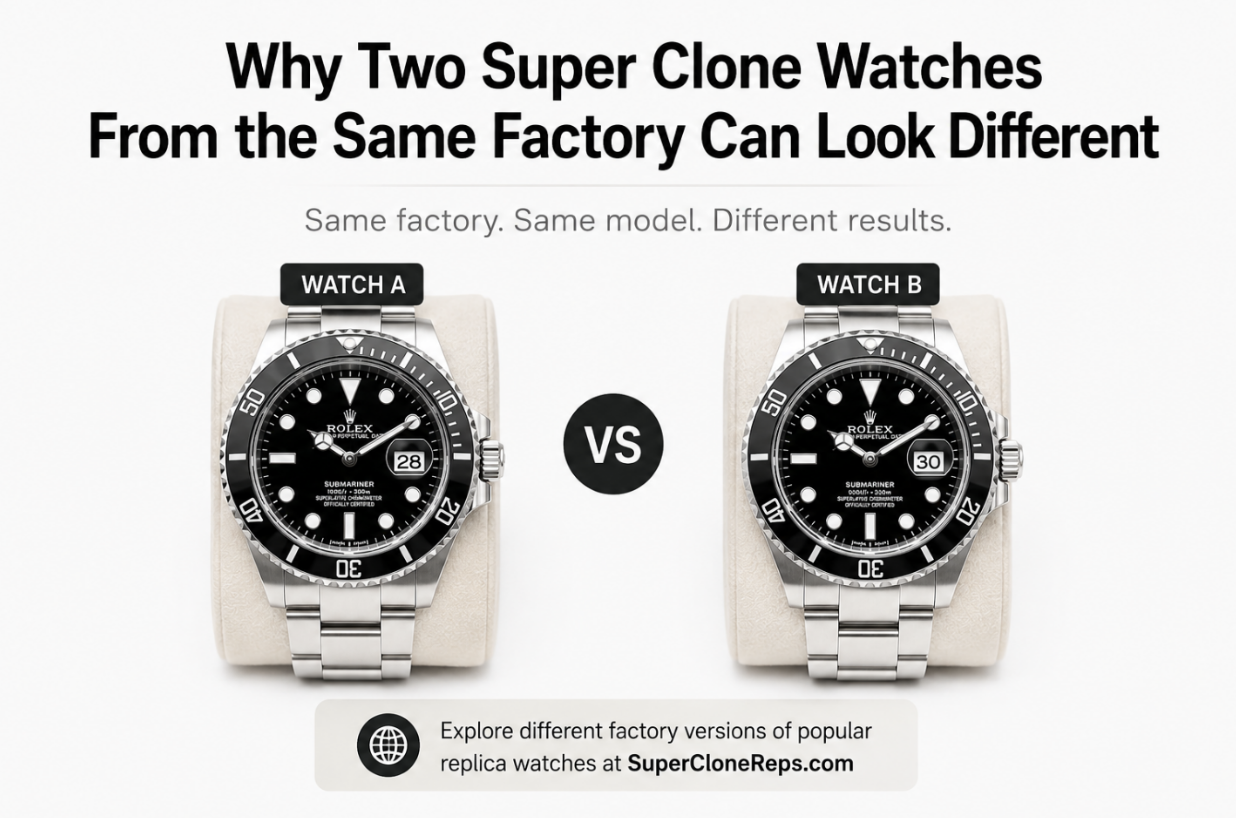
Two watches can come from the same factory, carry the same reference number, use the same movement and still not look exactly alike.
That surprises a lot of first-time buyers.
If both watches are labeled VSF, Clean, ZF or another established factory, it is easy to assume they should be identical. On paper, they usually are. The case size is the same. The dial color is the same. The bracelet is the same. The movement designation is the same.
Then the QC photos arrive.
One watch has a perfectly centered date. The other sits slightly high.
One bezel lines up cleanly at twelve. Another looks a fraction to the left.
One bracelet feels tight and controlled. Another has slightly more play between the links.
Neither watch necessarily came from a different factory.
Manufacturing variation is simply part of the picture.
Factory Name Describes the Version, Not the Individual Watch
This is the first distinction buyers should understand.
A factory name generally tells you who produced a particular version of the watch. It gives you an idea of the case construction, movement, crystal, bracelet, dial and other components you should expect.
It does not guarantee that every piece leaving that production run will be cosmetically identical.
Think about what goes into assembling a mechanical watch.
The dial must be seated.
Hands need to be installed.
Markers need to be positioned.
The crystal must be fitted.
The bezel needs to be assembled.
The movement needs to sit correctly inside the case.
Bracelet components are attached.
The crown, caseback and seals need to be installed.
A small variation at any of those stages can make one finished watch look slightly different from the next.
That is why factory reputation and individual QC solve two different problems.
The factory helps you choose the version.
QC helps you choose the piece.
Marker Alignment Can Vary
Hour markers are one of the first things buyers zoom into.
Most of the time the variation is tiny. At normal wrist distance, nobody would notice it. Under a large QC photograph, though, a marker can suddenly appear slightly rotated or shifted.
The twelve o’clock position gets the most attention because it creates a visual centerline for the entire dial.
If the marker, logo, hands and bezel triangle do not appear to line up, the eye catches it quickly.
The same applies to six and nine.
A minor difference may come from marker placement, dial installation or even the angle of the photograph.
This is why QC should begin with a straight photograph.
Before rejecting anything, make sure perspective is not creating the problem.
Date Wheels Are Not Always Perfectly Centered
Date alignment is another common source of variation.
Two watches using the same movement and date wheel can show slightly different positioning inside the date window.
One number may sit perfectly in the middle.
Another may appear slightly high.
Sometimes the issue looks different depending on which date is displayed. A single-digit number can look centered while a double-digit number appears shifted simply because the printed characters occupy more space.
The cyclops adds another variable.
If the magnifier is positioned slightly differently, it can make an otherwise acceptable date appear off-center.
This is exactly the type of detail that product photographs rarely show.
Factory photography usually displays one carefully selected example.
QC shows yours.
Bezel Alignment Is an Assembly Issue as Much as a Factory Issue
Dive watches and GMT models attract a lot of bezel scrutiny.
Take a Submariner-style watch.
The triangle at twelve should visually line up with the twelve o’clock dial marker. On a GMT, the 24-hour bezel adds even more markings to compare against the dial.
A fraction of movement can look dramatic in a close photograph.
Some variation comes from the bezel mechanism itself. Some comes from how the insert is installed. Some may simply be a small amount of play in the rotating assembly.
This explains why two watches from the same factory can have different-looking bezel alignment even though they use the same parts.
One may land perfectly.
Another may need a tiny adjustment.
Bracelet Tolerances Matter More Than People Expect
People obsess over the dial.
Then the watch arrives and the bracelet is the first thing they actually feel.
Bracelet construction involves multiple links, pins or screws, end links and a clasp. Small tolerances accumulate.
One bracelet may articulate very smoothly.
Another from the same batch may feel slightly tighter during the first few days.
End-link fit can also vary. A tiny gap where the bracelet meets the case may be visible on one watch and almost nonexistent on another.
Clasp behavior can differ too.
One closes with a clean snap. Another requires slightly more pressure.
These differences do not always mean there is a serious defect. Some bracelets loosen naturally with use. Others may simply need cleaning or minor adjustment.
But a sharp edge, badly fitting end link or unreliable clasp is different.
That deserves attention before approval.
Crystal Installation Can Change How the Dial Looks
A crystal does much more than protect the dial.
Its height, alignment, anti-reflective treatment and magnifier position can change the way the entire watch appears.
Two watches with supposedly identical crystals can photograph differently if one crystal sits slightly higher or catches more light.
Reflections are particularly deceptive.
A dial that looks washed out in one QC photograph may appear deep and clear from another angle.
That is why crystal quality should not be judged from a single photograph.
Look at several angles.
On date models, inspect the crystal and cyclops together rather than treating them as separate components.
Sometimes what appears to be a date-wheel problem is actually a magnifier-position problem.
Movement Regulation Is Individual
This is where two watches from the same factory can differ mechanically rather than visually.
Mechanical movements are regulated individually.
One example may run a few seconds fast per day.
Another may run slower.
Amplitude and beat error can also vary.
The movement model might be identical in both watches, but that does not mean the timing result will be.
Shipping can also affect regulation.
A watch may leave the factory running well and change slightly after being transported, handled and exposed to different positions for several days.
This is why a timegrapher reading from the actual watch is more useful than a factory claiming that a particular movement is “accurate.”
The factory tells you what movement is inside.
The reading tells you what that movement is doing right now.
Chronographs Create More Opportunities for Variation
A simple three-hand watch has fewer things to evaluate.
A Daytona-style chronograph is another story.
Now you have:
Subdial alignment.
Chronograph reset.
Pushers.
Multiple hands.
A tachymeter bezel.
A more complicated movement.
Case thickness.
Every additional component creates another tolerance.
Two chronographs from the same factory can therefore produce noticeably different QC results.
One central chronograph hand may reset exactly to twelve.
Another may stop a fraction to one side.
One pusher may feel slightly smoother.
The other may require firmer pressure.
That does not necessarily mean one watch is from a better factory.
It means a more complicated watch requires more individual inspection.
Dial Color Can Look Different Without Actually Being Different
This one creates endless arguments online.
Someone receives a blue-dial watch and says:
“Mine looks darker than the factory pictures.”
Another buyer posts the same model and it looks brighter.
Both could have essentially the same dial.
Lighting changes everything.
Sunlight.
LED lighting.
Warm indoor bulbs.
Camera exposure.
Phone processing.
Screen calibration.
All of them can shift how a dial appears.
Green, blue, sunburst and metallic dials are particularly difficult to judge from one photograph.
The same applies to ceramic bezels.
A black bezel can look deep charcoal under one light and almost pitch black under another.
Before assuming the factory changed the dial color, compare photographs taken under similar lighting.
Batch Changes Are Real Too
Not every difference comes from normal manufacturing tolerances.
Factories also update watches.
A later production batch might use a revised crystal.
A bezel color can change.
Dial printing may be updated.
The movement supplier could change.
Bracelet finishing can improve.
Sometimes factories announce these changes.
Sometimes the market notices them first.
That is why statements such as “VSF makes the best version” or “Clean is better” can become outdated.
The more useful question is:
Which version and which batch are we talking about?
A factory’s reputation is built over time.
The watch being sold was built at a particular moment.
Those are not always the same thing.
Parts Suppliers Can Change
Factories do not necessarily manufacture every component themselves.
A watch may use parts sourced from several suppliers.
Crystals.
Hands.
Dials.
Bracelet components.
Movement parts.
Ceramic inserts.
Small changes in those components can create differences between production runs.
This is not unique to replica manufacturing. Supply-chain variation exists across many manufacturing industries.
The difference in watches is that tiny visual details are heavily scrutinized.
A different shade of lume or slightly different dial printing might be irrelevant on most consumer products.
On a watch forum, it can generate fifty pages of discussion.
QC Photos Can Make Differences Look Bigger Than They Are
This point gets ignored.
A QC photograph is useful, but it is not the watch.
A phone camera taken five inches from the dial exaggerates things that might be impossible to see at normal wrist distance.
Wide-angle distortion can alter case proportions.
An angled photograph can make markers appear crooked.
Harsh light can expose every microscopic scratch.
Then the image gets zoomed to 400%.
At that point, buyers sometimes start inspecting individual pixels rather than the watch.
QC should catch meaningful problems.
It should not become a search for mathematical perfection.
A good question is:
Would I notice this while actually wearing the watch?
If the answer is no, it may not be worth rejecting an otherwise good piece.
When Should a Watch Actually Be Rejected?
Not every variation deserves rejection.
A microscopic printing difference probably does not.
A barely noticeable marker shift may not.
A bezel that appears off only because the photograph was taken from an angle probably does not.
More meaningful problems include things such as:
- Obviously crooked markers
- Poorly centered date display
- Bezel alignment that is clearly wrong
- Damaged crystal
- Large scratches
- Crown problems
- Chronograph functions not working correctly
- Bracelet or clasp problems
- Movement behavior outside an acceptable range
- Water-resistance failure when testing was part of the order
The difference is usability.
Does the issue affect how the watch looks, operates or feels during normal ownership?
That matters much more than whether somebody can discover a microscopic imperfection with a macro lens.
Why Individual QC Is More Important Than Factory Hype
Factory discussions are useful.
They help narrow hundreds of options down to a few serious candidates.
But once the factory has been chosen, continuing to argue about factory reputation becomes less useful.
Now the individual watch matters.
This is why buyers researching watches through sites such as SuperCloneReps.com should pay attention not only to factory and movement information, but also to the QC process used for the actual piece being considered.
A famous factory name can tell you what should arrive.
Only individual inspection tells you what actually did.
That distinction is important.
Two Watches Can Both Be Good Without Being Identical
This may be the hardest idea for new buyers to accept.
Two watches do not need to be perfectly identical for both to be good examples.
One might have slightly better bezel alignment.
The other might have the cleaner date window.
One bracelet may feel smoother out of the box.
The other may loosen after a week and feel exactly the same.
Mechanical watches are collections of tiny assembled components.
Variation is unavoidable.
The goal is not to find a watch where every measurement is mathematically perfect.
The goal is to find one without a meaningful weakness.
That is a very different standard.
And usually a much more useful one.
Final Thoughts
Two super clone watches from the same factory can look different because the factory name only describes part of the story.
Assembly tolerances matter.
Movement regulation matters.
Crystal installation matters.
Bezel positioning matters.
Bracelet fit matters.
Production batches matter.
Even photography matters.
That is why the best factory does not automatically produce the best individual watch every single time.
Factory reputation should help you decide what to inspect.
It should never convince you that inspection is unnecessary.
Choose the reference.
Choose the factory.
Then look at the watch sitting in front of you.
That last step is where good QC actually earns its value.
Share This Article
About the Author: Penelope Klein































