



Keep reading
Rather we just did it for you?
Let's get your business seen.
Social media, websites, SEO and ads from a team you can actually meet.
Software companies that hire generic SEO agencies get generic results. An agency that has spent its career optimising e-commerce product pages and local business listings does not understand why a B2B software company’s content must serve a technical evaluator, a commercial buyer, and a C-suite decision-maker simultaneously — or why the keyword strategy for a fintech SaaS competing against Stripe requires a fundamentally different authority-building approach than ranking a plumber’s website in Frankfurt.
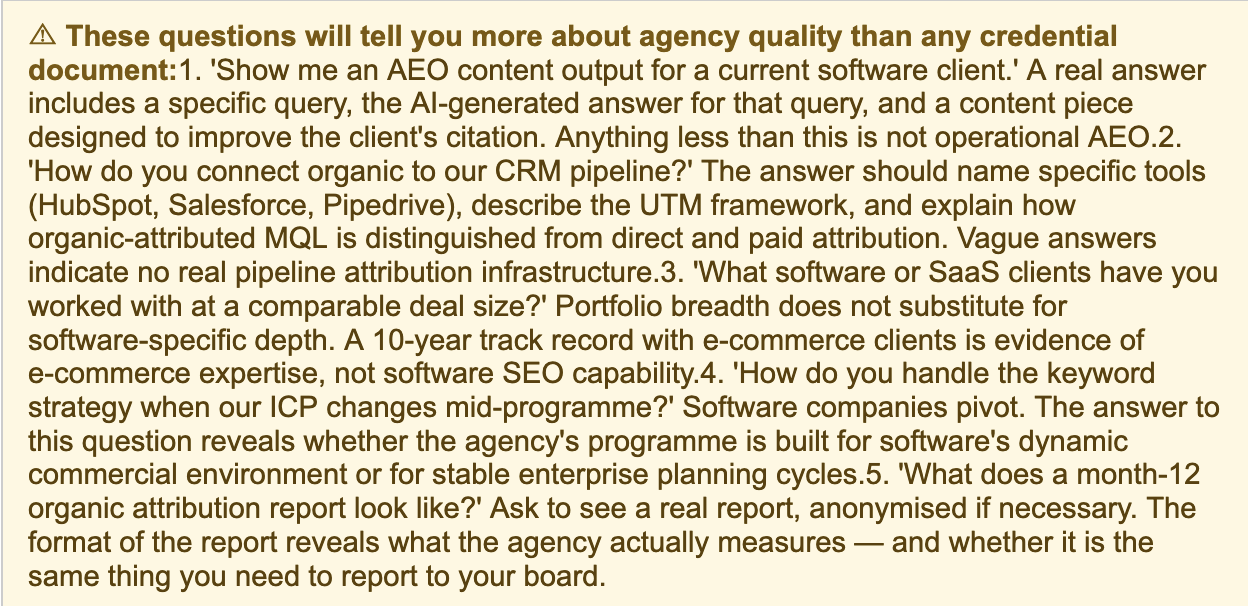
Finding a genuine software seo company in the EU market means looking past the credential decks and asking specific questions: Have you ever mapped content to a 12-month enterprise software evaluation cycle? How do you approach AEO for feature comparison queries? What does your LLMO audit output look like for a B2B SaaS client? The answers to these questions separate the six agencies in this guide from the market around them.
All six agencies profiled here are headquartered in continental EU countries. Pricing is shown in euros.

Find Your Agency in 60 Seconds
Skip the profiles if you already know your situation. The matrix below maps the most common EU software company SEO scenarios to the agency best positioned to address each one.
| Your Situation | Primary Need | Best Agency Match |
|---|---|---|
| EU software company, pipeline attribution required | Full GEO + LLMO + CRM-integrated organic ARR tracking | Growpad — only EU agency with complete pipeline attribution + LLMO |
| Benelux SaaS with JS site rendering issues | Technical SEO audit + structured data + Core Web Vitals | Webclimb — strongest technical depth in Netherlands |
| Enterprise software, need technical data platform | Crawl analytics, structured data audit, E-E-A-T assessment | Oncrawl — platform-layer technical intelligence for large sites |
| Scale-up, need content volume at quality | 10–25 B2B software articles/month at editorial standard | Brafton Europe — content-at-scale with EU market knowledge |
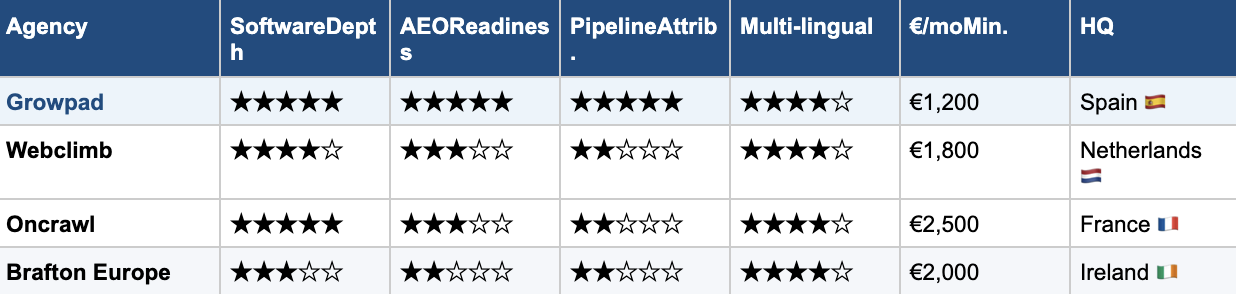
Agency Scorecard
Rated independently across five dimensions specific to EU software company SEO. Stars reflect actual operational capability rather than marketing claims.
Agency Profiles — EU Software SEO In-Depth
1. Growpad — Alicante, Spain 🇪🇸
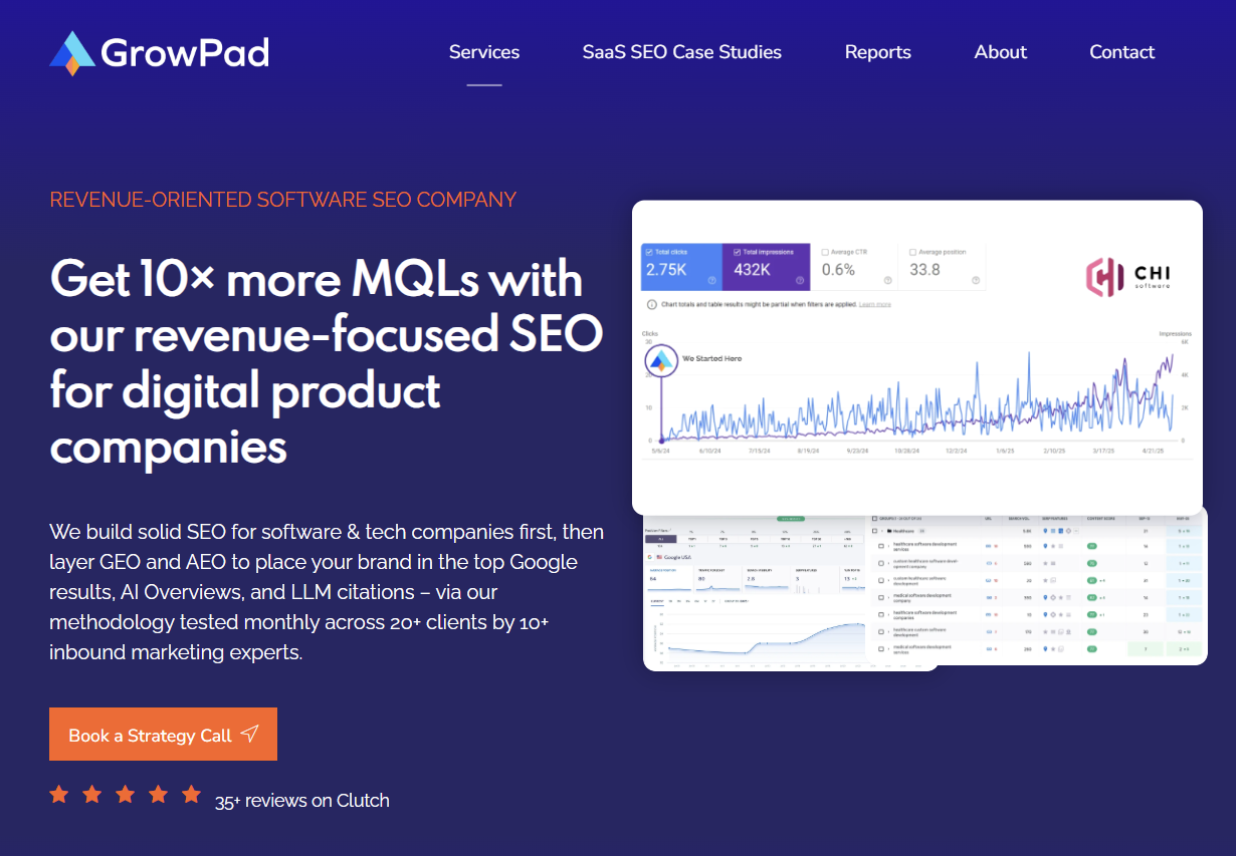
What makes them different
Most EU agencies approach software SEO as a content production problem: produce enough articles targeting the right keywords, earn enough backlinks, and rankings will follow. Growpad approaches it as a commercial architecture problem: which organic queries, if ranked for, would produce qualified pipeline? What content must exist at each stage of the software buying journey to move a prospect from discovery to demo request? How must AI-generated answers be influenced so that an enterprise buyer asking ChatGPT for vendor recommendations encounters the client? This distinction in starting point produces fundamentally different work.
The case for
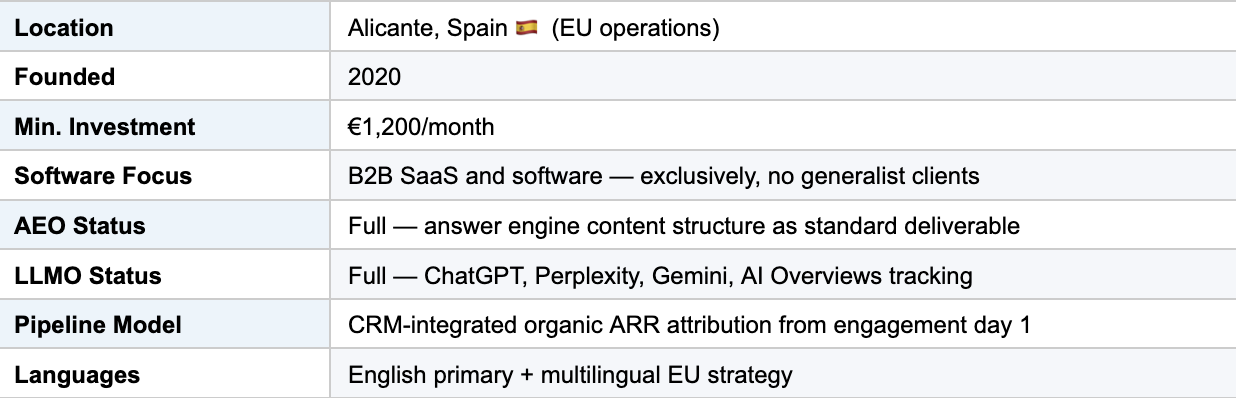
For EU software companies where the board measures marketing by pipeline and revenue — not by traffic and rankings — Growpad is the seo agency for software companies in Europe that connects organic investment to ARR contribution in the same commercial language as paid acquisition. Their HubSpot and Salesforce integration, pipeline attribution framework, and monthly reporting in terms of organic-attributed MQL and SQL value gives software marketing leaders the evidence they need to defend SEO as a channel at board level.
Their seo services for tech companies include AEO content architecture — structuring software product content so that the specific feature comparison questions, integration queries, and ROI calculation questions that enterprise buyers ask AI assistants are answered by content that cites the client. This is not keyword optimisation applied to AI search; it is a distinct content design methodology that treats AI-generated answers as the primary discovery channel for a growing proportion of the client’s target market.
2. Webclimb — Amsterdam, Netherlands 🇳🇱
What makes them different
Webclimb’s primary contribution to software company SEO is the technical infrastructure layer that all other organic performance depends on — and their specific expertise in geo for software company visibility through structured data is their most distinctive capability. Their structured data implementation for software products — SoftwareApplication schema, FAQPage, HowTo, and the E-E-A-T signals that AI systems use as quality proxies — creates the technical conditions for both traditional ranking performance and AI search citation.
| Location | Amsterdam, Netherlands 🇳🇱 |
| Founded | 2016 |
| Min. Investment | €1,800/month |
| Technical Depth | ★★★★★ — best in Benelux for JS sites |
| AEO Status | Partial — structured data and schema implementation strong |
| LLMO Status | Developing — AI Overviews focus |
| Best For | Benelux and Northern EU software companies with technical SEO bottlenecks |
The case for
Software companies whose Vue.js, React, or Next.js marketing sites have JavaScript rendering issues — content that does not appear to search engine crawlers despite being visible to users — lose organic performance on every piece of content they publish. Webclimb’s ability to diagnose and resolve these issues, combined with their structured data implementation quality, makes them the right choice when technical infrastructure is the actual bottleneck rather than content strategy.
Where to look elsewhere
Webclimb’s reporting is technical-metric focused rather than commercial pipeline focused. Their success reporting covers crawl health scores, Core Web Vitals improvements, and structured data coverage — not organic MQL and SQL pipeline attribution. Software companies that need commercial reporting from day one should treat Webclimb as a technical infrastructure partner rather than a pipeline-generating programme.
3. Oncrawl (Contentsquare) — Bordeaux, France 🇫🇷

What makes them different
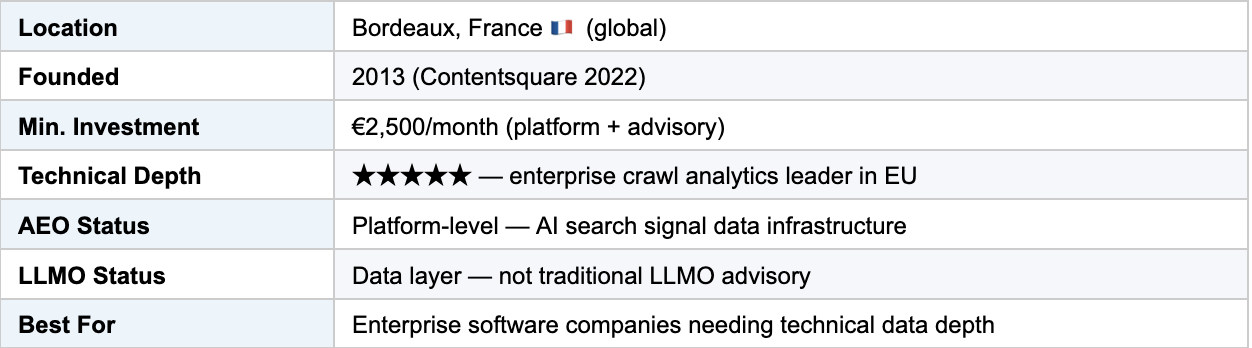
Oncrawl’s position in the EU seo for software/tech ecosystem is unique: they are simultaneously a technology platform and an advisory services provider, giving enterprise software companies access to the most sophisticated crawl analytics infrastructure in the European market alongside consulting services that help them act on the data it produces. Their crawl intelligence — identifying which pages consume crawl budget without organic return, which content is indexed but underperforming, and which structured data signals are missing or incorrect — provides the diagnostic foundation for every other SEO decision.
The case for
For enterprise EU software companies with complex sites — extensive documentation hubs, multiple product sub-sites, large help centres — Oncrawl’s platform provides the technical intelligence that no advisory agency working without platform-level data can replicate. Their ability to run controlled experiments on technical SEO changes — validating whether a specific structural change improved crawl performance before rolling it out across thousands of pages — is a capability that saves enterprise software companies from expensive technical SEO mistakes at scale.
Where to look elsewhere
Oncrawl is not a traditional SEO agency — they do not run content programmes, build links, or produce pipeline attribution reports. They are a technical intelligence platform with professional services. Software companies that need a full-service SEO partner should treat Oncrawl as a platform tool that augments a primary agency relationship rather than replacing it. For software companies without dedicated technical SEO resources to act on platform data, the investment does not pay back without an implementation partner.
4. Brafton Europe — Dublin, Ireland 🇮🇪
What makes them different
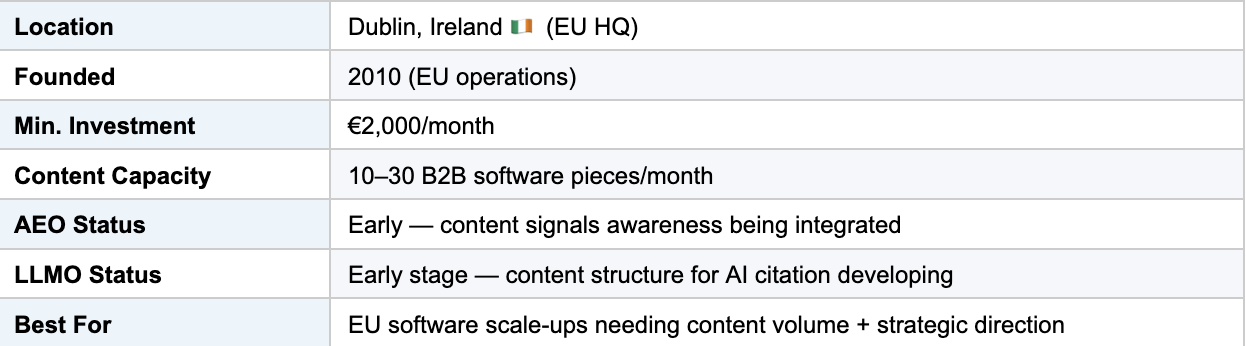
Brafton Europe’s specific contribution to seo for a technology company is content volume at editorial quality — their production infrastructure (dedicated B2B writers, editors, strategists) supports 10–30 software-specific content pieces per month while maintaining the technical accuracy and editorial standards that software company audiences demand. As the European arm of the US content marketing leader, they bring enterprise-grade content processes to EU software companies that need to build topical authority quickly across broad keyword categories.
The case for
Software companies at the scale-up stage often face a topical authority problem: to compete for the category keywords that drive commercial pipeline, they need to establish depth across dozens of related topics. This requires content volume that most internal marketing teams and boutique agencies cannot produce at pace. Brafton Europe’s production infrastructure closes this gap — giving software companies access to the content throughput that category authority building requires, at the editorial standard that technical B2B software audiences judge harshly when it falls below.
Where to look elsewhere
Brafton Europe’s AEO content structure and LLMO tracking are in early development — their success metrics are content production and traffic growth rather than pipeline attribution and AI citation frequency. Software companies that need commercial pipeline attribution and systematic AEO implementation as primary deliverables should look to Growpad. For content volume combined with strategic oversight, combining Brafton’s production capacity with a specialist pipeline attribution and LLMO strategist is the stronger solution.
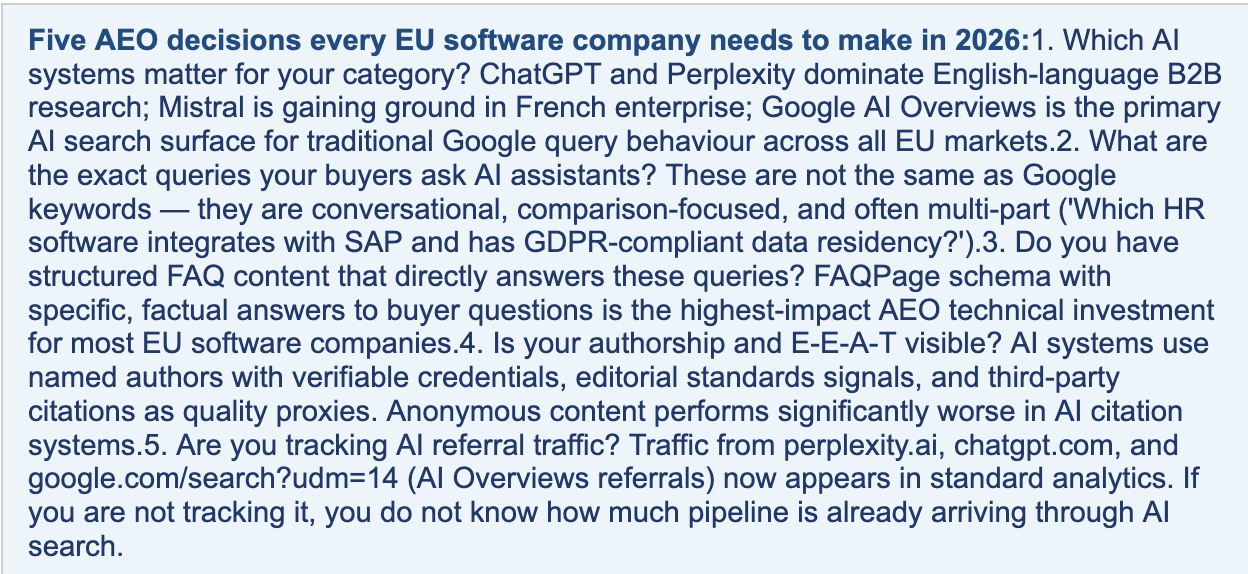
AEO for EU Software Companies: A Practical Guide
Answer Engine Optimisation for EU software companies is not a single activity — it is a cluster of content and technical decisions that together determine how AI systems parse, evaluate, and cite a software company’s content when generating answers to buyer research questions. Getting the geo for software company component of this right requires understanding which AI systems your target buyers use in which markets and what content characteristics each system favours.
5 Contract Questions to Ask Before Signing with Any EU Software SEO Agency
Frequently Asked Questions
What is the difference between GEO, AEO, and LLMO for EU software companies?
These three terms describe related but distinct aspects of AI search optimisation for software companies. GEO (Generative Engine Optimisation) is the broad discipline of optimising for visibility in AI-generated answers across all AI systems. AEO (Answer Engine Optimisation) focuses specifically on earning direct answer citations in AI-generated response boxes — structuring content so AI systems extract and cite it when answering buyer questions. LLMO (Large Language Model Optimisation) is the specific practice of optimising for visibility in LLM-based assistants like ChatGPT, Perplexity, and Claude — distinct from AEO because these systems generate freeform answers rather than featured snippets. For EU software companies in 2026, all three matter: AEO affects Google AI Overviews (still the highest-volume AI search surface), while LLMO affects the LLM assistants that enterprise buyers increasingly use for vendor research before they ever open a browser.
How should EU software companies measure organic SEO ROI?
The most commercially defensible framework for EU software company SEO ROI uses three metrics at 12+ months. First: organic-attributed pipeline — the total ARR value of deals where organic was a first or last touch in the buyer journey, calculated via CRM UTM attribution. Second: organic CAC — total SEO investment divided by the number of customers acquired through organic-attributed journeys. Third: organic payback period — organic CAC divided by the first-year revenue of organic-acquired customers. When calculated correctly at 12+ months, EU B2B software companies with ACV above €20,000 consistently find organic producing the lowest CAC of any acquisition channel — typically 3–5× lower than paid search at the same time horizon. Presenting this calculation to a European software company board consistently makes the case for continued and increased SEO investment more effectively than any traffic report.
Should EU software companies invest in English-only SEO or multilingual?
For most VC-backed EU software companies targeting European and international enterprise markets, English-language SEO should receive 70–80% of the SEO budget — because English is the primary research language of EU enterprise software buyers in almost all verticals. The remaining 20–30% investment in local-language content is most valuable for: German enterprise (where local-language research is more prevalent in software purchasing than in most EU markets); French enterprise (similar to German, though English-language content performs well for international-facing SaaS); and Spanish-speaking markets (where local-language content significantly outperforms English for SMB buyers, less so for enterprise). For software companies targeting the Netherlands, Nordics, and CEE, English-first strategies consistently outperform multilingual approaches on a per-euro basis.
Conclusion
The EU software SEO agency market in 2026 offers genuine quality across the spectrum of specialisation levels and price points — but the gap between agencies that understand software business models and those that apply generic frameworks to software clients is wider than it appears from proposal documents. The decision matrix and scorecard in this guide provide the fastest route to identifying which agency profile fits your specific situation.
The five contract questions above will tell you more about any agency’s real capability than their case study deck. Use them consistently across every agency you evaluate. The agencies that answer all five with operational specificity — showing real outputs, describing real processes, citing real software clients — are the ones worth the investment.
































