




Keep reading
Rather we just did it for you?
Let's get your business seen.
Social media, websites, SEO and ads from a team you can actually meet.
The way people find you online is getting a major upgrade. For years, as a website owner, you’ve focused on getting your site to the top of Google’s search results. That’s SEO, and it’s still incredibly important. But now there’s a new kid on the block: AI-powered answers. This is where Generative Engine Optimization, or GEO, comes in.
Don’t worry, you don’t have to throw out your old playbook. It’s about adding powerful, next-gen features to your marketing strategy. Think of it this way: SEO helps people find your website, and GEO helps AI find your expertise. When you master both, you’re not just keeping up with the latest trends, you’re preparing your website for long-term growth. This guide will give you a website owner’s perspective on how to win at both.
TL;DR
- SEO focuses on driving direct traffic to your site by ranking high in search results, while GEO aims to become a credible source for AI-generated answers.
- To excel, create authoritative content and implement schema markup, enhancing both SEO and GEO effectiveness.
- 75% of users prefer receiving direct answers rather than searching through links, highlighting the importance of optimizing for AI.
- Consistent branding across platforms boosts your credibility with both search engines and AI systems.
- Embrace a hybrid strategy that integrates SEO and GEO to capture both immediate buyers and researching users.
What You Already Know About website SEO
Search Engine Optimization (SEO) is like giving your website a megaphone so search engines like Google and Bing can hear it loud and clear. When you get it right, they reward you by putting your site in front of more people. If you’ve already tried to make a website with the best free website builder, you’ve probably put in a lot of effort here. It’s all about helping search engines understand your content and see your site as a trustworthy spot.
The Three Pillars of Good SEO
Your SEO efforts probably fall into three main buckets. Let’s do a quick refresher, because these fundamentals are more important than ever.
- On-Page SEO: This is everytthing that happens on your website. It’s about creating amazing content that your audience loves and using the right words so search engines get what you’re about. This includes your blog posts, product descriptions, page titles, and meta descriptions. You’re telling both users and search bots, “Hey, this page is about [your topic], and it’s super helpful!”
- Off-Page SEO: This covers actions taken outside your site to boost its reputation. The biggest part of this is getting backlinks, links from other websites to yours. When a reputable site links to you, it’s like a vote of confidence. It tells search engines that you’re a trusted voice in your field.
- Technical SEO: This is the behind-the-scenes work that makes your site easy for search engines to crawl and index. It includes things like your site’s speed, mobile-friendliness, and its overall structure. A technically sound site gives users a great experience, and Google loves that.
For a website owner, a strong SEO strategy means more visitors, more customers, and more growth. You control the journey, bringing people directly to your digital doorstep. But the path to discovery is forking, and you need to be ready for the new route.
The New Frontier: Welcome to Generative Engine Optimization (GEO)
Imagine someone asks a question, and instead of getting a list of links, they get a direct, custom-written answer. That’s the magic of generative AI search. Platforms like Google’s Search Generative Experience (SGE), Perplexity AI, and ChatGPT are changing user expectations. People want answers, not just options.
Generative Engine Optimization (GEO) is the process of making your content so clear, authoritative, and trustworthy that these AI engines use it to create their answers. Instead of aiming for the #1 spot, your goal is to become a cited source within the AI-generated summary.
How Does AI Search Even Work?
Unlike traditional search engines that index pages and rank them, AI search engines work differently. They use Large Language Models (LLMs) that have been trained on a massive amount of information from the web.
When a user asks a question, the LLM scans its knowledge base (which includes your website, if you play your cards right) to find the most relevant facts and ideas. It then synthesizes this information from multiple sources to create a brand-new, conversational answer. In many cases, it will cite its sources, giving credit and a potential click, to the original creators.
For you as a website owner, this is a huge shift. You’ re no longer just competing for a spot on a list. You’re competing to be the authority the AI trusts.
SEO vs. GEO: A Website Owner’s Comparison
Thinking about SEO and GEO as a tug-of-war is the wrong approach. They are two different tools for two related goals. Your job is to understand when and how to use each one.
The Goal of Your Content
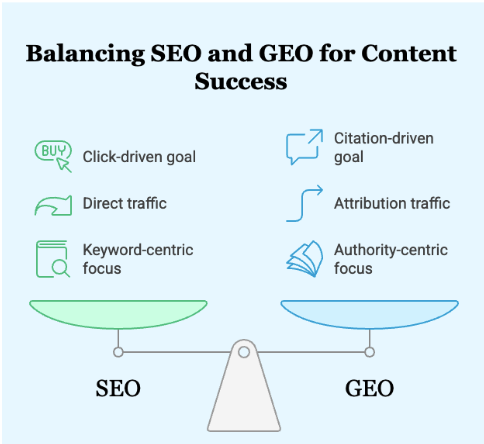
- With SEO, your goal is a click. You want to rank high enough that a user chooses your link from the list of results, bringing them to your website where you can guide their experience.
- With GEO, your goal is a citation. You want your content to be so factual and well-structured that the AI includes your information in its answer and names you as the source. The click is a bonus, but the initial win is the brand mention and stamp of authority.
The Type of Traffic You Get
- SEO drives direct traffic. Someone searches, clicks your link, and lands on your site. You can track this journey clearly using analytics tools. It’s a straightforward path from search to visit.
- GEO can lead to “attribution traffic.” You might see fewer direct clicks from search result pages, especially for simple informational queries. However, a user who sees your brand cited as a source may search for you directly later or click the citation link in the AI answer. This traffic is harder to track but builds long-term brand recognition.
Your Optimization Focus
- SEO is keyword-centric. You find out what words people are using to search and build your content around those terms. Backlinks and technical health are also crucial signals.
GEO is authority-centric. While keywords still matter, the bigger focus is on demonstrating your expertise. This means publishing content with verifiable facts, clear data, and an unambiguous point of view. It’s about becoming “cite-worthy.”
Your Game Plan: How to Adapt and Thrive
The rise of GEO might feel intimidating, but it’s actually a massive opportunity. Because it’s so new, the playing field is more level. By acting now, you can get a head start on your competition. The best part? The work you do for GEO will also make your SEO stronger. Here’s your step-by-step plan.
1. Double Down on True Expertise
Both SEO and GEO reward authority. It’s time to move beyond generic blog posts and become the undeniable expert in your niche.
- Create Cornerstone Content: Develop comprehensive guides, in-depth reports, and resource hubs that cover a topic from top to bottom. Think of a topic your customers always ask about and create the single best resource on the internet for it. This deep content is a goldmine for both traditional search and AI.
- Publish Original Research and Data: AI loves facts and figures. If you can, conduct your own surveys, analyze industry trends, or compile unique datasets. When you’re the primary source of a statistic, you become highly citable. For example, a real estate agent could publish a quarterly report on local housing prices.
- Embrace E-E-A-T: Google’s standards for Experience, Expertise, Authoritativeness, and Trustworthiness are the bedrock of both SEO and GEO. Showcase author bios with credentials, link to supporting sources, and make sure your content is factually accurate.
2. Structure Your Content for a Robot Audience
AI engines are powerful, but they are also very literal. You need to format your content in a way that makes it easy for them to understand and extract information. Luckily, this also makes your content easier for human readers to scan.
- Use Clear and Descriptive Headings: Organize your content with a logical hierarchy (H1, H2, H3). Instead of a vague heading like “Our Process,” use “Our 3-Step Web Design Process.” This gives both users and AI a clear roadmap of your content.
- Answer Questions Directly: Use your headings to pose common questions and then answer them immediately in the following paragraph. This makes your content perfect for being pulled into featured snippets (an SEO win) and AI answers (a GEO win).
- Incorporate Lists, Tables, and Bullet Points: Breaking down information into scannable formats helps AI quickly identify key points. If you’re comparing products or listing steps, use a table or a numbered list. It’s clean, efficient, and easy to parse.
3. Implement Schema Markup: The AI’s Cheat Sheet
Schema markup is a piece of code you add to your website to tell search engines exactly what your content is about. It’s like adding labels to your information. You can specify that a piece of text is a person’s name, a product’s price, or the date of an event.
This is incredibly powerful for both SEO and GEO. For SEO, it helps you get rich snippets in search results, like star ratings or event times. For GEO, it’s a direct line of communication to the AI, removing any guesswork about your content. Implementing schema for articles, FAQs, and products is a great place to start.
4. Build Your Brand’s Authority Everywhere
In the world of GEO, your reputation extends far beyond your own website. AI engines look at your brand’s overall footprint to determine if you’re a credible source.
- Get Mentioned on Reputable Sites: While backlinks are great for SEO, simple brand mentions (even without a link) on authoritative sites like industry news outlets or respected blogs help build your GEO credibility.
- Be a Guest on Podcasts and Webinars: Having your name and brand associated with expert conversations in your field sends strong signals of authority. These appearances often come with show notes that link back to your site.
- Maintain a Consistent Profile: Make sure your business name, address, and phone number are consistent across all platforms, from your website to social media profiles and local directories. This consistency builds a clear and trustworthy brand identity.
A Hybrid Strategy in Action
Ready to boost your sales? Let’s imagine you own a small, eco-friendly eCommerce store that sells coffee. Here’s how you can blend SEO and GEO to get more customers:
- SEO-Focused Content: You write a blog post titled “The 5 Best Organic Coffee Beans in 2025.” You optimize it for keywords like “best organic coffee” and aim to get it ranking high in Google to drive direct traffic from people ready to buy.
- GEO-Focused Content: You publish an in-depth report titled “The Environmental Impact of Shade-Grown Coffee: A 2025 Analysis.” This article is filled with statistics, quotes from agronomists, and data from fair-trade organizations. You structure it with clear headings and use schema markup to define the data points.
- The Result: Your SEO article brings in buyers. Your GEO report gets cited by an AI when someone asks, “Is shade-grown coffee better for the environment?” The AI answer mentions your brand and your report, establishing you as a thought leader. A user impressed by the answer then searches for your brand directly, already trusting your expertise.
This is the power of an integrated approach. You capture both the immediate buyer and the curious researcher, building a resilient and future-proof growth engine.
Start Your Evolution Today
The shift to a search world with AI-powered answers is happening now. As a website owner, you have a choice: you can wait and see what happens, or you can start adapting today and build a powerful competitive advantage.
Start by reviewing your existing content. Can you add more facts, data, and direct answers? Look at your technical setup. Is your site structured clearly? Begin thinking about every piece of content you create through two lenses: “How will this help me rank?” and “How will this make me citable?”
By embracing both SEO and GEO, you’re not just optimizing for algorithms. You’re optimizing for discovery, no matter what form it takes. You’re building a brand that’s not only found but also trusted. And in the long run, trust is the most valuable asset you can have.
































