

Keep reading
Rather we just did it for you?
Let's get your business seen.
Social media, websites, SEO and ads from a team you can actually meet.
Short answer: no. If you buy Instagram followers, you are paying for a number, not an audience. The accounts that arrive do not see your posts, do not buy your products and do not lift your reach. Instagram has said for years that this kind of activity breaks its rules, and the real cost is higher than the price on the seller’s page.
This guide breaks down what you actually get, what it costs once you count everything, what Instagram and UK regulators have said, and what to do instead if the real problem is that your page looks quiet. You will also find a free planner at the end to help you build followers who care.
What a bought follower actually is
When you pay for followers, the seller is not recruiting people who like your content. They are supplying accounts from a pool. Broadly, those fall into three types.
- Automated accounts. Profiles created in bulk by software. They tend to have no posts, a handful of random photos, and usernames made of letters and numbers.
- Compromised or dormant accounts. Real profiles that were hijacked or abandoned, and that are made to follow you without the owner knowing.
- Incentivised real users. People who follow accounts in return for credits or small payments. They are real, but they have no interest in your business.
None of them will like, save, comment, send your post to a friend or click the link in your bio. Those actions are the ones that matter, because they are what tell Instagram your content is worth showing to more people.
There is also the question of drop-off. Many sellers advertise a “refill guarantee” because the accounts they supply often disappear. If you are offered a refill, that is a sign the product is not stable. You are renting a number that may fall back down without warning.
The real cost, beyond the price tag
People tend to focus on the sticker price, which is usually small. The actual cost is made up of several parts.
1. Your engagement rate falls
Engagement rate compares how many people interact with a post to how many follow you. If you have 500 real followers and get 40 likes, that is a healthy picture. Add 5,000 fake followers and the same 40 likes now looks like a fraction of a per cent. Anyone who checks your page, including potential clients, will see a big audience that ignores you. It can make you look less credible than a small, active account.
2. Your reach can shrink
Instagram shows posts to a small group first and widens the audience if people respond. If most of your followers are inactive, early response is weak, and your content may stop travelling. You paid to make your own posts perform worse. If your numbers have already dipped, our 7-point check for an Instagram engagement drop will help you find out why.
3. Your advertising gets less efficient
If you run paid campaigns, your page is part of the picture. People who click an advert often check your profile first. An account with thousands of followers and almost no likes tends to reduce trust. Retargeting lists built from people who engage with your page are also less useful if they are full of accounts that were never interested.
4. Your account is at risk
Many sellers ask for your username only, but some ask for your password or a login through a third party. Handing over credentials can lead to account takeover, spam posts from your profile, or it being resold. Even without that, using services that break platform rules puts your account in a worse position if Instagram reviews it.
5. You lose time
The most expensive part is the months you could have spent building something real. A bought audience cannot be turned into customers, so the work still has to be done afterwards.
What Instagram has said about it
Instagram announced in November 2018 that it would start removing inauthentic likes, follows and comments from accounts that used third-party apps to grow their audience. In its post on removing fake likes, follows and comments, it said these apps violate its Community Guidelines and Terms of Use, and that it had built machine learning tools to identify accounts using them. Affected accounts received a message and were asked to change their password. Instagram also warned that accounts that kept using such apps could see their Instagram experience affected.
That post is several years old, and detection has only improved since. We cannot tell you exactly how any individual account would be treated, but the position of the platform has not changed: services that fake engagement are against the rules. Always check the current Community Guidelines in the Instagram Help Centre, because policies change. Anyone tempted to buy Instagram followers should first look at what the follower count is meant to achieve.
The UK legal and reputational angle
It is worth separating two things. Buying followers is not, as far as we know, a criminal offence in the UK. But the law on false impressions to customers is tightening, and anyone running a business account should know where the lines are.
The Digital Markets, Competition and Consumers Act 2024 came into force for consumer protection on 7 April 2025. According to the CMA’s announcement on the new regime, it banned fake reviews, and lets the Competition and Markets Authority (CMA) fine businesses up to 10% of global turnover for breaking consumer protection law. In March 2026, the CMA opened further investigations into fake and misleading reviews, as described on its news page about five businesses under investigation.
That legislation is about reviews and misleading practices rather than follower counts. So we are not saying a bought follower breaks the law. The point is the direction of travel: regulators are paying close attention to anything that creates a false impression of popularity. If you present inflated numbers to customers or sponsors as proof of reach, you are taking a risk you do not need to take. This is general information, not legal advice. For advertising claims in particular, the ASA’s CAP Code is the place to check.
A worked example: the same page, two ways
Picture a physiotherapy clinic in Guildford with 400 followers and an average of 30 likes per post. The owner wants the page to look bigger before a local newspaper feature, so she adds 4,000 bought Instagram followers.
Overnight the profile shows 4,400 followers. Posts still get 30 likes, so the engagement rate drops from 7.5% to under 1%. The journalist glances at the page and sees a mismatch. Patients searching for a physio see a page with plenty of followers but no conversation, so they trust the reviews on Google more. Three months later, a clean-up removes a chunk of the accounts, and the number falls again.
Now picture the same clinic spending those weeks posting a weekly Reel with a stretch for desk workers, a carousel of common injuries, and replies to every comment. The page might reach 700 followers, but the likes rise to 60, local people share the posts, and two new patients mention Instagram when they ring. That is a smaller number with a far bigger result. The figures here are illustrative rather than data from a real client, but the pattern is one we see often. In short, if you buy Instagram followers you are buying a number that cannot reply to a comment or book an appointment.
Why people buy Instagram followers, and what they really need
Most people who consider buying followers are in one of four situations.
- A new business with an empty page. The fix is a handful of strong posts and a clear bio, not 10,000 strangers.
- An influencer trying to win brand work. Brands ask for average reach, saves and audience location. Fake followers fail all three.
- A competitor seems far ahead. Their number may be earned, bought or old. Compare how engaged their followers are before you worry.
- A manager asking for growth. Report on enquiries, clicks and saves, which tie to the business. Follower count alone is a weak measure.
Whichever applies, the underlying need is credibility and reach. Both can be built in a fairly short time with the right habits.
What to do instead: a 6-step plan
- Clean up your profile. Use a recognisable profile photo, a bio that says who you help, and a link that goes somewhere useful. Pin your three best posts.
- Choose two or three content themes. People follow accounts that deliver something specific, such as tips, local recommendations or behind-the-scenes stories.
- Make Reels and carousels that are worth saving. Checklists, step-by-step guides and simple how-tos tend to be saved and shared, which are strong signals.
- Use search properly. Add a clear keyword in your caption and on-screen text. Many people find accounts through Instagram search, so make it obvious what you do.
- Talk to people. Spend 15 minutes a day replying to comments, answering DMs, and leaving thoughtful comments on local accounts.
- Collaborate. Use the Collab feature with partners, suppliers or local creators so both audiences see the post.
For a detailed route to your first thousand, read how to get 1000 followers on Instagram, and for a wider set of tactics see how to increase followers on Instagram in 2026.
Should you pay for anything?
Paying for growth is not a bad idea in itself. The difference is what you pay for. Instagram’s own advertising and boosting tools put your content in front of real people who then choose whether to follow. You can target by location and interest, set a tight budget and measure the result. That is paid promotion, and it is allowed.
The test is simple. If the service promises a number of followers, likes or views, be wary. If it shows your content to real people and lets them decide, that is advertising. If you are evaluating an agency or tool, our list of red flags for follower growth services shows what to look out for. The cost to buy Instagram followers is never just the price on the checkout page.
Common questions
Can Instagram tell if I bought followers?
Instagram has said it uses machine learning to find inauthentic activity. Beyond that, the signs are visible to anyone: sudden spikes, followers with no posts, and very low engagement. You do not need to be flagged by the platform for the damage to show.
Will bought followers drop off?
Often, yes. Accounts get removed or deactivated, and sellers commonly offer refills for that reason. Treat the number as temporary.
I already bought some. What now?
Change your password, check which apps have access to your account in your settings, and stop buying. You can also remove suspicious followers manually, though it is slow. Then focus on posting content that attracts real people.
Is it different for a personal account?
The mechanics are the same. A personal account may not face the same commercial risks, but the lost reach and security risk still apply.
What is a good follower count for a small business?
There is no standard. A local business with 600 engaged local followers can do more than a brand with 60,000 who never respond. Measure enquiries, clicks and saves.
Get the free Instagram growth planner
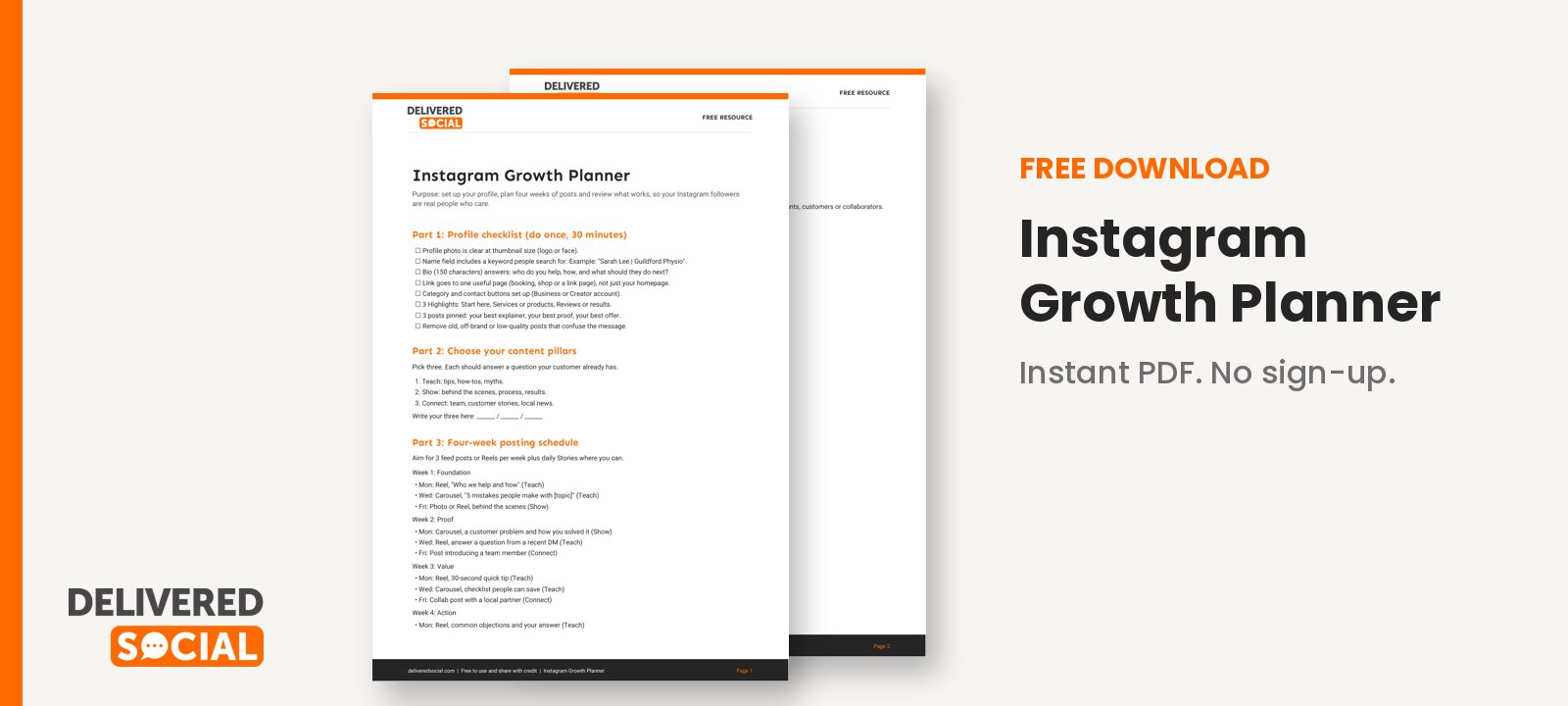
We have put together a simple planner that covers your profile checklist, a four-week posting schedule, content ideas, and a monthly review sheet so you can see what is working. Download the free Instagram growth planner.
If you would like help, Delivered Social offers social media management for businesses that want real growth, and you can contact us any time for an honest chat about where to start.