




Keep reading
Rather we just did it for you?
Let's get your business seen.
Social media, websites, SEO and ads from a team you can actually meet.
You spent weeks on a killer ad campaign. The copy is sharp, the targeting is dialed in, and you’re driving real traffic to your site. Then someone clicks your ad, and your page takes eight seconds to load. They leave. You paid for that click. And it’s gone.
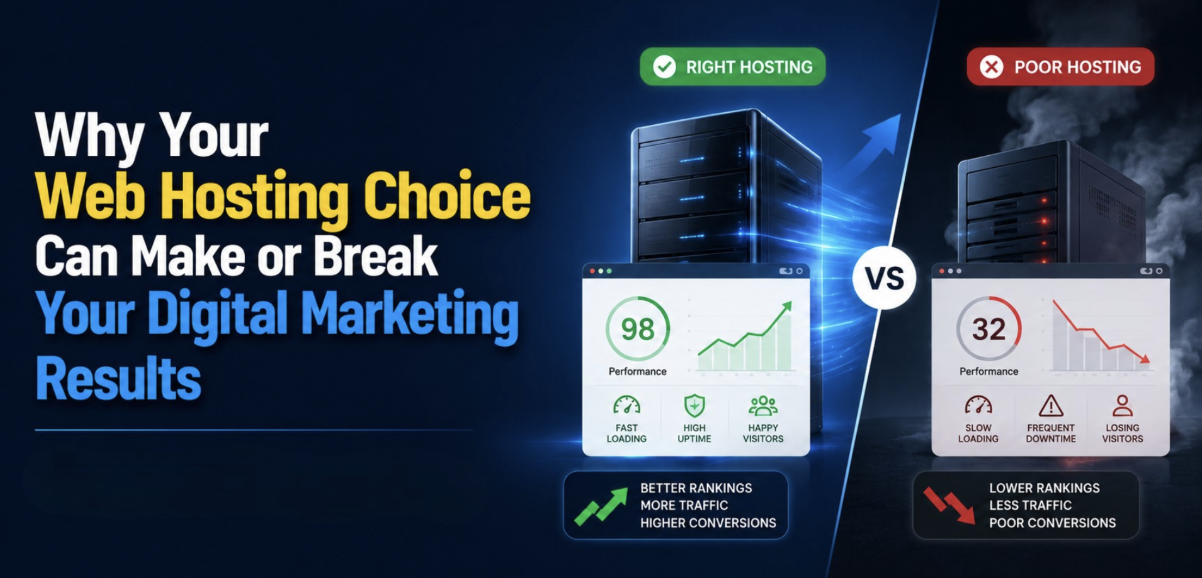
That’s the part most people skip when planning their digital marketing. They obsess over creatives, keywords, and funnels, but treat web hosting like a one-time checkbox. It’s not. The host you pick quietly shapes almost every marketing outcome you care about.
Let me explain how.
Your Site Speed Is Your First Impression
Think about the last time you waited more than five seconds for a website to load. Did you wait? Probably not.
Speed is the first thing your visitors experience: before your headline, before your product photos, before your offer. If your hosting server is slow, none of the rest of your marketing matters, because people are gone before they see any of it.
And it’s not just bounce rates you have to worry about. Google uses page speed as a ranking signal. A slow site gets pushed down in search results, which means you’re spending more on paid traffic just to make up for the organic rankings you’re losing. That’s an expensive spiral.
Good hosting puts your site on fast servers with enough resources that pages load quickly, even when traffic spikes, like during a campaign launch or a sale. You may also find our guide, Fully Managed Web Hosting for Small Businesses – What you need to know, useful.
Uptime Is Non-Negotiable
Here’s a scenario: You send out an email campaign to 10,000 subscribers. The email goes out at 9 AM. People click. Your site is down.
It happens. Some hosting providers oversell their server capacity, and when too many sites on the same server get traffic at once, things crash. Your campaign window, that short period when your audience is warm and paying attention, simply disappears.
Even 99% uptime sounds good until you do the math. That’s roughly seven and a half hours of downtime per month. If any of those hours overlap with your campaigns, you’ve wasted your budget.
When evaluating a host, look for 99.9% uptime guarantees, and check if there’s any real penalty or compensation when they miss it.
How Hosting Affects Your SEO?
There’s more to the hosting-SEO connection than speed.
Server location matters. If your target audience is in the UK but your server is in the US, the physical distance adds latency. Your pages load a little slower for exactly the people you’re trying to reach. Some hosts let you choose your server location; others don’t give you the option at all.
Shared IP reputation. On shared hosting, your site shares an IP address with hundreds of other websites. If any of those sites are used for spam or shady activity, your IP reputation suffers, which can affect how Google and other search engines treat your domain.
SSL certificates. Google marks sites without HTTPS as “Not Secure.” Most users won’t hand over their email address or payment info on an unsecured site. A decent host provides SSL for free. Some budget options still charge extra for it, which is worth knowing before you sign up.
Picking the Right Host: What to Actually Compare
This is where people get overwhelmed. There are hundreds of hosting providers, and most of them make similar promises.
If you’re in the research phase, two names you’ll keep running into are Hostinger and GoDaddy. Both are massively popular, both target beginners, and both look similar on the surface, but they behave very differently when it comes to actual load speeds, renewal pricing, and support quality.
A proper side-by-side look at Hostinger vs GoDaddy shows just how much those differences add up, especially once you factor in long-term campaign performance.
Beyond comparisons, here’s what to keep in mind:
What type of hosting do you actually need?
- Shared hosting: Works fine for small blogs or early-stage sites with low traffic. Not ideal once you’re running consistent campaigns.
- VPS hosting: More resources, more control. Better for growing businesses that see traffic spikes.
- Managed WordPress hosting: Built specifically for WordPress sites, with caching and performance optimizations built in. Worth it if WordPress is your platform.
- Cloud hosting: Scales automatically based on traffic. More expensive but useful if your traffic is unpredictable.
Customer support quality. This sounds boring but it matters. When your site goes down at 2 AM before a big campaign, you want someone who actually answers and knows what they’re doing. Live chat support is table stakes now, but the quality varies enormously between providers.
Renewal pricing. Almost every hosting provider hooks you with a low introductory rate and then doubles or triples the price on renewal. Make sure you know what you’ll be paying in year two, not just year one. BearHost is a notable exception to this trend. They maintain flat pricing, meaning the cost you pay in month one is the same in month thirteen and beyond, with no surprise hikes.
The Hidden Cost of “Good Enough” Hosting
Let’s be honest. A lot of businesses pick hosting based on price alone. The $2.99/month plan looks fine when you’re just starting out. But there are real costs that don’t show up on the pricing page.
Slower load times mean worse Quality Scores on Google Ads. Your Quality Score directly affects how much you pay per click and where your ads appear. A slow landing page drags that score down, which means you’re paying more for worse placement. Over a year of campaigns, that adds up.
Higher bounce rates hurt remarketing. If visitors leave before your page even loads, your remarketing pools shrink. You have fewer people to retarget, which reduces the efficiency of your entire paid social strategy, hurting your lead acquisition efforts in the process.
Security vulnerabilities. Budget hosts often lag on security patches. A hacked site doesn’t just lose traffic. It gets flagged by Google, which can take weeks or months to recover from. That’s your entire SEO investment potentially wiped out.
What a Well-Hosted Site Actually Enables
Flip it around. When your hosting is solid, a few things happen:
Your landing pages load fast enough that your paid campaigns actually convert. You’re not throwing money at traffic that bounces before seeing the offer.
Your SEO builds steadily because Google can crawl your site reliably, your Core Web Vitals are in good shape, and your rankings improve over time, which means more free traffic and less dependence on paid.
Your email campaigns work better. Someone clicks your newsletter, the page loads instantly, and they’re in your checkout flow before the enthusiasm fades.
You can actually test things. Split tests, new landing pages, campaign-specific URLs. All of this works better when you’re not worried about whether the server will hold up.
A Few Questions Worth Asking Before You Commit
Before signing up with any host, run through these:
- Where are their data centers, and are any of them close to my main audience?
- What’s the average response time on their support?
- Do they include daily backups, or is that an add-on?
- What happens to my site during traffic spikes: does it slow down, crash, or scale automatically?
- What’s the actual renewal price after the first term?
These aren’t complicated questions, but most people never ask them until something goes wrong.
The Bottom Line
Digital marketing is expensive. Between ad spend, content creation, email tools, and all the rest, most businesses are putting real money into getting traffic. It makes no sense to let that investment leak out through slow load times, unexpected downtime, or a host that can’t handle a campaign launch.
Hosting isn’t glamorous. Nobody gets excited about picking a server. But it’s the infrastructure everything else runs on, and treating it as a commodity often costs more in the long run than just paying for something reliable upfront.
Pick something that’s fast, stable, and backed by support that actually shows up when you need it. Everything else you build in your marketing will work better because of it.
































