

Keep reading
Rather we just did it for you?
Let's get your business seen.
Social media, websites, SEO and ads from a team you can actually meet.
Should you buy Google reviews? No. In the UK it can now put you on the wrong side of consumer law, Google can remove the reviews and put a public warning on your business profile, and the reviews themselves rarely help you win customers. The good news is that real reviews are easier to collect than most owners think, if you build a simple habit around asking for them.
This guide explains what actually happens when a business pays for reviews, what the rules say, and the practical routine we recommend instead. If you only want the quick version: stop, remove anything you cannot stand behind, and start asking real customers at the right moment.
Is it legal to buy Google reviews in the UK?
Fake reviews are not just against a platform’s rules. Since the Digital Markets, Competition and Consumers Act 2024 (the DMCC Act) came into force, the UK’s consumer protection regime bans fake reviews and the practices that encourage them. The Competition and Markets Authority (CMA) published its guidance for businesses in April 2025, and you can read it on GOV.UK (CMA208).
In plain terms, the law targets three things:
- Writing, commissioning or submitting a fake review, which includes paying someone else to do it.
- Incentivised reviews where the reward is not made clear to readers.
- Publishing or presenting reviews in a misleading way, for example showing only the good ones when you claim to show them all.
A law firm summary of the draft rules, from DAC Beachcroft, notes that businesses breaching the prohibitions can face civil fines of up to £300,000 or 10% of global annual turnover, whichever is higher. It also says anyone who offers services to traders to produce fake reviews can be caught too. That matters for small firms: the person selling you the reviews carries risk, and so do you.
The CMA has also been checking websites. A July 2025 update, summarised by Greenberg Traurig, said the regulator was writing to firms that looked non-compliant and asking them to explain the changes they were making. You are very unlikely to be a first target as a small local business. But “unlikely” is not the same as “safe”, and it is not a risk worth taking for a few extra stars.
What Google does when it spots fake Google reviews
Google has its own rules, and they are strict. On its Business Profile restrictions page, Google says it takes fake and incentivised reviews very seriously. If it decides that violating activity took place on your profile, it removes the reviews and may also restrict the profile. The examples it gives are:
- Your profile cannot receive new reviews or ratings for a fixed period.
- Your existing reviews or ratings are hidden for a fixed period.
- Your profile shows a warning to customers that fake reviews were removed.
Google says it emails the business owner before applying a restriction, and you can appeal. But look at that list from the point of view of a customer. A warning banner on your profile is far worse than having fewer reviews. Someone comparing three local plumbers will not choose the one with a notice saying fake reviews were taken down.
The cost of getting caught is therefore not “we lose the reviews we paid for”. It is “we lose the reviews we paid for, we lose the genuine ones for a while, and customers see a trust warning”. That is a bad trade for a handful of five-star ratings.
How paid reviews actually work, and why they get caught
You do not need to know the sellers’ names to understand why this approach fails. The pattern is nearly always the same.
Reviews are posted from accounts that exist only to post reviews. Those accounts often have no profile photo, no history of visiting real places, and a trail of five-star reviews for unrelated businesses in different cities. A plumber in Guildford praised by an account that also loves a dentist in Leeds and a gym in Glasgow looks odd to a human, and it looks odd to Google’s detection systems too.
Then there is timing. Real reviews arrive slowly and unevenly, after real jobs. Bought reviews arrive in bursts. A profile that goes from one review a month to twelve in a weekend is easy to spot.
Finally, there is the wording. Paid reviews tend to be vague (“Great service, highly recommend!”) and rarely mention the thing a real customer would: the name of the person who helped, the problem that was solved, the day it happened. Readers notice that. Many people now scan the written reviews, not just the star rating.
So you pay money, the reviews get removed (or stay and do nothing), and you are left with the legal and reputational risk. Some sellers promise replacement reviews if the originals vanish. That just means paying twice for the same problem. Anyone tempted to buy Google reviews should know how closely regulators are now watching the practice.
Why fake reviews do not even help with sales
Set the rules aside for a moment and think about what a review is for. It reassures a stranger that choosing you is a safe decision. That only works if the review sounds like it came from someone who really used your business.
Real reviews carry details. They mention the leaking tap, the Saturday appointment, the friendly apprentice who tidied up. These specifics are what persuade, and you cannot buy them in bulk. You can only earn them one customer at a time.
There is also a quiet internal cost. If your team knows the reviews are fake, nobody has a reason to improve the service that real customers are describing. Honest reviews, even the awkward ones, are free feedback. Fake ones hide the problems you should be fixing.
The better route: earn real reviews with a repeatable system
Most happy customers never leave a review, simply because nobody asked and it did not occur to them. That is the opportunity. A good google review request process is small, polite and consistent. Here is the routine we suggest to small businesses.
1. Ask at the moment of peak happiness
The best time is straight after the customer has had a good result: the job is finished, the meal was great, the project was approved. For a service business, that might be the day the work is signed off. For a shop or restaurant, it could be at the till or in a thank-you message that evening.
2. Make it one tap away
Every extra step loses people. Use the direct review link from your Google Business Profile (Google lets you copy a share link from your profile) and put it in a text message, an email signature, an invoice or a QR code on a card. Do not send people to your homepage and hope they find the right place.
3. Ask personally, then follow up once
A message from a named person always beats a generic one. Something like: “Hi Sam, thanks for choosing us today. If you were happy with the service, would you mind leaving a short Google review? It really helps a small local business. Here is the link.” If there is no response after about a week, one polite reminder is plenty. After that, leave it.
4. Ask everyone, not only the people you expect to praise you
Picking out only the customers you think will be delighted skews your picture, and it can look misleading if you present a handful of selected reviews as typical. Ask every customer in the same way. A mix of five-star and four-star reviews, with the odd awkward one answered well, looks far more trustworthy than a wall of perfect scores.
5. Reply to every review
Thank people by name, mention something specific from their review, and keep it short. Replies show prospective customers that a real person is behind the business. They also remind the reviewer that you care, which makes them more likely to come back.
If you want ready-made wording, a QR code checklist and reply templates, the free pack at the end of this article has them. We also cover the full step-by-step plan for building up to 100 reviews in our guide on how to get more Google reviews.
Can you offer something in return for a review?
This is where many small businesses slip up, usually with good intentions. Offering a discount, a prize draw entry or a freebie in return for a review is what the law and Google both call an incentive. Google’s restrictions page names incentivised reviews alongside fake ones, and the CMA’s rules focus on incentives that readers are not told about.
Our advice is simple: do not tie any reward to leaving a review. Thank people for their time, by all means, with a note or a quick message. But keep any discount or gift completely separate from the act of reviewing, and never make it depend on the rating.
The same goes for staff and family. Reviews from people with a connection to the business, who are not presenting that connection, can mislead readers. If your team used a service themselves and want to say so, ask them to be open about it, or better, leave it to real customers. If you buy Google reviews, you risk removal, a damaged reputation and legal trouble, all for a rating that customers will not trust.
What if you have already bought reviews?
If you have paid for fake Google reviews in the past, do not panic, but do not leave it. Here is a sensible clean-up plan:
- Stop any ongoing arrangement and do not pay for replacement reviews.
- Look through your profile for reviews you cannot link to a real customer. Make a list.
- Flag those reviews to Google through the review menu, or ask your supplier to remove them if they posted from accounts they control.
- Start collecting real reviews straight away, so your genuine ones outweigh the doubtful ones.
- Write down your review policy. The CMA’s work has shown that a clear, accessible policy on how you handle reviews is part of being compliant if you publish reviews on your own site.
If you have received a warning or restriction from Google, use the appeal option it provides and add context about what you changed. Google says it re-reviews the profile with any extra information you supply.
What if a competitor is posting fake reviews about you?
This happens too. Do not respond in kind. Instead, report each review to Google using the “Report review” option, keep screenshots with dates, and reply to the review calmly and factually in public (“We cannot find a record of a customer with this name, please contact us so we can look into this”). Building up real reviews quickly also dilutes the damage. If it is a serious or repeated pattern, you may want legal advice.
Common questions about buying reviews
Is it illegal to buy Google reviews in the UK?
Commissioning fake reviews is banned under the UK’s consumer protection rules, as set out in the CMA’s guidance. Penalties can be significant, and Google can restrict your profile as well. Always check the current CMA guidance for the latest wording.
Can Google tell which Google reviews are fake?
It uses automated systems and human checks, and it removes reviews it finds in breach. Reviews from accounts with unusual patterns, bursts of activity or no real history are the easiest to spot.
How many reviews do I need?
There is no magic number. A steady flow of recent, detailed reviews matters more than a big total. Ten reviews from the last three months often reassure more than fifty from three years ago.
Are fake follower and fake review services the same problem?
They are close cousins. Both try to manufacture trust that has not been earned, and both carry platform and legal risk. If you are weighing up any growth service, our checklist on follower growth service red flags will help you judge it.
How to spot a suspicious review profile yourself
If you want to check your own profile or a competitor’s, look for clusters of reviews posted within a day or two, reviewers with only one or two reviews, generic wording with no specifics, and reviewers who have reviewed unrelated businesses in distant places. The same habit of looking for patterns helps with social media too, and our guide to spotting fake followers shows how.
Get the free Review request pack
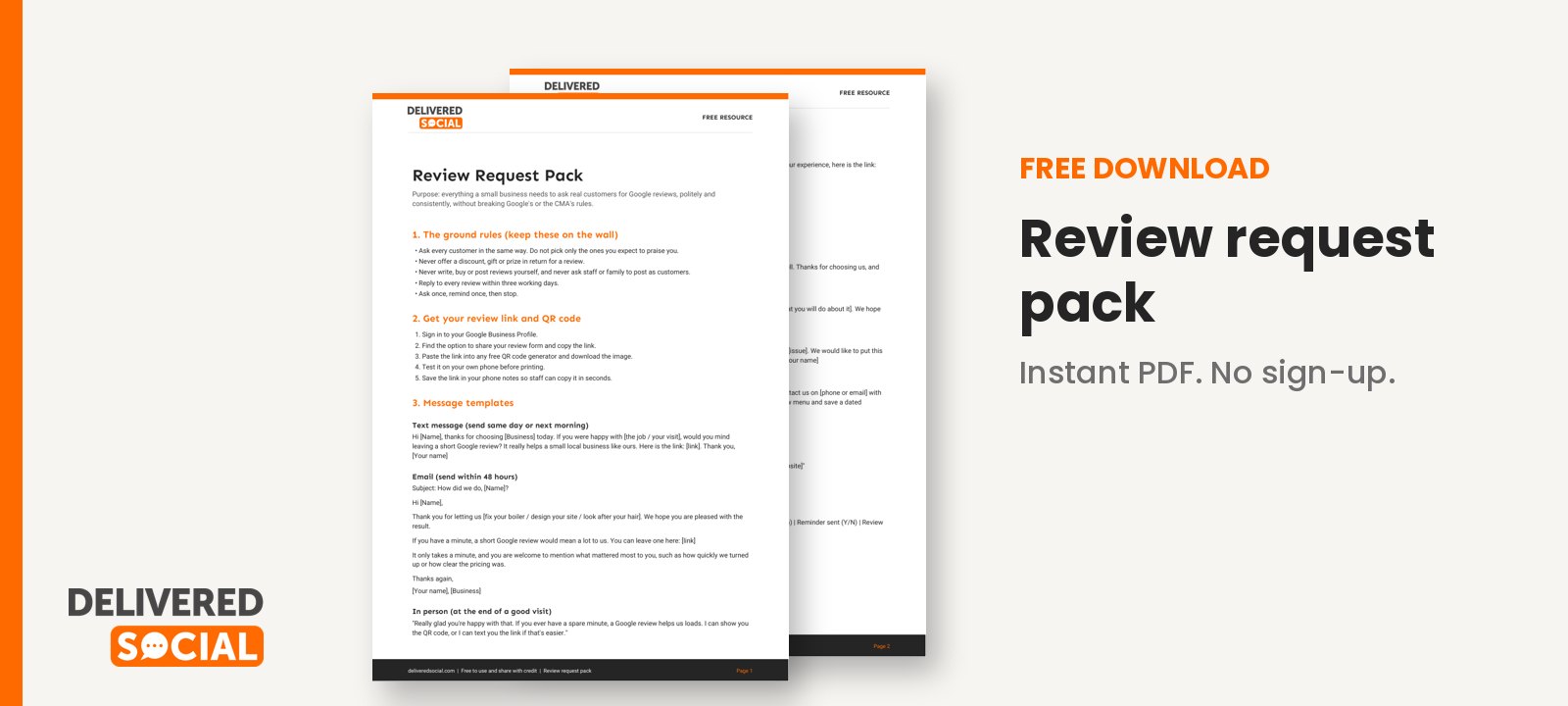
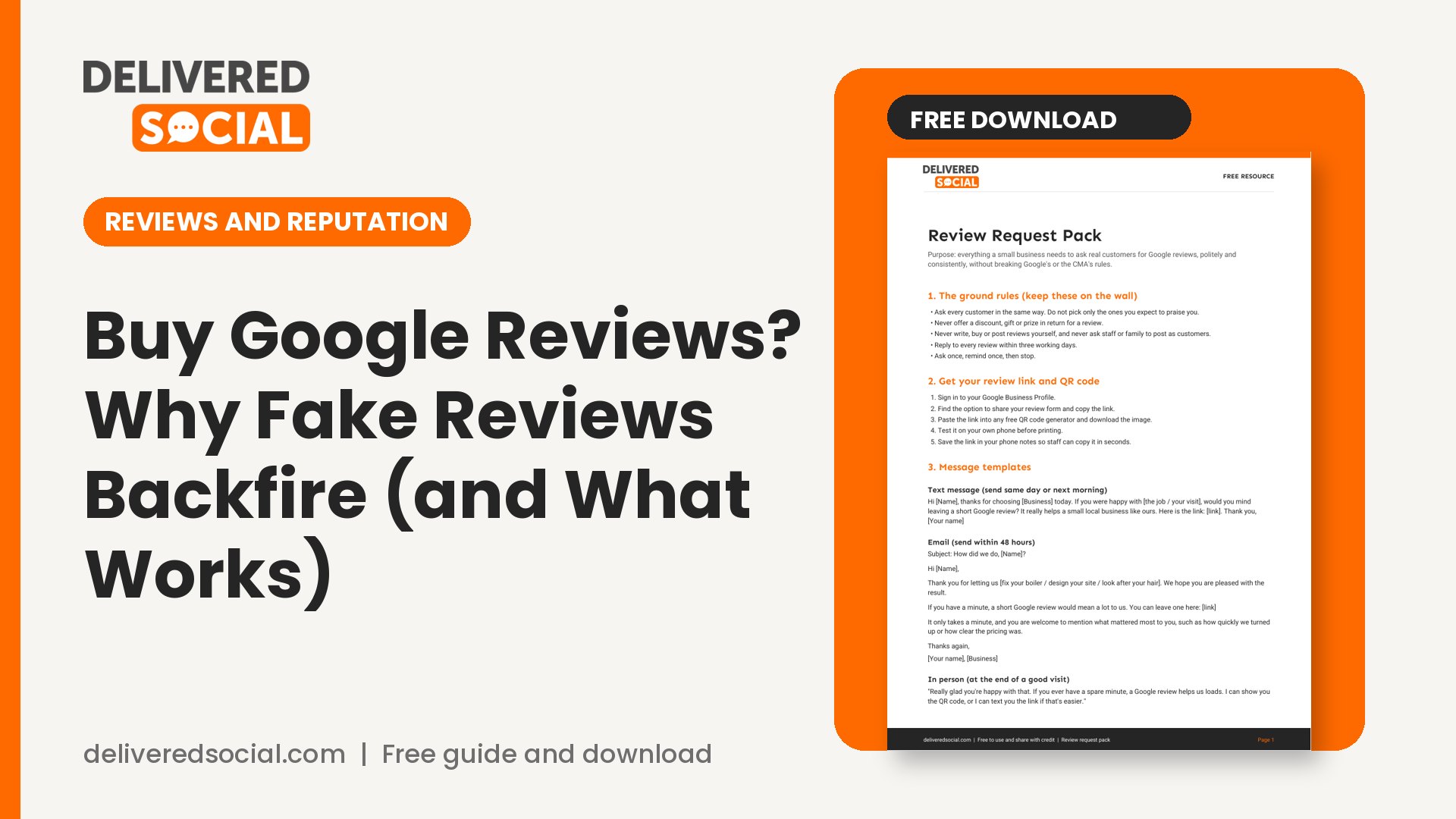
We have put together a Review request pack with message templates for text, email and in person, a simple QR code card layout, reply templates for good and not-so-good reviews, and a weekly tracking sheet. It is free to use and designed for busy owners.
Download the free Review request pack
If you would rather have help with your online reputation, Delivered Social can support your social media management and local visibility, and you are welcome to get in touch for a friendly chat about what would work for your business.