

Keep reading
Rather we just did it for you?
Let's get your business seen.
Social media, websites, SEO and ads from a team you can actually meet.
You can spot fake followers on almost any account in about ten minutes, without paid tools. Look at three things: how engagement compares with audience size, what the comments actually say, and what a sample of the followers look like. If those three disagree with the follower count, you are probably looking at an inflated audience.
This guide walks through the ten-minute check step by step, so you can use it on a competitor, an influencer you are thinking of hiring, a possible partner, or your own account. It also explains what to do with the results. You do not need to be an analyst, and you do not need to accuse anyone of anything. You are just collecting evidence.
What counts as a fake follower?
People use “fake” loosely, so it helps to separate the types:
- Bot accounts. Automated profiles created in bulk, often with stolen photos or no photo at all.
- Inactive accounts. Real accounts that were abandoned years ago and never post, like or comment.
- Mass-follow accounts. Real people who follow thousands of accounts hoping to be followed back. They exist, but they rarely engage.
- Purchased or swapped followers. Accounts added through a paid or “follow for follow” arrangement. They may be bots or real people with no interest in the content.
Not all of these are the account owner’s doing. Every large account collects some bots and dormant profiles naturally, and Instagram removes many of them over time. The question is not “is there any fake activity?” but “is the audience mostly real, interested people?”
Step 1: Compare followers with engagement (2 minutes)
Open the account and look at the last nine to twelve posts. Add up the likes and comments on each, divide by the follower count, and multiply by 100. That gives you an engagement rate for each post. We explain this in detail in our guide to social media benchmarks for the UK, but for this quick check you only need a rough picture.
For context, Quid’s 2026 benchmark report (the report was previously published under the Rival IQ name) put median Instagram engagement at 0.30% of followers across industries. Different studies give different figures, so treat that as a rough guide rather than a pass mark. What you are looking for is an account that sits far below the usual range.
Warning signs:
- An account with 50,000 followers whose posts get a few dozen likes.
- Engagement that is wildly inconsistent, with one post at 2,000 likes and the next at 40, and no obvious reason such as a collaboration or paid promotion.
- Likes that look healthy but comments that are rare, repetitive or irrelevant.
One low-engagement account does not prove fake followers. Many genuine accounts have a quiet audience. But a big gap between audience size and activity is the first thing to note down.
Step 2: Read the comments (2 minutes)
Comments are harder to fake convincingly than follower counts. Scroll through the comments on three posts and ask:
- Do commenters respond to what the post says, or is it generic (“Nice!”, “Love this”, a row of emojis)?
- Do many comments come from accounts with strange or random usernames, such as a name followed by a long string of digits?
- Are comments in a language unrelated to the account’s audience? A Guildford cafe getting dozens of comments in a language nobody speaks locally is a clue.
- Do the same few phrases appear under every post?
- Does the account owner reply, and do the replies lead to real conversations?
Real communities have texture. People ask questions, tag friends, disagree, share stories. Purchased or automated comments are flat.
Step 3: Sample the followers (3 minutes)
Open the follower list and tap through 20 profiles. Do not just look at the top of the list, because the newest followers appear first and can be skewed by a recent campaign. Scroll down and sample from different places.
Look for these patterns:
- No profile photo, or a stock photo.
- No posts, or only one or two.
- Following thousands of accounts but followed by very few.
- Usernames that look machine-made, such as random letters and numbers.
- Bios in a style that does not fit, such as promotional links or adult content on a family business account.
- Private accounts with no profile detail at all.
If five or six profiles out of twenty look suspicious, that is not unusual. If twelve or more do, the audience probably contains a lot of low-quality followers. Write down your ratio. It is a rough sample, not a scientific measure, but it is still telling.
Step 4: Check the growth pattern (1 minute)
If you have access to the account’s own insights, look at follower growth over time. If you do not, you can still look for clues. Search for the account’s earlier posts and compare engagement then and now. Look at when follower numbers jumped. Real growth usually has a cause: a viral Reel, a press mention, a campaign, a collaboration. Sudden, unexplained jumps of thousands of followers, followed by a drop a few weeks later, often point to purchased followers that were later removed.
Instagram itself has said that it removes fake likes, follows and comments from accounts using third-party apps to generate them. You can read its announcement, Reducing Inauthentic Activity on Instagram. That is one reason a follower count can fall suddenly, and a sudden fall after a surge is worth noting.
Step 5: Check the audience location and fit (2 minutes)
For your own account, Instagram insights show the top locations and age ranges of your followers. For someone else’s account, you can infer fit from the comments and the sample you just looked at.
Ask whether the audience matches the business. A Hampshire estate agent with most of its audience in another country, or a UK influencer whose followers look overwhelmingly international for no clear reason, deserves a question. It could be innocent, such as an expat community, but you should know before spending money on the partnership.
A worked example of the maths
Say an account has 20,000 followers. Over its last ten posts it gets a total of 600 likes and 40 comments, which is 640 interactions. Divide by ten posts and you get an average of 64 per post. Divide 64 by 20,000 and multiply by 100, and the engagement rate is 0.32%. That sits close to the 0.30% median in the Quid report, so on its own it is not suspicious.
Now say the same account has 20,000 followers and gets 60 interactions per post, but the comments are all one-word replies from accounts with no photos. The rate is similar, but the quality is not. This is why the numbers are only the first step. The comments and the follower sample tell you whether the people behind the numbers are real.
Putting it together: a simple scorecard
After the ten minutes, give the account a score for each check, say 0 (red flags), 1 (some concerns) or 2 (looks healthy):
- Engagement versus audience size
- Comment quality
- Follower sample
- Growth pattern
- Audience fit
A total of 8 to 10 suggests a healthy audience. A score of 4 to 7 means ask questions. A score of 3 or below means you should be careful about spending money or time on this account. The free scorecard at the end of this article lays out the whole method on one page.
Why a fake follower check matters for businesses
A fake follower check is not only for influencer marketing. Here is where it saves real money.
- Hiring influencers or creators. If you pay per post based on follower count, inflated numbers mean you overpay for reach that does not exist.
- Choosing partners. A business offering a joint promotion because of its “large audience” may not have one.
- Judging competitors. A competitor’s follower count may not reflect real customer interest, so do not chase it.
- Understanding your own account. If your engagement rate is low, fake or inactive followers may be part of the reason. They cannot be fixed by posting more.
It also matters for how you present your own numbers. In the UK, advertising and consumer protection rules expect claims to be honest. If you are going to quote a follower figure in a pitch, make sure it reflects real people.
Do fake followers hurt your account?
They can. Social platforms judge posts in part by how people respond. If a post is shown to followers who never respond, the early engagement looks weak, and the post may be shown to fewer new people. There is also the issue of trust: a stranger who sees 20,000 followers and 15 likes will form their own conclusions.
That is one reason we do not suggest paying for numbers. We cover it in our articles on whether you should buy TikTok followers and whether buying Instagram followers is worth the cost. In both cases the numbers go up, but the things that matter, such as sales, enquiries and trust, do not.
How to clean up your own audience
If your check turns up a lot of low-quality followers, you can do something about it:
- Stop the source. If you have used a growth service, bot or follow-for-follow group, end it. See our article on follower growth service red flags for more.
- Remove the obvious ones. On Instagram you can remove a follower from your list without blocking them. Do this for clearly fake or spammy profiles. It takes time, so tackle ten or twenty a day.
- Tighten your security. Change your password, turn on two-factor authentication and remove any connected apps you do not trust.
- Rebuild with real engagement. Post content aimed at your actual customers, reply to comments, and work with local partners.
- Measure the right thing. Track engagement rate, reach, saves, replies and enquiries, not just follower count. A smaller, engaged audience is worth more than a large, silent one.
Instagram also says it only recommends original, high-quality content to new audiences, and that accounts can become ineligible for recommendations if their content repeatedly breaks its guidelines. You can read more in its guide to recommendations for creators. Focusing on content quality is a better investment than any shortcut.
What about online follower checker tools?
There are many websites and apps that claim to give you a “fake follower percentage” for any account. They can be a useful extra signal, but treat them with caution. They usually work from public data and estimate, so results differ between tools. Some ask you to sign in with your Instagram account, which is a security risk. Never share your password with a checker. Run your own fake follower check first, and treat any tool as a second opinion.
Common questions
How many fake followers is normal?
Almost every sizeable account has some. There is no official “normal” figure, and any percentage quoted without a source should be treated carefully. What matters is whether engagement and audience quality make sense together.
Can I see who is a fake follower on my own account?
Instagram does not label followers as fake. You can scroll through your list and judge using the signs above, and you can remove followers you do not want.
Does a low engagement rate mean a lot of fake followers?
Not always. Low engagement can also come from weak content, poor timing, or an audience that has simply lost interest. Use the comment and follower checks to tell the difference.
Is it rude to ask an influencer for proof of their audience?
No. Professional creators expect it. Ask for screenshots of their audience insights, including location and age, and a few recent campaign results.
Get the free Fake follower scorecard
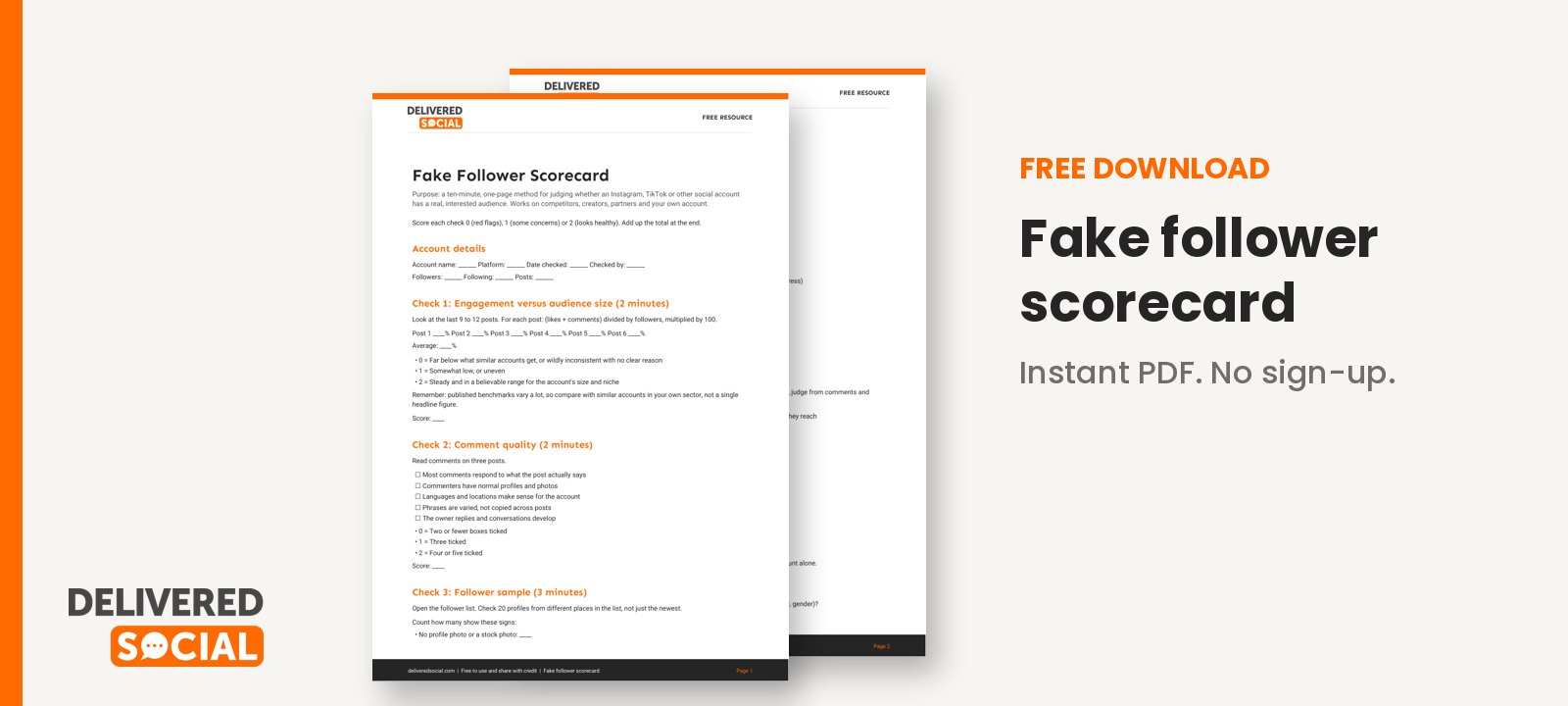
We have made a one-page Fake follower scorecard that follows this ten-minute method. It has a scoring grid, a list of questions to ask influencers, and a record sheet so you can compare accounts side by side.
Download the free Fake follower scorecard
If you would like a second pair of eyes on your own audience, Delivered Social offers social media management and audits for businesses that want honest numbers and real growth, and you can contact us to talk it through.