

Keep reading
Rather we just did it for you?
Let's get your business seen.
Social media, websites, SEO and ads from a team you can actually meet.
Every few weeks someone emails a small business promising “page one of Google in 30 days” for £99. Sometimes it’s harmless. Sometimes it’s black hat SEO, and the business ends up worse off than when it started. Knowing the difference between white hat and black hat SEO protects your website, and your money.
This guide explains both in plain English, with examples of each, the risks, and how to spot black hat tactics before you sign up to them. We’ve cleaned up after cheap SEO more than once, so we’ll also share what that looks like.
The short answer
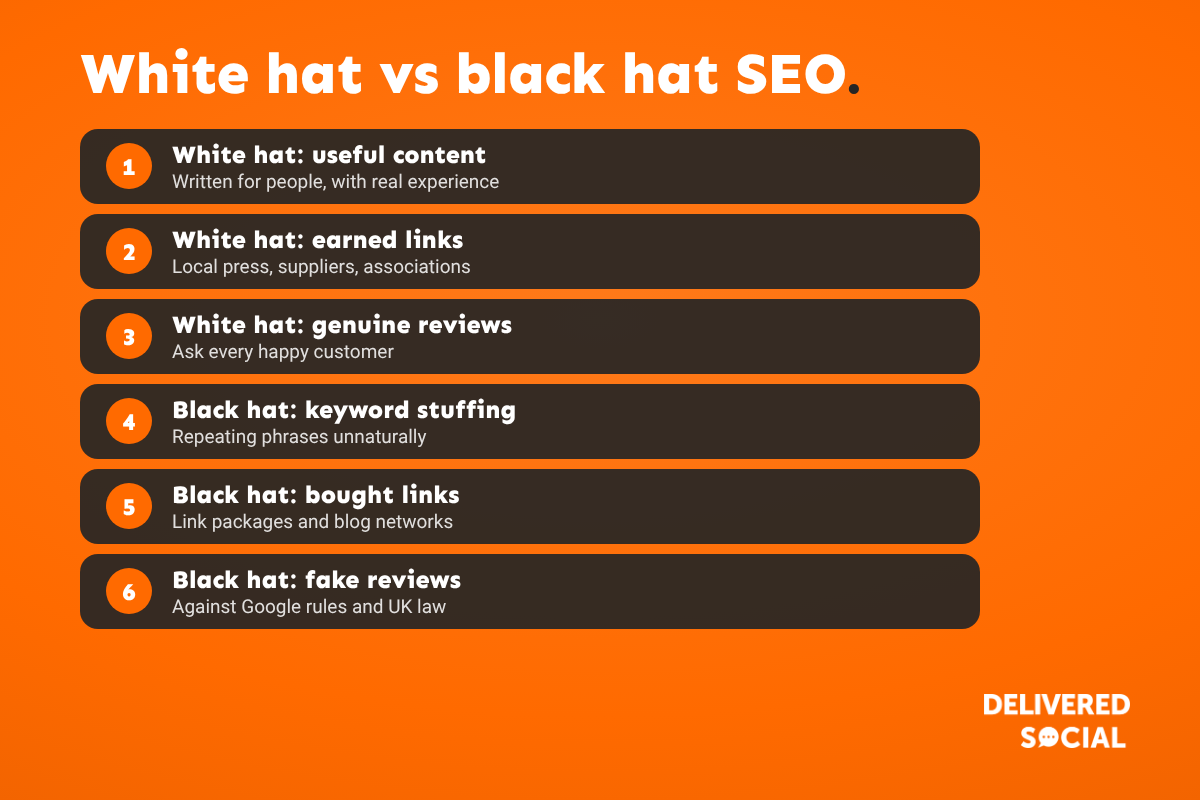
White hat SEO follows Google’s guidelines. It improves your website for real people: useful content, a fast site, genuine links and honest reviews. Results take time but last.
Black hat SEO tries to trick search engines into ranking a site higher than it deserves. It can work for a short time, but it breaks Google’s spam policies and can get your site demoted or removed from results.
In between sits grey hat SEO: tactics that aren’t clearly banned but push the boundaries, such as buying expired domains to redirect or paying for “guest posts” purely for links.
White hat vs black hat at a glance
| White hat | Black hat | |
|---|---|---|
| Content | Original, helpful, written for people | Copied, spun or AI-generated in bulk, stuffed with keywords |
| Links | Earned from relevant, real websites | Bought in bulk, private blog networks, link farms |
| Keywords | Used naturally in titles and headings | Repeated unnaturally or hidden in white text |
| Reviews | Genuine reviews from real customers | Fake or paid reviews |
| Speed of results | Months, but lasting | Sometimes fast, but short-lived |
| Risk | Low | Penalties, lost rankings, removal from Google |
Examples of white hat SEO
- Keyword research and optimisation: choosing the searches your customers make and using them naturally. See our guide to keyword optimisation.
- Useful content: guides, answers and pages that genuinely help, with real examples and experience.
- Technical health: a fast, mobile-friendly, secure site where every important page is indexed.
- Earned links: mentions from local news, suppliers, associations and sites that find your content useful.
- Local SEO: a complete Google Business Profile, consistent business details and genuine reviews.
- Structured data: schema markup that helps search engines understand your business accurately.
Examples of black hat SEO
- Keyword stuffing: cramming a phrase into a page so often it stops making sense.
- Hidden text and links: white text on a white background, or tiny links only search engines see.
- Cloaking: showing search engines different content from what visitors see.
- Buying links in bulk: hundreds of links from unrelated or low-quality sites, often from “link packages”.
- Private blog networks (PBNs): networks of sites built only to link to each other.
- Scaled low-quality content: mass-producing thin pages, whether copied, spun or auto-generated, purely to catch searches.
- Doorway pages: near-identical pages for every town, each with almost no unique content.
- Fake reviews: buying or writing reviews. As well as breaking Google’s rules, fake reviews are illegal under UK consumer law.
- Negative SEO: pointing spammy links at a competitor to try to harm them.
What happens if you use black hat SEO?
Google deals with spam in two main ways:
- Algorithmic demotion: Google’s systems spot spammy patterns and quietly stop rewarding them. Rankings can drop overnight after an update.
- Manual actions: a person at Google reviews the site and applies a penalty. You’ll see it in the Manual actions report in Google Search Console.
Recovering means removing the problem (deleting spammy pages, getting bad links removed or disavowed), then, for manual actions, submitting a reconsideration request. It can take months, and some sites never fully recover their old rankings.
When we take on a site that’s had cheap SEO in the past, the clean-up often comes before any growth work: unpicking bought links, merging thin pages and fixing pages that were never indexed properly in the first place.
How to spot black hat SEO before you buy it
- Guaranteed rankings. Nobody can guarantee position one on Google.
- Very fast results for very little money. “Page one in 30 days for £99” is a warning sign.
- Vague answers about links. Ask exactly where links will come from. “Our network” is a red flag.
- Lots of pages with little content. Dozens of near-identical location pages appearing overnight.
- Reports full of rankings for words nobody searches, with no enquiries or sales.
- Anyone offering reviews for money or freebies.
- You don’t own anything. The agency controls your Search Console, Google Business Profile or content.
Is grey hat SEO worth the risk?
For most small businesses, no. Grey hat tactics might give a short-term bump, but the rules change and today’s grey area is often tomorrow’s penalty. Your website and Google Business Profile are long-term assets. It’s rarely worth risking them for a few months of extra traffic.
Frequently asked questions
What is the difference between white hat and black hat SEO?
White hat SEO follows Google’s guidelines and improves your site for real people. Black hat SEO tries to trick search engines and risks penalties.
Is black hat SEO illegal?
Most black hat SEO isn’t illegal, it just breaks Google’s rules. Some tactics, such as fake reviews or hacking other websites to add links, can break the law.
Does black hat SEO still work?
Sometimes briefly, but Google is very good at spotting it, and the rankings rarely last. The risk to your business usually outweighs any short-term gain.
How do I know if my site has a Google penalty?
Check the Manual actions report in Google Search Console. A sudden, sharp drop in traffic after a Google update can also point to an algorithmic problem.
Is buying backlinks black hat?
Buying links purely to pass ranking power goes against Google’s spam policies. Paid or sponsored links should be marked as sponsored or nofollow.
Is AI-written content black hat?
Not in itself. Google cares whether content is helpful. Mass-producing low-quality pages to manipulate rankings is spam, however they’re written.
Want SEO that lasts?
We only use white hat SEO for businesses across Surrey, Hampshire and the UK, with plain-English reports on enquiries, not vanity rankings. See our SEO services or call us on 01483 608 303 for a friendly chat.