

Keep reading
Rather we just did it for you?
Let's get your business seen.
Social media, websites, SEO and ads from a team you can actually meet.
Is LinkedIn social media? It’s a question that comes up a lot, usually from business owners who think of LinkedIn as an online CV rather than a place to post. The short answer is yes: LinkedIn is a social media platform, just one built around work, careers and business. This guide explains why LinkedIn is a social media platform, how it differs from Facebook, Instagram and TikTok, what makes it so useful for B2B businesses, and how to use it to win customers rather than just collect connections.
Is LinkedIn a social media platform?
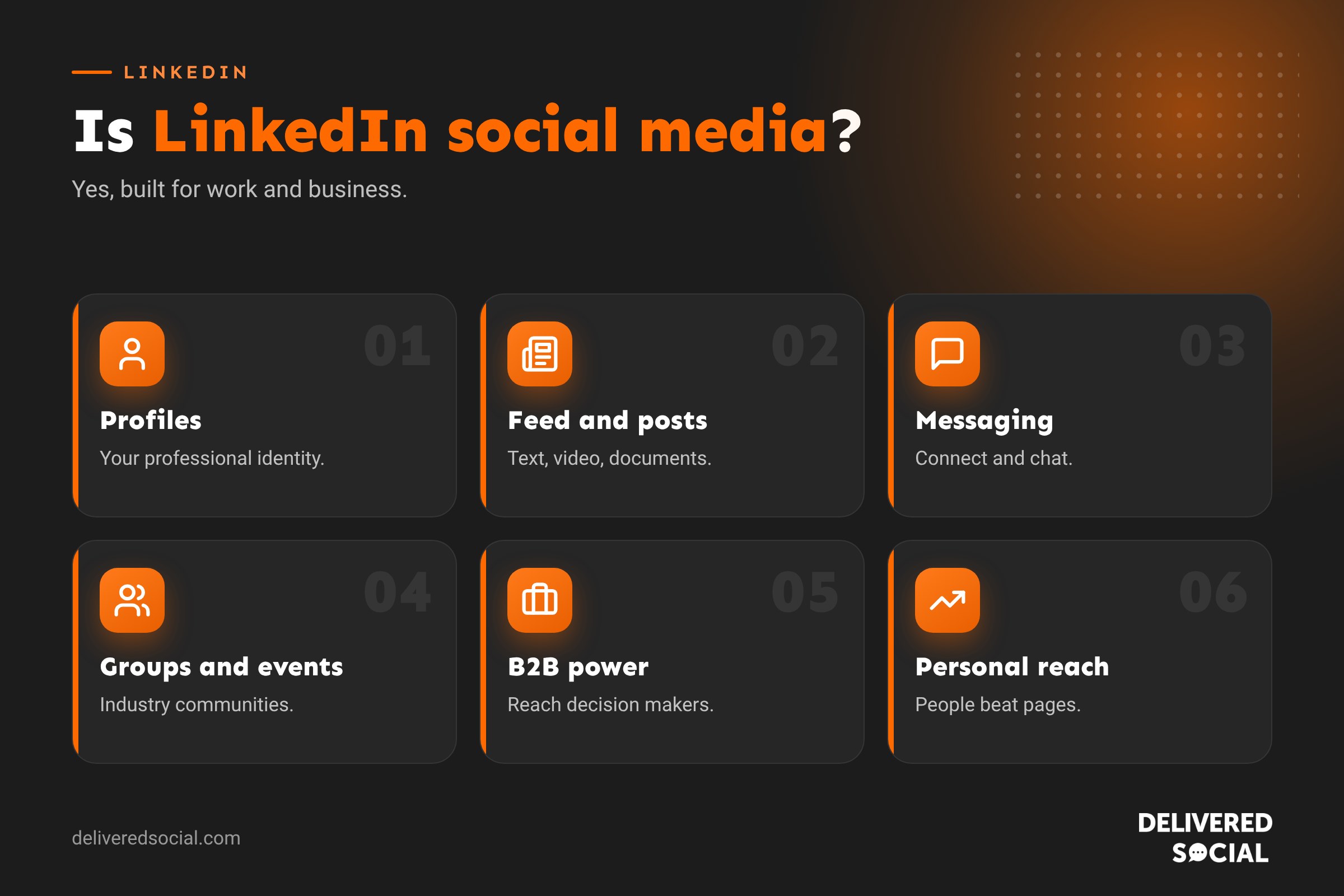
Yes. Social media means online platforms where people create profiles, share content and interact with others. LinkedIn does all of that. You have a profile, you connect with and follow people, you post updates, articles and videos, and people like, comment on and share them. It also has messaging, groups, events, newsletters and live video.
What makes LinkedIn different is its purpose. Rather than friends, family and entertainment, it’s focused on professional networking, careers and business.
Why do people say LinkedIn isn’t social media?
- It started as a job and recruitment site. Many people still use it mainly to find jobs or hire staff.
- Profiles look like CVs, with work history, skills and qualifications.
- The tone is more professional than other platforms.
- Some people only log in when they’re job hunting.
But over the years, LinkedIn has become a full social platform, with a feed, creators, video, newsletters and huge amounts of daily engagement.
What makes LinkedIn social
| Feature | What it does |
|---|---|
| Feed | Posts from connections, people you follow and recommended content |
| Posts | Text, images, documents (carousels), polls and videos |
| Articles and newsletters | Long-form writing that followers can subscribe to |
| Comments and reactions | Like, Celebrate, Support, Love, Insightful and Funny |
| Messaging | Direct messages and InMail |
| Groups | Communities around industries and interests |
| Events and Live | Online events and live streams |
| Company pages | Business profiles that people can follow |
LinkedIn vs other social media platforms
| TikTok | ||||
|---|---|---|---|---|
| Main purpose | Work, careers and business | Friends, family and community | Visual sharing | Entertainment |
| Typical content | Insights, advice, news, career updates | Life updates, groups, events | Photos, Reels, Stories | Short videos |
| Best for | B2B, recruitment, personal brands | Local businesses and communities | Consumer brands | Reach and awareness |
| Tone | Professional but personal | Casual | Aspirational | Playful |
Why LinkedIn matters for businesses
- Decision makers are there. Business owners, managers and directors use LinkedIn to keep up with their industry.
- Personal profiles reach further than company pages. A founder posting regularly can build huge trust.
- It’s great for B2B sales. You can find and connect with the exact people you want to work with.
- It builds credibility. Recommendations, posts and case studies show expertise.
- Recruitment. It’s still the best platform for hiring.
- Precise ad targeting by job title, industry, company size and seniority.
Personal profile vs company page
Both matter, but they do different jobs:
- Personal profiles usually get far more reach and engagement. People connect with people. Founders and team members posting is often the most effective way to grow a business on LinkedIn.
- Company pages give your business an official presence, show job vacancies, host Showcase pages and run ads. They’re where people check you out.
The best approach combines both: share company updates on the page, and have key people repost and add their own perspective.
What to post on LinkedIn
- Lessons learned from running your business.
- Behind the scenes of projects and your team.
- Client wins and case studies, with permission.
- Industry insights and your opinion on news.
- How-to tips that help your ideal customer.
- Document carousels breaking down a process.
- Short videos of you explaining something.
- Celebrations, such as anniversaries, awards and new hires.
Tips for using LinkedIn well
- Complete your profile with a clear photo, headline and About section that says who you help.
- Post consistently, two or three times a week is plenty for most people.
- Write like a person. Short paragraphs, plain English, a personal angle.
- Start with a strong first line, because only the first couple of lines show before “see more”.
- Comment on other people’s posts. Thoughtful comments get you noticed by their audience.
- Connect with intent. Add a short, friendly note rather than a sales pitch.
- Don’t pitch straight away in messages. Build a relationship first.
- Track results with LinkedIn analytics.
Our guide to scheduling LinkedIn posts can help you stay consistent.
Is LinkedIn right for every business?
LinkedIn is essential for B2B businesses, professional services, recruiters, consultants and anyone selling to other businesses. For consumer brands, such as a café or a clothing shop, it’s less important for direct sales, but still useful for recruitment, networking with local businesses, building partnerships and sharing company news.
LinkedIn in the UK
LinkedIn is widely used by UK professionals, with tens of millions of UK members. It’s especially strong among managers, business owners and people working in professional services, technology, finance, marketing and the public sector. That makes it a valuable platform for businesses in places like Surrey and Hampshire, where many decision makers commute to or work with London businesses.
LinkedIn for different types of business
| Business type | How to use LinkedIn |
|---|---|
| Professional services (accountants, solicitors, consultants) | Share expertise, answer common questions, build referral relationships |
| B2B suppliers and manufacturers | Showcase projects, reach buyers and procurement teams |
| Agencies and freelancers | Share results and case studies, show your thinking |
| Local consumer businesses | Recruit staff, network with other local businesses, share community news |
| Charities | Find corporate partners, volunteers and trustees |
Building a LinkedIn habit
The businesses that get the most from LinkedIn treat it like a habit rather than a project. A realistic routine might be fifteen minutes a day: five minutes replying to comments and messages, five minutes commenting thoughtfully on posts from clients, prospects and local businesses, and five minutes connecting with a few new relevant people. Add two or three posts a week and you’ll build visibility steadily without it taking over your day.
LinkedIn advertising
LinkedIn ads let you target people by job title, seniority, company, industry and location, which makes them powerful for B2B. They tend to cost more per click than other platforms, so they work best when each customer is valuable, such as professional services, software or business-to-business contracts. Lead gen forms, which pre-fill with people’s LinkedIn details, can make it easy for prospects to enquire without leaving the platform.
Quick glossary
- Connection: a two-way relationship on LinkedIn, like a friend on Facebook.
- Follower: someone who sees your posts without connecting.
- InMail: a paid message to someone you’re not connected with.
- Company page: your business’s official LinkedIn profile.
- Newsletter: a LinkedIn article series people can subscribe to.
Common LinkedIn mistakes
- An empty or outdated profile with no photo or headline.
- Connecting and immediately pitching in messages.
- Only posting company announcements with no personality.
- Posting and disappearing without replying to comments.
- Using engagement pods or automation tools that break LinkedIn’s rules.
- Posting once in a blue moon and expecting results.
Avoid these, and even a small amount of regular activity can make a real difference.
Key takeaways
- LinkedIn is a social media platform focused on professional networking.
- It has a feed, posts, comments, messaging, groups, events and video.
- Personal profiles usually reach more people than company pages.
- It’s essential for B2B, recruitment and professional services.
- Helpful, personal content works better than hard selling.
How to measure LinkedIn success
Use LinkedIn’s built-in analytics for your profile and company page. Look at impressions, engagement, profile views, follower growth and, most importantly, conversations started and enquiries received. A post with modest reach that sparks a conversation with the right prospect can be worth far more than a viral post. Keep a simple note of where each new client first came across you, and you’ll soon see how much LinkedIn contributes.
LinkedIn changes its features and algorithm regularly, adding new formats such as video feeds and newsletters. Keep an eye on what is new, test it early and keep what works for your audience. Early adopters of new LinkedIn features often get extra reach while the format is still fresh.
Start small, stay consistent and be helpful.
Frequently asked questions
Is LinkedIn considered social media?
Yes. It’s a social media platform for professional networking and business content.
Is LinkedIn a social media app?
Yes. LinkedIn has apps for iPhone and Android as well as its website.
What is the difference between LinkedIn and Facebook?
LinkedIn focuses on work and business; Facebook focuses on friends, family and communities.
Should my business be on LinkedIn?
If you sell to other businesses or need to recruit, yes. Consumer businesses benefit too, though less directly.
Is a personal profile or company page better?
Use both. Personal profiles reach more people; company pages give official credibility.
Want LinkedIn to bring in business?
We help businesses and founders across Surrey, Hampshire and the UK grow on LinkedIn. Read our guide to LinkedIn company pages, see our social media management services or call us on 01483 608 303.