

Keep reading
Rather we just did it for you?
Let's get your business seen.
Social media, websites, SEO and ads from a team you can actually meet.
Ask a successful small business owner where their best customers came from, and many will say “someone I met”. Networking is one of the oldest and most effective marketing tools there is, and it works hand in hand with digital marketing. This guide explains what networking is in a business context, how networking and marketing fit together, the different types of networking, how to network well online and in person, and how to turn new connections into real business.
What is networking?
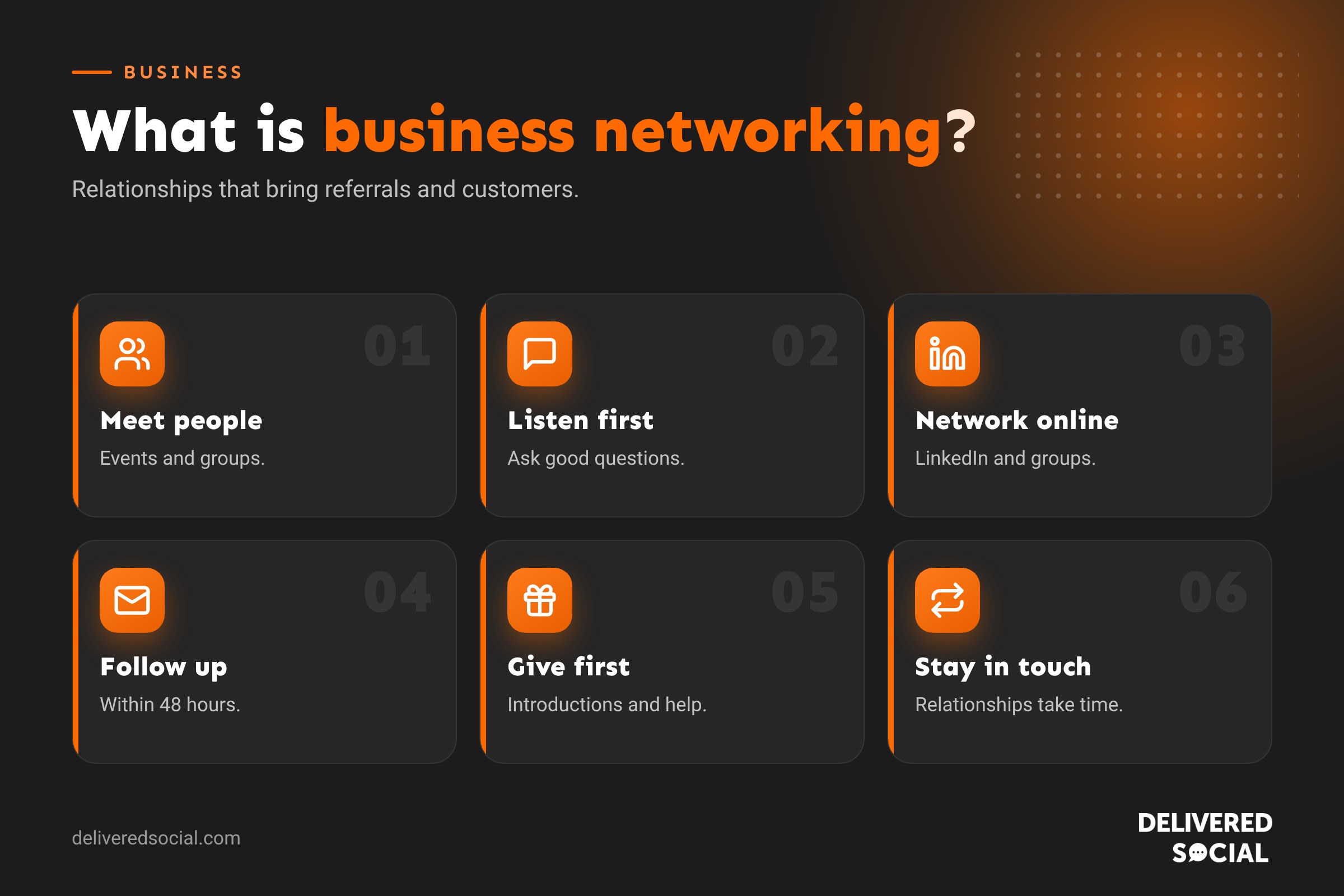
Business networking means building relationships with other people who can help your business grow, and whom you can help in return. Those people might become customers, refer customers to you, partner with you, supply you, advise you or simply support you. Good networking is about relationships, not quick sales.
Networking and marketing: how they fit together
Marketing reaches lots of people at once. Networking builds deeper relationships with fewer people. Each makes the other stronger:
- Networking gives your marketing faces. People who’ve met you notice and engage with your posts.
- Marketing keeps you in mind. Regular social posts remind your network what you do.
- Networking creates referrals, often the highest-quality leads a business can get.
- Marketing builds credibility, so when someone looks you up after meeting you, they’re impressed.
Types of business networking
| Type | What it is | Good for |
|---|---|---|
| Structured referral groups | Regular meetings where members pass referrals | Steady referrals in a local area |
| Chamber of commerce and business associations | Local business communities with events and support | Local visibility and connections |
| Industry events and trade shows | Gatherings around a specific sector | Meeting buyers, suppliers and peers |
| Informal networking | Breakfasts, coffee mornings, after-work drinks | Relaxed relationship building |
| Online networking | LinkedIn, Facebook groups, online communities | Reaching people beyond your area |
| Community involvement | Charity events, sponsorships, local projects | Goodwill and reputation |
How to network at events
- Know your goal. Meet three new people? Find a supplier? Reconnect with a contact?
- Prepare a simple introduction. Who you help and how, in a sentence: “I help local cafés get more customers through Instagram.”
- Ask questions. Be curious about other people’s businesses. People remember good listeners.
- Look for ways to help. Can you introduce them to someone or share a useful tip?
- Swap details or connect on LinkedIn there and then.
- Make a note of what you talked about.
- Follow up within 48 hours.
How to network online
- Complete your profile with a clear photo and headline.
- Connect with people you meet, adding a short personal note.
- Comment thoughtfully on other people’s posts.
- Share helpful posts about your expertise and business journey.
- Join relevant groups and events.
Our guide is LinkedIn social media? explains how to use LinkedIn well.
Facebook groups
- Join local business groups and community groups.
- Follow the group rules; many limit self-promotion.
- Answer questions helpfully, without always pitching.
Instagram and other platforms
- Engage with other local businesses’ posts and Stories.
- Collaborate on giveaways, joint posts or events.
- Tag and celebrate partners and suppliers.
Following up: where networking really works
Most networking fails because people never follow up. A simple process:
- Send a short message within two days: “Great to meet you at the breakfast. I loved hearing about your new café opening.”
- Offer something useful, such as an introduction, an article or a tip.
- Suggest a coffee or call if there’s a genuine reason to talk more.
- Stay in touch by engaging with their social posts and checking in occasionally.
- Keep a simple record in a spreadsheet or CRM of who you met and when.
Turning your network into referrals
- Be specific about who you help. “Hair salons in Portsmouth” is easier to refer than “anyone”.
- Refer others first. Generosity builds goodwill.
- Thank people for referrals, whether or not they turn into work.
- Share success stories so your network knows what you do well.
- Make it easy with a simple link, card or short description people can pass on.
Networking tips for people who hate networking
- Go with a friend or colleague at first.
- Arrive early, when it’s quieter and easier to start conversations.
- Look for people standing alone; they’ll be glad you said hello.
- Focus on listening rather than talking.
- Set a small goal, such as two good conversations, then go home.
- Try online networking first if face-to-face feels daunting.
Measuring networking
Networking takes time, so track it over months. Note how many new connections you make, how many conversations you follow up, referrals given and received, and the business that comes from them. Ask every new customer how they heard about you. If one group or event keeps producing results, invest more time there.
Networking and your social media
When you meet someone, they’ll almost certainly look you up online. Make sure your LinkedIn profile, website and main social profiles are up to date, show what you do clearly and include recent posts. Share photos from networking events (with permission), tag the people and organisers, and thank hosts publicly. It shows you’re active, connected and part of the local business community.
Choosing the right networking group
There are many types of groups, from weekly breakfast referral clubs to monthly chamber events and informal coffee mornings. Before committing, visit as a guest and ask yourself:
- Are the members the kind of people who could become customers or refer them?
- Is there already someone in your line of work? Some groups only allow one per trade.
- Does the time and cost fit your diary and budget?
- Do members actually help each other, or is it just selling?
- Do you enjoy being there? You’ll get more from a group you look forward to.
Give a group at least six months before judging it, because trust and referrals take time to build.
What to say when someone asks “what do you do?”
Most people answer with their job title, which is quickly forgotten. Instead, describe who you help and the result you get them: “I help busy families in Fareham keep their gardens looking great without spending their weekends on it.” It’s memorable, it invites questions, and it makes it easy for people to think of someone who needs you. Practise it until it sounds natural rather than rehearsed.
Networking etiquette
- Don’t hand out business cards before you’ve had a proper conversation.
- Don’t add people to your mailing list without permission.
- Do turn up on time and stay engaged rather than checking your phone.
- Do keep promises, such as sending an introduction you offered.
- Do thank the organisers and hosts.
Quick glossary
- Referral: when someone recommends your business to a potential customer.
- Elevator pitch: a short introduction to what you do.
- CRM: a system for keeping track of contacts and conversations.
- Warm lead: a potential customer who already knows or trusts you.
Online networking communities
Beyond LinkedIn, many industries and towns have their own online communities, from Facebook groups for local businesses to Slack and WhatsApp groups for particular trades or professions. These can be great places to ask questions, share knowledge and build relationships between face-to-face events. Be a helpful member first: answer questions, share useful resources and celebrate others’ wins. Opportunities tend to follow people who give generously.
Networking for introverts
Many brilliant networkers describe themselves as introverts. Their secret is depth over breadth: a few meaningful conversations rather than working the room. Prepare a couple of open questions in advance, such as “What’s been the highlight of your year so far?”, take short breaks when you need them, and follow up thoughtfully afterwards. One-to-one coffees after events often suit introverts better than the events themselves.
Key takeaways
- Networking builds relationships that lead to customers, referrals and partnerships.
- It works best alongside your digital marketing.
- Mix in-person events with online networking on LinkedIn and in groups.
- Always follow up within a couple of days.
- Give before you ask, and be specific about who you help.
Above all, be patient. Networking is a long game, and the relationships you start today may bring your best customers in a year or two.
A simple rule of thumb: for every event you attend, aim to follow up with at least two people and offer one genuine introduction or piece of help. Small, consistent actions like these build a network that keeps sending opportunities your way.
Frequently asked questions
What is networking in business?
Building relationships with people who can help your business grow, and helping them in return.
Is networking part of marketing?
Yes. It’s a relationship-based form of marketing that works alongside digital channels.
How do I start networking?
Join a local business group or chamber, attend an event and connect with people on LinkedIn afterwards.
Is online networking as good as in person?
Both work. Online reaches more people; in person builds stronger relationships quickly.
How long does networking take to work?
Usually months. Consistency and follow-up make the difference.
Want your online presence ready for networking?
We help businesses across Surrey, Hampshire and the UK with social media, LinkedIn and websites. See our social media management services or call us on 01483 608 303.