

Keep reading
Rather we just did it for you?
Let's get your business seen.
Social media, websites, SEO and ads from a team you can actually meet.
Social media management has grown from “the intern posts on Facebook” into a proper profession. A good social media manager can grow a brand, bring in enquiries and protect a business’s reputation. But what does the job actually involve, and do you need one? This guide explains what a social media manager does, the skills and tools involved, how management of social media works day to day, what it costs to hire someone in-house or through an agency, and how to choose the right option for your business.
What is social media management?
Social media management is planning, creating, publishing, monitoring and improving a business’s presence on social platforms. It covers content, community, advertising and reporting, all tied back to business goals such as enquiries, sales, bookings or recruitment.
What does a social media manager do?
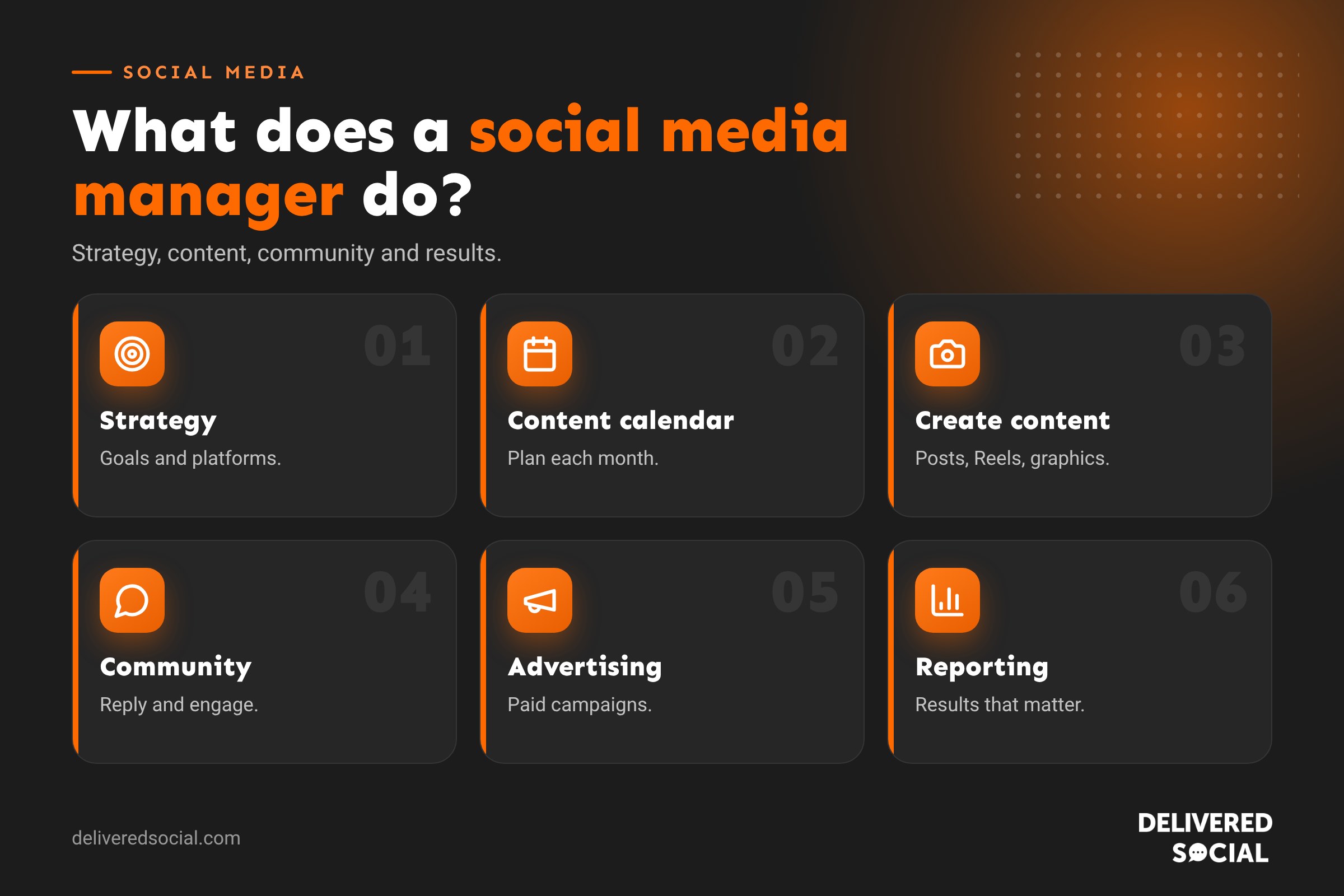
| Responsibility | What it involves |
|---|---|
| Strategy | Setting goals, choosing platforms, defining the audience and tone of voice |
| Content planning | Building monthly content calendars around themes, offers and events |
| Content creation | Writing captions, designing graphics, filming and editing videos |
| Scheduling and publishing | Posting at the right times on each platform |
| Community management | Replying to comments and messages, moderating and engaging |
| Advertising | Planning, running and optimising paid campaigns |
| Analytics and reporting | Tracking performance and reporting on results |
| Trend watching | Keeping up with platform updates and trends |
| Reputation management | Handling complaints, reviews and tricky situations |
| Collaboration | Working with influencers, partners and other teams |
A typical week for a social media manager
- Monday: review last week’s results, plan the week, check upcoming events.
- Tuesday: film and photograph content, write captions.
- Wednesday: design graphics, edit videos, schedule posts.
- Thursday: review ads, adjust budgets and targeting.
- Friday: report to the client or boss, plan next week.
- Every day: reply to comments and messages, post Stories, watch trends.
Skills a good social media manager needs
- Writing: clear, engaging captions in the brand’s voice.
- Visual creativity: an eye for design, photography and video.
- Video editing: short-form editing for Reels, TikTok and Shorts.
- Strategy: linking social activity to business goals.
- Analytics: understanding data and acting on it.
- Advertising: running paid campaigns on Meta, TikTok and LinkedIn.
- Customer service: calm, helpful responses, even to complaints.
- Organisation: managing calendars, deadlines and several platforms.
- Curiosity: keeping up with constant platform changes.
Tools social media managers use
- Design: Canva, Adobe Express or Adobe Creative Cloud.
- Video: CapCut, Premiere Pro or platform editors.
- Scheduling: Meta Business Suite, Metricool, Later, Buffer or Hootsuite.
- Analytics: native platform insights and Google Analytics.
- Advertising: Meta Ads Manager, TikTok Ads Manager, LinkedIn Campaign Manager.
- Planning: spreadsheets, project management tools and shared calendars.
Our guide to social media apps for business covers these in more detail.
In-house, freelancer or agency?
| In-house | Freelancer | Agency | |
|---|---|---|---|
| Cost | Salary, pension, holiday, tools and training | Day rate or monthly fee | Monthly fee |
| Skills | One person’s skill set | One person’s skill set | A team: strategy, design, video, ads |
| Cover | Gaps during holidays and sickness | Depends on availability | Team cover |
| Knowledge of your business | Very deep | Varies | Builds over time |
| Best for | Larger businesses with lots of content | Smaller, focused needs | Businesses wanting a full service without hiring |
For many small and medium businesses, an agency offers the most skills for the money, because you get a team for less than the cost of one full-time hire. Our guide to social media management costs covers pricing in more detail.
Signs you need a social media manager
- Your accounts go quiet for weeks at a time.
- Messages and comments go unanswered.
- You’re spending hours on social media and not seeing results.
- Your posts look inconsistent or out of date.
- You want to run ads but don’t know where to start.
- Competitors are clearly winning customers on social media.
How to brief a social media manager
- Explain your goals: enquiries, bookings, sales, awareness or recruitment.
- Describe your ideal customers and where they spend time online.
- Share your brand guidelines, tone of voice and examples you like.
- Agree approval processes so content goes live smoothly.
- Give access properly through Meta Business Suite, LinkedIn admin roles and similar, never by sharing passwords.
- Agree reporting: what you’ll see each month and how success is measured.
How to measure a social media manager’s work
- Growth in reach and engagement.
- Website visits from social media.
- Enquiries, bookings and sales linked to social.
- Response times to messages.
- Return on ad spend for paid campaigns.
- Quality and consistency of content.
Followers matter less than whether social media is helping the business grow.
Becoming a social media manager
If you’re thinking about the role as a career, start by managing accounts for a local business or charity, build a portfolio of results, learn short-form video editing and paid ads, and keep up with platform changes. Many social media managers come from marketing, journalism, design or customer service backgrounds.
Social media management packages
Agencies and freelancers usually offer packages based on the number of platforms, posts per month and services included. A typical package might cover strategy, a monthly content calendar, a set number of posts and Reels, Stories, community management and a monthly report. Paid advertising management is often an add-on, with ad spend paid separately. When comparing packages, look at what’s actually included, such as whether video filming, photography and replying to messages are covered, not just the number of posts.
Questions to ask before hiring
- Can you show results you’ve achieved for similar businesses?
- Who will actually create our content and manage our accounts?
- How will you learn about our business and customers?
- What does the approval process look like?
- How quickly will messages and comments be answered?
- What will you report on each month?
- How long is the contract, and what happens if we leave?
Working well with a social media manager
The best results come from a partnership. Share news, photos and behind-the-scenes moments regularly, give feedback quickly, tell them about offers and events well in advance, and let them know which enquiries came from social media. A social media manager who understands your business can tell your story far better than one working from guesswork.
Quick glossary
- Content calendar: a plan of what to post and when.
- Community management: engaging with and moderating your audience.
- Organic: unpaid social media activity.
- Paid social: advertising on social platforms.
- Tone of voice: the personality in your brand’s writing.
How social media managers handle a crisis
Sometimes things go wrong: a complaint goes viral, a post is misunderstood or an account gets hacked. A good social media manager has a plan. They pause scheduled posts, respond quickly and calmly, move detailed conversations to private messages, keep the business owner informed, and follow up publicly once the issue is resolved. They also make sure accounts have strong security, so hacks are less likely in the first place.
The future of social media management
The role keeps evolving. Short-form video, social search, AI tools, creator partnerships and social shopping are all changing how businesses use social media. Good social media managers keep learning, test new features early and adapt strategies as platforms change, while staying focused on what matters most: helping the business reach and win customers.
Key takeaways
- Social media managers plan, create, publish, engage, advertise and report.
- The role needs writing, visual, video, data and people skills.
- Businesses can hire in-house, use a freelancer or work with an agency.
- Agencies often give small businesses the widest skills for the money.
- Measure success by business results, not just followers.
Social media manager vs social media agency
A social media manager is usually one person, whether employed or freelance. A social media agency is a team that often includes strategists, designers, video editors, copywriters and advertising specialists. Some businesses combine the two, with an in-house coordinator who knows the business inside out working alongside an agency for creative and ads.
Whichever route you choose, make sure your social media has a clear owner, a plan and regular reporting. That alone puts you ahead of many competitors.
Good social media management pays for itself in time saved and customers won.
Choose a partner who understands your goals.
Frequently asked questions
What does a social media manager do day to day?
Plans and creates content, schedules posts, replies to comments and messages, runs ads and reports on results.
Do small businesses need a social media manager?
If social media matters to your customers and you don’t have time to do it well, yes.
Is it better to hire in-house or use an agency?
It depends on budget and volume. Agencies give access to a team; in-house gives deep business knowledge.
What skills does a social media manager need?
Writing, design, video editing, analytics, advertising, customer service and organisation.
How do I give a social media manager access safely?
Use business tools like Meta Business Suite and admin roles rather than sharing passwords.
Want a social media team on your side?
We manage social media for businesses across Surrey, Hampshire and the UK. See our social media management services or call us on 01483 608 303.