

Keep reading
Rather we just did it for you?
Let's get your business seen.
Social media, websites, SEO and ads from a team you can actually meet.
WordPress powers a huge share of the web, yet many business owners aren’t quite sure what it actually is. Is it free? Is it open source? Is it a website builder, a content management system, a framework or a programming language? Is it front end or back end? The answers matter, because they affect what you own, what it costs and how much freedom you have. This guide answers the common question “is WordPress open source?” and explains, in plain English, what WordPress really is, how it works, what open source means for your business and how it compares with closed platforms.
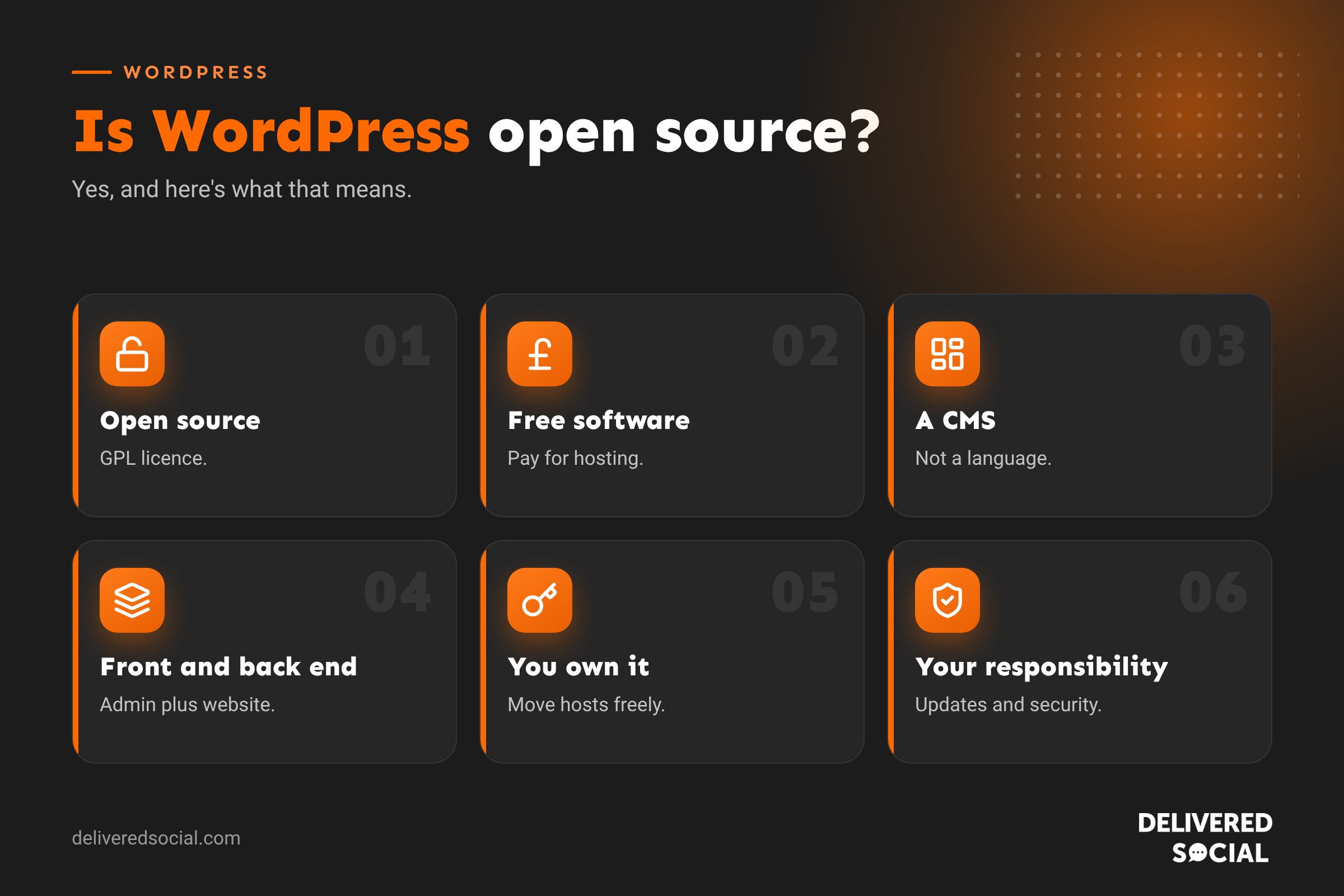
The short answer
Yes. WordPress is free, open-source software released under the GNU General Public License (GPL). Anyone can download it, use it for any purpose, study how it works, change it and share it. It’s built and maintained by a global community of volunteers and companies, and it’s used for everything from personal blogs to large business and government websites.
What does open source mean?
Open-source software is software whose source code is publicly available, under a licence that allows people to use, modify and redistribute it. WordPress’s GPL licence grants four key freedoms:
- Use it for any purpose, including commercial websites.
- Study how it works and change it.
- Share copies with others.
- Share your changes with others, under the same licence.
That’s why WordPress itself costs nothing, and why thousands of developers have built themes and plugins that extend it.
WordPress.org vs WordPress.com
| WordPress.org | WordPress.com | |
|---|---|---|
| What it is | The open-source software, free to download | A commercial hosting service built on WordPress |
| Who hosts it | You, on hosting you choose | WordPress.com |
| Cost | Software is free; you pay for hosting and a domain | Free and paid plans |
| Control | Full control of code, themes and plugins | Depends on your plan |
When people say WordPress is open source, they mean the WordPress.org software. Most business websites use this self-hosted version. See is WordPress free? for the costs involved.
Is WordPress a CMS?
Yes. WordPress is a content management system (CMS): software that lets you create, edit and organise website content without writing code. You log in to a dashboard, write pages and posts in an editor, upload images, manage menus and publish. Our guide to what a CMS is explains the wider category.
Is WordPress a website builder?
Sort of. WordPress can be used like a website builder, especially with block themes or page builders that let you design pages visually. But unlike all-in-one builders such as Wix or Squarespace, self-hosted WordPress doesn’t include hosting, and you choose your own themes and plugins. It’s more flexible, with a little more responsibility. See Wix vs Squarespace vs WordPress.
Is WordPress a framework?
Not in the strict sense. Frameworks like Laravel or React are toolkits developers use to build applications from code. WordPress is a complete application with an admin area, database structure and content features. That said, developers often use WordPress as a foundation for custom projects, using its APIs and plugin system much like a framework.
Is WordPress a programming language?
No. WordPress is written in PHP, a programming language, along with HTML, CSS, JavaScript and a MySQL or MariaDB database. You don’t need to know these languages to use WordPress, but developers use them to build themes and plugins.
Is WordPress front end or back end?
Both. The back end is the admin dashboard and server-side code where you manage content, settings and users. The front end is the website visitors see, generated from your theme and content. WordPress can also be used “headless”, where it only manages content in the back end and a separate front end displays it.
Is WordPress a CRM or hosting provider?
Neither by itself. WordPress isn’t a customer relationship management system, but plugins and integrations can connect it to CRMs. It isn’t a hosting provider either: you host self-hosted WordPress with a hosting company. WordPress.com, the commercial service, does include hosting. See our guide to WordPress hosting costs.
Who owns WordPress?
No single company owns the WordPress software. It’s an open-source project, with the trademark held by a non-profit foundation. Thousands of contributors help develop it, and several companies, including Automattic (which runs WordPress.com), contribute heavily. Because the code is open source, it would continue even if any single company stopped supporting it.
What open source means for your business
- No licence fees: the core software is free.
- Ownership and portability: you can move your site to any host, and you’re not locked into one company’s platform.
- Choice: thousands of themes and plugins, and many developers and agencies who know WordPress.
- Longevity: a huge community means WordPress isn’t going away.
- Transparency: the code is open to inspection, and security issues are found and fixed publicly.
- Flexibility: almost anything can be built or integrated.
The responsibilities that come with it
Open-source freedom comes with responsibilities:
- Choosing good hosting.
- Keeping WordPress, themes and plugins updated.
- Backups and security.
- Choosing well-maintained plugins.
Many businesses hand these tasks to their web agency through a maintenance plan. See also is WordPress safe?
Are WordPress themes and plugins open source?
Themes and plugins in the official WordPress directory are GPL licensed and free. Many developers also sell premium themes and plugins, which are still usually GPL, but you pay for updates, support and extra features. Avoid “nulled” (pirated) premium plugins: they often contain malware and don’t receive updates.
Open source vs closed platforms
| Open source (WordPress) | Closed platforms (e.g. Wix, Squarespace, Shopify) | |
|---|---|---|
| Software cost | Free | Included in subscription |
| Hosting | Your choice | Included, can’t change |
| Customisation | Almost unlimited | Within platform limits |
| Ownership | Full | You own content; platform owns the system |
| Maintenance | Your responsibility (or your agency’s) | Handled by the platform |
| Moving away | Easy to change host | Often harder to migrate |
Is WordPress still a good choice?
For most business websites, yes. It’s mature, flexible, SEO-friendly and supported by a vast ecosystem. Our guide is WordPress still relevant? looks at how it compares with newer AI and no-code tools.
How WordPress is developed
WordPress is developed in the open. Contributors propose changes, discuss them publicly, test new features and release major versions a few times a year, with smaller security and maintenance releases in between. Anyone can contribute code, translations, documentation, design ideas or support. That openness is part of why WordPress has adapted to so many changes in the web over the years, from blogging to full site editing.
Example: what open source means in practice
Imagine a local business unhappy with its current host. With WordPress, it can move the whole site, content, design and all, to a faster host in an afternoon. It can hire any WordPress agency to make changes, not just the one that built the site. If it later needs a booking system, an online shop or a membership area, it can add a plugin rather than rebuilding on a new platform. That freedom is the practical value of open source.
Common myths about open source
- “Free means low quality.” WordPress is used by major organisations worldwide; free refers to the licence, not the quality.
- “Open source means anyone can edit my site.” No. The code is public, but only people you give access to can change your website.
- “There’s no support.” There’s community support, plus thousands of agencies, developers and hosts offering paid support.
Quick glossary
- Open source: software whose code is public and can be freely used and changed.
- GPL: the GNU General Public License, WordPress’s licence.
- CMS: content management system.
- PHP: the programming language WordPress is written in.
- Headless: using WordPress only for content, with a separate front end.
Key takeaways
- WordPress is free, open-source software licensed under the GPL.
- It’s a content management system, not a programming language or framework.
- It covers both the back end (admin) and front end (website).
- Open source gives you ownership, choice and freedom to move.
- You’re responsible for hosting, updates and security, or your agency is.
Frequently asked questions
Is WordPress open source?
Yes. WordPress is released under the GPL licence and is free to use and modify.
Is WordPress completely free?
The software is free; hosting, domains and premium extras cost money.
Is WordPress a CMS?
Yes, it’s the world’s most widely used content management system.
What language is WordPress written in?
Mainly PHP, with HTML, CSS, JavaScript and a MySQL or MariaDB database.
Is WordPress front end or back end?
Both: an admin back end and a visitor-facing front end.
Who owns WordPress?
No single company owns the software; it’s a community-built open-source project.
Can I use WordPress for a commercial website?
Yes, the licence allows any use, including commercial.
Is open source less secure?
Not inherently. Security depends on updates, hosting and good practice.
Can I modify WordPress code?
Yes, but use plugins and child themes rather than editing core files, which are overwritten by updates.
Want a WordPress website that’s looked after?
We build, host and maintain WordPress websites for businesses across Surrey, Hampshire and the UK. Call us on 01483 608 303.