



Keep reading
Rather we just did it for you?
Let's get your business seen.
Social media, websites, SEO and ads from a team you can actually meet.
More and more people now ask ChatGPT, Gemini, Copilot, Perplexity or Google’s AI Mode for recommendations instead of scrolling through ten blue links. Ask “who is a good accountant in Guildford?” or “what is the best CRM for a small charity?” and an AI tool gives one tidy answer, often naming a handful of businesses. LLM SEO is the work of making sure your business is one of the names that comes up. This plain English guide explains what LLM SEO is, how large language models choose what to say, and the practical steps a small business can take to get mentioned.
What is LLM SEO?
LLM stands for large language model, the technology behind ChatGPT, Claude, Gemini and similar tools. LLM SEO means optimising your website and wider online presence so that these tools understand who you are, trust you, and recommend or cite you in their answers.
You will also hear it called generative engine optimisation (GEO), answer engine optimisation (AEO) or AI SEO. The labels overlap. Our guide to AEO vs GEO explains the differences, but the goal is the same: be the answer, not just a link.
How LLMs decide what to say
AI assistants build answers in two main ways:
- From training data. The model learned from a huge snapshot of the web, books and other sources. If your brand was mentioned often and consistently before that snapshot, the model may already “know” you.
- From live search. Many tools now search the web in real time, read the top results and summarise them, often with citations. ChatGPT search, Perplexity, Copilot and Google’s AI Overviews all work this way.
The second route is where most small businesses can make progress quickly. If your pages rank well, answer questions clearly and are easy to quote, AI tools are far more likely to pull from them.
LLM SEO vs traditional SEO
| Traditional SEO | LLM SEO | |
|---|---|---|
| Goal | Rank a page in search results | Be named or cited in an AI answer |
| Success measure | Rankings, clicks, traffic | Mentions, citations, referral visits |
| Content style | Keyword targeted pages | Clear, quotable answers to real questions |
| Authority signals | Backlinks, page experience | Mentions, reviews, consistency across the web |
| Foundation | Technical SEO | Technical SEO plus entity clarity |
The two are not rivals. Good LLM SEO is built on good SEO. If Google cannot crawl and understand your site, AI tools that rely on search results will struggle too. Our SEO for beginners guide covers those foundations.
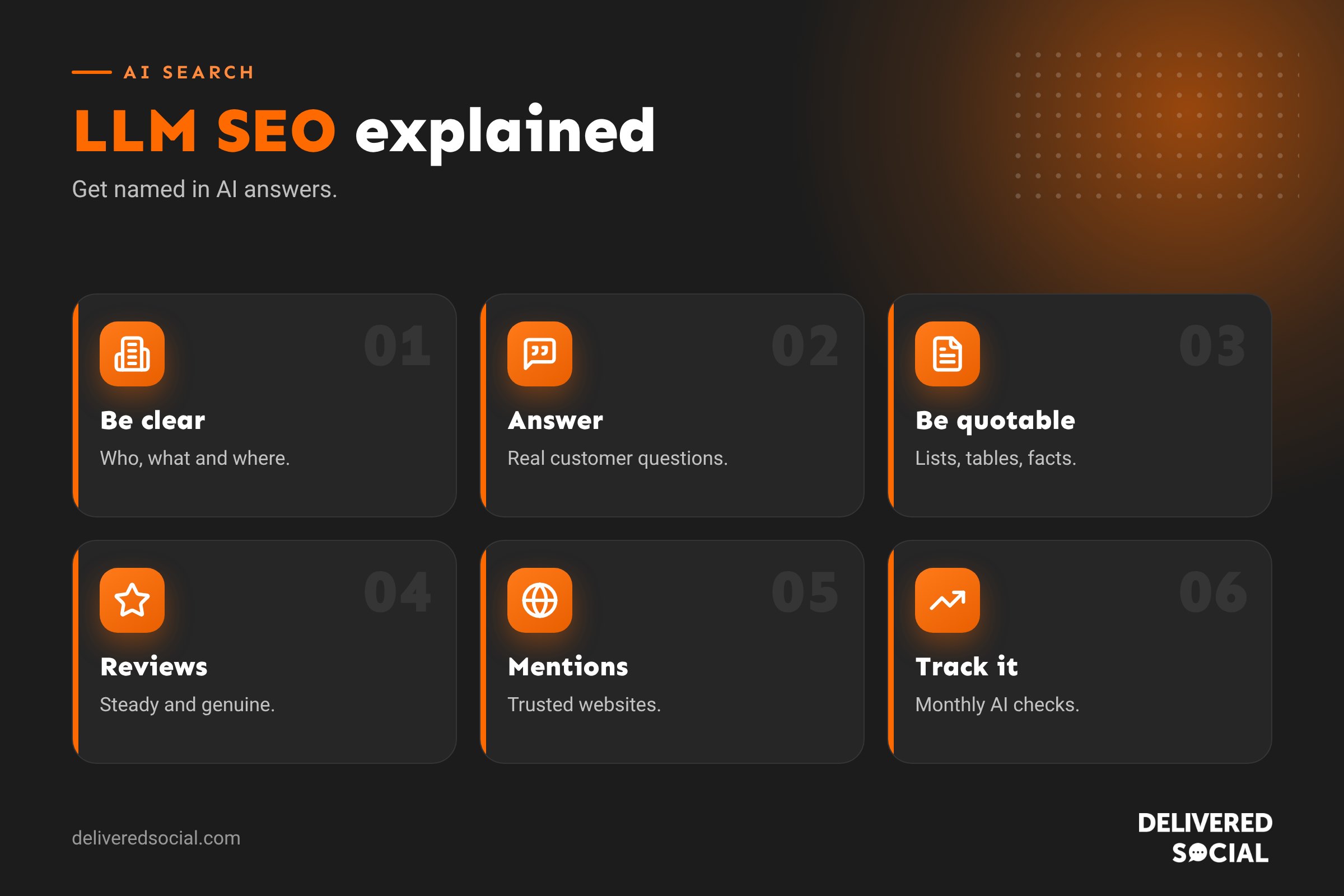
Step 1: Make your business easy to understand
LLMs think in entities: people, places, organisations and things, and the relationships between them. Your job is to make your entity crystal clear.
- Use the same business name, address, phone number and description everywhere: your website, Google Business Profile, social profiles, directories and Companies House listings.
- State plainly what you do, who for, and where, near the top of your home page and about page. “We are a family run plumbing and heating company covering Portsmouth, Fareham and Havant” is far more useful to an AI than a vague slogan.
- Create a proper about page with your history, team, accreditations and awards.
- Add Organization or LocalBusiness structured data with your logo, address, social profiles and opening hours.
Step 2: Answer the questions people actually ask
People talk to AI tools in full sentences. Instead of typing “boiler service Portsmouth” they ask “how often should I get my boiler serviced and how much does it cost in Portsmouth?” Pages that answer those questions directly are the ones AI tools quote.
- List the questions customers ask you on the phone, in emails and in person.
- Check what people search for using tools such as Google’s “People also ask” boxes and keyword research tools.
- Write a clear, direct answer in the first two or three sentences of a section, then add detail.
- Use headings that match the question, so both people and machines can find the answer fast.
- Include specifics: prices or price ranges, timescales, locations, steps and examples.
Step 3: Write content that is easy to quote
AI tools like content they can lift and summarise without confusion. That means:
- Short paragraphs with one idea each.
- Definitions in plain English (“A ground source heat pump is…”).
- Lists and tables for comparisons, costs and steps.
- Facts and figures with sources, dated where things change.
- Original insight from your own work: what you see with customers, common mistakes, real examples.
Thin, generic content rewritten from other websites gives an AI no reason to choose you. First hand experience does.
Step 4: Earn mentions beyond your own website
LLMs weigh what others say about you as well as what you say about yourself. Brands that are mentioned across trusted sites are more likely to be recommended.
- Collect Google reviews steadily, and respond to them.
- Get listed in reputable industry and local directories.
- Share expert comment with local press, trade publications and podcasts.
- Contribute guest articles to relevant websites.
- Join and get named on partner, supplier and association websites.
- Be active on platforms AI tools read heavily, such as LinkedIn, YouTube and community forums.
Step 5: Get the technical basics right
- Make sure your site is fast, secure and mobile friendly.
- Check your robots.txt does not block the crawlers you want, such as OAI-SearchBot for ChatGPT search, Googlebot and Bingbot. Many AI search tools rely on Bing’s index, so submit your sitemap to Bing Webmaster Tools as well as Google Search Console.
- Keep important content in plain HTML text, not hidden in images, PDFs or scripts.
- Use structured data for FAQs, products, services, reviews and articles where it is genuinely relevant.
- Keep pages updated, with clear dates, so AI tools can see the information is current.
Step 6: Track your AI visibility
You cannot improve what you do not measure. Start simply:
- Write a list of 20 to 30 questions your ideal customers might ask an AI tool.
- Ask them in ChatGPT, Gemini, Copilot and Perplexity every month and note whether you are mentioned, and who is.
- Check Google Analytics for referral traffic from chatgpt.com, perplexity.ai, copilot.microsoft.com and gemini.google.com.
- Consider a dedicated tracking tool once you are serious. We compare options in our guide to the best AI search tracking tools.
Common LLM SEO mistakes
- Chasing tricks. Hidden prompts, keyword stuffing and fake reviews can backfire and damage trust.
- Inconsistent details. Different names, addresses or descriptions confuse models about who you are.
- Ignoring Bing. Several AI tools lean on Bing results, yet many businesses never check how they appear there.
- Publishing generic AI content. If your article says the same as everyone else, there is no reason to cite yours.
- No reviews. AI recommendations for local services often reflect review volume and sentiment.
A simple LLM SEO plan for small businesses
| Month | Focus |
|---|---|
| Month 1 | Fix your business details everywhere, improve your about page, add structured data |
| Month 2 | Write or rewrite your top service pages to answer key questions clearly |
| Month 3 | Publish two or three helpful guides based on real customer questions |
| Ongoing | Reviews, local press, guest articles, monthly AI visibility checks |
What this looks like in practice
Imagine a garden design company in Surrey. Before LLM SEO, its website says “We create beautiful outdoor spaces” with a gallery and a contact form. Ask ChatGPT for a garden designer in Woking and it never appears.
Over a few months the company rewrites its home page to say exactly what it does and where, adds pages answering “how much does a garden design cost in Surrey?” and “how long does a garden makeover take?”, collects 40 new Google reviews, gets featured in a local magazine and lists its RHS award on its about page. Six months later, the same question in ChatGPT and Perplexity names it alongside two larger competitors, and it starts seeing visits from AI referrals in Google Analytics.
None of that involved tricks. It was clear information, useful content and genuine reputation, which is what LLM SEO really comes down to.
Key takeaways
- LLM SEO is about being named and cited in AI answers, not just ranking.
- It builds on traditional SEO; you need both.
- Make your business details consistent and your services crystal clear.
- Answer real customer questions in a direct, quotable way.
- Earn reviews and mentions across trusted websites.
- Track your AI visibility monthly.
Frequently asked questions
What does LLM SEO mean?
Optimising your website and online presence so AI tools built on large language models mention or cite your business.
Is LLM SEO the same as GEO?
Broadly, yes. Both describe getting visibility in AI generated answers.
Does traditional SEO still matter?
Yes. Many AI tools pull from search results, so strong SEO helps LLM visibility.
How long does LLM SEO take?
Live search tools can pick up improvements within weeks; training data changes are much slower.
Can I pay to appear in ChatGPT?
Not for organic answers. Visibility comes from clear content and genuine reputation.
Do reviews help with AI recommendations?
They often do, especially for local services, where AI tools reflect review volume and sentiment.
Which AI tools should I check?
ChatGPT, Google’s AI Overviews and AI Mode, Gemini, Copilot and Perplexity cover most UK users.
Should I block AI crawlers?
Only if you have a specific reason. Blocking search crawlers can stop AI tools citing you.
Is LLM SEO worth it for a small local business?
Yes. Local recommendations are a common AI question, and competition is still low.
How do I know if it is working?
Track mentions in regular AI checks and look for AI referral traffic in Google Analytics.
Want your business recommended by AI?
We help businesses and charities across Surrey, Hampshire and the UK get found in Google and in AI search, with SEO, content and digital PR. Call us on 01483 608 303.
































