



Keep reading
Rather we just did it for you?
Let's get your business seen.
Social media, websites, SEO and ads from a team you can actually meet.
When someone asks ChatGPT “which marketing agency should I use in Hampshire?” or “what is the best wedding venue near Guildford?”, it gives a short answer that names a few businesses. If yours is one of them, you win a warm enquiry. If it is not, you may never know the customer existed. This guide explains how to rank in ChatGPT: how ChatGPT chooses which businesses and pages to mention, and the practical steps that make your business more likely to appear.
Can you actually rank in ChatGPT?
Not in the way you rank on Google. There is no fixed list of positions and no way to pay for an organic mention. Answers vary from person to person and day to day. But you can massively improve the chances that ChatGPT knows about you, trusts you and includes you when it answers questions in your area. Think of it as becoming the obvious answer.
How ChatGPT finds businesses to recommend
ChatGPT builds answers from two sources:
- What it learned in training. The model was trained on a huge amount of text from the web. Well known brands that are mentioned often appear from memory.
- What it finds with search. For questions about local services, products, prices and recent events, ChatGPT searches the web, reads several pages and summarises them, usually with links to its sources.
For most small and medium businesses, the search route is where you can make a difference. ChatGPT search draws on results from search engines and its own crawler, OAI-SearchBot. If your pages are visible in search, clearly written and trusted, you are in with a chance.
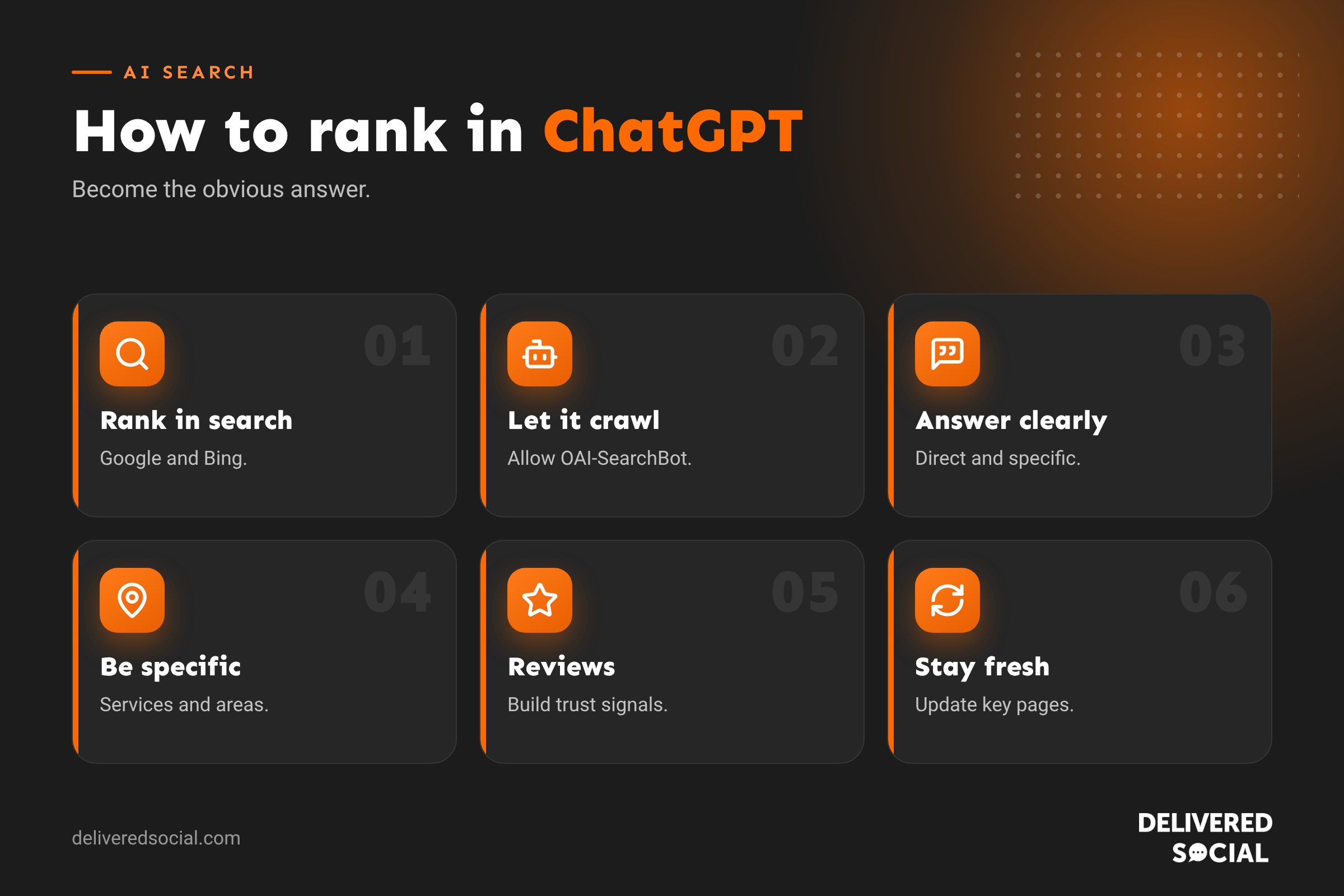
Step 1: Rank well in normal search first
ChatGPT often reads the pages that already rank for a question. Strong traditional SEO is therefore the foundation:
- Service pages for each main service and location you cover.
- Clear page titles and headings that match how people search.
- A fast, mobile friendly, secure website.
- Internal links between related pages.
- Your site submitted to both Google Search Console and Bing Webmaster Tools, as Bing data feeds several AI tools.
If you are new to this, start with our SEO for beginners guide.
Step 2: Let ChatGPT’s crawler in
Check your robots.txt file and any security or firewall settings. If OAI-SearchBot is blocked, ChatGPT search cannot read your pages, and it is less likely to cite them. Some hosting firewalls and security plugins block unfamiliar bots by default, so it is worth asking your web team to check.
Step 3: Answer real questions in plain English
People ask ChatGPT long, specific questions. The pages that get quoted are the ones that answer them directly. For each important topic:
- Use the question as a heading, for example “How much does a loft conversion cost in Surrey?”
- Give the direct answer in the first sentence or two.
- Back it up with detail: price ranges, what affects the cost, timescales, examples.
- Add a short FAQ section to service pages covering the questions customers ask you every week.
Step 4: Be specific about who you are and where you work
ChatGPT needs to be confident about what your business does. Vague copy such as “solutions for modern businesses” leaves it guessing. Instead:
- Say exactly what you do, who for and which towns or regions you cover.
- Use the same business name, address and phone number on every listing.
- Add LocalBusiness or Organization structured data to your site.
- Keep your Google Business Profile, LinkedIn page and directory listings complete and up to date.
Step 5: Build reviews and third party mentions
When ChatGPT recommends local businesses, it often reflects what other sites say: review platforms, directories, local news and “best of” lists. To strengthen that picture:
- Ask every happy customer for a Google review, and reply to reviews.
- Get listed on reputable industry directories and trade bodies.
- Pitch expert comment to local press and trade magazines.
- Win awards and list them on your website.
- Ask partners and suppliers to mention you on their websites.
Step 6: Create content worth citing
ChatGPT is more likely to cite pages that add something new. Content that works well includes:
- Original data, surveys or pricing guides.
- Step by step guides based on your own experience.
- Clear comparisons and tables.
- Case studies with real results.
- Local guides that only a local business could write.
Generic content written to fill space rarely earns a citation.
What helps and what does not
| Helps | Does not help |
|---|---|
| Clear service and location pages | Keyword stuffing |
| Direct answers to real questions | Hidden text or “prompt injection” tricks |
| Consistent business details | Fake or bought reviews |
| Genuine reviews and press mentions | Mass produced, generic AI articles |
| Fast, crawlable website | Blocking AI search crawlers |
| Structured data and FAQs | Paying for “guaranteed” ChatGPT rankings |
How to check if you appear in ChatGPT
- Write down 20 questions your customers might ask, mixing general and local ones.
- Ask each question in ChatGPT with search turned on, in a fresh chat.
- Record whether your business is mentioned, linked, or missing, and which competitors appear.
- Repeat monthly to spot trends, as individual answers vary.
- Look in Google Analytics for visits from chatgpt.com to see real traffic.
Our round up of ChatGPT rank tracking tools covers software that automates this.
Why your business might not appear
- Your website does not clearly say what you do or where.
- Your pages do not rank in search for the questions people ask.
- Competitors have far more reviews and mentions.
- ChatGPT’s crawler is blocked.
- Your business details are inconsistent across the web.
- The question is too broad, and ChatGPT names big national brands instead of local firms.
A worked example
A dog grooming salon in Fareham asks ChatGPT “best dog groomer in Fareham” and finds three rivals named, but not itself. A quick check shows its website title just says “Home”, it has 12 reviews compared with competitors’ 150, and its Bing listing has the wrong phone number.
Over the next few months it rewrites its home page title and copy to say “Dog grooming in Fareham”, adds a prices page and FAQs about breeds and appointment times, fixes its listings, and asks every customer for a review. Within a few months it starts to appear in ChatGPT’s answer for the same question, and gets its first bookings from people who say “ChatGPT recommended you”.
Questions worth targeting
Not every question is worth chasing. Focus on the ones that lead to enquiries. Good examples include:
- “Best” questions: “best accountant for small businesses in Woking”.
- Cost questions: “how much does a new boiler cost in Hampshire?”
- Comparison questions: “is it better to rent or buy office space in Guildford?”
- Problem questions: “why is my website not showing on Google?”
- Specialist questions: “who builds websites for charities in Portsmouth?”
Each of these deserves a clear page or section on your website that answers it better than anyone else.
Keep information fresh
ChatGPT search favours information that looks current. Out of date prices, old opening hours and articles from years ago can count against you, or worse, lead ChatGPT to give customers the wrong details about your business. Review your key pages every few months, update prices and facts, show a “last updated” date on guides, and remove or redirect pages for services you no longer offer. Keep your Google Business Profile hours and photos current too, as AI tools often repeat that information.
Key takeaways
- You cannot buy a ChatGPT ranking, but you can make your business the obvious answer.
- Strong traditional SEO is the foundation, including Bing.
- Make sure ChatGPT’s crawler can read your site.
- Answer real questions directly and specifically.
- Reviews and third party mentions carry a lot of weight.
- Check your visibility monthly and track AI referral traffic.
Frequently asked questions
How do I get my business mentioned in ChatGPT?
Rank well in search, be clear about what you do and where, and build reviews and mentions.
Can I pay ChatGPT to recommend my business?
No. Organic answers cannot be bought.
Does ChatGPT use Google results?
ChatGPT search uses its own crawler and search partners; strong visibility in Bing and Google both help.
How long does it take to appear in ChatGPT?
Changes can show in search based answers within weeks, though it often takes a few months.
Why does ChatGPT give different answers each time?
Answers are generated fresh, so wording and recommendations vary. Look at trends over time.
Do reviews affect ChatGPT recommendations?
Often, yes, particularly for local services.
Should I write content for ChatGPT or for people?
For people. Clear, helpful content for humans is also what AI tools prefer to cite.
Is ranking in ChatGPT the same as ranking in Google’s AI Overviews?
The principles are similar, but each tool uses its own sources. Our guide to AI Overviews covers Google.
Can a small business compete with big brands in ChatGPT?
Yes, especially for local and specialist questions where big brands are less relevant.
How do I see traffic from ChatGPT?
In Google Analytics, look at referral traffic from chatgpt.com.
Want to be the business ChatGPT recommends?
We help businesses across Surrey, Hampshire and the UK get found in Google and in AI search tools. Call us on 01483 608 303.
































