



Keep reading
Rather we just did it for you?
Let's get your business seen.
Social media, websites, SEO and ads from a team you can actually meet.
Generative engine optimisation (GEO) is the practice of getting your business mentioned, cited and recommended in AI generated answers from tools such as ChatGPT, Google’s AI Overviews and AI Mode, Gemini, Copilot and Perplexity. If you already know what GEO is, the next question is what to actually do. This guide sets out practical generative engine optimisation strategies that small and medium businesses can put in place, with examples, a checklist and a simple way to measure progress.
A quick recap: what GEO is
Traditional SEO aims to rank pages in search results. GEO aims to make your content the source AI tools draw on when they write an answer. The two overlap heavily: strong SEO makes GEO easier. For the background, read our guide to what generative engine optimisation is.
Strategy 1: Make your brand an unmistakable entity
AI tools need to know exactly who you are before they recommend you.
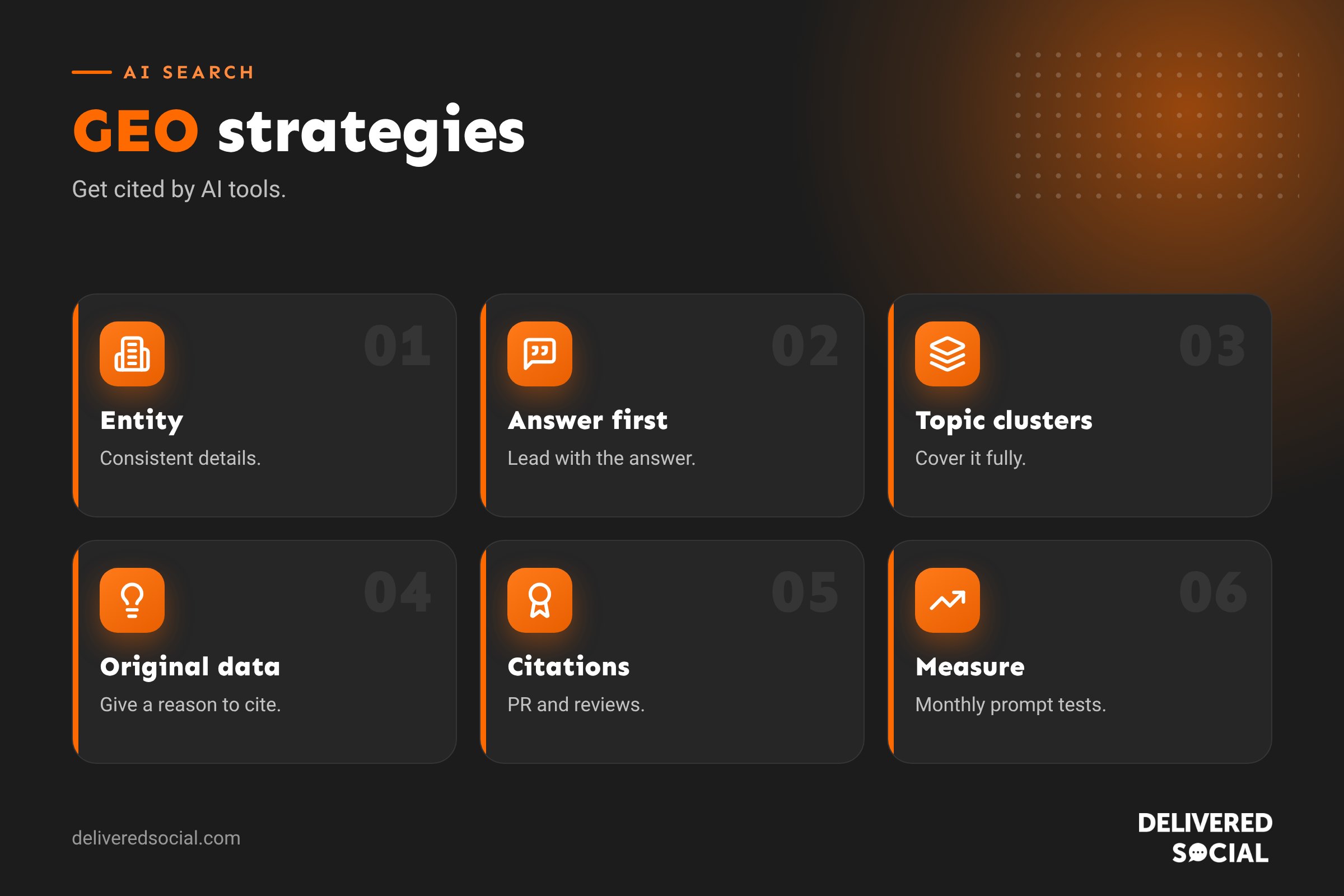
- Use one consistent business name, description, address and phone number across the web.
- Write a clear “what we do, who for, where” statement on your home and about pages.
- Add Organization or LocalBusiness structured data, including sameAs links to your social profiles.
- Keep your Google Business Profile, LinkedIn, Companies House and directory listings complete and accurate.
Strategy 2: Write answer first content
Generative engines pull short, direct passages. Structure pages so the answer comes first:
- Use the question as the heading.
- Answer it in one or two sentences straight underneath.
- Then expand with detail, examples and caveats.
- Use lists and tables for steps, comparisons and prices.
A page about “how much does a commercial cleaning contract cost?” should say the typical range in the first line, not after three paragraphs about your company history.
Strategy 3: Cover topics completely
AI tools often break a question into sub questions and look for sources that cover them all. Build topic clusters: a main guide plus supporting articles that answer related questions, all linked together. For a wedding venue, that might be a main page on the venue, plus guides to prices, capacity, catering, accommodation, accessibility and winter weddings.
Strategy 4: Publish original information
If your page repeats what everyone else says, an AI has no reason to cite you. Give it something unique:
- Your own pricing data or cost surveys.
- Results and statistics from your customer work.
- Expert opinions with a named author and credentials.
- Local knowledge only you have.
- Case studies with real numbers.
Strategy 5: Earn citations on trusted sites
Generative engines lean on sources they trust. Being mentioned on those sources makes you more visible:
- Digital PR in local and trade press.
- Expert quotes in industry articles.
- Listings in reputable directories and “best of” round ups.
- Guest articles on relevant websites.
- Active, helpful participation in forums and communities.
- Steady flows of genuine reviews.
Strategy 6: Strengthen trust signals
- Show named authors with bios and experience.
- Display accreditations, awards and memberships.
- Cite your sources and date your content.
- Keep contact details, policies and company information easy to find.
These are the same experience, expertise, authority and trust signals Google values, and AI tools reward them too.
Strategy 7: Keep the technical foundations solid
- Allow search and AI crawlers such as Googlebot, Bingbot and OAI-SearchBot.
- Submit sitemaps to Google Search Console and Bing Webmaster Tools.
- Make sure key content is in HTML text, not locked in images or PDFs.
- Keep pages fast and mobile friendly.
- Use relevant structured data for FAQs, products, services, reviews and articles.
Strategy 8: Use more than one format
AI tools increasingly read video transcripts, podcasts and social posts. Repurpose your best guides as YouTube videos with good titles and descriptions, LinkedIn posts and short social clips. Each format is another chance to be found and cited.
Strategy 9: Measure and iterate
- Build a list of 20 to 50 prompts your customers might use.
- Test them monthly across ChatGPT, Gemini, Copilot, Perplexity and Google’s AI features.
- Record mentions, citations and which competitors appear.
- Track AI referral traffic in Google Analytics.
- Improve the pages and topics where competitors are winning.
Our guide to AI search tracking tools covers software that can automate this.
GEO strategy checklist
| Area | Action |
|---|---|
| Entity | Consistent details, clear description, structured data |
| Content | Answer first, complete topic clusters, original insight |
| Authority | PR, reviews, directories, guest content |
| Trust | Named authors, accreditations, sources, dates |
| Technical | Crawlable, fast, sitemaps in Google and Bing |
| Formats | Video, podcasts, social posts |
| Measurement | Monthly prompt tests and AI referral traffic |
GEO for different types of business
- Local services: focus on Google Business Profile, reviews, location pages and local press.
- Ecommerce: detailed product pages, comparison guides, reviews and product structured data.
- B2B: thought leadership, case studies, original research and LinkedIn.
- Charities: clear explanations of your cause, impact data and press coverage.
What to avoid
- Hidden instructions aimed at AI tools.
- Mass produced, thin articles.
- Fake reviews or self published “best of” lists that rank yourself first.
- Expecting instant, guaranteed results.
Where to start this month
If all of this feels like a lot, start with three jobs. First, check your business details are identical on your website, Google Business Profile, Bing Places and the top directories in your industry. Second, pick your three most important services and rewrite those pages so each one answers the questions customers ask, in plain English, with prices or price ranges where you can. Third, run ten prompts in ChatGPT and Perplexity and note who gets recommended. That baseline tells you where you stand and gives you something to measure against next month.
Examples of GEO in action
A local accountant. A two partner practice in Basingstoke rewrote its service pages to answer “how much does an accountant cost for a sole trader?” and “do I need an accountant for self assessment?”, each with a clear price range in the opening line. It added its ICAEW membership and partner bios, tidied its directory listings and asked every client for a Google review in January. Within a few months, Perplexity began citing its pricing page for local cost questions.
An online shop. A UK retailer selling walking boots added a detailed buying guide comparing boot types, a sizing guide based on its own returns data and FAQ sections on each product page. AI shopping answers started quoting its sizing advice, and the brand gained mentions in roundups on outdoor blogs.
A charity. A hospice added a clear “how we are funded” page, impact statistics with dates and sources, and a press page linking to local news coverage. When people asked AI tools which local charities support end of life care, the hospice appeared with an accurate summary of its work.
How GEO fits with your wider marketing
GEO is not a separate project that sits on its own. The PR you do for brand awareness earns citations. The reviews you collect for Google also shape AI recommendations. The helpful guides your sales team share with prospects become the pages AI tools quote. The best approach is to add a GEO lens to work you already do: before publishing anything, ask “would an AI tool want to quote this, and would it be clear who wrote it?”
Prioritising your GEO work
| Priority | Why |
|---|---|
| Fix business details and structured data | Quick, cheap and the foundation for everything else |
| Rewrite top service and product pages | These answer the questions closest to a sale |
| Build reviews | Strong influence on local recommendations |
| Publish original guides and data | Gives AI tools a reason to cite you |
| Digital PR | Builds the third party mentions AI tools trust |
Key takeaways
- GEO is about being cited in AI answers, built on strong SEO.
- Make your brand an unmistakable entity.
- Lead with direct answers and cover topics completely.
- Publish original information worth citing.
- Earn mentions on trusted sites and keep measuring.
Frequently asked questions
What are the best GEO strategies?
Clear entity information, answer first content, original data, trusted citations and solid technical SEO.
Is GEO different from SEO?
It has a different goal, being cited in AI answers, but relies on the same foundations.
How long does GEO take to work?
Often a few months, though search based AI tools can reflect changes sooner.
Do I need special tools for GEO?
Not to start. Manual prompt testing and Google Analytics are enough at first.
Does structured data help GEO?
Yes, it helps machines understand your business and content.
Is GEO worth it for local businesses?
Yes. AI tools are increasingly used for local recommendations.
Can GEO hurt my SEO?
No. Done properly, it supports your SEO.
What content gets cited most?
Clear, factual, well structured content with original information.
Should I write for AI or for people?
For people. Helpful human content is what AI tools prefer.
How do I measure GEO?
Monthly prompt tests and AI referral traffic in analytics.
Can I do GEO myself?
Yes. The basics are clear writing, consistent details, reviews and regular checking.
Does social media help GEO?
Yes. Active profiles and helpful posts add to the picture AI tools build of your brand.
Want a GEO strategy for your business?
We help businesses across Surrey, Hampshire and the UK grow visibility in Google and AI search. Call us on 01483 608 303.
































