



Keep reading
Rather we just did it for you?
Let's get your business seen.
Social media, websites, SEO and ads from a team you can actually meet.
An agency that runs paid social and search for its clients will eventually get the request. A retail client wants Connected TV. A B2B client wants an account-based display across a named list of companies. A hospitality client wants audio placements on streaming radio. Each request points to an enterprise demand-side platform, and each raises the same question for the agency owner: build the capability or partner for it.
The true cost of building
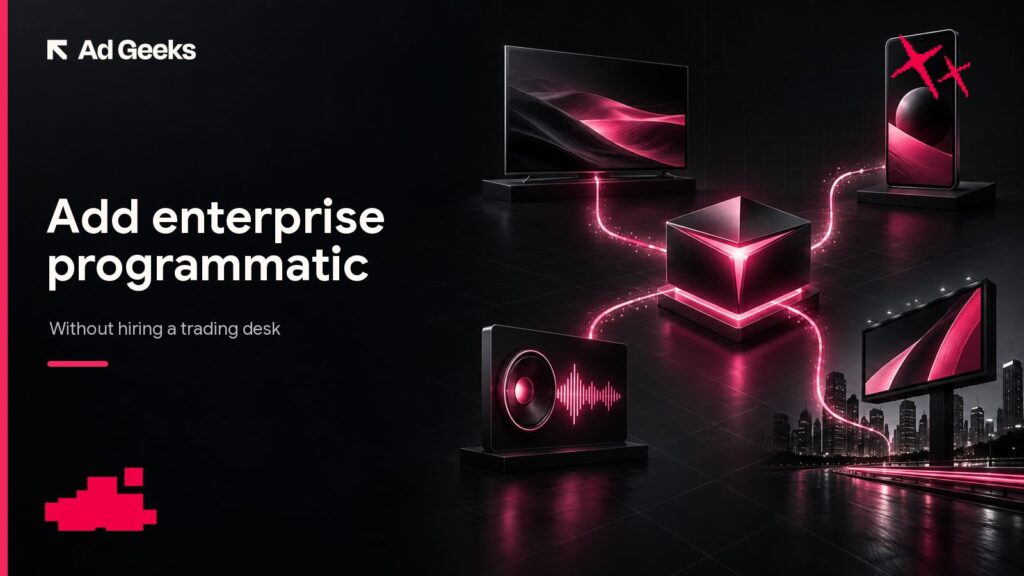
Setting up an in-house programmatic function looks like a hiring problem at first. Traders with DSP certifications sit at the top of the recruiting list, followed by an analyst who reads log-level data. Those hires take months to land in most markets.
The platform contracts add a second layer. Direct DV360 or Amazon DSP seats typically require enterprise-level minimum spend, in some cases $50,000 to $200,000 or more per month, according to the FAQ published by Ad Geeks. An agency with five mid-sized clients rarely has that volume on one platform. The third layer is time. Workflows, brand-safety templates, deal libraries with publishers, and reporting pipelines take months to mature, and client demand does not wait for the infrastructure.
What partnering looks like in 2026
Ad Geeks, a Google Marketing Platform Partner in the Display & Video 360 category, announced in September 2026 an expanded partner model built for exactly this situation. The agency describes the arrangement as an extension of the client team: an independent agency uses the programmatic partner model for agencies to support its own client campaigns, while keeping the client relationship and the strategy lead. Platform recommendations follow the campaign brief, the audience, the inventory requirement, the geography, and the measurement need.
“The strategic question is not which DSP has the most features; it is which combination of data, inventory, controls and measurement best serves the campaign. We are expanding our partner model so agencies and brands can make that choice with specialist support and execute it with consistent governance.”
– Giorgi Amashukeli, Chief Executive Officer, Ad Geeks Agency
Platform by platform
The four platforms in the model each answer a different client request.
Display & Video 360 covers display, video, native, audio, mobile, in-app, and Connected TV, together with YouTube inventory and private-marketplace or Programmatic Guaranteed deals. Ad Geeks lists cross-device targeting, brand-safety controls, creative testing, frequency planning, and real-time reporting among its DV360 services.
The Trade Desk operates as an independent omnichannel DSP. Its channel set spans Connected TV, video, display, audio, and digital out-of-home, with audience and measurement tools built for cross-channel planning.
Amazon DSP extends campaigns across Amazon-owned properties and third-party inventory while applying Amazon shopper signals. The Ad Geeks service portfolio includes support for Amazon Attribution and Amazon Marketing Cloud, which matters for retail clients that sell on Amazon.
Adform is a European full-stack option that the agency describes as cookieless-ready and privacy-first, relevant for clients operating under GDPR or in other privacy-sensitive markets.
Governance is the part clients notice
Client-facing agencies live or die on reporting. When a campaign spans two DSPs, the client wants one view of delivery and outcomes. Each DSP can apply its own platform-level frequency controls, while unified reporting helps monitor aggregate exposure; cross-platform deduplication and household-level frequency management may remain limited. Ad Geeks positions multi-DSP management and unified reporting as a core part of the model, so the burden of coordinating separate buying platforms sits with the partner rather than with the agency’s account team.
Proof points to check
Any partner should show its work. Ad Geeks publishes programmatic case studies covering DV360 campaigns for AWS, J.P. Morgan, Verizon, Dell, bp pulse, and Gulf, plus an iGaming acquisition campaign run through Adform. The agency’s Google Marketing Platform Partner listing appears in Google’s public partner directory.
A short checklist for agency owners
Before signing a programmatic partnership, an agency owner should have answers to the following points.
- Which platform seats the partner holds directly, and which partner statuses back them.
- Whether the arrangement is fully managed or self-service with support. Ad Geeks offers both models, per its website.
- How reporting is delivered and whether raw platform data is available on request.
- How fees relate to media spend and whether minimums apply.
- Who speaks to the client, and under whose brand the work is presented.
The build option remains right for agencies with the volume to justify direct seats. For everyone else, the partner route turns a months-long infrastructure project into a first campaign that goes live in weeks.
































