


Keep reading
Rather we just did it for you?
Let's get your business seen.
Social media, websites, SEO and ads from a team you can actually meet.
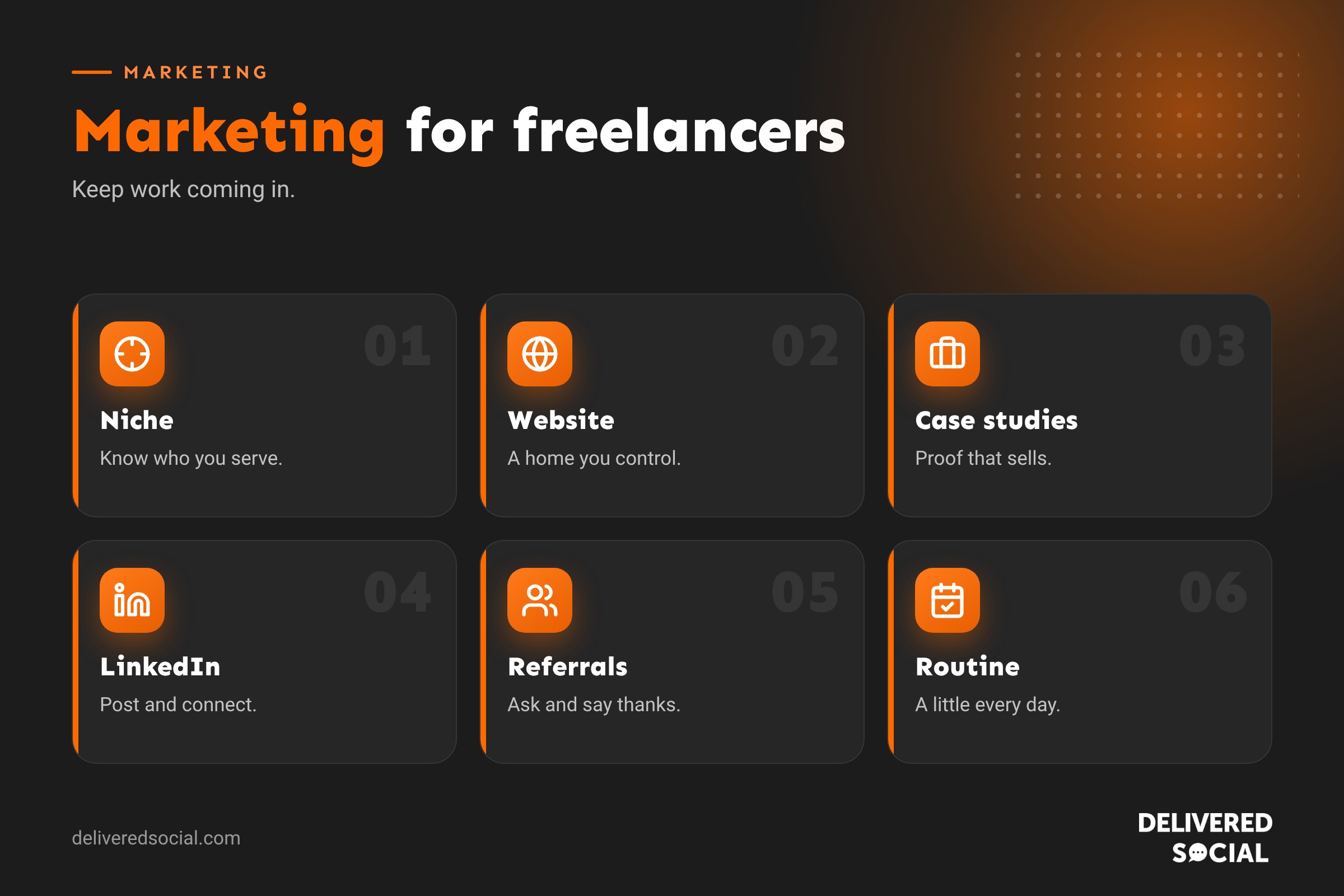
Being a freelancer means you’re not only the person doing the work, you’re also the sales team, marketing department and brand manager. Many talented freelancers struggle not because their work isn’t good, but because the right clients don’t know they exist. The good news is that freelance marketing doesn’t need a big budget, just a clear message and consistent habits. This guide covers marketing for freelancers: how to define your niche, build a simple online presence, use LinkedIn and social media, get referrals, price with confidence and create a weekly marketing routine you’ll actually stick to.
Why freelancers need marketing
- Feast and famine: without steady marketing, work dries up after big projects end.
- Better clients: marketing helps you attract clients who value your work rather than chase the cheapest price.
- Higher rates: a clear position and strong proof let you charge more.
- Choice: a pipeline of enquiries means you can say no to the wrong projects.
Step 1: Choose a niche (or at least a focus)
“I’m a graphic designer” competes with thousands of people. “I design packaging for independent food brands” stands out. A niche makes your marketing easier because you know exactly who you’re talking to, where they spend time and what they care about.
You can niche by:
- Industry: hospitality, charities, construction, healthcare.
- Service: email copywriting, Shopify development, brand photography.
- Problem: “websites that bring in enquiries”, “social media for busy owners”.
- Location: a town or region, especially for in-person services.
You don’t have to turn away other work. A focus simply makes your marketing sharper.
Step 2: Write a clear positioning statement
Try this simple formula: I help [who] to [achieve what] through [how]. For example: “I help independent cafés fill more tables through social media content they don’t have time to create.” Use it on your website, LinkedIn headline, email signature and when people ask what you do.
Step 3: Build a simple online home
You don’t need a huge website, but you do need somewhere you control that explains what you do and makes it easy to get in touch.
- Home page: your positioning, key services and a clear call to action.
- Services: what you offer, who it’s for and how it works.
- Portfolio or case studies: proof of results.
- About: your story and a friendly photo.
- Contact: a simple form, email and booking link.
Our guide to web design for beginners covers the basics if you’re building it yourself.
Step 4: Show proof with case studies
Clients want evidence you can deliver. Short case studies are one of the most persuasive marketing tools a freelancer has. Use a simple structure:
- The client and their challenge.
- What you did.
- The result, ideally with numbers.
- A quote from the client.
Ask happy clients for testimonials and Google reviews as soon as a project finishes, while they’re delighted.
Step 5: Use LinkedIn properly
For freelancers serving businesses, LinkedIn is often the most valuable platform.
- Headline: your positioning, not just your job title.
- About section: who you help, how, and proof.
- Featured section: case studies, your website and a booking link.
- Post regularly: share tips, behind-the-scenes work, lessons learned and client wins.
- Comment thoughtfully on posts by potential clients and partners.
- Connect with intent: send personal notes, not sales pitches.
Step 6: Pick one or two other social platforms
Go where your clients are. Instagram suits visual work like design, photography and interiors. TikTok and YouTube suit people comfortable on camera and teaching. Facebook groups can work well for local services. Choose one or two and show up consistently rather than spreading yourself thin. Our guide to creating a social media strategy helps.
Step 7: Make referrals a system
Referrals are the biggest source of work for most freelancers. Don’t leave them to chance.
- Do great work and be easy to work with.
- Ask happy clients directly: “Do you know anyone else who’d benefit from this?”
- Stay in touch with past clients with occasional check-ins.
- Build relationships with complementary freelancers and agencies who can pass work your way.
- Thank people who refer you, with a note, a gift or a referral fee.
Step 8: Network (online and in person)
Local business events, industry meetups, coworking spaces and online communities all lead to work. Go to help and learn, not to pitch. Follow up within a day with a friendly message, and stay in touch.
Step 9: Content that builds trust
Sharing what you know positions you as an expert. Ideas include:
- Short tips and how-tos.
- Before-and-after examples.
- Answers to common client questions.
- Your process explained step by step.
- Lessons from projects.
- A simple monthly email newsletter. See what is a newsletter?
Step 10: Get found on Google
- Set up a free Google Business Profile if you serve a local area.
- Collect Google reviews.
- Use the terms clients search for on your website, such as “freelance copywriter Guildford”.
- Write a few helpful articles answering client questions.
- List yourself in relevant directories and professional bodies.
Freelance platforms: use with care
Marketplaces can help you get started and fill gaps, but competition on price is fierce and the platform owns the relationship. Use them as one channel, while building your own reputation, website and direct client base.
Pricing as part of your marketing
How you price sends a message. Very low rates can make clients doubt quality. Consider packaging services into clear offers with fixed prices, such as “Brand starter pack” or “Monthly social media support”, which are easier to buy than vague hourly rates. Explain the value and results, not just the time.
A simple weekly marketing routine
| Day | Marketing task (30 to 45 minutes) |
|---|---|
| Monday | Post a tip or insight on LinkedIn |
| Tuesday | Comment on 10 posts from potential clients and partners |
| Wednesday | Follow up with past clients or warm leads |
| Thursday | Share a project, case study or behind-the-scenes post |
| Friday | Update your portfolio, ask for a review or plan next week |
Consistency beats intensity. Small, regular effort keeps your pipeline full even when you’re busy.
Tracking what works
Keep a simple spreadsheet of every enquiry: where it came from, what it was for and whether it turned into work. After a few months, you’ll know which channels deserve more of your time.
Common freelance marketing mistakes
- Only marketing when work runs out.
- Trying to appeal to everyone.
- No portfolio or proof.
- Posting sales pitches instead of helpful content.
- Not asking for referrals or reviews.
- Competing only on price.
Example: a freelance copywriter’s first 90 days
A newly freelance copywriter decides to focus on property businesses. In month one she rewrites her LinkedIn profile, builds a simple five-page website and writes three short case studies from her previous employment. In month two she posts on LinkedIn three times a week, comments on posts from estate agents and lettings firms, and attends two local business networking events. In month three she emails past colleagues to let them know she’s freelancing and asks happy clients for reviews. By the end of the quarter, most of her enquiries come from LinkedIn and referrals, and she can see which activities to double down on.
Retainers: smoothing out income
One of the best marketing moves a freelancer can make is turning one-off projects into ongoing retainers, such as monthly content, maintenance or support. Retainers reduce the pressure to keep finding new clients, give clients consistent help and make your income more predictable. Offer them at the end of successful projects, when clients can see the value you bring.
Quick glossary
- Niche: a specific audience or specialism you focus on.
- Positioning: how you describe what makes you different.
- Pipeline: potential work at different stages.
- Productised service: a clearly defined package with a fixed price.
- Social proof: reviews, testimonials and results that build trust.
Key takeaways
- A clear niche and positioning make every marketing activity easier.
- A simple website and strong case studies build trust.
- LinkedIn, referrals and networking bring most freelance work.
- Share helpful content to show expertise.
- Market a little every week, even when you’re busy.
Frequently asked questions
How do freelancers find clients?
Through referrals, LinkedIn, networking, a good website, social media and sometimes freelance platforms.
Do freelancers need a website?
It’s strongly recommended, as it gives you a professional home you control.
Is LinkedIn worth it for freelancers?
Yes, especially if you work with businesses.
Should I niche down as a freelancer?
Usually yes. A focus makes marketing easier and helps you charge more.
How much time should I spend on marketing?
Around 30 to 60 minutes a day, or a few hours a week, consistently.
How do I get more referrals?
Do great work, ask happy clients directly and stay in touch.
Should I use freelance platforms?
They can help, but build your own direct client base too.
How do I stop the feast and famine cycle?
Keep marketing even when busy, and consider retainer packages for steady income.
Want help marketing your business?
We help freelancers and small businesses across Surrey, Hampshire and the UK with websites, social media and SEO. Call us on 01483 608 303.