



Keep reading
Rather we just did it for you?
Let's get your business seen.
Social media, websites, SEO and ads from a team you can actually meet.
A decade ago, a digital marketing agency’s address could be part of its sales pitch. A large office in the right location suggested stability, scale and credibility. Today, clients are more likely to judge an agency by the quality of its campaigns, the strength of its strategy and the results it can demonstrate.
That shift has changed the role of the office.
Client meetings now happen over video, account managers can manage campaigns from almost anywhere, and creative teams regularly collaborate across different towns, cities and even countries. At the same time, agencies still benefit from having professional places to meet clients, run workshops and bring teams together.
This is where flexible workspaces have become increasingly relevant.
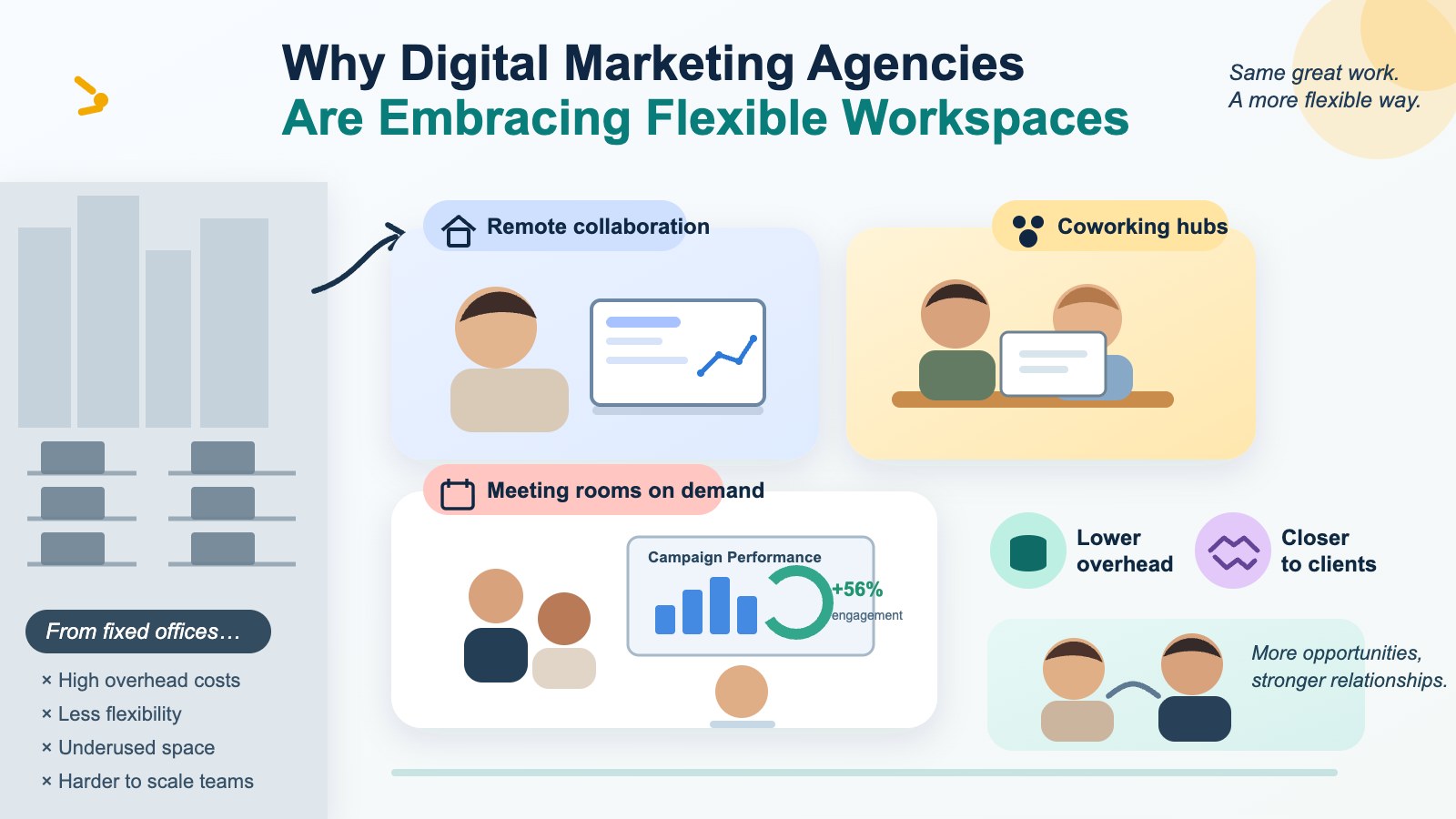
Marketing agencies often run lean, project-based teams that expand for launches, seasonal campaigns or major client wins and reduce again when workloads change. A permanent office sized around peak headcount can therefore sit partly empty for long periods. Flexible workspace arrangements give agencies another option by allowing them to use desks, private offices and meeting rooms according to their actual requirements.
so, what Is a flexible workspace? This guide provides an overview of the different workspace models available and how they differ from conventional long-term office commitments.
Flexible Workspaces Match the Way Modern Agencies Operate
Digital marketing agencies rarely operate with completely predictable workloads.
A new client might require additional account management support, paid media specialists, designers, copywriters and developers for several months. Once a major website launch or campaign is complete, that temporary capacity may no longer be necessary.
Traditional office leases do not always suit this way of working. Taking a larger office to prepare for future growth can mean paying for unused space, while taking a smaller office can create problems when teams need to expand.
Flexible workspaces can give agencies greater room to adapt.
An agency might maintain a small permanent office for its core team while booking extra desks during busy campaign periods. Meeting rooms can be reserved for client strategy sessions, while larger collaborative areas can be used for campaign planning days or creative workshops.
Instead of treating property as a fixed overhead, agencies can begin treating workspace as another operational resource that changes according to demand.
A Professional Setting Still Matters to Clients
Remote working has made location less important, but it has not made face-to-face interaction irrelevant.
For marketing agencies in particular, important conversations often benefit from being held in person. Brand workshops, campaign planning sessions, website discovery meetings and quarterly performance reviews can involve multiple stakeholders and complex decisions.
A professional meeting environment can make those sessions more productive while also contributing to how an agency presents itself.
Agencies working across Surrey and Hampshire, for example, may serve businesses in several different towns without needing one large central headquarters. A team working with clients in Guildford one week and Basingstoke the next may benefit more from access to suitable meeting spaces than from requiring every member of staff to commute to the same office every day.
Local presence can also support an agency’s wider marketing proposition. A business searching for a marketing agency in Guildford may value the reassurance that the agency understands the local market and can meet nearby when necessary.
The same principle applies to companies comparing a digital marketing agency in Surrey. Clients may want regional expertise and accessibility without necessarily expecting an agency’s entire workforce to occupy a traditional office five days a week.
Flexible workspaces can help agencies deliver that combination.
Workspace Can Support an Agency’s Local Marketing Strategy
For agencies serving defined geographical markets, physical presence and digital visibility can complement one another.
Local landing pages, Google Business Profile optimisation, location-focused content and regional case studies can help an agency demonstrate relevance to businesses within a particular area. However, marketing a business as locally accessible is more convincing when the agency can genuinely meet clients in that region.
Flexible workspace networks can support this approach. Rather than opening and maintaining several permanent offices, an agency may be able to use professional meeting spaces in locations where it already has clusters of clients or where it wants to develop new business.
That can be particularly useful when testing a new market.
Before committing to a permanent office in another town or city, an agency could run client meetings, networking events or sales appointments from flexible premises and assess whether there is enough demand to justify a longer-term investment.
In this sense, workspace decisions can become part of market expansion strategy rather than simply a facilities question.
Better Spaces for Pitches and Strategy Sessions
Winning marketing work often involves more than sending a proposal. For larger accounts, agencies may need to deliver pitches, present creative concepts, review campaign data or run discovery workshops with several decision-makers.
The environment matters.
Trying to conduct an important pitch from a noisy café or through an unreliable home video connection can undermine an otherwise professional presentation. A well-equipped meeting room offers a controlled environment with appropriate seating, screens and fewer distractions.
Flexible workspace providers can give smaller agencies access to these facilities without requiring them to maintain expensive boardrooms that may only be used a few times each month.
This can help independent and growing agencies present themselves professionally while keeping their property costs proportionate to their size.
Flexible Space Can Support Creative Collaboration
Marketing teams may work effectively remotely for much of the week, but certain activities still benefit from people being in the same room.
Campaign concepts, brand positioning, content planning and creative problem-solving can involve rapid discussion and visual collaboration. Teams may also find occasional in-person sessions useful for maintaining relationships between strategists, creatives, developers and account managers.
That does not necessarily require a permanent office. Agencies can instead organise regular collaboration days and use suitable workspace when there is a clear purpose for bringing everyone together.
Research from the CIPD on flexible and hybrid working has highlighted the importance of deliberately creating opportunities for collaboration, connection and organisational belonging when employees are working flexibly.
For agencies, this might mean arranging monthly creative sessions, campaign retrospectives, team training or in-person onboarding rather than expecting employees to attend an office simply because desks are available.
The distinction is important. The office becomes a place for specific high-value activities rather than the default location for every task.
Flexible Working Can Help Agencies Recruit More Widely
Marketing agencies compete heavily for specialist talent.
SEO professionals, paid media specialists, developers, designers, videographers and experienced account managers are not always located within convenient commuting distance of an agency’s headquarters.
A flexible or hybrid model can increase the potential recruitment pool.
Instead of restricting hiring to candidates who can commute to one office every day, agencies can recruit from a wider geographical area while still giving employees opportunities to meet in person.
This can be particularly valuable for agencies that need specialist expertise but may not have enough work to justify building every capability into a large permanent team.
Freelancers, contractors and specialist partners can also be brought into collaborative sessions when a campaign requires them.
The Economics Can Support Agency Margins
Marketing is a competitive sector, and agencies have to monitor operating margins carefully.
Office rent is only one part of the cost of maintaining traditional premises. Businesses may also face expenditure relating to fit-out, furniture, utilities, maintenance, meeting-room technology and other property-related commitments.
Flexible workspace arrangements commonly bundle several of these facilities into a simpler fee. That does not automatically make flexible space cheaper in every situation. A large agency with stable headcount and very high office usage may find a conventional lease more economical over the long term.
For smaller or rapidly changing agencies, however, flexibility can reduce the risk of committing too much capital to space that may not be fully used.
Money that would otherwise be tied up in premises can potentially be directed towards activities that contribute more directly to growth, such as hiring specialists, investing in marketing technology, developing new services or running business development campaigns.
Hybrid Working Is No Longer an Exception
The broader shift towards hybrid working also suggests agencies are adapting to a structural change rather than a temporary trend.
ONS data on hybrid working in Great Britain found that 28% of working adults hybrid worked between January and March 2025, with hybrid working becoming increasingly established since 2022.
For marketing agencies, this is particularly relevant because much of the work is already digital.
Campaign management platforms, analytics dashboards, project management software, cloud-based creative tools and video conferencing mean employees do not need to be physically together to perform every task.
The challenge is therefore less about deciding between remote work and office work and more about deciding which environment is most effective for each activity.
The Office Is Becoming a Marketing Tool Rather Than a Headquarters
The most interesting change may be how agencies think about physical space itself. An office no longer needs to be a building where every employee reports each morning. It can instead support specific moments that matter to the business.
That might include hosting a prospective client for a pitch, filming marketing content in a professional environment, running a brand workshop, bringing a distributed team together for campaign planning or meeting an important regional client closer to their location.
Used in this way, workspace becomes connected to client experience, business development, employer branding and campaign delivery.
The agencies adapting successfully are not necessarily abandoning offices. They are becoming more deliberate about why they use them.
For digital marketing businesses whose teams, clients and campaigns are already flexible, the workspace is increasingly following the same model. Rather than being a fixed symbol of size or success, it becomes something more useful: a resource that can expand, move and adapt alongside the agency itself.































