



Keep reading
Rather we just did it for you?
Let's get your business seen.
Social media, websites, SEO and ads from a team you can actually meet.
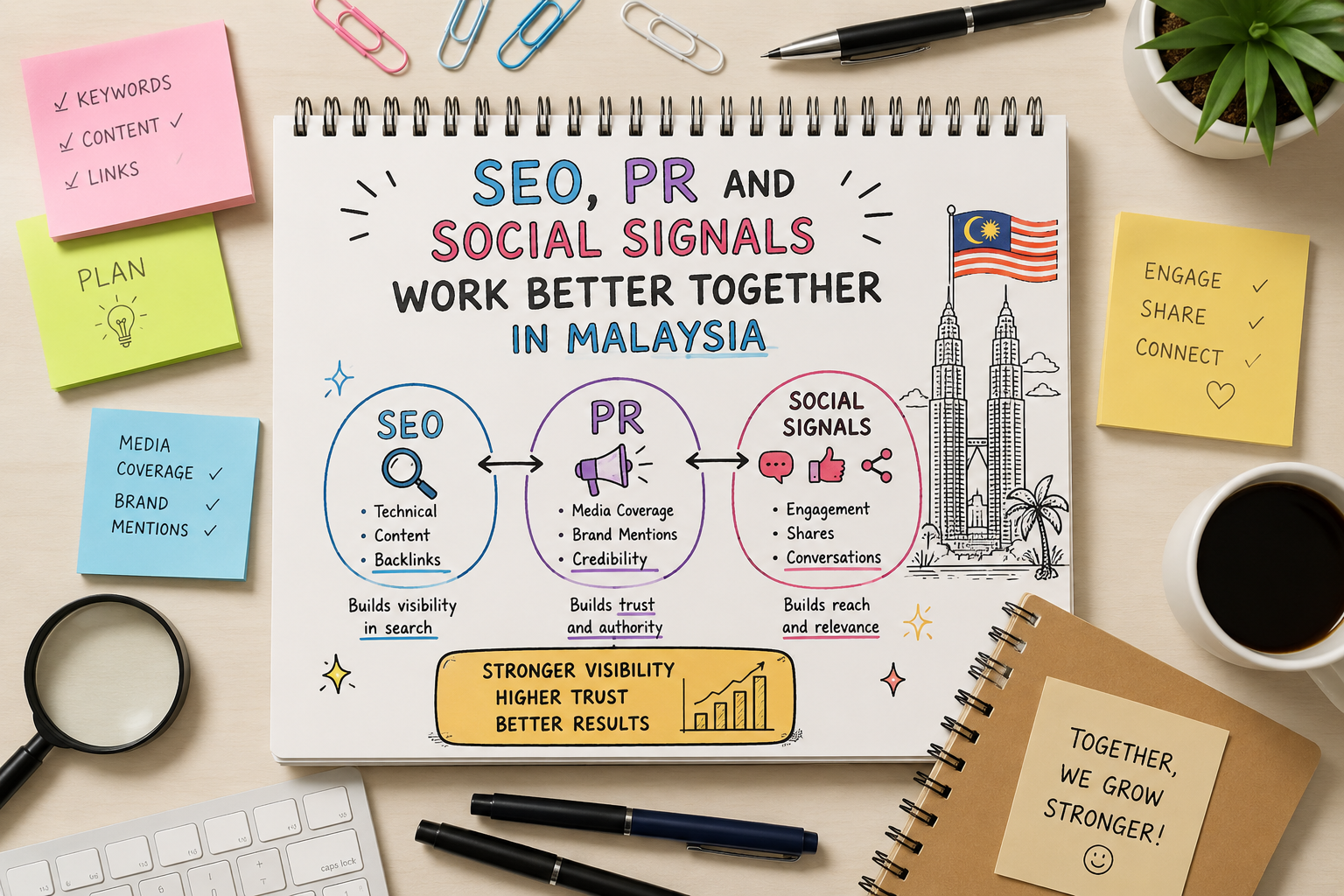
In the past, businesses used to view SEO, PR, and social media as isolated marketing efforts. SEO teams focused on rankings, PR teams chased media coverage, and social media managers concentrated on engagement and followers.
This doesn’t make sense anymore in 2026.
Today, Malaysian consumers rarely trust a business after seeing it in just one place. A customer may find a brand on TikTok and follow up by searching for it on Google, reading the reviews, seeing media coverage, reading LinkedIn posts, and asking friends in WhatsApp groups, before heading to the brand’s website to make an inquiry.
That is why SEO, PR and social signals work best together nowadays. SEO helps people discover your brand, PR makes people trust your business, and social signals make your brand visible, active and credible across the wider internet. Whether you are a PR agency or a marketing firm, it’s important to be aware of the changing landscape.
Why Visibility Alone Loses
Google ranking remains important, particularly in product and services-related and local intent queries. However, visibility without trust has become a growing problem.
A business may rank well for keywords like:
- SEO Malaysia
- Accounting firm KL
- Property lawyer Malaysia
- International school Selangor
But after clicking the website, users tend to go back to researching instead of venturing further.
Many customers are now doing their secondary trust checks almost reflexively. They check the company name again, read reviews, check social media or read any media coverage before they make their decision.
This behavior is common in fields where trust is paramount, such as finance.
| Industry | Why Trust Signals Matter |
| Healthcare | Patients want reassurance and authority |
| Finance | Users are cautious about scams |
| Education | Parents compare credibility carefully |
| Property | Buyers research extensively |
| Professional Services | Clients validate expertise externally |
Just having a nice website is not enough to build trust.
What Social Signals Actually Mean
There is a lack of understanding about social signals.
Some businesses believe that social engagement automatically boosts rankings. Others ignore social media all together, arguing that Google has said likes and shares are not direct ranking factors.
The reality sits in the middle.
Social signals can refer to comments, shares, reposts, saves, discussions, mentions, and engagement with a brand online.
These may not be direct ranking factors, but they will impact the broader visibility ecosystem of a business.
For instance, when you post a LinkedIn article about AI trends in Malaysian SEO, it may generate industry discussion, expose the brand to journalists or potential customers, and eventually increase branded searches later.
A TikTok video from a café could also result in:
- Increased branded searches
- More Google Maps traffic
- Review growth
- User-generated content
These contribute to a stronger online presence and brand awareness over time.
Many Businesses Are Not Aware Of How Important PR Is

PR is often reduced to press releases and backlinks, but modern PR is much broader than that.
With good PR, businesses can influence how they are perceived, establish trust and credibility online, and gain third-party validation from other parties. This is important because people generally trust what others say about a brand more than what the brand says about itself.
When a Malaysian company appears in interviews, podcasts, industry commentary, or business publications, the brand starts building credibility beyond its own website.
This also affects how users perceive a brand in search results. If people repeatedly see a company mentioned by trusted third parties, the business often feels more established and trustworthy before users even click the website.
That matters in competitive market sectors where customers compare multiple providers carefully.
Example: A Malaysian Accounting Firm
Imagine an accounting firm creating valuable tax information articles for their website.
This may boost rankings, just by itself.
However, if the same firm also appears in media commentary discussing Budget 2026 tax changes, shares LinkedIn analysis, and gets quoted by financial publications, the perception of authority becomes much stronger.
Customers are no longer just seeing a website trying to rank. They are seeing wider signals suggesting the business is active and knowledgeable within its field.
Social Media And Search Are Not Separate, They Are Connected
There is one major misconception about search behaviour: that it always starts with Google.
This is not the case anymore.
In many industries, social media now generates the initial demand, before search even happens.
This is particularly evident in Malaysia where there is a strong reliance on platforms such as TikTok, Facebook, Instagram, LinkedIn and YouTube when it comes to consumer discovery.
A person may first encounter:
- A skin care clinic on TikTok
- A B2B founder through LinkedIn
- A café through Instagram Reels
- A lawyer through Facebook commentary
Only afterwards do they search the business on Google.
Social media often plants the initial awareness. Search becomes the validation step later.
This is one reason why businesses focusing purely on rankings sometimes struggle to convert visitors despite strong SEO performance. People may find the brand, but they may not feel familiar enough with it yet.
How SEO Strengthens PR And Social Strategy
The relationship can work in reverse as well.
Data from SEO can help you boost your PR and social campaigns.
Keyword research reveals what audiences are actively searching for, while Search Console and competitor analysis highlight growing topics and content gaps.
Instead of guessing what people care about, businesses can use SEO insights to shape broader visibility campaigns.
Example
A solar company notices that increasing searches around:
- Solar rebate Malaysia
- Setup for EV home charging
- Solar panel tax deduction
Instead of just blogging, the business could:
| SEO Insight | PR/Social Opportunity |
| Rising electricity cost searches | Media commentary about energy bills |
| EV-related searches | LinkedIn discussions about home charging |
| Solar incentive interest | Educational TikTok explainers |
This creates alignment between search demand, PR positioning, and social visibility.
Why AI Search Changes Everything Further
The rise of AI-generated search experiences has made external brand signals even more important.
Platforms like OpenAI ChatGPT, Google Gemini, and Perplexity AI Perplexity increasingly evaluate information from multiple sources across the internet.
These systems often analyse:
- Websites
- Reviews
- Media coverage
- Public discussions
- Brand mentions
- Third-party references
This means businesses can no longer rely purely on publishing content on their own websites.
If nobody else references the company externally, AI systems may have fewer trust signals supporting the brand’s authority.
In practical terms, brands that consistently appear across search, media, and social conversations are often easier for AI systems to recognise and describe confidently.
The Malaysian Trust Loop
- A customer finds a business somewhere on the web.
- After that, they verify the authenticity of the business.
- Repeated exposure builds familiarity.
- Familiarity builds trust.
- Trust increases the likelihood of conversion.
This process may seem straightforward, but it represents a complete paradigm shift in the way that businesses approach visibility.
Rather than just the question “How do we get higher rankings?”, businesses are now being asked:
“How do we become recognisable and trusted across multiple channels? ”
That shift is becoming increasingly important in Malaysia’s competitive digital environment.
Real-Life Examples Of SEO, PR And Social Signals Working Together
A Local Café Brand
A café gains traction through customer-generated TikTok videos. Local creators begin posting about it, and users later search the café directly on Google Maps and Google Search.
The result is not just temporary virality. The business starts building stronger local SEO signals, branded search demand, reviews, and broader familiarity.
A B2B SaaS Company
A SaaS company publishes SEO-focused educational content while its founder regularly shares LinkedIn commentary about AI adoption trends in Malaysia.
Industry publications later quote the founder in related discussions.
Over time, the company earns backlinks, social engagement, branded searches, and stronger topical authority.
An SEO Agency
An SEO company in Malaysia publishes research on AI visibility, contributes commentary to media outlets, and shares educational insights across LinkedIn and social media.
Potential clients searching “SEO Malaysia” may later recognise the brand because they have already encountered the agency elsewhere before.
That recognition can heavily influence conversion behaviour.
Common Mistakes Businesses Still Make
Treating SEO As Purely Technical
Technical SEO matters, but rankings alone rarely build brand trust anymore.
Treating PR Only As Link Building
PR is not just about collecting backlinks. It also shapes perception and authority.
Using Social Media Only For Promotions
Constant promotional posting often struggles to build meaningful engagement or audience trust.
Ignoring Brand Search Reputation
Some businesses focus heavily on rankings while ignoring what appears when users search the company name directly.
How Malaysian Businesses Can Align SEO, PR, And Social Signals Better
Businesses do not necessarily need massive budgets to integrate these channels more effectively.
The key is consistency.
A useful starting point is developing a clear positioning angle that can be reinforced across:
- Website content
- Media commentary
- Social media
- Educational content
A good alternative to this is to improve the utilization of visibility resources.
A single media interview could turn into:
- A LinkedIn article
- A TikTok clip
- Instagram quote graphics
- A blog post
- Newsletter content
This helps businesses extract more long-term visibility from the same expertise.
Why This Matters More For Malaysian SMEs In 2026
Larger brands already invest heavily across search, media, and social channels because they have stronger budgets and recognition.
SMEs often lag behind because they still separate marketing efforts too aggressively or rely entirely on paid advertising.
However, integrated visibility strategies may actually benefit SMEs even more.
When a smaller Malaysian business appears consistently across Google search, social discussions, media mentions, reviews, and educational content, the business can look significantly more established than competitors relying only on basic SEO or ads.
This matters because many Malaysian buyers no longer convert from a single touchpoint. They compare, validate, search again, and look for signals suggesting the business is real, active, and trustworthy.
Holistic Integration of SEO, PR, and Social Signals
SEO, PR and social signals are not isolated marketing disciplines anymore.
SEO makes businesses discoverable. PR builds up authority and third-party trust. Social signals boost visibility and audience engagement across the wider internet.
Together, they create a stronger digital presence than any individual channel can achieve alone.
For Malaysian businesses in 2026, visibility is no longer just about ranking on Google, but also becoming recognisable, credible, and consistently present across the places where customers search, validate, discuss, and compare brands.
Businesses that understand this shift early will likely build stronger long-term authority than businesses still treating SEO, PR, and social media as separate efforts.
Frequently Asked Questions About How SEO, PR, and Social Signals Work Together
Is There A Direct Link Between Social Signals And SEO Rankings?
Not directly in the traditional sense, but social signals can indirectly support SEO through increased visibility, referral traffic, branded searches, and backlink opportunities.
Why Is PR Important For SEO?
PR is a way for businesses to establish authority, third-party validation, and brand trust. Strong media visibility can also improve branded search reputation and topical credibility.
How Does Social Media Influence Search Behaviour?
People frequently discover brands or a subject through social media before they look it up on Google. This can lead to a boost in branded search demand and visibility.
Why Are External Brand Signals Important For AI Search?
AI search platforms analyse information from multiple sources across the internet, including reviews, media coverage, and public discussions to evaluate credibility.
Can SMEs Benefit From Combining SEO, PR, And Social Media?
Yes. SMEs can strengthen brand trust and visibility significantly by appearing consistently across search, media, and social channels rather than relying only on rankings.
Is SEO Still Important In 2026?
Absolutely. SEO remains essential for discoverability, but rankings alone are no longer enough without supporting trust signals from PR, reviews, and social visibility.
































