

Keep reading
Rather we just did it for you?
Let's get your business seen.
Social media, websites, SEO and ads from a team you can actually meet.
Is a follower growth service legit? Sometimes, if it means a person or agency who helps you plan content, run ads and build a real audience. Usually not, if it promises a set number of followers, likes or views for a fixed price, or asks for your password. Real growth is slow, comes from real people, and can’t be guaranteed to the digit.
The problem is that both kinds describe themselves in almost the same words. This guide gives you eight red flags to check before you pay anyone, a list of questions to ask, and a description of what a good service looks like. Nothing here names a company. These are patterns you can apply to any offer that lands in your inbox or direct messages.
Is a follower growth service legit? Start with what it is selling
Every social media growth service falls into one of three groups, and the group tells you most of what you need to know.
- Services that sell numbers. You pay, and a count goes up. The followers, likes or views come from fake accounts, hacked accounts, networks of real people paid pennies, or automated tools. These are the ones to avoid.
- Services that sell attention. They run paid adverts, arrange collaborations with real creators, or manage competitions. This can be legitimate if done openly and within the rules, though results vary.
- Services that sell work. A person or team plans, creates and posts content, replies to comments, and reports on progress. Growth is a result of the work, not a purchased number.
When someone approaches you, ask which group they belong to. A trustworthy provider answers plainly. A dodgy one gets vague, and vagueness is the first warning sign.
Red flag 1: A guaranteed number
“5,000 followers in 7 days, guaranteed.” Nobody who builds an audience properly can promise that, because nobody controls whether strangers choose to follow you. The only way to guarantee a number is to manufacture it, with accounts that aren’t real people.
A reasonable provider will talk about ranges, effort and past results with clients in similar situations. They will say “we expect”, not “we guarantee”. If the whole pitch rests on a precise number and a deadline, walk away.
Red flag 2: They ask for your password
Handing over your login is the single most dangerous thing you can do. Whoever has it can change your email, lock you out, message your customers or sell the account. A legitimate agency works by being added to your business tools with limited access, not by holding your personal password.
For Facebook and Instagram this means using proper access controls, which are explained in our guide on how to add an admin to a Facebook Page. And whatever you do, turn on two-step verification on your accounts first. The National Cyber Security Centre explains why it matters in its guidance on setting up 2-step verification.
Red flag 3: The price is far too low, or it arrives instantly
Real work takes time and costs money. Writing a post, shooting a video, replying to comments and checking results all use hours of someone’s day. If a package offers thousands of followers for the price of a sandwich, ask yourself what is actually being delivered.
Instant delivery is a second clue. Real followers don’t arrive in a few minutes, and accounts that suddenly gain thousands of followers overnight look suspicious to the platform and to anyone who checks. If you’ve already bought something and are worried, our guide to spotting fake followers in 10 minutes shows you how to check what you received. So is a follower growth service legit? Only if it never touches your login and never sells fake engagement.
Red flag 4: They won’t explain how it works
Ask, “How exactly do you get these followers?” and listen carefully. Phrases like “our proprietary method”, “secret algorithm” or “we have a network” often cover something you wouldn’t want to know about.
A good provider can describe their method in a few sentences in plain English: “We post three times a week, reply to comments, run a small ad budget to a local audience and report monthly.” You should be able to repeat it to a colleague. If you can’t explain the service to someone else, you shouldn’t be paying for it.
Red flag 5: The platform rules are ignored or brushed off
Major platforms have rules against fake engagement, and many restrict automation too. Some providers say “it’s perfectly safe” or “everyone does it.” That isn’t an answer.
The risk is to your account, not theirs. Platforms can remove fake followers, reduce the reach of your posts or restrict and close accounts, and the provider doesn’t carry any of that cost. Read the current terms yourself before agreeing, because they change. If the provider can’t point to how their method sits within those terms, treat it as a no. Our guide on Instagram bots and what is safe to automate goes through the grey areas in more detail.
Red flag 6: There are no real clients, case studies or contactable people
Look for evidence that the business exists and has done real work:
- A company name, registered address and a UK company number (you can check this on the Companies House register).
- Named clients you can contact or at least verify, not just screenshots of rising graphs.
- A website that describes the service in detail rather than just a payment button.
- A person you can speak to on the phone or video.
Be careful with testimonials. Fake reviews are now banned in the UK. The government’s announcement on the ban on fake reviews says businesses and platforms must take steps to prevent and remove them. A provider whose entire reputation rests on glowing but unverifiable reviews deserves a second look. Ask yourself: is a follower growth service legit if it will not tell you how it finds the followers?
Red flag 7: They want you to commission fake reviews, comments or testimonials
Some growth packages bundle in “reviews” or “comments” to make your account look busy. This is where the risk moves from your account to your legal position. The CMA’s guidance says businesses must not commission third parties to write fake reviews and may be liable for those third parties’ actions. It also says agencies must not write or arrange them for clients, as both sides risk breaking the law. Penalties can reach up to 10% of global turnover. You can read the details in the CMA’s guidance for businesses and agencies.
If a provider suggests “a few five-star reviews to get you started”, that’s both a red flag and a good reason to end the conversation. The legal route to reviews is simply asking real customers, which we explain in our guide to how to get your first 100 real Google reviews.
A similar point applies to paid promotion. If the provider arranges for influencers to post about you, those posts must be clearly labelled as adverts. The advertising regulator sets out what counts in its guidance on recognising ads on social media. A provider who shrugs at labelling is putting you at risk.
Red flag 8: Pressure, vague contracts and no reporting
Watch how the sale is handled. Pressure tactics, such as “this price ends tonight” or “only three spaces left”, are designed to stop you thinking. A good provider is happy for you to take a week and compare.
Then look at what you get in writing:
- A clear scope of what they will do each month.
- How long the contract runs and how to cancel.
- Who owns the content and the accounts. (It should be you.)
- What reports you’ll receive, and whether you’ll have direct access to your own analytics.
If a provider won’t show you your own numbers, or reports only on “followers” and never on enquiries, bookings or sales, ask why. Follower counts are the easiest figure to inflate and the least useful figure to run a business on.
What a legitimate social media growth service looks like
Now the good news. Plenty of agencies and freelancers do honest, useful work. A good one will:
- Start by asking about your business goals, not by quoting a follower count.
- Explain what they will do in plain English, and what they need from you.
- Be honest that growth takes months, and that results depend on your content, market and budget.
- Work through proper access, such as being added as a manager, and never ask for your personal password.
- Show you real examples and put you in touch with real clients.
- Report on things that matter to a business, like enquiries, website visits, bookings and sales, alongside audience growth.
- Stay within platform rules and UK advertising law, including clear labels on adverts.
Good providers still can’t promise results. They can show you a method, a timeline and a track record.
Questions to ask before you pay anyone
Copy these into an email or a call. You’ll learn a lot from how someone answers.
- Where exactly do the new followers or engagement come from?
- Do you need access to my account, and if so, what type?
- Can you show me results for a client like me, and may I speak to them?
- What happens if the platform removes followers or restricts my account?
- What am I paying for each month, and who does the work?
- How do I cancel, and what do I own when we finish?
- What will you report on, and will I see my own analytics?
A confident provider answers all seven calmly. A shaky one dodges at least two. Before you pay, ask once more: is a follower growth service legit, or just well packaged?
If you’ve already paid for a service that turned out badly
Don’t panic, and don’t keep paying to fix it. Work through these steps:
- Change your passwords and turn on two-step verification, particularly if you shared a login.
- Remove the provider’s access from your business tools and any connected apps.
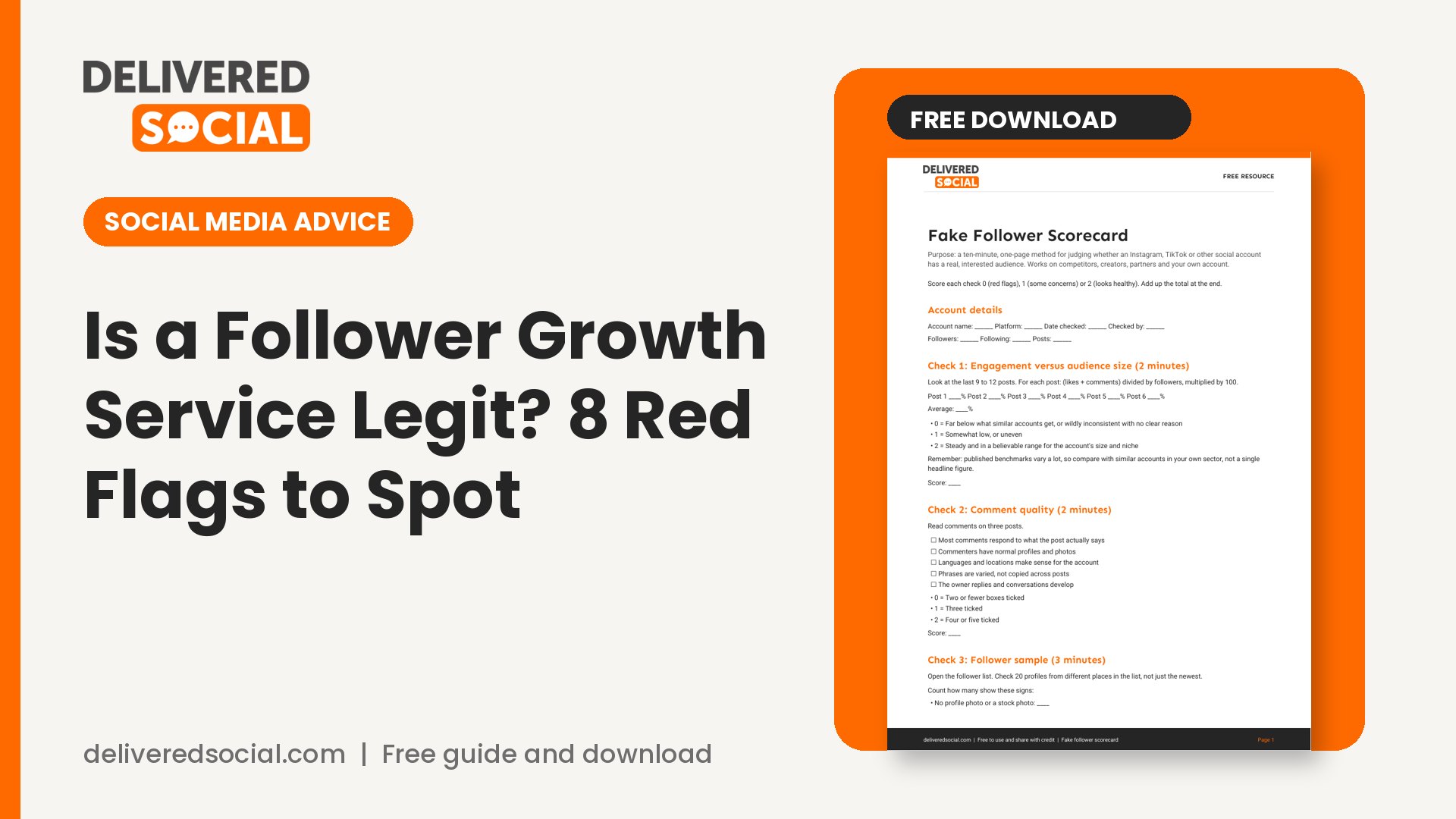
- Check the quality of your audience with a simple scorecard (our free pack below has one).
- Stop any recurring payments. If you paid by card, speak to your bank about your options.
- Rebuild from your real audience. Post for the customers you want, and give it time.
If your account has been restricted or you’ve been locked out, treat that as a separate problem and follow the platform’s own appeal process.
Frequently asked questions
Are all social media growth services scams?
No. Services that do real work, like content creation, community management and properly run advertising, are a normal part of marketing. The ones to avoid sell guaranteed numbers or ask for access they don’t need.
Is paid advertising a legitimate way to grow?
Yes. Running adverts through the platform’s own tools is allowed. The results are real people seeing your content, and some will follow. It costs money, but it’s transparent.
Can buying followers hurt my business?
It can. Fake followers don’t buy, don’t comment and can distort your figures, so you make worse decisions. They can also put your account at risk and damage trust if customers notice.
How do I check a provider is real?
Search for the company on the Companies House register, ask for client references you can call, and see whether the same person answers your questions each time.
What is a realistic result in the first three months?
That depends on your starting point, your sector and your budget, so be sceptical of anyone who quotes a figure before they’ve seen your account. A realistic early result is a clearer strategy, regular posting and the first signs of real conversation.
Get the free Fake Follower Scorecard
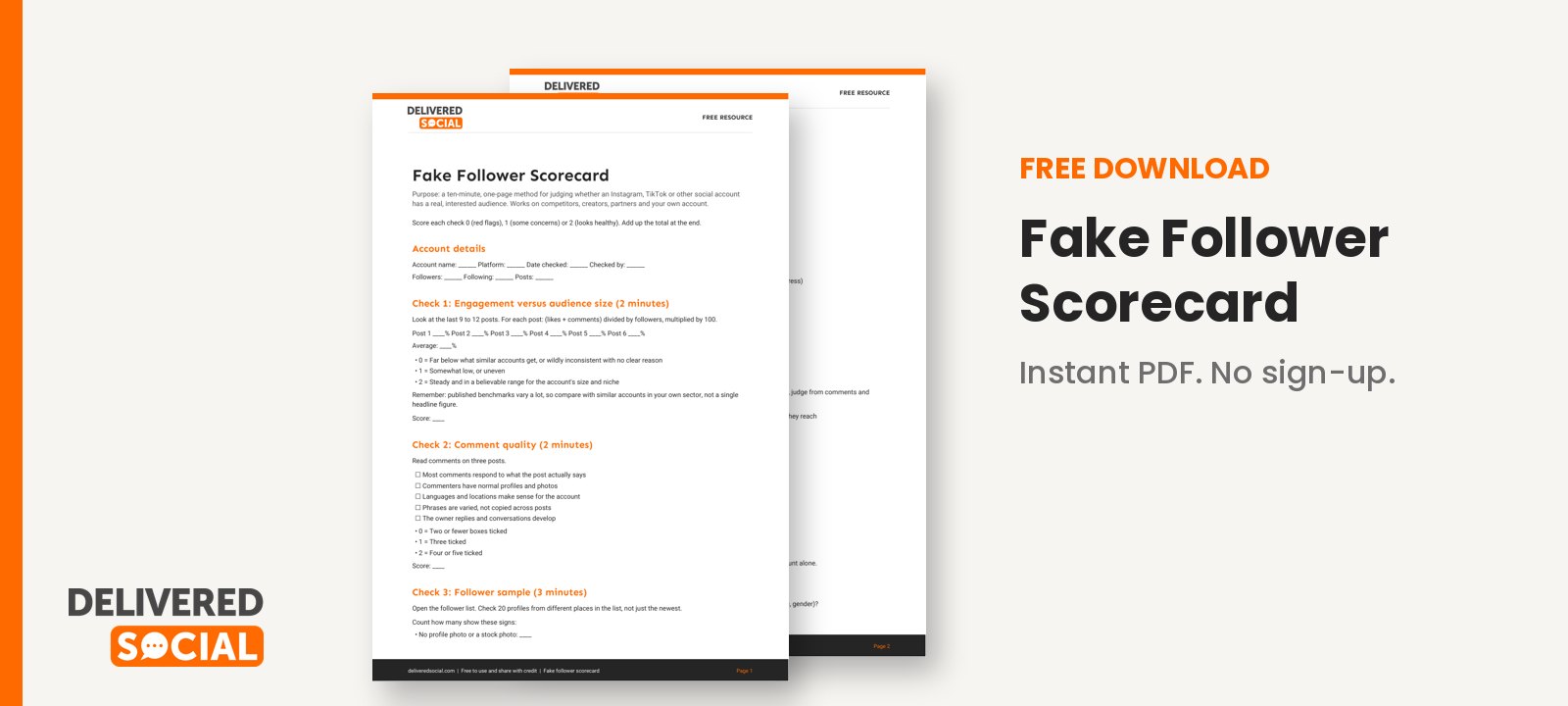
Whether you are checking a provider’s own account, your competitors, or an audience you have already paid for, our scorecard helps you judge quality in about ten minutes. Download the free Fake Follower Scorecard and keep it with your marketing notes.
If you’d like a team that grows your audience the slow, honest way, Delivered Social offers social media management with plain-English reporting, and you can get in touch to talk through your goals.