

Keep reading
Rather we just did it for you?
Let's get your business seen.
Social media, websites, SEO and ads from a team you can actually meet.
Are Google Ads pay per click? Mostly, yes. Search ads, the text ads you see at the top of Google, charge you only when someone clicks. But Google Ads also offers other ways to pay, such as per 1,000 impressions, per video view and, with some smart bidding, effectively per conversion. Knowing which you’re paying for makes a big difference to how far your budget goes.
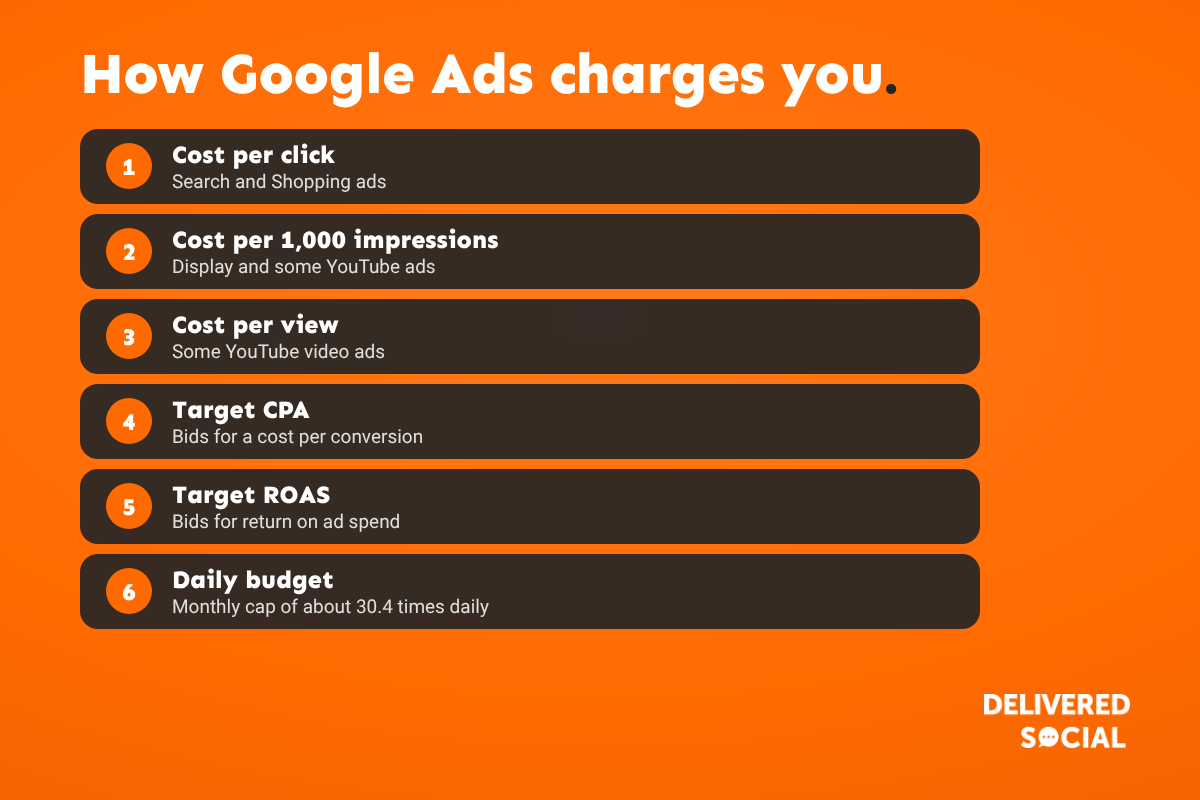
How Google Ads charges you
| Payment model | You pay when | Typically used for |
|---|---|---|
| Cost per click (CPC) | Someone clicks your ad | Search ads, Shopping ads, most Performance Max |
| Cost per 1,000 impressions (CPM) | Your ad is shown 1,000 times | Display and some YouTube campaigns, for awareness |
| Cost per view (CPV) | Someone watches or interacts with your video | Some YouTube video ads |
| Target CPA (cost per action) | Usually still per click, but Google bids to hit your target cost per conversion | Lead generation and sales once tracking is solid |
| Target ROAS | Usually still per click, bidding for a return on ad spend | Ecommerce with reliable sales tracking |
For most small businesses running Search ads, you’re paying per click.
How the cost per click is set
Google runs an auction every time someone searches. Your position and price depend on:
- Your bid: the most you’re willing to pay for a click (or what smart bidding sets for you).
- Ad quality: how relevant your ad and landing page are, and how likely people are to click.
- Ad assets and format: extra links, call buttons and locations can lift your ad.
- Competition and context: who else is bidding, the searcher’s location, device and time of day.
You usually pay less than your maximum bid, just enough to beat the advertiser below you. Better ads and landing pages can win higher positions for less money.
How much does a click cost in the UK?
It depends heavily on the sector. Local trades and retail clicks might cost well under £1 to a few pounds. Competitive services such as law, finance, insurance and some B2B searches can cost £10 or more per click. Use Google’s Keyword Planner (free with an account) to see estimates for your own searches. For a fuller picture see our guide to Google Ads management costs.
How much should a small business spend?
For a small local business, we usually suggest starting at around £500 to £1,000 a month in ad spend. That’s enough clicks to learn what works without risking too much. Very small budgets spread thinly across lots of keywords rarely produce enough data to improve.
You control spending with a daily budget. Google can spend up to twice your daily budget on busy days, but over a month you won’t pay more than your average daily budget multiplied by about 30.4.
What we find when we take over Google Ads accounts
When a business brings us an account that isn’t working, the same three problems come up again and again:
- Broken or missing conversion tracking. If Google can’t see which clicks become enquiries or sales, it can’t optimise, and you can’t tell what’s working.
- Wasted search terms. Without negative keywords, ads show for irrelevant searches, such as “jobs”, “free” or “DIY”, and every click costs money.
- Poor landing pages. Ads sending everyone to the homepage instead of a page that matches the search, with a clear call or quote button.
Fixing those three often cuts the cost per enquiry significantly before a single bid is changed.
How to get more from every click
- Set up conversion tracking first: form submissions, calls and sales.
- Check the search terms report weekly and add negative keywords.
- Group keywords tightly so each ad closely matches the search.
- Send each ad group to a matching landing page.
- Use ad assets: sitelinks, call buttons, locations and structured snippets.
- Limit locations and schedule to where and when you can actually serve customers.
- Move to smart bidding only once you have enough conversions for it to learn from.
Is pay per click worth it?
For many businesses, yes, because you only pay when someone shows interest, and results start straight away. The catch is that clicks aren’t customers. PPC works when the tracking, targeting and landing pages are right. Many businesses use Google Ads for quick enquiries while SEO builds longer-term traffic.
Frequently asked questions
Are Google Ads pay per click?
Search and Shopping ads charge per click. Display and some video ads can charge per 1,000 impressions or per view instead.
Do I pay if someone sees my ad but doesn’t click?
Not for search ads on a CPC basis. You only pay when someone clicks.
What is a good cost per click?
It depends on your sector and what a customer is worth. A better measure is cost per enquiry or sale compared with the value of a new customer.
Can I set a maximum spend?
Yes. You set a daily budget, and monthly spend won’t exceed roughly 30.4 times that figure.
Is Google Ads PPC the same as Facebook ads?
Not quite. Facebook and Instagram ads usually charge per 1,000 impressions by default. See our guide to whether Facebook ads are pay per click.
Want your Google Ads to work harder?
We set up and manage Google Ads for small businesses across Surrey, Hampshire and the UK, starting with tracking, search terms and landing pages. See our Google Ads management or call us on 01483 608 303 for a friendly chat.