

Keep reading
Rather we just did it for you?
Let's get your business seen.
Social media, websites, SEO and ads from a team you can actually meet.
“How much can I earn from Google AdSense?” is one of the most common questions we hear from bloggers and small publishers. The honest answer: for most UK websites, AdSense earns pounds, not thousands, until traffic gets into the tens of thousands of visits a month. This guide explains how AdSense pays, what affects your earnings, realistic figures, and how to earn more.
How Google AdSense pays you
AdSense lets you show Google ads on your website. Advertisers bid to appear on your pages, and you get a share of what they pay.
- Paid mainly per impression. Since 2024, AdSense pays publishers mostly per 1,000 ad impressions rather than per click, though advertisers may still buy on a cost-per-click basis behind the scenes.
- Revenue share. For ads on your content, Google says publishers receive around 80% of the revenue after the advertiser side has taken its fees, which works out at roughly 68% of what the advertiser pays. For AdSense for Search (ads in a search box on your site) the share is 51%.
- Payment threshold. UK publishers are paid once their balance reaches £60, usually by bank transfer around the 21st to 26th of the following month.
The number that matters: page RPM
Forget cost per click. The figure to watch is page RPM: how much you earn per 1,000 page views. You’ll find it in your AdSense reports.
A simple formula:
Monthly earnings = (monthly page views ÷ 1,000) × page RPM
| Monthly page views | At £2 RPM | At £5 RPM | At £10 RPM |
|---|---|---|---|
| 5,000 | £10 | £25 | £50 |
| 20,000 | £40 | £100 | £200 |
| 50,000 | £100 | £250 | £500 |
| 100,000 | £200 | £500 | £1,000 |
| 500,000 | £1,000 | £2,500 | £5,000 |
These are illustrations, not promises. RPMs vary hugely by topic, audience and time of year, so check your own reports after a few months.
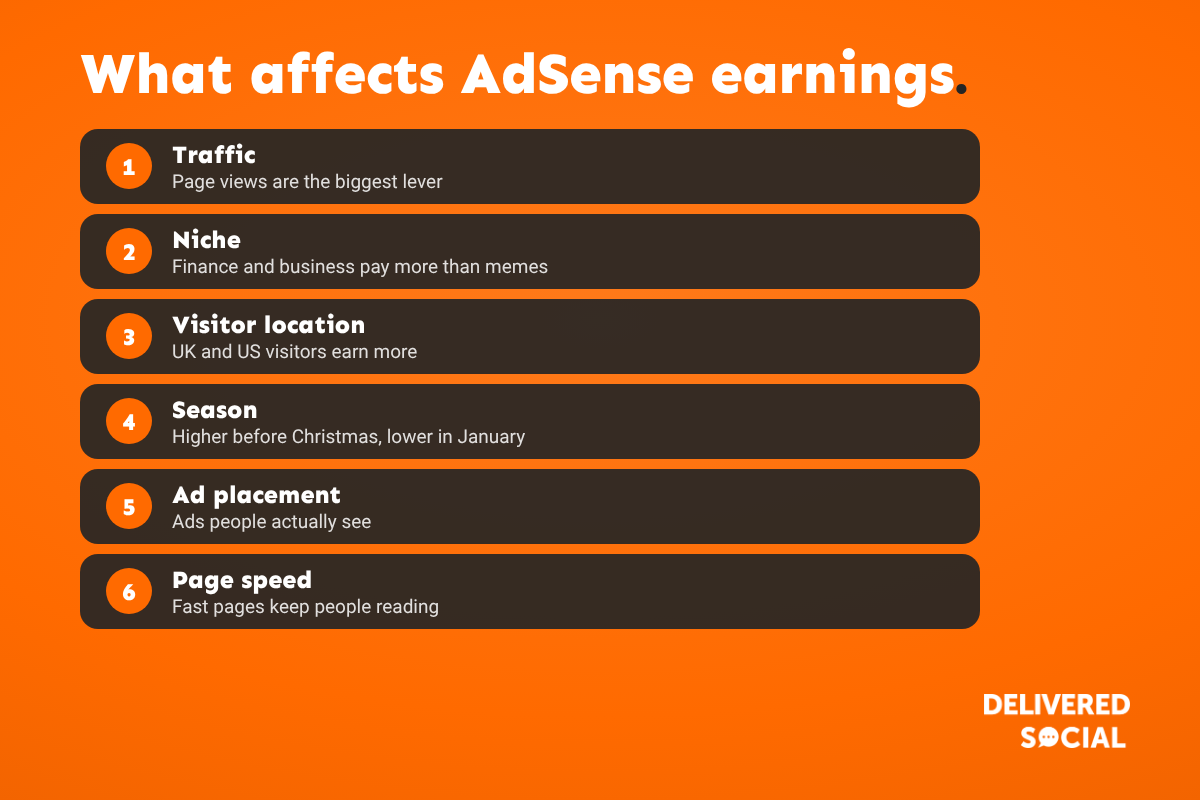
What affects how much you earn
- Your niche. Topics where advertisers pay a lot for customers, such as finance, insurance, law, property, business software and health, usually earn far more per view than entertainment, recipes or memes.
- Where your visitors are. UK, US, Canadian and Australian visitors usually earn more than visitors from countries where advertisers spend less.
- Time of year. Advertisers spend heavily from October to December, so RPMs often rise before Christmas and drop in January.
- Ad placement and number. Ads that are seen earn more. Too many ads slow your site and annoy visitors.
- Device mix. Mobile visitors often earn less per view than desktop visitors, although that gap varies.
- Page speed and user experience. A fast, clean site keeps people reading more pages.
- Auto ads vs manual placement. Auto ads are easy, but testing your own placements can raise earnings.
Is AdSense worth it for a business website?
Usually not. If your website exists to win customers, an advert for a competitor is the last thing you want next to your enquiry form. For a business, one extra customer is normally worth far more than a year of AdSense earnings. AdSense makes sense for:
- Blogs, magazines and information sites with lots of traffic.
- Hobby and community sites that want to cover hosting costs.
- Publishers who also earn from affiliate links, sponsorship or their own products.
How to get approved for AdSense
- Have plenty of original, useful content. Thin or copied pages are the most common reason for rejection.
- Clear navigation, an about page, a contact page and a privacy policy.
- Follow AdSense programme policies, including no adult, violent or copyright-infringing content.
- Use a cookie consent tool that meets UK and EU rules, as AdSense requires a Google-certified consent management platform for visitors in the UK and EEA.
- Add the AdSense code to your site and wait for review, which can take a few days to a few weeks.
How to earn more from AdSense
- Grow search traffic. More page views is the biggest lever. That means keyword optimisation and genuinely useful articles.
- Write for higher-value topics within your niche, such as buying guides and comparisons.
- Keep people reading with internal links to related articles.
- Test placements: an ad within the first few paragraphs and one mid-article often outperform sidebars.
- Keep your site fast, especially on mobile.
- Add other income streams, such as affiliate links, sponsored posts or your own products. AdSense is rarely the best earner on its own.
Common AdSense mistakes
- Clicking your own ads or asking others to. This breaks the rules and can get your account closed.
- Putting ads above everything so visitors can’t find the content.
- Buying cheap traffic, which earns little and can be flagged as invalid.
- Expecting meaningful income from a few thousand monthly views.
Frequently asked questions
How much does AdSense pay per 1,000 views in the UK?
It varies widely. Many UK sites see somewhere between a pound or two and over £10 per 1,000 page views, depending on niche, audience and season. Check your own page RPM in AdSense for the real figure.
Does AdSense pay per click?
Since 2024, publishers are paid mainly per impression rather than per click, although some advertisers still buy clicks.
How much traffic do I need to make money with AdSense?
To earn a noticeable monthly income, most sites need tens of thousands of page views a month. Under 10,000 page views, earnings are usually small.
When does AdSense pay?
Once your balance reaches the payment threshold (£60 for UK accounts), Google pays the following month, usually between the 21st and 26th.
Can I use AdSense on a business website?
You can, but most businesses shouldn’t. Ads can send potential customers to competitors, and the earnings are usually far smaller than the value of one new customer.
Want more traffic to your website?
Whether you earn from ads or from customers, it all starts with getting found. See our SEO services or call us on 01483 608 303 for a friendly chat.