

Keep reading
Rather we just did it for you?
Let's get your business seen.
Social media, websites, SEO and ads from a team you can actually meet.
Structured data is a small piece of code that tells search engines the facts about a page in a format they can read instantly: that this is a business, here’s its address and opening hours, this is a product, here’s its price and reviews. It doesn’t change what visitors see, but it can change how your pages appear in Google, and it helps AI search tools understand you too.
This guide explains structured data in plain English, which types matter for small businesses, how to add it to a WordPress site, and how to check it’s working.
What is structured data?
Structured data (often called schema or schema markup) uses a shared vocabulary from Schema.org to label information on a page. Google recommends adding it in a format called JSON-LD, a short block of code in the page that visitors never see.
For example, a local business might tell Google:
- This is a LocalBusiness called Delivered Social.
- Its address, phone number and opening hours are these.
- It serves these areas and has this logo.
Without structured data, Google has to work this out from the page text. With it, there’s no guesswork.
Why structured data matters
- Rich results. Structured data can make you eligible for enhanced listings, such as product prices and star ratings, breadcrumbs, event dates and recipe details. These stand out and can earn more clicks.
- Clearer understanding. It helps Google connect your website with your business, location and services.
- AI search. AI Overviews and chat tools rely on clear, well-organised information. Structured data is part of how we help clients appear in AI answers, alongside clear FAQs and strong reviews.
One important point: structured data doesn’t directly boost rankings, and Google doesn’t guarantee rich results even when your markup is perfect.
The types that matter most for small businesses
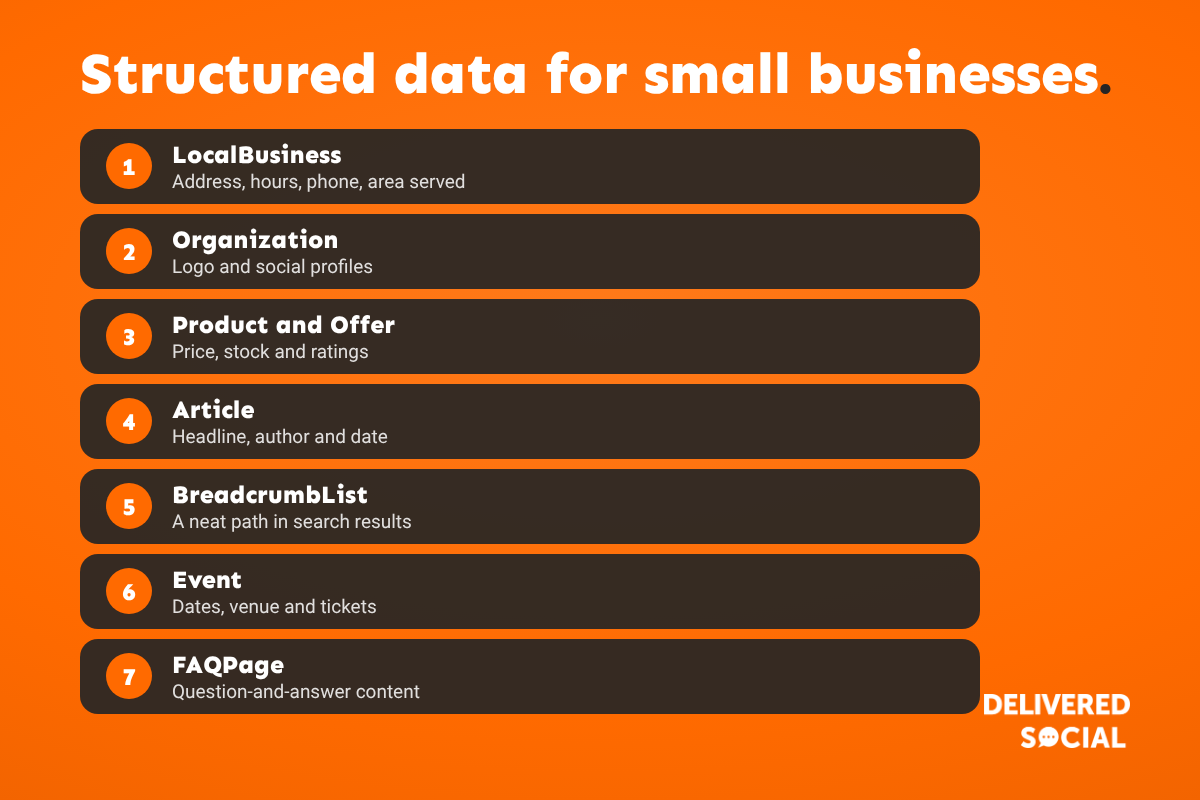
| Type | Use it for | What it can help with |
|---|---|---|
| LocalBusiness (or a subtype such as Restaurant, Dentist, Plumber) | Your home or contact page | Address, hours, phone, area served |
| Organization | Your home page | Logo, social profiles, contact details |
| Product and Offer | Product pages | Price, availability and review ratings in results |
| Article or BlogPosting | Blog posts | Headline, author, date |
| BreadcrumbList | Every page | A neat breadcrumb path in search results |
| Event | Event pages | Dates, venue and tickets |
| FAQPage | Pages with question-and-answer sections | Helps machines understand Q&A content |
| Review and AggregateRating | Products and some services | Star ratings, within Google’s rules |
Know the rules before you add it
- Only mark up what’s visible on the page. Don’t add reviews, prices or FAQs to the code that visitors can’t see.
- FAQ rich results are limited. Since 2023 Google mostly shows FAQ rich results only for well-known government and health sites. FAQ markup can still help search engines understand your content, but don’t expect the drop-down questions in results.
- HowTo rich results have been retired.
- Self-serving reviews don’t qualify. A business can’t mark up reviews of itself on its own site to get star ratings for its organisation in results.
- Misleading markup can lead to a manual action in Google Search Console.
How to add structured data to a WordPress site
- Use your SEO plugin. Most WordPress SEO plugins add Organization, Article and Breadcrumb markup automatically. Check its settings so your business name, logo and type are correct.
- Add LocalBusiness details such as address, phone, opening hours and area served. Some plugins have a local business section; otherwise a developer can add a JSON-LD block to your contact or home page.
- For shops, WooCommerce and most ecommerce platforms add Product markup. Make sure prices, stock and reviews are filled in.
- Avoid duplicates. Two plugins adding the same markup can cause errors. Use one source.
We build client websites on WordPress, and adding the right schema is part of the build and our SEO work.
How to test your structured data
- Google’s Rich Results Test shows which rich results a page is eligible for and flags errors.
- The Schema Markup Validator (validator.schema.org) checks all Schema.org markup, not just Google features.
- Google Search Console has enhancement reports, such as Breadcrumbs and Products, that show errors across your whole site.
After fixing errors, use Search Console’s URL Inspection tool to request indexing of the page.
Common structured data mistakes
- Marking up information that isn’t on the page.
- Wrong business type or an old address left in the code.
- Duplicate markup from several plugins.
- Fake or self-written reviews in the markup.
- Adding it once and never checking Search Console for errors.
Frequently asked questions
What is structured data in SEO?
It’s code that labels the information on a page, such as a business address or product price, so search engines understand it and can show it in richer ways.
Does structured data improve rankings?
Not directly. It can make you eligible for rich results that attract more clicks, and it helps search engines understand your pages.
What is the difference between structured data and schema?
People use them interchangeably. Schema.org is the shared vocabulary; structured data is the markup on your page that uses it.
Which format should I use?
Google recommends JSON-LD. It’s a separate block of code, so it’s easier to add and maintain.
Do I need a developer to add schema?
Not always. SEO plugins handle the basics. For custom types, such as detailed local business or event markup, a developer can help.
Does structured data help with AI search?
It can help AI tools understand who you are and what you offer, alongside clear content, FAQs and strong reviews.
Want your site set up properly?
We build and optimise WordPress websites for small businesses across Surrey, Hampshire and the UK, with the technical SEO done right. See our SEO services or call us on 01483 608 303 for a friendly chat.