

Keep reading
Rather we just did it for you?
Let's get your business seen.
Social media, websites, SEO and ads from a team you can actually meet.
How much does PPC cost in the UK? There are two parts to the bill: the money you pay Google, Microsoft or Meta for clicks (your ad spend), and the fee for whoever sets up and manages the campaigns. For a small local business, a sensible starting point is around £500 to £1,000 a month in ad spend, plus management. This guide explains what drives the cost, what clicks cost in different sectors, how agencies charge and how to work out what you can afford.
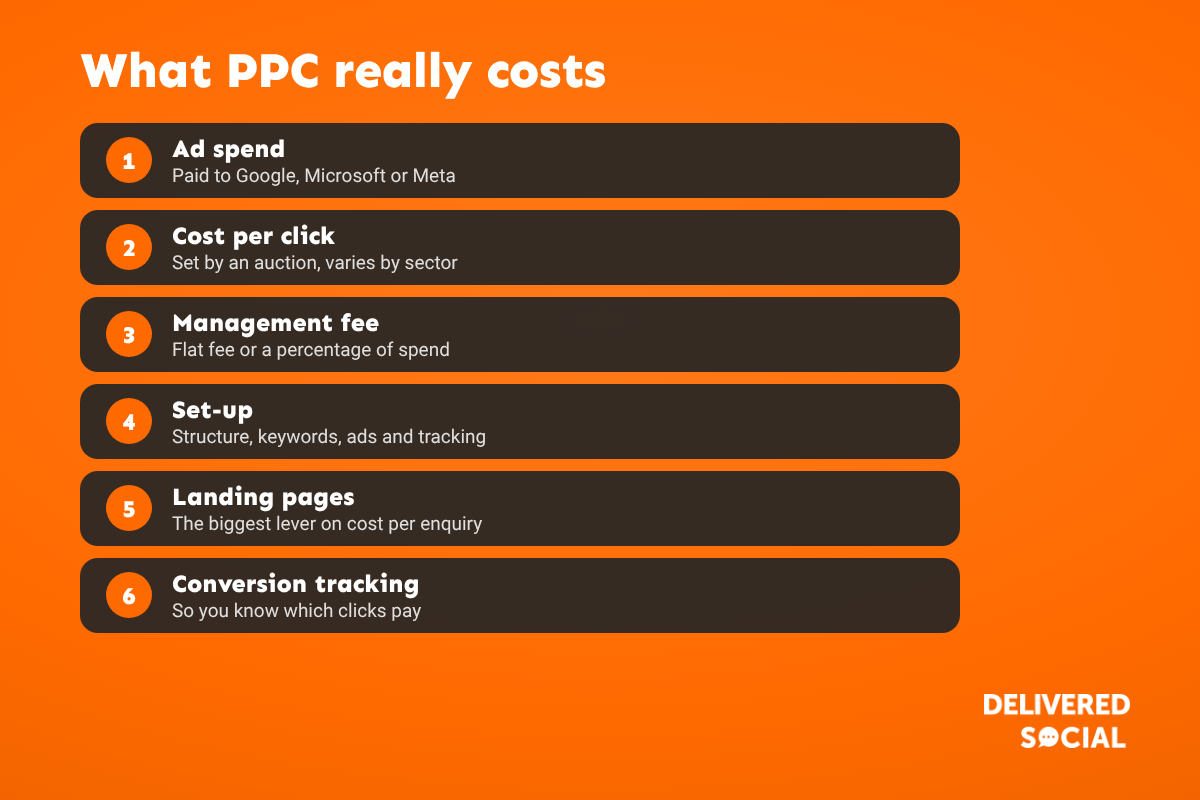
PPC costs at a glance
| Cost | Typical range for a UK small business | Notes |
|---|---|---|
| Ad spend | £500 to £1,000+ a month to start | Paid directly to Google, Microsoft or Meta. You set the budget. |
| Cost per click | Under £1 to £10+ depending on sector | Set by an auction. Competitive sectors cost more. |
| Management fee | A few hundred pounds a month upwards, or a percentage of spend | Agencies often charge a flat fee or around 10 to 20% of ad spend, sometimes with a minimum. |
| Set-up | Often a one-off fee, or included | Account structure, keyword research, ads and conversion tracking. |
| Landing pages | Optional | A page built for the ad can cut the cost per enquiry more than any bid change. |
What decides how much a click costs?
Every time someone searches, Google runs an auction. What you pay depends on:
- Competition: how many businesses are bidding on the same searches, and how much a customer is worth to them.
- Ad quality: Google rewards relevant ads and landing pages with better positions for less money. Our guide to Quality Score explains how.
- Location: clicks in London usually cost more than in smaller towns.
- Timing and device: busy times and mobile searches can cost more or less depending on your sector.
- Your bidding strategy: manual bids, Maximise Clicks or smart bidding towards conversions.
You usually pay less than your maximum bid: just enough to beat the advertiser below you.
What clicks cost by sector
These are broad guides to UK search clicks. Your own costs will depend on your keywords, location and ad quality, so check Google’s Keyword Planner for estimates before you start.
| Sector | Typical cost per click |
|---|---|
| Retail and ecommerce | Under £1 to around £2 |
| Restaurants, hospitality and leisure | Under £1 to around £2 |
| Local trades (plumbers, roofers, electricians) | Around £2 to £8 |
| Professional services (accountants, B2B) | Around £3 to £10 |
| Legal, finance and insurance | Often £10 or more |
PPC costs on other platforms
- Microsoft Advertising (Bing): smaller audience, but clicks are often cheaper than on Google. You can import your Google campaigns.
- Facebook and Instagram: usually charged per 1,000 impressions by default, not per click. See how much Facebook ads cost.
- LinkedIn: clicks are typically much more expensive, but the targeting by job title and company suits B2B.
- TikTok: good for reaching younger audiences with video, usually bought on impressions.
How agencies charge for PPC management
- Flat monthly fee: the simplest model. You know what you’ll pay each month.
- Percentage of ad spend: commonly 10 to 20%, often with a minimum fee. It scales as you spend more.
- Set-up fee plus monthly fee: covers the initial build, then ongoing management.
- Performance-based: rare, and usually needs very reliable tracking.
Whatever the model, ask what’s included: how often the account is checked, whether landing pages and tracking are covered, and what you’ll see in reports. Our guide to choosing a PPC agency has the questions to ask.
How much should you spend on PPC?
For a small local business, we usually suggest starting at around £500 to £1,000 a month in ad spend. That’s enough clicks to learn which searches turn into enquiries, without risking too much. Very small budgets spread across lots of keywords rarely produce enough data to improve. Competitive sectors such as law and finance need more, because each click costs more.
A simple way to set your budget is to work backwards from what a customer is worth:
- Profit per customer: say a job is worth £600 profit.
- Your close rate: you win 1 in 4 enquiries, so each enquiry is worth £150 to you.
- Your cost per enquiry: at £3 a click and 1 in 20 clicks enquiring (5%), each enquiry costs £60.
In that example, every £60 spent brings an enquiry worth £150, so the campaign pays for itself comfortably. If your numbers are the other way round, fix the landing page and targeting before spending more.
Where PPC budgets get wasted
When businesses bring us accounts that aren’t working, the same three problems come up again and again:
- Broken or missing conversion tracking. Google can’t optimise for enquiries it can’t see, and you can’t tell which keywords pay for themselves.
- Wasted search terms. Without negative keywords, ads show for searches like “jobs”, “free” or “DIY”, and every click costs money.
- Poor landing pages. Every ad sending people to the homepage, instead of a page that matches the search with a clear call or quote button.
Fixing these often cuts the cost per enquiry before a single bid is changed.
PPC strategies that keep costs down
- Start narrow: your best services, in the areas you actually cover, at the times you can answer the phone.
- Use phrase and exact match for your most important keywords, and check the search terms report weekly.
- Write ads that match the search, with prices, guarantees or reviews where you can.
- Send each ad group to a matching landing page with reviews near the top and a short form.
- Add call, location and sitelink assets so your ad takes up more space.
- Target your own brand name cheaply to stop competitors taking those clicks.
- Move to smart bidding only once you have steady conversions for it to learn from.
Is PPC worth the cost?
For many businesses, yes. You only pay when someone shows interest, you can start and stop any time, and results begin straight away. The catch is that clicks aren’t customers: PPC pays when the tracking, targeting and landing pages are right. Many businesses use PPC for quick enquiries while SEO builds longer-term traffic. If you’re unsure how charging works, see are Google Ads pay per click?
Frequently asked questions
How much does PPC cost per month?
For a small UK business, typically £500 to £1,000 a month in ad spend to start, plus a management fee if you use an agency.
What is the minimum budget for Google Ads?
There’s no official minimum. You can spend a few pounds a day, but very small budgets rarely produce enough clicks to learn and improve.
How much does a PPC agency charge?
Usually a flat monthly fee or a percentage of ad spend, often 10 to 20%, sometimes with a set-up fee. Always check what’s included.
Can I control how much I spend?
Yes. You set a daily budget. Google can spend up to twice that on a busy day, but over a month you won’t pay more than about 30.4 times your daily budget.
Is PPC cheaper than SEO?
Not necessarily. PPC costs continue for as long as you want traffic, while SEO takes longer but keeps working. Many businesses use both.
Why are my clicks so expensive?
Usually competitive keywords, broad targeting or a low Quality Score. Tighter keywords, better ads and a matching landing page often bring costs down.
Want PPC that pays for itself?
We set up and manage Google Ads and paid social for small businesses across Surrey, Hampshire and the UK, starting with tracking, search terms and landing pages. See our Google Ads management or call us on 01483 608 303 for a friendly chat.