

Keep reading
Rather we just did it for you?
Let's get your business seen.
Social media, websites, SEO and ads from a team you can actually meet.
Before most people call, book or buy, they look you up. They read your Google reviews, glance at your social media and check what comes up when they search your name. Online reputation management is simply looking after that first impression: knowing what’s being said about you, responding well, and building a steady stream of genuine, positive feedback.
This guide explains how small businesses can manage their online reputation, the tools that help, how to handle negative reviews, and what UK law now says about fake reviews.
What is online reputation management?
Online reputation management (often shortened to ORM) covers everything that shapes how your business looks online:
- Reviews on Google, Trustpilot, Facebook, Tripadvisor and sector sites.
- Search results for your business name, including your Google Business Profile.
- Social media, including comments, messages and posts that mention you.
- Press and forums, such as local news, Reddit or community groups.
For a small business, most of it comes down to reviews and how you respond.
Why your online reputation matters
- It decides who gets the call. When people compare businesses on Google Maps, rating and number of reviews are often the first things they look at.
- It affects local rankings. Review quantity, quality and freshness are part of how Google ranks local businesses.
- It feeds AI search. Google’s AI features and chat tools draw on reviews and mentions when they describe or recommend businesses.
- It tells you what to fix. Reviews are free, honest feedback on your service.
Online reputation tools
| Tool | What it does | Cost |
|---|---|---|
| Google Business Profile | Alerts for new Google reviews, and replying from your phone | Free |
| Google Alerts | Emails you when your business name appears in new web pages | Free |
| Trustpilot Business | Review invitations, replies and widgets for your site | Free plan, paid upgrades |
| Tripadvisor Management Center | Reply to reviews and update your listing (hospitality) | Free, paid upgrades |
| Facebook and Instagram inbox | Comments, messages and recommendations in one place | Free |
| Social media scheduling tools | Many, such as Metricool, combine scheduling with a shared inbox for comments and messages | Free and paid plans |
| Social listening tools | Track mentions of your brand across social media, news and forums | Usually paid |
For most small businesses, Google Business Profile alerts, Google Alerts and a shared social inbox cover the essentials.
A simple reputation routine
- Daily: check new reviews and social comments, and reply.
- Weekly: ask recent happy customers for a review, and post an update on your Google profile.
- Monthly: search your business name, check your rating and review count against competitors, and look for patterns in feedback.
- Quarterly: make sure your name, address, phone number and opening hours are correct everywhere they appear.
How to respond to negative reviews
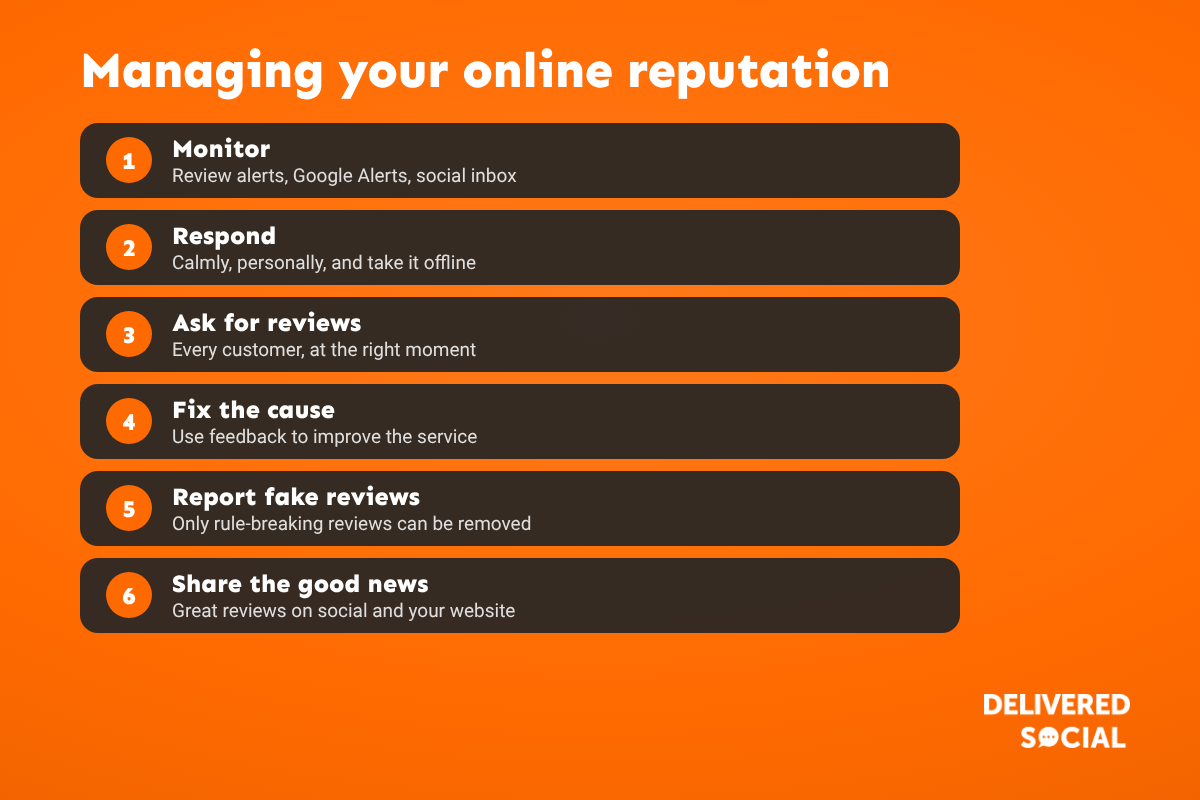
A bad review isn’t the end of the world. How you reply is often read by more people than the review itself. Our approach is simple: reply calmly, and take it offline.
- Don’t reply in the heat of the moment. Wait until you can be calm and polite.
- Thank them and apologise for their experience, without arguing about the details in public.
- Offer to put it right offline, with a name and a direct email or phone number.
- Keep it short and personal. Copy-and-paste replies look like you don’t care.
- Fix the cause if there’s a genuine problem, so it doesn’t happen again.
Never reveal customer details or personal information in a reply.
Can you remove bad reviews?
Only if they break the platform’s rules, for example fake reviews, spam, conflicts of interest such as a competitor, offensive content or reviews about a different business. You can’t remove a review just because it’s negative. Our guide to removing Google reviews explains how to report one and what to expect.
How to get more genuine reviews
- Ask at the right moment: straight after a job is finished or a great visit.
- Make it easy: send your Google review link by text or email, or use a QR code at the till or on receipts.
- Ask everyone, not just the customers you think will be happy. Selective asking can break platform rules.
- Reply to every review, good and bad. It shows people you’re listening.
See our guide to getting more Google reviews for wording you can copy.
What UK law says about fake reviews
Since 6 April 2025, under the Digital Markets, Competition and Consumers Act 2024, fake reviews are banned in the UK. Businesses must not write or commission fake reviews, publish reviews in a misleading way, or offer incentives for reviews without making that clear. The Competition and Markets Authority (CMA) enforces the rules and can fine businesses. In short: never buy reviews, never post reviews for yourself or your friends, and don’t hide or cherry-pick the ones you show.
Online reputation for restaurants and hospitality
Restaurants, cafés, pubs and hotels live and die by reviews on Google and Tripadvisor. A few extras help:
- Reply within a day or two, using the guest’s name and something specific from their review.
- Add recent photos of dishes and the room, so your profile reflects how you look today.
- Share great reviews on social media and your website, with the guest’s permission where needed.
- Brief your team. A quick “if you enjoyed tonight, we’d love a Google review” at the end of service works.
Our guide to local SEO for restaurants covers the wider picture.
Should you use a reputation management company?
Most small businesses can manage their reputation themselves with a good routine. Outside help is worth it if you’re getting lots of reviews across many sites, have several locations, or don’t have time to reply consistently. Be wary of anyone promising to remove reviews or “push down” results for a fee: legitimate removal only happens when reviews break the rules.
Frequently asked questions
What is online reputation management?
Monitoring and improving what people see about your business online, mainly reviews, search results and social media.
How long does it take to improve an online reputation?
A steady flow of new reviews and good replies can lift your rating within a few months. Bigger issues take longer and usually need the underlying problem fixed.
Should I reply to every review?
Yes, ideally. Short, personal thanks for good reviews and calm, helpful replies to negative ones.
Can I pay for reviews?
No. Fake and undisclosed paid reviews are illegal in the UK and break every major platform’s rules.
What are the best free online reputation tools?
Google Business Profile notifications, Google Alerts and the free inboxes in Facebook, Instagram and Tripadvisor.
Want help looking after your reputation?
We help small businesses across Surrey, Hampshire and the UK with Google Business Profiles, reviews and social media. See our SEO services or call us on 01483 608 303 for a friendly chat.