

Keep reading
Rather we just did it for you?
Let's get your business seen.
Social media, websites, SEO and ads from a team you can actually meet.
You’ve probably heard of SEO, search engine optimisation. Social media optimisation, or SMO, is its social cousin: making your social profiles and content easier to find, more engaging and more likely to bring people back to your business. This guide explains what social media optimisation means, how it differs from SEO and social media marketing, the key areas to optimise on each platform, and a practical checklist you can work through this week.
What does social media optimisation mean?
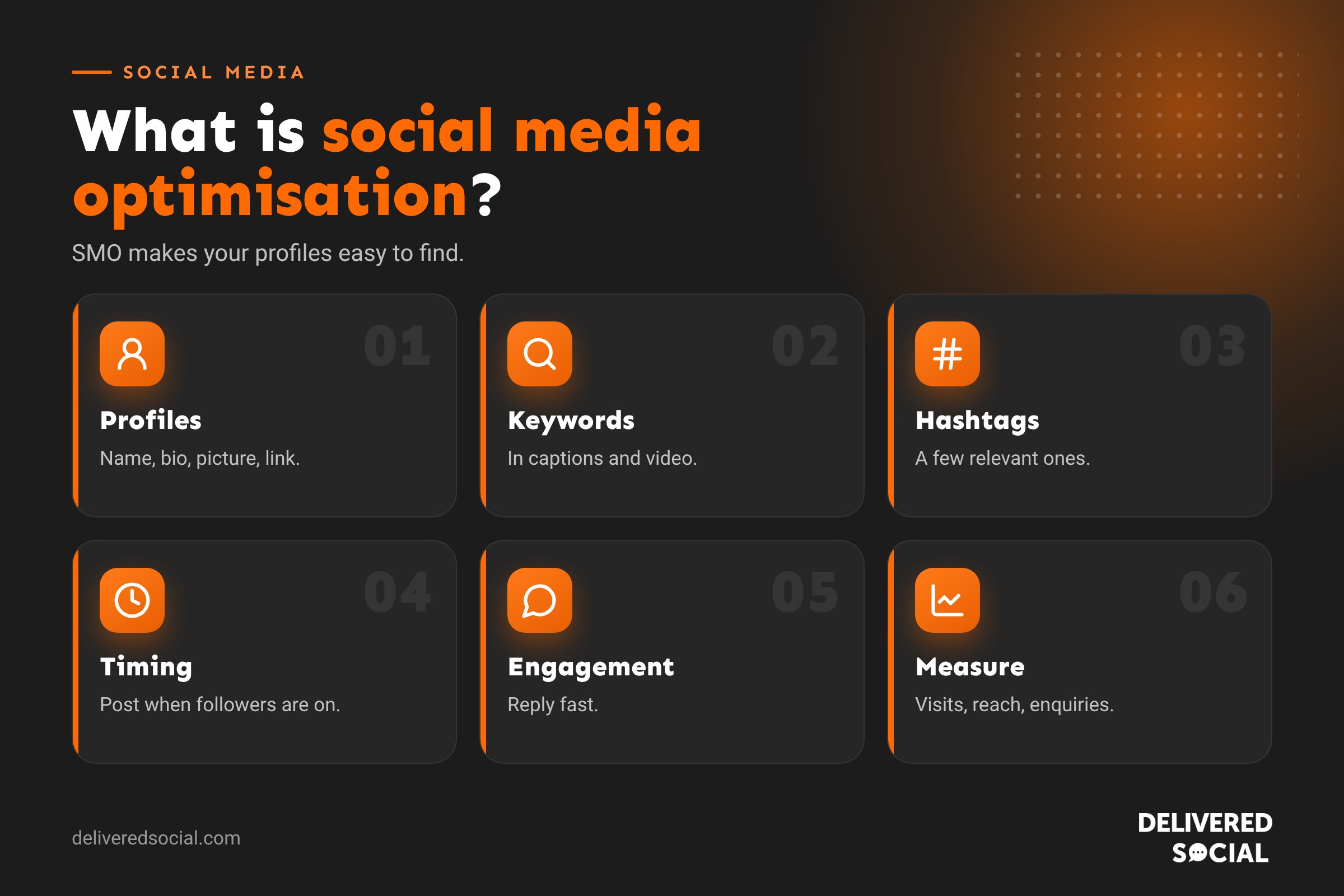
Social media optimisation is the process of improving your social media profiles, content and activity so that more of the right people find you, engage with you and take action, such as visiting your website, getting in touch or buying. It covers everything from your username and bio to the keywords in your captions, the times you post and the way you reply to comments.
In short, SMO makes sure every piece of your social presence is working as hard as it can.
SMO vs SEO vs social media marketing
| What it focuses on | |
|---|---|
| SEO | Getting your website found in search engines like Google |
| SMO | Getting your social profiles and posts found and engaged with |
| Social media marketing | The wider strategy: content, community, ads and campaigns on social platforms |
SMO sits between the two. It uses SEO-style thinking, such as keywords and searchability, on social platforms, and it supports your wider social media marketing.
Why social media optimisation matters now
- People search on social. Many people, especially younger audiences, search TikTok, Instagram and YouTube for recommendations instead of Google.
- Social posts appear in Google. Profiles, YouTube videos and some social posts show in search results.
- Algorithms reward relevance. Clear keywords and engagement help platforms understand who to show your content to.
- First impressions count. A well-optimised profile turns visitors into followers and customers.
- AI tools read social content. Clear, consistent information helps AI assistants describe your business accurately.
The main areas of social media optimisation
1. Profile optimisation
- Consistent name and username across platforms.
- Keyword-rich name field where allowed, such as “Ruby’s Bakery | Cakes Guildford” on Instagram.
- A clear bio that says what you do, who for and where.
- A recognisable profile picture, your logo or face.
- A working link to your website or a landing page.
- Contact details and location on business profiles.
- Highlights, pinned posts and featured sections showing your best content.
2. Content optimisation
- Keywords in captions, on-screen text and spoken words in videos.
- Strong hooks in the first line or first few seconds.
- The right formats for each platform: Reels, carousels, Shorts, documents.
- Relevant hashtags, a few targeted ones rather than dozens.
- Alt text on images for accessibility and searchability.
- Clear calls to action, such as “Save this”, “Comment below” or “Book via the link”.
3. Timing and consistency
- Post regularly on a schedule you can keep up with.
- Check your analytics for when your audience is most active.
- Use scheduling tools to stay consistent.
4. Engagement optimisation
- Reply to comments and messages quickly.
- Ask questions to start conversations.
- Engage with other accounts in your industry and area.
- Encourage saves and shares with genuinely useful content.
5. Website integration
- Add social links and share buttons to your website.
- Set Open Graph images so links look good when shared.
- Embed social content on your site where it adds value.
- Use tracking links to see which platforms send visitors.
Platform-by-platform SMO tips
| Platform | Quick wins |
|---|---|
| Keyword in the name field, clear bio, keyword captions, alt text, Highlights | |
| TikTok | Search-friendly captions, on-screen text, spoken keywords, pinned videos |
| Complete About section, opening hours, services, reviews, call-to-action button | |
| Keyword headline, detailed About, company page with specialities, featured posts | |
| YouTube | Keyword titles and descriptions, chapters, thumbnails, playlists |
| Keyword boards and Pin titles, claimed website, vertical Pins |
A social media optimisation checklist
- Is your username the same, or as close as possible, on every platform?
- Does your bio say what you do, who for and where in one or two lines?
- Does your name field include a keyword where the platform allows it?
- Is your profile picture clear at a tiny size?
- Does your link go to a useful, mobile-friendly page?
- Are your contact details and location filled in?
- Do your captions include words people actually search for?
- Are you using a handful of relevant hashtags?
- Do your videos include on-screen text and captions?
- Are you replying to comments and messages within a day?
- Are your best posts pinned or highlighted?
- Are you checking analytics monthly and adjusting?
Measuring social media optimisation
Track these numbers before and after you optimise:
- Profile visits and follower growth.
- Reach from search and non-followers.
- Engagement rate on posts.
- Link clicks and website visits from social.
- Enquiries and sales that started on social.
Our guide to engagement rate shows how to calculate it.
Common SMO mistakes
- Different names and logos on every platform.
- Vague bios like “Living the dream” that don’t say what you do.
- Hashtag stuffing instead of clear captions.
- Broken or outdated links.
- Ignoring comments and messages.
- Posting the same thing everywhere without adapting it to each platform.
SMO for local businesses
For local businesses, social media optimisation has a strong location element. People search social platforms for things like “best brunch Southsea” or “hairdresser Guildford”, so:
- Add your town or area to your name field, bio and captions where natural.
- Tag your location on posts and Reels.
- Mention nearby landmarks, streets and events in your content.
- Engage with other local businesses and community accounts.
- Keep opening hours, address and contact details up to date on every profile.
Pair this with an up-to-date Google Business Profile, and your business becomes much easier to find for people nearby.
A 30-day SMO plan
- Week 1: audit and fix all profiles: names, bios, pictures, links and contact details.
- Week 2: research the words your customers search for and add them to captions and on-screen text.
- Week 3: pin or highlight your best content and refresh any outdated posts or Highlights.
- Week 4: set up a daily 10-minute engagement routine and check your analytics to set a baseline.
SMO and AI search
More people now ask AI assistants for recommendations. These tools often draw on information that’s consistent across the web, including social profiles, reviews and your website. Keeping your business name, services, location and descriptions consistent everywhere helps make sure you’re described accurately when someone asks for a recommendation.
Quick glossary
- SMO: social media optimisation.
- SEO: search engine optimisation for websites.
- Alt text: a written description of an image.
- Open Graph: code that controls how links look when shared.
- Social search: people using social platforms as search engines.
Optimising video for social search
Video now dominates most platforms, so it needs optimising too. Say your main keyword out loud in the first few seconds, because platforms transcribe speech. Add on-screen text that repeats it, such as “Kitchen renovation in Fareham”. Use captions so people watching without sound can follow. Write a descriptive caption under the video, and choose a clear cover image that shows what the video is about. These small steps help platforms understand your video and show it to people searching for that topic.
Key takeaways
- Social media optimisation makes your profiles and posts easier to find and more engaging.
- It uses keywords, clear profiles, the right formats and consistent engagement.
- People increasingly search social platforms, so SMO matters more than ever.
- Start with your profiles, then your captions, then your engagement habits.
- Measure profile visits, reach, engagement and enquiries.
Who should look after SMO?
In a small business, social media optimisation is often done by the owner or whoever posts on social. A quarterly review of profiles, plus good habits each time you post, covers most of it. As you grow, it can be worth having a specialist or agency look after it, especially if social media is a big source of customers or you’re running ads, where optimised profiles help adverts convert.
Platforms change their rules and features often, so treat social media optimisation as an ongoing habit rather than a one-off job. Review it every few months.
Frequently asked questions
What does social media optimisation mean?
Improving your social profiles, content and activity so more of the right people find and engage with you.
What is SMO in digital marketing?
SMO is social media optimisation, the social equivalent of SEO.
Is SMO the same as SEO?
No. SEO focuses on search engines and websites; SMO focuses on social platforms. They support each other.
How long does social media optimisation take?
Profile fixes take an afternoon. Content and engagement improvements build results over weeks and months.
Do hashtags still matter for SMO?
A few relevant hashtags help, but keywords in captions and on-screen text matter more now.
Want your social profiles working harder?
We optimise and manage social media for businesses across Surrey, Hampshire and the UK. Read our Instagram bio ideas, see our social media management services or call us on 01483 608 303.