

Keep reading
Rather we just did it for you?
Let's get your business seen.
Social media, websites, SEO and ads from a team you can actually meet.
When you need a new website or help with an existing one, you’ll see people describe themselves as web developers, WordPress developers, web designers, full-stack developers and more. It can be hard to know who you actually need, and whether a WordPress specialist or a general developer is the better fit. This guide explains WordPress developer vs web developer: what each does, the skills involved, typical costs, when to choose which, and the questions to ask before you hire. It’s also useful if you’re considering a career in either.
What is a web developer?
A web developer builds websites and web applications using code. The term is broad and covers several specialisms:
- Front-end developers build what users see and interact with, using HTML, CSS and JavaScript, often with frameworks like React or Vue.
- Back-end developers build the server side: databases, APIs, logins and business logic, using languages like PHP, Python, Node.js, Ruby or C#.
- Full-stack developers work across both front and back end.
Web developers may build sites from scratch, use frameworks, or work with content management systems including WordPress.
What is a WordPress developer?
A WordPress developer specialises in building, customising and maintaining websites on WordPress. Their work includes:
- Building custom themes or child themes.
- Creating custom blocks for the block editor.
- Developing or customising plugins.
- Integrating WooCommerce, booking systems, CRMs and other tools.
- Speed optimisation, security hardening and updates.
- Migrations, troubleshooting and fixing broken sites.
They work mainly in PHP (the language WordPress is written in), HTML, CSS and JavaScript, with deep knowledge of how WordPress works under the hood.
Is a WordPress developer a “real” developer?
Yes. There’s a big range, from people who mostly configure themes and page builders to highly skilled engineers building complex plugins, headless sites and integrations. The label covers both, which is why asking about specific experience matters.
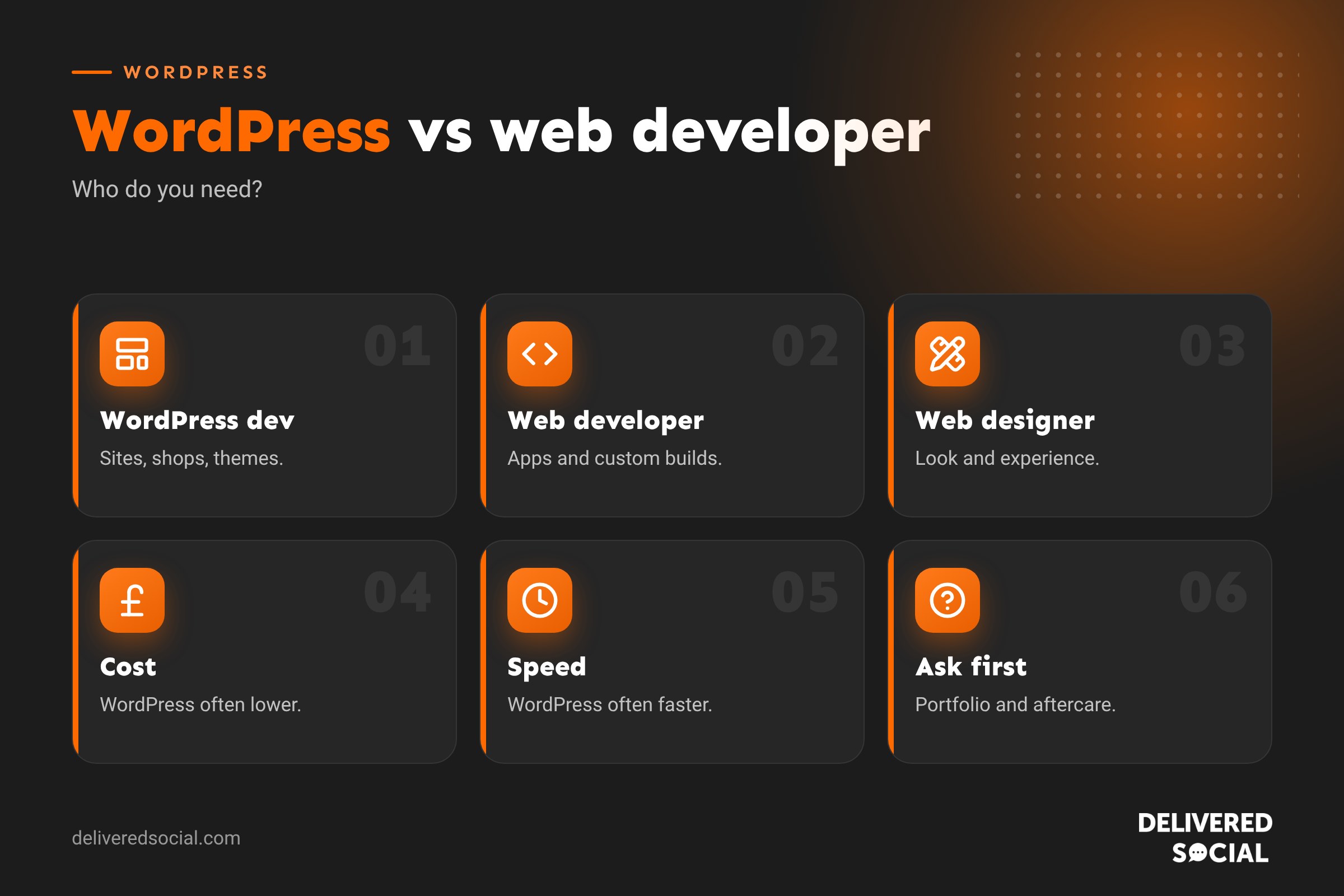
Side-by-side comparison
| WordPress developer | Web developer | |
|---|---|---|
| Focus | WordPress sites, themes, plugins and WooCommerce | Any website or web app, any technology |
| Main languages | PHP, HTML, CSS, JavaScript | Varies: JavaScript, Python, PHP, Ruby, C# and more |
| Typical projects | Business sites, blogs, shops, memberships | Custom platforms, web apps, portals, SaaS products |
| Content editing for clients | Built in through the WordPress dashboard | Depends on the build; may need a CMS added |
| Speed to launch | Often faster, thanks to existing tools and plugins | Can be slower for custom builds |
| Cost | Often lower for standard business sites | Often higher for bespoke applications |
| Ongoing maintenance | Updates to core, themes and plugins | Depends on the stack and hosting |
What about web designers?
Web designers focus on how a site looks and works for users: layout, branding, colour, typography and user experience. Some design and build; others hand designs to a developer. Many small business websites are created by designer-developers who handle both, especially on WordPress. See our guide to web design for beginners.
When to hire a WordPress developer
- You want a business website you can update yourself.
- You already have a WordPress site that needs fixes, new features or a redesign.
- You want an online shop with WooCommerce.
- You need blog, SEO and marketing features.
- Your budget suits a proven platform rather than a bespoke build.
- You need a hacked, slow or broken WordPress site fixed.
When to hire a general web developer
- You’re building a web application, such as a booking platform, portal or software product.
- You need complex custom functionality WordPress isn’t suited to.
- You need a specific technology stack, such as for integration with existing systems.
- You expect very high traffic or unusual performance requirements.
- You want a headless set-up with a modern JavaScript front end.
Cost comparison
Rates vary by experience, location and project. As a rough guide in the UK:
- Standard WordPress business site: often from a few thousand pounds, depending on design and features.
- Custom WordPress site with bespoke features or WooCommerce: typically more, depending on complexity.
- Custom web application: usually significantly higher, often tens of thousands of pounds or more.
Our guide to how much a WordPress website costs gives more detail.
Freelancer, agency or in-house?
| Option | Pros | Cons |
|---|---|---|
| Freelancer | Lower cost, direct contact | Limited capacity, single point of failure |
| Agency | Design, development, SEO and support in one team | Usually higher cost |
| In-house | Dedicated, knows your business | Salary and overheads, may lack breadth |
Questions to ask before you hire
- Can you show similar projects you’ve built?
- Will you build a custom theme or use a ready-made theme or page builder?
- Which plugins will the site rely on, and why?
- How will you make the site fast, secure and accessible?
- Will I be able to edit content easily myself?
- Who owns the code, design and domain?
- What happens after launch: hosting, updates and support?
- How do you handle SEO and redirects if replacing an existing site?
Red flags
- No portfolio or references.
- Very low quotes with vague scope.
- Reluctance to give you admin access or ownership.
- Dozens of plugins for simple features.
- No plan for updates, backups or security.
- Pirated or “nulled” premium themes or plugins.
For career changers: which path?
WordPress development is a practical route into the industry: there’s huge demand from small businesses, and you can start earning sooner. General web development opens doors to software companies and larger tech roles, with a broader skill set. Many developers start with WordPress and branch out, or keep WordPress as a specialism alongside modern JavaScript skills. Our guide on how to learn WordPress is a good starting point.
Example: choosing the right person
A recruitment agency wants a new website with job listings, candidate applications and a blog, which their team will update daily. A WordPress developer can deliver this quickly using a proven job board plugin and a custom theme, with an editing experience the team already understands. A software company, meanwhile, wants a client portal where customers log in to manage subscriptions, view data dashboards and connect to their accounting systems. That’s a custom web application, so a full-stack web developer is the better fit, perhaps with WordPress still powering the marketing website.
Using both together
Many businesses use WordPress for their marketing website and blog, and a separate custom-built application for their product or customer portal. This combination gives marketing teams an easy way to publish content while developers focus on the product. A good agency or developer will help you decide where the line sits.
Skills that matter for both
Whichever you hire, look for good communication, a focus on security, performance and accessibility, clean and documented code, sensible use of version control and backups, and a willingness to explain decisions in plain English. Technical skill matters, but so does being easy to work with over the long term.
Quick glossary
- Front end: the parts of a site users see and interact with.
- Back end: the server, database and logic behind the scenes.
- Full stack: working across front and back end.
- Headless WordPress: WordPress used only for content, with a separate front end.
- Child theme: a theme that safely customises another theme.
Key takeaways
- Web developer is a broad term; WordPress developers specialise in one platform.
- For most business websites and shops, a WordPress developer is a cost-effective choice.
- For bespoke web applications, a general web developer is usually better.
- Check portfolios, ownership and aftercare before hiring.
- Agencies combine design, development, SEO and support.
Frequently asked questions
What is the difference between a WordPress developer and a web developer?
A WordPress developer specialises in WordPress; a web developer can work with any technology.
Do WordPress developers need to code?
Good ones do, mainly PHP, HTML, CSS and JavaScript.
Is a WordPress developer cheaper?
Often for standard business sites, because WordPress provides so much out of the box.
Can a web developer build a WordPress site?
Yes, though a WordPress specialist will know the platform’s best practices better.
Are WordPress developers in demand?
Yes. WordPress powers a huge share of websites, creating steady demand.
Should I learn WordPress or JavaScript first?
For quick client work, WordPress; for broader tech careers, JavaScript. Many learn both.
Do I need a developer to update my WordPress site?
Not for everyday content, but yes for custom features, fixes and major changes.
What does a WordPress developer charge?
It varies widely by experience, project size and location.
What is a full-stack developer?
A developer who works on both the front end users see and the back end behind it.
Can a WordPress developer build a custom plugin?
Yes. Experienced WordPress developers build custom plugins for features that don’t exist off the shelf.
Do I need a developer or a designer?
For a new site, usually both skills, which many small agencies and designer-developers provide together.
Is headless WordPress worth it?
For most small businesses, no. It suits larger sites needing a custom front end or very specific performance requirements.
How do I check a developer’s work?
Ask for live examples, speak to past clients and test the sites they’ve built on your phone.
Need a WordPress team you can rely on?
We design, build and support WordPress websites for businesses across Surrey, Hampshire and the UK. Call us on 01483 608 303.