

Keep reading
Rather we just did it for you?
Let's get your business seen.
Social media, websites, SEO and ads from a team you can actually meet.
Asking three web designers for a quote and getting back three wildly different prices is a common and confusing experience. One says £800, another £4,000, and a third £12,000, all for “a website”. The difference usually comes down to what’s included, how the site is built and what happens after launch. This guide explains how to get and compare a web design quote: what a good quote should include, what affects the price, the questions to ask, and a simple template you can use whether you’re requesting quotes or writing them.
Why web design quotes vary so much
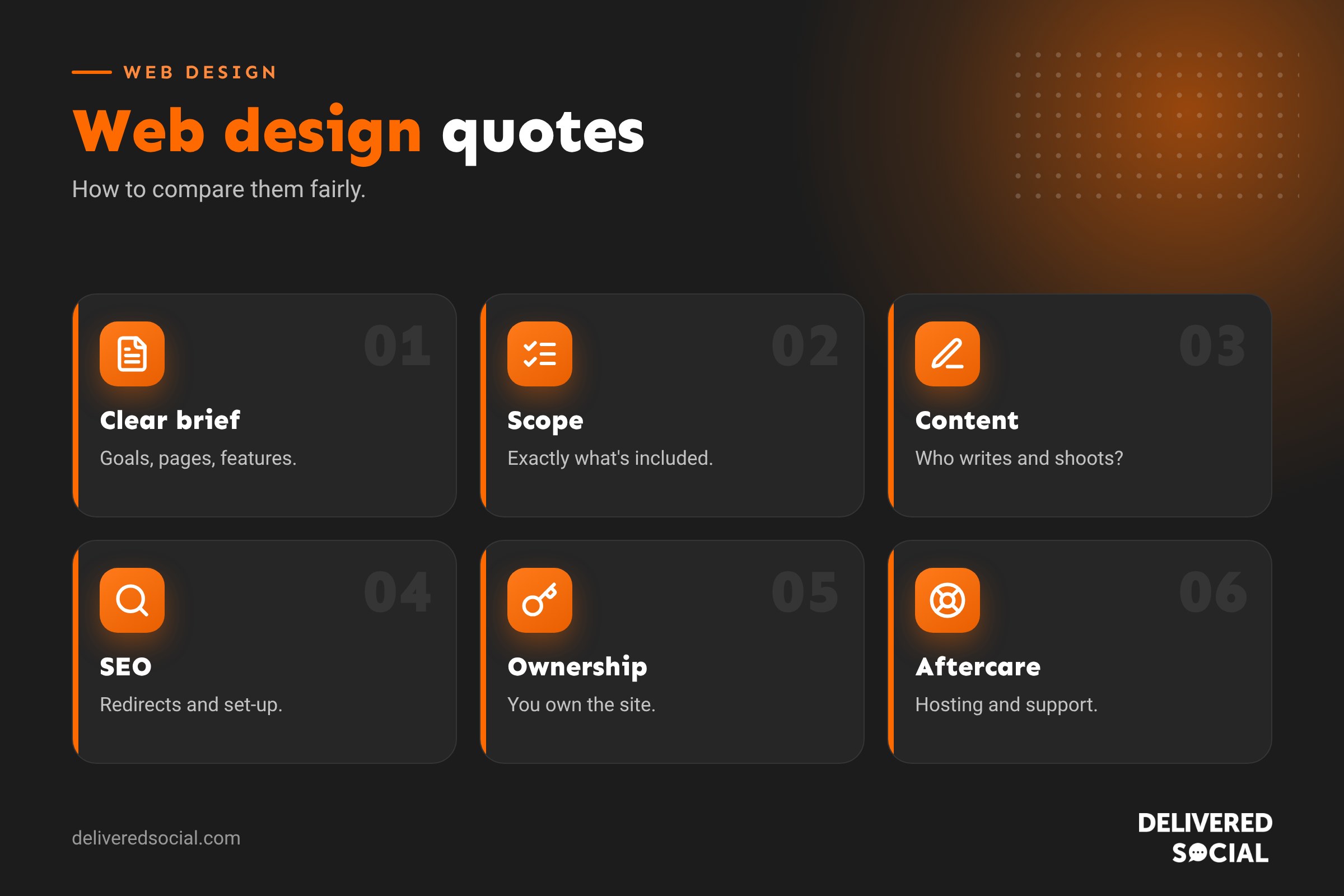
- Template vs custom design: adapting a ready-made theme is much quicker than designing from scratch.
- Number of pages and templates: more unique layouts mean more work.
- Features: shops, bookings, memberships and integrations add complexity.
- Content: who writes the words and provides the photos?
- SEO and migration: protecting rankings when replacing an old site takes time.
- Experience: seasoned professionals and agencies charge more but bring strategy and reliability.
- Aftercare: hosting, maintenance and support may or may not be included.
Step 1: Write a clear brief
The better your brief, the more accurate and comparable your quotes will be. Include:
- About your business: what you do, who your customers are.
- Goals: more enquiries, online sales, bookings, recruitment, credibility.
- Current website: what works and what doesn’t.
- Pages you think you need.
- Features: contact forms, shop, booking, blog, member area, integrations.
- Content: will you supply words and photos, or need help?
- Brand: existing logo and colours, or do you need branding too?
- Examples: websites you like and why.
- Timeline: any deadline, such as a launch or event.
- Budget range: sharing a range helps designers suggest the right approach.
Step 2: What a good quote should include
| Section | What to look for |
|---|---|
| Understanding of your goals | Shows they’ve listened and understood your business |
| Scope | Number of pages, templates and features clearly listed |
| Design approach | Custom design, adapted theme or page builder |
| Platform | Which system, such as WordPress, and why |
| Content | Who provides copy, photos and video |
| SEO | Basic on-page SEO, redirects and analytics set-up |
| Mobile and accessibility | Responsive design and accessibility standards |
| Revisions | How many rounds of design changes are included |
| Timeline | Key milestones and launch date |
| Payment terms | Deposit and stage payments |
| Ownership | You own the domain, content and site |
| Aftercare | Hosting, maintenance, support and training costs |
Typical UK web design price ranges
Prices vary widely, so treat these as rough guides:
- Simple brochure site using a template: from several hundred to a couple of thousand pounds.
- Professional small business site with custom design: often a few thousand pounds.
- Ecommerce site: typically higher, depending on products, payments and integrations.
- Complex custom sites and web apps: often well into five figures.
Our guides to WordPress website costs and ecommerce website costs go into more detail.
Ongoing costs to ask about
- Domain renewal.
- Hosting. See WordPress hosting costs.
- Maintenance: updates, backups and security.
- Premium plugin or theme licences.
- Support and small changes after launch.
- SEO, content and marketing, if needed.
Step 3: Questions to ask every designer
- Can I see similar websites you’ve built, and speak to past clients?
- Who will actually design and build my site?
- What’s included, and what would cost extra?
- How many design revisions are included?
- Will I be able to update the site myself, and will you train me?
- Who owns the website, domain and content?
- How will you protect my Google rankings if replacing an old site?
- What happens if something breaks after launch?
- What are the ongoing monthly or yearly costs?
Step 4: Compare quotes fairly
Put quotes side by side in a simple table with rows for scope, features, content, SEO, timeline, aftercare and total cost over two or three years. The cheapest upfront quote isn’t always cheapest overall once hosting, maintenance and fixes are included. Look for value: the quote most likely to achieve your goals.
Red flags in a web design quote
- Vague scope with no list of pages or features.
- No mention of mobile design or SEO.
- You won’t own the domain or site.
- Very low prices with lots of “extras” later.
- No portfolio or contactable references.
- Pressure to sign immediately.
- No plan for updates, backups or security.
A simple web design quote template
Whether you’re requesting or writing a quote, this structure keeps it clear:
- Project overview: client, goals and audience.
- Scope: list of pages, templates and features.
- Deliverables: design, build, content, SEO set-up, training.
- Exclusions: what’s not included.
- Timeline: discovery, design, build, testing, launch.
- Investment: project fee, payment schedule and ongoing costs.
- Assumptions: for example, client supplies photos by a set date.
- Terms: ownership, revisions, support and cancellation.
- Next steps: how to approve and get started.
Tips for freelancers writing quotes
- Start with the client’s goals, not your process.
- Offer two or three package options to give choice.
- Be specific about what’s included and excluded.
- Include aftercare as a recurring option.
- Show relevant case studies.
- Set an expiry date on the quote.
Our guide to marketing for freelancers covers winning more work.
Why the cheapest quote can cost more
A low-cost site might use an overloaded theme, dozens of plugins, poor hosting and no SEO set-up. It can look fine at launch, then become slow, hard to update, vulnerable to hacks and invisible on Google. Rebuilding it a year later costs more than doing it properly first time. Focus on the return: a website that brings in steady enquiries pays for itself.
How long does a website project take?
A simple site might take a few weeks; a typical small business site often takes six to twelve weeks from start to launch; larger projects take longer. Delays most often come from content, so having words and photos ready speeds things up.
Example: comparing three quotes
A physiotherapy clinic asks three providers to quote for a new website. Quote one is £900 using a template, with no copywriting, SEO or aftercare. Quote two is £3,800 with custom design, booking integration, basic SEO, redirects from the old site, training and three months of support. Quote three is £9,500 with brand strategy, photography, copywriting and advanced integrations. The clinic realises quote one would need extra spending on booking, SEO and support, and that quote three includes branding they already have. Quote two best matches their goals and budget, so they choose it with confidence.
Fixed price or day rate?
Most small business websites are quoted at a fixed price for a defined scope, which gives you certainty. Larger or less defined projects may be quoted at a day rate or split into phases, starting with discovery and planning. Either way, make sure changes to scope are agreed in writing with their cost before work starts, so there are no surprises on the final invoice.
What to prepare before asking for quotes
Gather your logo and brand files, a list of pages, any existing content, photos you’d like to use, logins for your current website and domain, and examples of sites you like. The more you can share, the faster and more accurate your quotes will be.
Quick glossary
- Scope: exactly what work is included in the project.
- Template: a page layout reused across similar pages.
- Revisions: rounds of changes to designs.
- Aftercare: hosting, maintenance and support after launch.
- Discovery: the research and planning phase at the start.
Key takeaways
- A clear brief leads to accurate, comparable quotes.
- Good quotes spell out scope, content, SEO, timeline, ownership and aftercare.
- Compare total cost over a few years, not just the upfront price.
- Ask for portfolios and references.
- Choose the quote most likely to achieve your goals.
Frequently asked questions
How much should a small business website cost?
Often a few thousand pounds for a professional custom design, less for template-based sites.
What should a web design quote include?
Scope, features, content, SEO, timeline, payment terms, ownership and aftercare.
Why are web design quotes so different?
Because of differences in scope, design approach, experience and what’s included.
Should I share my budget?
Yes, a range helps designers recommend the right solution.
How many quotes should I get?
Two or three is usually enough to compare.
Is a deposit normal?
Yes, typically with stage payments through the project.
Who should own the website?
You should own your domain, content and site.
Are monthly website plans worth it?
They can be, if they include hosting, updates, backups and support you’d otherwise pay for separately.
Should hosting be included in the quote?
It should at least be listed, with yearly costs, so you can compare the full picture.
Can I negotiate a web design quote?
Often, by adjusting scope, phasing features or supplying content yourself, rather than simply asking for a lower price.
What if the project goes over budget?
A good quote explains how extra work is agreed and priced before it starts.
Want a clear, honest website quote?
We design and build websites for businesses across Surrey, Hampshire and the UK, with clear pricing and aftercare. Call us on 01483 608 303.